Tax Allowances Definition: Maximize Your Financial Benefits
Understanding Tax Allowances: Your Personal Financial Shield

Think of your income as a pie. Taxes take a slice. Tax allowances are like a shield, protecting part of your pie from taxes. They're the portions of your income that aren't taxed, leaving you with a bigger piece to enjoy.
This isn't just the government being nice. It's a system designed with specific goals.
Tax allowances recognize that not everyone's finances are the same. A single parent with childcare costs faces different pressures than a new professional.
A dependent allowance, for instance, recognizes the cost of caring for a child or elderly parent. These allowances also aren't fixed; they shift with the economy and social priorities.
How Tax Allowances Shape Policy
Tax allowances play a role in tax policy and economic goals. They can encourage things like investing and buying a home. Historically, they've also helped people facing financial hardship.
Essentially, they're specific amounts you deduct from your taxable income, reducing what you owe in taxes. For a deeper dive into how these allowances have shaped tax policy over time, you can explore more research on the topic. Learn more about the history of tax allowances.
Defining Tax Allowances
This brings us to the core of what a tax allowance is: a reduction in your taxable income, lowering your tax bill. This isn't just symbolic; it directly affects your take-home pay.
The specific allowances available, and their effects, depend on things like your marital status, dependents, and life circumstances. Understanding these details is key to maximizing your financial benefits.
Tax Allowances as Financial Tools
Think of tax allowances as tools in your financial toolbox. Knowing which ones you qualify for and how they work with other tax rules lets you take control of your tax planning.
This isn't just about paying less tax; it's about making smart financial choices that fit your goals. We’ll explore the different types of tax allowances, their practical uses, and how they affect your finances in the next sections.
The Real Dollar Impact: How Tax Allowances Change Your Bottom Line
Let's talk about how tax allowances actually affect your money. They're not just some abstract idea; they put real dollars back in your pocket.
Think about Sarah, a marketing manager making $65,000 a year. She gets a standard personal allowance of $13,850. This lowers the amount of her income that gets taxed.
If her effective tax rate is 20%, that allowance translates to roughly $2,770 in savings. That's a significant chunk of change – maybe enough for a nice family vacation or several months of groceries.
This effect gets even bigger when you think about different family situations. Married couples filing jointly often see even more combined benefits. Single parents can also find that tax savings really help their monthly budget.
These allowances can truly make a difference. A single parent might use the extra money for childcare, while a married couple could put it towards a down payment on a house.
Understanding the Numbers
Let's look at some examples with different incomes and family types to see how tax allowances give you more spending power.
Imagine a family with two working parents and a child. Their combined allowances, plus the dependent allowance for their child, could really lower their total tax bill. Understanding this is key to smart financial planning.
Why Defining Tax Allowances Matters
Knowing what a tax allowance is is important for making the most of your money. It's not just about the definition; it's about understanding how these allowances work within the whole tax system and how you can use them to your advantage.
Resources like our IRS Offer in Compromise guide can help you navigate tricky tax situations. They provide practical tips for managing what you owe and maximizing your savings.
The Bigger Picture
The OECD's 2025 'Taxing Wages' report shows that tax allowances significantly lower taxable income. On average, they knocked off 15.9% of workers' taxable income.
This led to effective tax rate reductions of 4.7% for married couples with one income and 7.3% for single-parent families. Discover more insights into the OECD report.
This data highlights how important tax allowances are in shaping overall tax burdens and promoting fairness. By breaking down the details and looking at real examples, you’ll see why understanding tax allowances is essential for managing your finances.
It helps you make informed choices about your money and optimize your tax situation, especially as your income increases and your finances get more complex.
Your Complete Guide To Tax Allowance Types
Tax allowances can feel a bit like a secret menu at your favorite restaurant—lots of options, but you need to know what to ask for. Each allowance is designed with specific life situations and financial realities in mind.
Think of the standard personal allowance as your base discount—a portion of your income that the tax authorities automatically exclude from taxation.
Beyond that, things get more interesting.
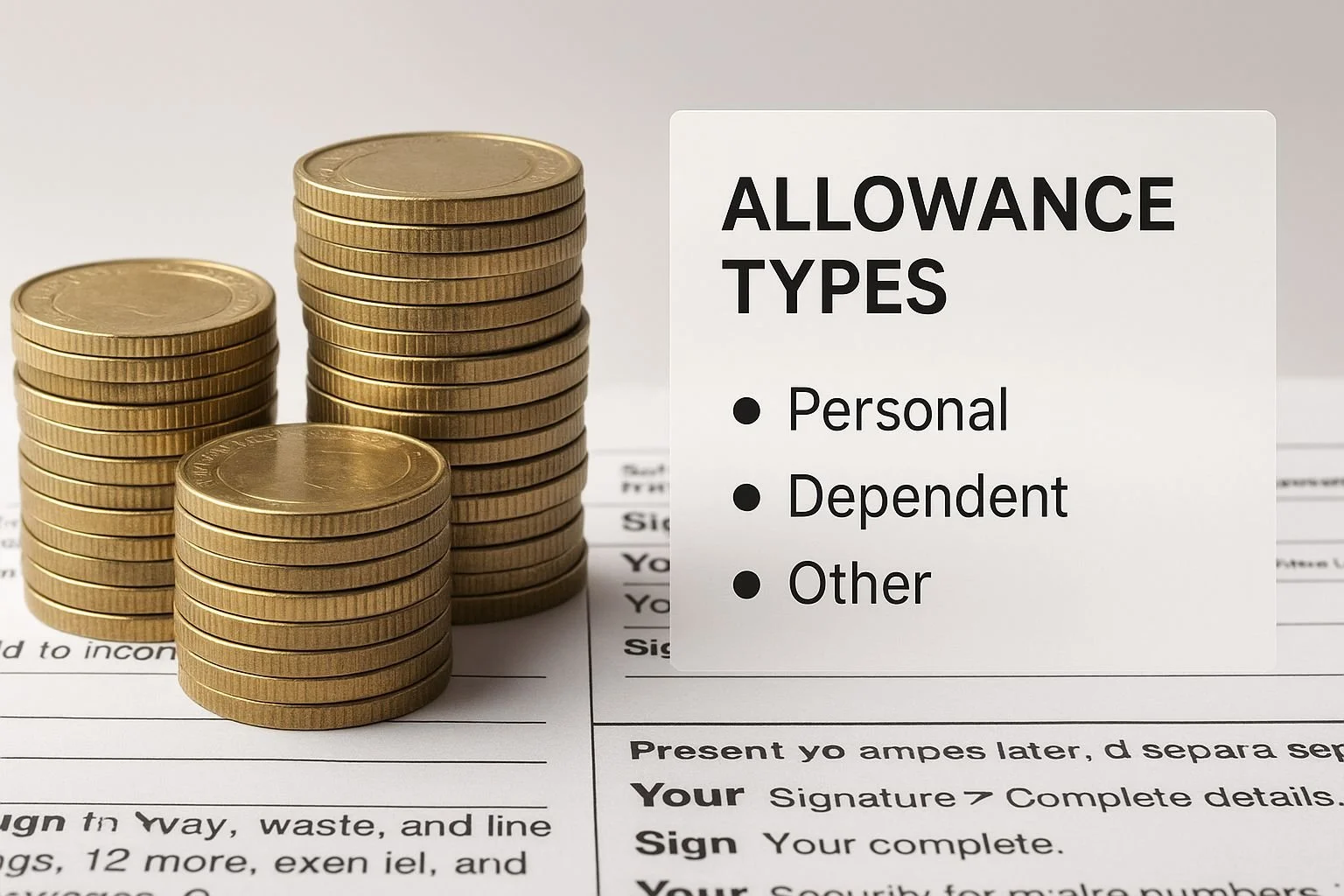
This infographic uses stacked coins and tax forms to represent different types of allowances and how they relate to each other. It’s a visual reminder of the range of allowances available, from personal and dependent allowances to those for businesses and charitable giving. Understanding these different options and their potential impact is key to effective tax planning.
Dependent, Blind, and Other Personal Allowances
Think of dependent allowances like a family discount at the grocery store. They acknowledge the added costs of raising children, such as diapers, school supplies, and medical bills.
These allowances recognize that supporting family members comes with increased financial responsibilities. Similarly, blind allowances offer additional support for those with disabilities, acknowledging the extra expenses that may arise due to specific circumstances.
Business and Charitable Contribution Allowances
Beyond personal allowances, there are others designed to encourage certain activities. Business allowances act like incentives for entrepreneurship and investment.
Imagine them as fertilizer for economic growth, allowing businesses to deduct expenses related to launching new ventures or buying equipment. Charitable contribution allowances reward giving back to the community by offering a tax break for donations to worthy causes.
Navigating the Allowance Landscape
Understanding which allowances apply to you is like having a personalized tax savings roadmap. Big life changes—marriage, kids, starting a business—can significantly affect your eligibility for different allowances.
It’s important to periodically review your tax situation to ensure you're claiming everything you’re entitled to. For example, getting married might open up access to the marriage allowance, potentially lowering your tax bill.
Check out our guide on allowance for taxes for more on strategically using these tools.
Maximizing Your Tax Benefits
Knowing which allowances you qualify for, and how they interact, helps you claim all applicable deductions and minimize what you owe. This isn’t about finding loopholes; it’s about understanding the rules and playing smart.
Overlooking potential allowances means leaving money on the table—money that could be working towards your financial goals. By being informed and proactive, you can make the most of the available tax allowances.
Let's take a closer look at some common allowances with this helpful table:
Common Types of Tax Allowances and Their Applications A comprehensive comparison of different tax allowance types, their typical amounts, and who can claim them
| Allowance Type | Purpose | Typical Amount Range | Eligible Taxpayers | Key Benefits |
|---|---|---|---|---|
| Personal Allowance | Reduces taxable income | Varies by jurisdiction | Most taxpayers | Lowers overall tax burden |
| Marriage Allowance | Recognizes combined income of married couples | Varies by jurisdiction | Married couples | Can reduce tax liability |
| Dependent Allowance | Offsets costs of raising children | Varies by jurisdiction and number of dependents | Taxpayers with qualifying dependents | Reduces taxable income |
| Blind Allowance | Provides additional support for visually impaired individuals | Varies by jurisdiction | Legally blind taxpayers | Offsets disability-related expenses |
| Business Allowance | Encourages investment and business growth | Varies by type of expense and jurisdiction | Business owners | Reduces taxable business income |
| Charitable Contribution Allowance | Incentivizes charitable giving | Varies by donation amount and jurisdiction | Taxpayers who make charitable donations | Reduces taxable income and supports nonprofits |
Note: The "Typical Amount Range" is for illustrative purposes and can vary significantly based on specific regulations and individual circumstances. Always consult with a tax professional for personalized advice.
As you can see, various allowances cater to different situations. Understanding these distinctions helps you make informed decisions and maximize your tax benefits.
Behind The Scenes: How Tax Allowances Work In Your Paycheck

Ever wondered why the amount you actually get in your bank account doesn't quite match up with your salary after a simple tax calculation? The answer lies in tax allowances. These allowances work behind the scenes, reducing the tax withheld from each paycheck. Let's unravel this mystery.
When you fill out your W-4 form, you're essentially giving instructions to your employer on how to handle these tax allowances. Think of it as a personalized tax instruction manual.
The W-4 lets you specify your filing status (single, married, etc.) and claim any additional allowances. This directly impacts how much tax is deducted from your paycheck. Generally, claiming more allowances means less tax withheld.
The Payroll Calculation Process
Imagine your payroll system as a mini-accountant. It starts with your gross pay (your total earnings before any deductions). Then, it subtracts your allowances to arrive at your taxable income. The tax is then calculated based on this reduced amount.
Let's say you earn $5,000 a month. If your allowances total $1,000, your taxable income becomes $4,000. The tax is calculated on the $4,000, not the full $5,000. Over a year, this difference can significantly impact your take-home pay.
Reading Your Pay Stub: Verification and Insights
Your pay stub is like a receipt for your paycheck. It details all the calculations, including your gross pay, allowances claimed, and taxable wages. Make sure these figures align with your W-4 instructions. Any discrepancies might point to errors that need fixing.
The Impact of Allowance Changes: Adjusting Your Withholding
Changing your allowances is like adjusting the knobs on your tax withholding. Increasing your allowances means less tax withheld, giving you more money in each paycheck. However, this could lead to a smaller refund or even taxes owed when you file your annual return.
Decreasing your allowances does the opposite. It means more tax withheld now but potentially a larger refund or smaller tax bill later.
Life changes, such as getting married or having a child, often mean a change in your tax allowance definition. Updating your W-4 accordingly ensures your withholding aligns with your new situation.
Strategic Withholding: Optimizing for Your Situation
Understanding tax allowances allows you to be strategic about your withholding. You can fine-tune your W-4 to match your projected tax liability, potentially improving your cash flow throughout the year while remaining compliant. It's not about avoiding taxes; it's about smart financial planning.
By understanding how these allowances work, you can avoid tax-time surprises and manage your finances more effectively.
Tax Allowances Around The World: A Global Perspective
Tax allowances aren't unique to any single country. They're a common tool governments worldwide use to balance collecting taxes with supporting their citizens. Let's explore how different countries approach this.
Family-Focused Allowances in Europe
Think of Germany. They offer generous family allowances, reflecting their strong cultural emphasis on supporting parents. These allowances recognize the costs of raising kids and provide significant tax breaks for families.
France takes a similar approach, with increasing benefits for larger families, helping offset childcare costs.
France and Germany see the bigger picture by using their tax systems to support families and encourage population growth. These countries actively offset the financial challenges of raising a family through tax incentives.
Targeted Allowances in Singapore
Singapore is known for its efficient and targeted policies. Rather than broad allowances, they use tax breaks to encourage specific behaviors. Think of it as gently nudging people in certain directions.
They offer incentives for things like retirement savings, healthcare expenses, and even investing in education. It's a way to boost individual financial health while also stimulating growth in key sectors.
Singapore's approach focuses on using tax allowances to achieve strategic national goals, like growing national savings or promoting healthy living.
Balancing Act in the Nordics
Nordic countries, with their high tax rates and robust social safety nets, use allowances to ensure fairness. They balance these high taxes with carefully designed allowances so that basic living expenses aren't overly burdened. It's a complex system, but it aims to provide a high standard of living for everyone while still funding government services.
Imagine a high tide lifting all boats – that's similar to how the Nordic model strives to function. The high tide of taxation supports a strong social safety net, while strategically placed allowances keep basic costs affordable for everyone.
Different Philosophies, Different Approaches
These international examples aren't just interesting trivia. They reveal different philosophies about the role of taxation in society. Some countries primarily use tax allowances to ensure fairness. Others use them as strategic levers, incentivizing things like investment, charitable giving, or even having children.
Globally, the way tax allowances are structured and how common they are varies significantly. This has a big impact on overall tax rates and government revenues.
In places like the European Union, where countries such as Denmark, France, and Austria have top personal income tax rates exceeding 55%, tax allowances are crucial for lowering the actual tax burden on individuals. Explore global tax data for a broader understanding.
Evolving Allowances
Understanding global approaches helps us see why allowances exist and how they might change. As economic and social conditions shift, tax allowances often get adjusted to address new challenges.
For instance, a country might increase allowances for renewable energy investments to fight climate change or create new ones for digital skills training to meet evolving job market demands. These adaptations reflect how tax policy is constantly evolving to shape society.
Tax allowances aren't static; they're dynamic tools that governments adjust based on their current needs. This constant evolution allows tax systems to be responsive to societal and economic changes.
Calculating Your Tax Allowances: A Practical Workshop
Ready to demystify tax allowances? Let's explore how these calculations work, turning abstract concepts into practical financial knowledge. We'll start simple and gradually add complexity, ensuring you understand every step.
Starting With the Basics: Personal Allowance
First, let's look at your personal allowance. This is the amount subtracted from your income before taxes are calculated. Think of it as your initial tax-free cushion. The exact amount depends on your filing status and other individual factors.
For example, if your annual income is $50,000 and your personal allowance is $12,000, your taxable income becomes $38,000. This directly reduces your tax bill.
Adding Layers: Marriage and Dependents
Now, let's add some real-life scenarios. Married couples filing jointly combine their personal allowances, creating a larger tax shield. Dependent allowances, for children or other qualifying individuals, further reduce taxable income.
Imagine a family with two children. Their combined personal allowances, plus the dependent allowances, significantly lower their overall tax burden. This is where the real impact of tax allowances becomes clear.
Business Owners and Freelancers: Additional Considerations
For business owners and freelancers, things get a bit more intricate. Various deductions and allowances are available, specific to business expenses and income structures. Navigating these requires understanding the rules, but the potential tax savings can be significant. For example, a business owner might qualify for allowances related to equipment, office space, or even healthcare.
Working Through the Numbers: Real-World Examples
Let's solidify your understanding with practical examples. Imagine a single person earning $60,000 annually with a $12,000 personal allowance. Their taxable income is $48,000. Now, consider a married couple earning $100,000 with two children. Their combined allowances could significantly reduce their taxable income.
You might find this helpful: IRS Payment Plan Calculator Guide
Common Calculation Mistakes and How to Avoid Them
Even seemingly straightforward calculations can be tricky. One common error is incorrectly claiming allowances. This can lead to overpaying taxes during the year or an unexpected tax bill later. Another mistake is confusing allowances with deductions or credits, which have different effects on your overall tax liability. We'll cover these common pitfalls and offer tips to avoid them.
Empowering Your Tax Planning: Practical Tools and Strategies
Understanding these calculations is more than just number-crunching; it's about empowering your tax planning. By accurately calculating your allowances, you can make informed decisions about your withholding, potentially improving your cash flow throughout the year. This helps you optimize your tax situation and make the most of your money.
Understanding how tax allowances are calculated is a powerful financial management tool. It's about taking control of your finances.
Let's illustrate these calculations with real-world scenarios:
Tax Allowance Calculation Examples by Income Level Step-by-step calculation examples showing how tax allowances reduce tax liability across different income brackets
| Gross Income | Standard Allowances | Additional Allowances | Taxable Income | Tax Savings (assuming 20% tax rate) |
|---|---|---|---|---|
| $40,000 | $12,000 | $0 | $28,000 | $2,400 |
| $75,000 | $24,000 (Married Filing Jointly) | $4,000 (1 Dependent) | $47,000 | $5,400 |
| $120,000 | $24,000 (Married Filing Jointly) | $8,000 (2 Dependents) | $88,000 | $6,400 |
Note: These are simplified examples and don’t account for all possible tax situations. Always consult a tax professional for personalized advice.
By understanding these calculations, you gain valuable insights into how tax allowances actually affect your finances. This helps you make informed decisions and maximize your tax benefits.
Separating Tax Allowance Facts From Fiction
Let's clear up some common misunderstandings about tax allowances. These misconceptions can sometimes lead to costly mistakes, so it's worth taking the time to understand how they actually work.
One common myth is that claiming more allowances always means you'll owe money come tax time. Not necessarily! The goal is to have your withholding match your actual tax liability as closely as possible, and allowances are just one factor in that equation.
For more on minimizing your tax burden, check out some strategies to reduce your tax liability.
Untangling Allowances, Deductions, and Credits
People often confuse allowances with deductions, but they work differently. Think of allowances as adjusting your withholding throughout the year, influencing how much you take home in each paycheck.
Deductions, on the other hand, come into play when you actually file your taxes. They reduce the amount of your income that the government considers taxable. There's also another piece of the puzzle: tax credits.
These are different from both allowances and deductions because they directly lower your tax bill. Mixing up these three concepts can make tax planning a real headache.
The Myth of "More Allowances, Less Taxes"
Some believe that claiming more allowances is an easy way to lower their taxes. It's not that simple. Claiming too many allowances will reduce your withholding, which could lead to a bigger tax bill or a smaller refund when you file.
On the flip side, claiming too few allowances means you're overpaying throughout the year, essentially giving the government an interest-free loan. The key is finding the right balance – the Goldilocks zone where your withholding aligns with your projected tax liability.
Why These Myths Persist
These misconceptions often arise from the complexity of tax laws and a general lack of clear, accessible information. Even the terminology itself can be confusing.
Words like “allowance,” “deduction,” and “exemption” are sometimes used interchangeably, which adds to the muddle. Plus, tax laws change, making it tough for everyone to stay up-to-date.
Avoiding the Traps: Knowledge is Power
The best defense against tax confusion is knowledge. Understanding how tax allowances really work lets you make informed decisions. It’s not about finding loopholes; it’s about understanding the rules and playing by them.
By grasping the relationship between allowances, deductions, and credits, you can fine-tune your tax strategy, potentially saving money and avoiding unwelcome surprises down the line.
Ready to take control of your tax situation? Contact Attorney Stephen A. Weisberg today for a free tax debt analysis. We can help you understand where you stand and create a personalized strategy to address your tax concerns.
➥ Contact Attorney Stephen A. Weisberg for a free Tax Debt Analysis.
Contact Me Here: https://www.weisberg.tax/contact-1
Email: sweisberg@wtaxattorney.com
Phone/Text: (248) 971-0885
Address: 300 Galleria Officentre, Suite 402, Southfield, MI 48034
