The IRS Accepted 14% of all Offers in Compromise Last Year. It Accepts About 95% of Mine
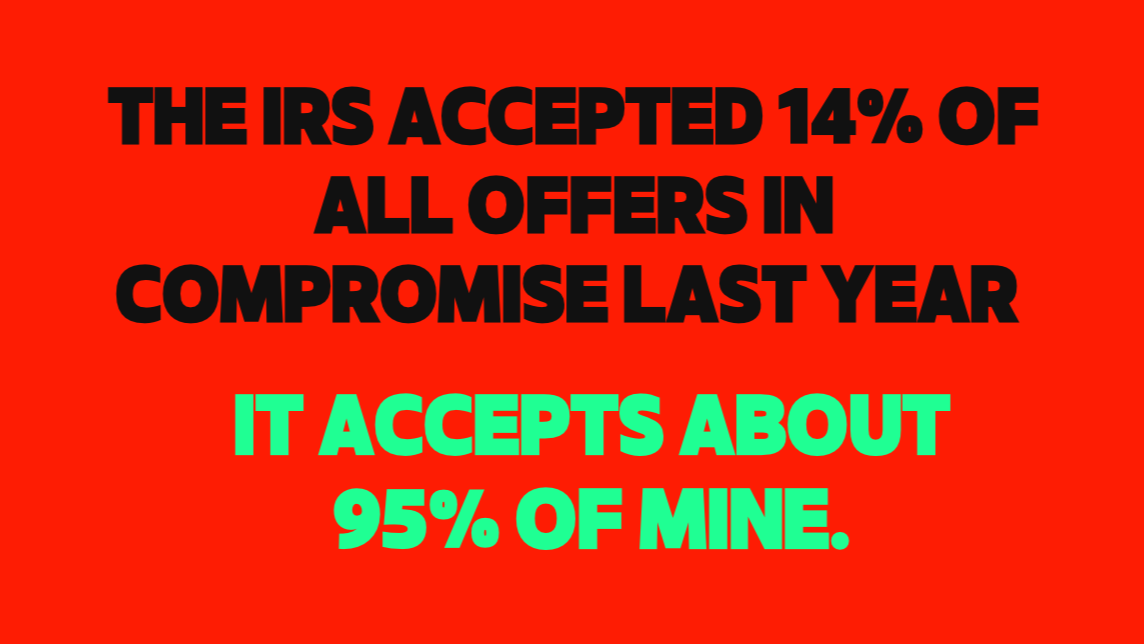
In 2025, the IRS accepted roughly 1 in 7 Offers in Compromise that taxpayers submitted.
Over the years I've been filing them, the IRS has accepted about nineteen out of every twenty I've submitted for my clients.
Accepted offers have dropped, and the experts I've heard discuss this don't have a clear explanation for why. Some are concluding that offers don't work anymore.
Wrong.
Here are five things you should know the next time a client asks you about settling with the IRS.
1. The National Numbers Are Worse Than the Headlines Make Them Sound
In fiscal 2025, taxpayers submitted about 38,800 Offers in Compromise, and the IRS accepted about 5,500. As I said, that's 1 out of every 7 submitted, or 14%.
The IRS pushed back on that 14% acceptance rate number. Of the offers that actually reached an accept-or-reject decision, the IRS says it accepted about half, and that rate has held fairly steady over the years.
Both numbers are true, and you should understand the difference. If 5,500 acceptances represent about half of the offers the IRS decided, then only around 10,800 offers were decided at all.
That means something like seven in ten offers were sent back, withdrawn, or closed without anyone at the IRS ever deciding whether the taxpayer qualified.
Many failed offers don't fail on the merits. They never even get to the merits.
The IRS's statement that its acceptance rate on decided offers hasn't changed means the standard for qualifying hasn't gotten tougher, but the fact that 50% of offers are decided on their merits means the IRS is rejecting a ton of offers.
2. My 95 Percent Acceptance Rate
My number is measured the same way as the 1 in 7. It counts every offer I submit, from the day it goes in, including any that come back.
About 95 percent of the offers I've submitted have been accepted.
Why is my approval percentage so high?
Because I only submit an offer when the client qualifies or has a reasonable chance of qualifying. I don't file an offer for a client who doesn't qualify, no matter how much they wanted one or how hard scam artists had sold them on the idea before they got to me.
Deciding who should file is the work. The negotiation that happens afterward is a significant part of it, but the offers that succeed were mostly won in the analysis that happened before the IRS ever received them.
If the standard hasn't changed, who is filing all the offers that fail?
3. Where the Failed Offers Come From
In my experience, most of them come from two places: national tax relief firms and taxpayers filing on their own.
They tend to fail in two different ways.
Returned offers usually come from people who didn't follow the filing rules. Rejected offers usually come from people who never qualified in the first place.
Here's what a returned offer looks like.
A bookkeeper sent me a landscaping client last spring who had filed his own offer after reading about it online. He'd filled out the forms carefully and felt good about his number.
He didn't know that the IRS won't consider an offer from someone who hasn't filed every required return and isn't current on estimated payments for the current year. He was missing a return and hadn't made a single estimated payment.
His offer came back without anyone looking at whether his Offer number made sense.
Rejected offers are a different animal. National firms sell the Offer in Compromise to almost everyone. Radio ads and letters sell the idea that everyone can settle their tax debt for a portion of what's owed before anyone's even looked at the facts.
Those offers reach an Offer Examiner who runs the numbers and turns them down because the client simply doesn't qualify.
Simple as that.
Then the tax firm tells the client, "Hey, we tried."
4. How Do You Qualify
The IRS accepts an offer when it determines that it cannot reasonably collect more than the offer amount. That's the test.
Owing a lot doesn't qualify someone, and neither does having a hard year. What matters is how the IRS values two things: the client's assets and the client's future income.
On the asset side, the IRS looks at the equity in everything the client owns, generally at a quick-sale value. That includes the home, vehicles, bank accounts, retirement accounts, and business assets.
On the income side, the IRS subtracts allowable living expenses from monthly income, using its own standards rather than what the client actually spends. Only certain expenses are allowable.
If, based on the monthly disposable income they've calculated, you could pay the total debt before the statute of limitations when the debt gets written off, no offer will be accepted, no matter what the number. If you can't, multiply that monthly disposable income by 12 or 24 months, depending on the offer type.
Add those together, and very simplistically, that's roughly the minimum the IRS will accept. If the taxpayer can't pay that amount, no deal.
A full analysis of the client's financials will tell you a lot about who qualifies, but you don't have to take it that far to spot an Offer that won't work.
If the client has real equity in their home, an offer is often off the table unless they can pay that equity as part of the offer. The same goes for retirement or investment accounts.
If the client's income is well above what the IRS allows for living expenses, the future income piece alone may kill the offer.
Before any of that matters, the client has to be in compliance, with all required returns filed, current estimated payments made, and payroll deposits current if they have employees.
Here's what a qualifying offer looks like.
A financial advisor sent me a client in his early sixties who had closed his contracting business. He owed about $40,000, rented his home, drove an old truck, and lived on a small pension and Social Security.
When we ran the numbers, his monthly disposable income was $0. Same with equity. There was almost nothing to collect. We brought his filings current, then submitted an offer, and it was accepted for a SMALL fraction of the balance.
That client is whom the ads are actually describing. And that client is much rarer than what the ads portray.
5. When They Don't Qualify for an Offer
Most clients who ask about an offer don't qualify. That doesn't mean they can shave off some of the balance.
One of my clients owned a restaurant and owed about $65,000. Before she came to me, a national firm had filed an offer of around $12,000 on her behalf. Meanwhile, she had $100k equity in her home.
After months, the offer was rejected, and she was out $10k that she paid for a firm to file an offer that was never going to be accepted.
We negotiated a Partial Pay Installment Agreement instead. She makes a monthly payment to the IRS, but she would never pay off the total tax owed, and when the collection statute expires, the unpaid debt went away.
The equity that killed her offer did not kill the PPIA. The rules around assets are very different between the two, and there is far more room to work with in a PPIA if you know how the IRS applies them.
For clients with little ability to pay, Currently Not Collectible or a PPIA can pause collection while the statute keeps running. Combined with the right timing, that can also end with the client paying far less than the balance.
In my practice, I've actually reached more outcomes where the client pays less than they owe through these routes than through offers. Most taxpayers, and plenty of professionals, have never heard of them.
So what do those two numbers actually mean?
Offers still work. For any client with tax debt, the question isn't whether they can settle, but whether an offer is the right tool for their situation.
TL;DR
⏩ The IRS accepted about 1 in 7 Offers in Compromise submitted in fiscal 2025, but it only made a determination on about half of them. Roughly seven in ten never reached a decision.
⏩ About 95 percent of the offers I submit are accepted, because I only submit offers for clients who qualify.
⏩ Returned offers usually come from people who didn't meet the filing rules, such as unfiled returns or missing estimated payments.
⏩ Rejected offers usually come from people who never qualified, often after a national firm sold them on "pennies on the dollar."
⏩ The IRS accepts an offer only when it can't reasonably collect more from the client's assets and future income.
⏩ Home equity, sizable retirement accounts, and income well above IRS expense standards are warning signs.
⏩ Clients who don't qualify for an offer can often still pay less than they owe through a Partial Pay Installment Agreement or Currently Not Collectible status.
When a client tells you they saw an ad about settling their tax debt for less, what do you say?
BTW, I get the same three questions from CPAs and attorneys every time they have a client with tax debt. I finally wrote the answers down.
Want to understand your options before you call anyone?
Download my free book — Freedom From Tax Debt — a plain-language guide to how the IRS collections process actually works and what resolution really looks like.
➥ Contact Attorney Stephen A. Weisberg for a free Tax Debt Analysis.
Contact Me Here: https://www.weisberg.tax/contact-1
Email: s.weisberg@weisberg.tax
Phone/Text: (248) 971-0885
Address: 300 Galleria Officentre, Suite 402, Southfield, MI 48034
