Can the IRS Freeze Your Bank Account? What You Need to Know
Yes, the IRS absolutely has the legal authority to freeze your bank account. This action is officially known as a bank levy, and it's one of the most powerful tools they have for collecting unpaid taxes.
But here’s the most important thing to understand: this never, ever happens out of the blue. It’s the final, predictable outcome of a long collections process that gives you plenty of warning.
The Short Answer Is Yes, But Not Without Warning

The thought of the IRS reaching directly into your bank account is understandably terrifying. However, a bank levy isn't a random, sudden attack. It's a last resort the IRS uses only after a taxpayer has been sent—and has ignored—multiple written warnings about a tax debt.
Think of it less like a surprise ambush and more like a slow-moving storm you can see building on the horizon. The law requires the IRS to give you fair warning and multiple chances to fix the problem long before they take your money.
The Legal Road to a Bank Freeze
Before the IRS can legally touch your funds, they have to follow a strict, multi-step process. This isn't just bureaucratic red tape; it's designed to protect your rights.
Here’s a look at the typical sequence of events that must happen before the IRS can issue a levy, highlighting your chances to step in and prevent it.
Key Stages Before an IRS Bank Freeze
| Stage | What Happens | Your Opportunity |
|---|---|---|
| 1. Tax Assessment | The IRS officially calculates and records the tax you owe in their system. | Review the assessment. If it's wrong, you can begin the process to dispute it. |
| 2. First Notice & Demand | You receive an initial bill in the mail (like a CP14 notice) stating the amount due and requesting payment. | This is your first and easiest chance to pay the bill or contact the IRS to set up a payment plan. |
| 3. Follow-Up Notices | If you don't respond, the IRS sends a series of increasingly urgent letters over several months. | Each notice is another reminder to engage. You can still arrange a payment agreement or dispute the debt. |
| 4. Final Notice of Intent to Levy | You receive a "Final Notice of Intent to Levy and Notice of Your Right to a Hearing" by certified mail. | This is the final warning. You have 30 days from the date on this letter to act before a levy can be issued. This is the time to request a hearing or resolve the debt immediately. |
| 5. Bank Levy Issued | The IRS sends a levy notice directly to your bank, instructing them to freeze your account. | Even after the freeze, you have one last chance to stop the seizure of funds. |
This entire sequence shows that the power to stop a levy is almost always in your hands. The IRS would much rather work with you than go through the hassle of seizing your assets.
Once the IRS sends the levy to your bank, the bank is legally required to freeze your funds up to the total amount of your tax debt, including penalties and interest. This freeze holds for a mandatory 21-day period.
This 21-day window is your last, final opportunity to contact the IRS and negotiate a solution before the bank is forced to send your money to the U.S. Treasury.
Understanding the Path to an IRS Bank Levy
The IRS doesn't just wake up one morning and decide to freeze your bank account. It’s a methodical, predictable process with plenty of warning signs. Think of it as a long road with clear signposts—if you know what to look for, you can get off the highway long before you reach the end.
It all kicks off with a tax assessment. This is the moment the IRS officially logs in their system that you owe them money. Soon after, you'll get your first letter in the mail, usually a CP14 Notice. This is just a basic bill that states the amount you owe and demands payment.
While that first letter can definitely be a jolt, it's really just the opening act. If you don't respond, the IRS will follow up with a series of additional notices, each one a bit more serious than the last. These letters are your opportunities to sort things out before the situation escalates.
The image below lays out the official timeline of notices you'll receive before the IRS takes action.
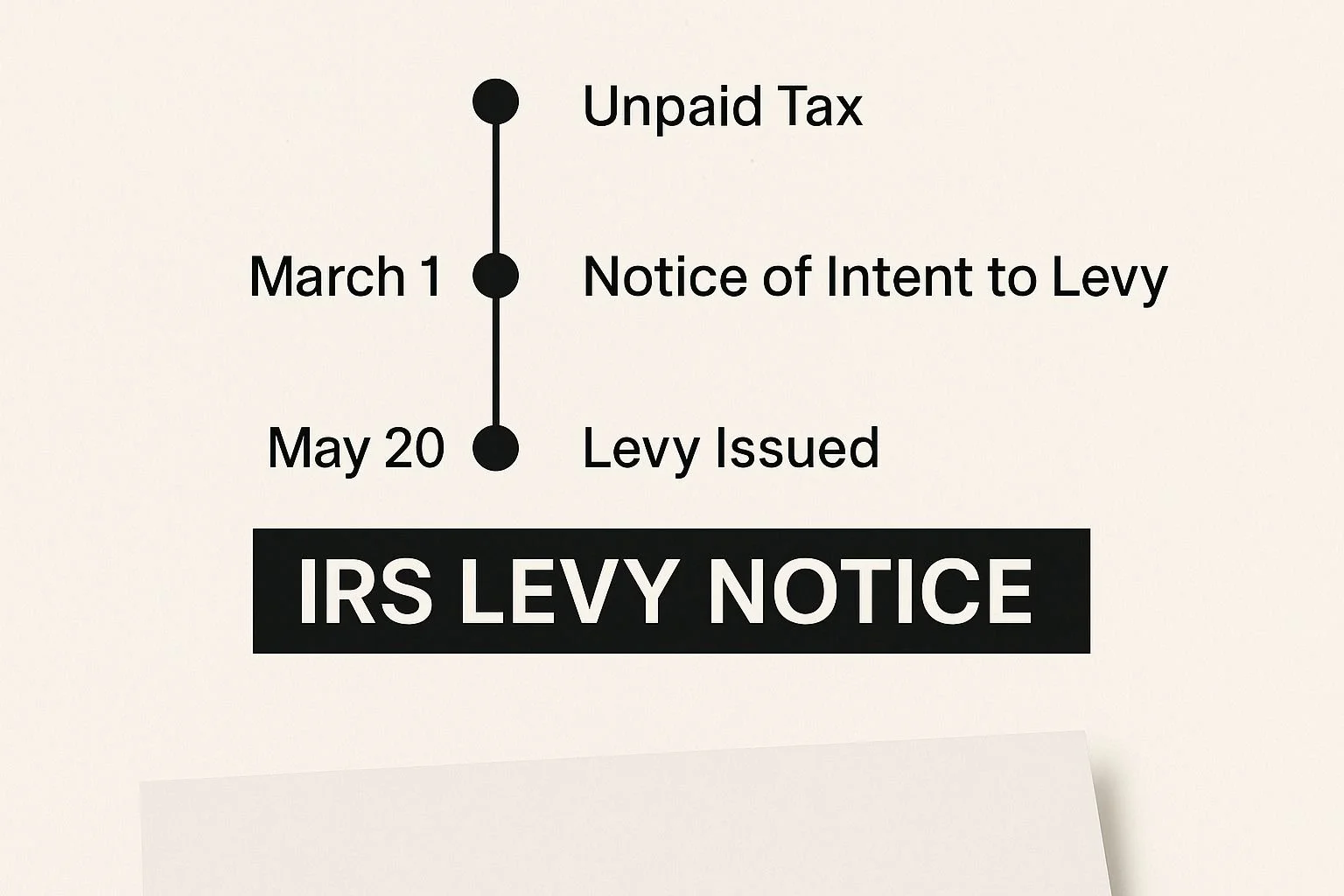
As you can see, a levy isn't their first move; it's the final one after multiple attempts to get in touch.
The Critical Final Notice
The whole sequence leads up to one single, crucial document: the Final Notice of Intent to Levy and Notice of Your Right to a Hearing. This isn't just another reminder; it's the government's final warning shot. To make sure you get it, this notice arrives via certified mail, which highlights its legal weight.
Getting this letter in your hands means the IRS is done waiting and is now legally cleared to start seizing your assets. But it also opens one last window of opportunity for you to act.
This final notice gives you a 30-day window to either pay the balance, set up a formal payment plan, or request a Collection Due Process (CDP) hearing to challenge the levy itself.
If you let that 30-day period pass without taking action, you've given the IRS the green light to contact your bank. They are legally required to give you this due process before they can touch your money. Taxpayers who get in touch with the IRS during this window to work something out, like an installment agreement, can almost always prevent a bank account freeze.
Key Notices in the Levy Process
To break it down, the road to a levy is paved with several key documents. If you spot any of these in your mailbox, it's time to pay close attention.
CP14 Notice: This is the first bill you'll receive for the taxes you owe.
CP501/CP503: These are follow-up reminders that your tax bill is past due.
CP504: The tone gets more serious here. This notice states the IRS intends to levy your property.
Letter 1058/LT11: This is the big one—the final, certified notice that officially starts your 30-day countdown.
Once that 30-day period expires, the IRS is authorized to contact your bank and initiate the levy. By simply recognizing these notices for what they are, you can take control of the situation long before it gets out of hand.
What Happens During the 21-Day Freeze Period

So, the IRS has issued a levy. The moment that notice hits your bank, they are legally required to freeze your funds. But it's not an instant seizure. This action kicks off a critical 21-day hold period—a final, crucial window for you to stop the government from taking that money permanently.
During this time, your bank acts as a neutral middleman. They aren’t on your side or the IRS's; they're simply complying with a legal order. For exactly 21 calendar days, the bank will hold the funds in your account, up to the total amount you owe in taxes, penalties, and interest.
Let's say you owe the IRS $8,000 and have $10,000 in your account when the levy is processed. The bank will freeze the $8,000. You can still access the remaining $2,000. If your balance is less than what you owe, say only $5,000, your entire account will be frozen.
Using the 21 Days to Your Advantage
This three-week window is your time to act, not panic. Your money is essentially in limbo, giving you a chance to get on the phone with the IRS and negotiate a release before the funds are sent away for good.
It's also important to know that the levy is a one-time snapshot of your account balance at the exact moment the bank receives it. Any new deposits made during those 21 days are generally safe. A paycheck that hits your account the day after the freeze starts, for instance, wouldn't typically be included in the frozen amount.
The entire point of this 21-day freeze is to give you one last, clear opportunity to settle your tax debt. If you don't take action, the bank has no choice. On day 22, they are legally required to send the frozen funds directly to the IRS.
This period is designed to give taxpayers a chance to arrange a payment plan or dispute the levy, potentially preventing the withdrawal altogether. In fact, IRS data shows that around 60% of tax debts are eventually handled through payment plans or offers in compromise—solutions that can help avoid a levy in the first place.
Key Actions to Take Immediately
Your one and only goal is to get the IRS to fax or mail a "Release of Levy" notice to your bank before that 21-day clock runs out. This doesn’t happen on its own; it requires you to immediately and directly communicate with the IRS to present a workable solution.
Here are the most common and effective steps to take:
Prove Economic Hardship: You need to show the IRS that the levy is causing "significant economic hardship," meaning you can't cover basic living expenses like rent, utilities, food, or critical medical care.
Negotiate a Payment Plan: Propose a formal Installment Agreement. This shows you're serious about paying off the debt in a way that’s manageable for you and acceptable to them.
Submit an Offer in Compromise (OIC): If your financial situation is dire, you might qualify to settle your tax debt for less than the full amount owed through an OIC.
Starting any of these processes is often enough to convince the IRS to release the hold on your account.
How to Get an IRS Bank Levy Released
That feeling of dread when you discover the IRS has frozen your bank account is something else. It's jarring, stressful, and can make you feel powerless. But here’s the most important thing to remember: that 21-day hold is your window of opportunity.
You have a very limited time to get the IRS to release the levy before your bank is legally required to send them the money. This doesn't happen on its own. It’s up to you to contact the IRS immediately, understand the playbook, and show them you have a plan. Quick, decisive action is everything.
Fortunately, there are a few well-established paths to getting a bank levy released, and which one is right for you depends entirely on your financial situation.
Prove You Are Facing Economic Hardship
The quickest way to get a levy released is to prove it's causing you a significant economic hardship. This isn't just a casual term; it's an official IRS designation. It means the freeze on your account is making it impossible for you to cover your basic, reasonable living expenses.
You’ll need to show the IRS that without access to those funds, you can't pay for absolute necessities. Think of things like:
Your rent or mortgage payment to keep a roof over your head.
The utility bills needed to keep the lights on and water running.
Groceries for yourself and your family.
Urgent medical care or essential prescriptions.
Making this case requires laying your financial cards on the table. You'll almost certainly need to provide the IRS with a detailed breakdown of your income and expenses.
Negotiate a Formal Resolution
Another powerful approach is to stop reacting and start proposing a solution for the tax debt itself. When you take the first step to get back into compliance, the IRS is often willing to release the levy as a sign of good faith. It shows them you're serious.
The two most common ways to do this are:
Installment Agreement: This is simply a formal payment plan. You agree to pay off your tax bill over time in monthly chunks you can actually afford. Once the IRS approves your agreement, they’ll almost always release the levy.
Offer in Compromise (OIC): If your financial reality is that you truly cannot pay the full amount you owe, you might qualify for an OIC. This is an agreement to settle your tax debt for less than what you owe. Just submitting a valid OIC application is usually enough to stop collection actions, including a levy on your bank account.
By proactively engaging with the IRS and setting up a payment solution, you show them you are serious about compliance. This negotiation is often the fastest way to get your account unfrozen while also creating a long-term plan to get out of tax debt.
Argue the Levy Was a Mistake
It's not the most common scenario, but let's be honest—the IRS does make mistakes. If you can prove the levy was issued in error, you can get it released.
Here are a few legitimate reasons a levy might have been improper:
You already paid the tax debt in full.
The legal time limit for collecting the debt—the statute of limitations—has expired.
You’ve filed for bankruptcy, which should have triggered an automatic stay on all collection activities.
The IRS didn’t follow their own rules, like failing to send you the "Final Notice of Intent to Levy" before taking action.
If any of these situations apply to you, you need to contact the IRS immediately with clear documentation proving the error. Do that, and they should release the hold on your account pretty quickly.
Proactive Steps to Prevent an IRS Bank Account Freeze
The absolute best way to deal with an IRS levy? Make sure it never happens. While knowing how to get a levy released is important, avoiding one in the first place will save you a world of stress and money. The good news is that prevention isn't about some secret tax code trick; it all comes down to a few basic habits that keep you on the right side of the IRS.
The golden rule, above all else, is this: always file your tax returns on time, every single time. This holds true even if you know for a fact you can't pay a dime of what you owe. In the eyes of the IRS, failing to file and failing to pay are two completely separate problems. The penalties for not filing are often far harsher, and it sends a signal that you're trying to hide.
Filing a return, even with a zero payment, is an act of good faith. It keeps the dialogue open and stops the IRS from having to guess at your income—a scenario that almost always leads to more aggressive collection tactics.
The Power of Picking Up the Phone
The moment you realize you can't cover your tax bill, your next move is to communicate. The IRS isn't psychic, and ignoring their letters is the fastest way to turn a manageable debt into a full-blown crisis, complete with a frozen bank account.
Don't wait for those scary, red-stamped notices to pile up. Get ahead of it. Reach out to the IRS, explain what's going on, and start exploring your options. You can often stop the collections train in its tracks before it even leaves the station.
By making the first move, you're framing the conversation. You stop being a taxpayer dodging a debt and become a responsible person actively looking for a solution. This simple change in perspective can completely alter how the agent on the other end of the line approaches your case.
Simple Habits That Keep Your Money Safe
Beyond filing and communicating, a few simple organizational habits can act as a powerful shield against a levy. These aren't complicated, but they are crucial for ensuring you never miss a warning that starts the clock ticking on a freeze.
Keep Your Address Current: It sounds painfully obvious, but it’s a surprisingly common mistake. If you move, you have to officially tell the IRS by filing Form 8822. If they send notices to your old place, you'll never see them, but legally, they've fulfilled their duty to notify you.
Open IRS Mail Immediately: It's tempting to let that official-looking envelope sit on the counter while you brace yourself for bad news. Don't. Every piece of mail from the IRS has a purpose and, usually, a deadline. Quick action is your best defense.
Know Your Resolution Options: Understanding what solutions are out there before you're in hot water gives you a massive advantage. Get familiar with the basics of things like Installment Agreements and Offers in Compromise so you're ready to have an intelligent conversation if the time comes.
Sometimes, the best offense is a good defense. When you combine timely filing with proactive communication and solid record-keeping, you're not just reacting to the IRS—you're managing the relationship. You turn them from a potential threat into a creditor you can actually work with, making sure the question "can the IRS freeze my bank account?" stays purely hypothetical.
Common Myths About IRS Bank Freezes Debunked
When you're already stressed about a tax problem, the last thing you need is bad information. There's a lot of chatter and outright myths about what the IRS can and can't do, so let's clear the air and stick to the facts.
Understanding the reality of an IRS bank levy helps you see that while the situation is serious, it's not the Wild West scenario many people picture.
Myth 1: The IRS Can Freeze Your Account Without Warning
This is probably the biggest and most frightening misconception out there. The idea that you could wake up one morning and find your account frozen out of the blue is terrifying, but it's also completely untrue.
The IRS follows a strict, legally required process. You’ll receive a series of letters and notices long before a levy is even on the table. The final step is the "Final Notice of Intent to Levy," which gives you a 30-day window to respond. A freeze is the final step in a long process, never a surprise attack.
Myth 2: They'll Take Every Penny You Have
Another common fear is that the IRS will simply drain your entire bank account, leaving you with nothing. This is not how a levy works.
The bank is instructed to freeze funds only up to the specific amount you owe, which includes the original tax debt plus any accrued penalties and interest.
Think of it this way: if you owe $5,000 but have $7,000 in your checking account, the bank will only hold the $5,000 for the IRS. The remaining $2,000 is still your money to use. It's a targeted action, not a total wipeout.
Key Takeaway: A bank levy isn’t a financial clean sweep. It targets a specific dollar amount, and you have a mandatory 21-day hold period to negotiate a release before the money is ever sent to the IRS.
Myth 3: Once It's Frozen, the Money Is Gone Forever
It’s easy to feel like a freeze is the end of the road, but that's not the case. That 21-day hold period we keep mentioning is your lifeline.
This waiting period is built into the system for a reason. It's a crucial window of opportunity designed to give you one last chance to contact the IRS and resolve the issue. You can negotiate a payment plan, prove financial hardship, or point out an error on their part. It’s a chance to act, not a closed door.
Common Questions About IRS Bank Levies
When you're facing an IRS levy, the situation can feel overwhelming, and a flood of very practical questions usually follows. Let's tackle some of the most common concerns people have when their bank account is suddenly frozen.
Can the IRS Take Money From My Joint Account?
This is a big one, and the answer often surprises people: Yes, they absolutely can.
Even if the tax debt belongs only to one spouse, the IRS has the authority to levy a joint bank account. From their perspective, every dollar in that account is fair game to settle the debt of either owner, right up to the full amount you owe.
The non-liable spouse isn't entirely without options, but it’s an uphill battle. They would need to file a formal "wrongful levy" claim after the money has already been taken, which is a complicated and stressful process.
Are My Social Security Benefits Safe?
This is where it gets a little nuanced. Certain federal payments, including Social Security, have some built-in protection, but it's not a complete shield.
When the bank gets the levy notice, they have to look back at the last two months of your account activity.
The bank is legally required to identify any direct deposits from federal benefit programs (like Social Security) and protect an amount equal to two months' worth of those payments. However, any money in your account above this protected amount is still vulnerable and can be seized.
How Fast Can I Get a Levy Released?
The speed of a levy release depends almost entirely on how quickly you act and the path you take.
Paying the debt in full is obviously the quickest way out. If you can do that, the levy can often be released within a few business days.
But for most people, that's not realistic. The other options, like setting up an Installment Agreement or proving you're facing a significant economic hardship, take more time. They involve paperwork, negotiation, and waiting for the IRS to approve your case.
The most critical thing to remember is the 21-day freeze period. You have to take decisive action within those three weeks to have any chance of stopping the bank from sending your money to the IRS for good.
If you're staring down a bank levy or another serious tax problem, waiting is the worst thing you can do. At Attorney Stephen A Weisberg, we begin with a free, no-obligation Tax Debt Analysis to map out the best solution for your situation. Contact us today to schedule your free consultation.
Want to understand your options before you call anyone?
Download my free book — Freedom From Tax Debt — a plain-language guide to how the IRS collections process actually works and what resolution really looks like.
➥ Contact Attorney Stephen A. Weisberg for a free Tax Debt Analysis.
Contact Me Here: https://www.weisberg.tax/contact-1
Email: s.weisberg@weisberg.tax
Phone/Text: (248) 971-0885
Address: 300 Galleria Officentre, Suite 402, Southfield, MI 48034
