IRS Offer and Compromise Calculator: Find Your Savings
An Offer in Compromise (OIC) can be a lifeline, letting you settle your tax debt with the IRS for less than you originally owed. But it's not a get-out-of-jail-free card. The IRS reserves this program for people and businesses who are truly struggling with financial hardship or have very specific circumstances that make paying the full amount impossible.
Should You Consider an Offer in Compromise?

Before you even touch an IRS Offer in Compromise calculator, you need to have a frank conversation with yourself about whether this is a realistic path. The IRS doesn't approve these agreements easily; they are only interested if what you're offering is the most they can ever hope to collect from you.
The weight of a huge tax bill is incredibly stressful, so the thought of settling it for pennies on the dollar is obviously appealing. Just remember, the IRS will put your entire financial life under a microscope to make sure you truly qualify.
The Three Grounds for an Accepted Offer
The IRS typically grants an OIC for one of three main reasons. Seeing where—or if—you fit in is the first real step. Before anything else, you must have all your tax returns filed and be current on any estimated tax payments.
Once that's handled, your offer will need to fall into one of these categories:
Doubt as to Collectability: This is the most common reason an OIC gets accepted. It simply means that your income and assets aren’t enough to cover your tax debt before the time limit for the IRS to collect expires. This is known as the Collection Statute Expiration Date (CSED).
Doubt as to Liability: This is a much rarer path. Here, you're not arguing that you can't pay; you're arguing that you don't actually owe the tax in the first place and have the evidence to back it up.
Exceptional Circumstances (Effective Tax Administration): This is for unique, compelling situations. It applies when paying the tax would cause an extreme economic hardship or would simply be unfair, even if you technically have the assets to cover the bill.
Before you spend a single minute plugging numbers into a calculator, take a hard look at your situation. Does it realistically align with one of these three scenarios? This initial self-check will save you a lot of time and heartache down the road.
Ultimately, the goal is to figure out if an OIC is the right solution for your financial puzzle. If your numbers show you could pay off the debt through a standard installment agreement, the IRS will almost certainly reject your offer.
How to Use the IRS Pre-Qualifier Tool

This is the landing page for the official IRS Offer in Compromise Pre-Qualifier tool, your starting point for seeing if this path is even a possibility for you. Think of it as a quick litmus test—it’s designed to give you a preliminary "yes" or "no" before you dive headfirst into the full, often grueling, application process.
So, are you ready to see where you stand? Using the official IRS Offer in Compromise calculator, which they call the Pre-Qualifier Tool, is the smartest first step. The IRS has actually made this whole process much more digital and accessible than it used to be, which is a big help.
You can now use your Individual Online Account with the IRS to check your eligibility, get your ducks in a row, and even submit an OIC application electronically.
The Pre-Qualifier is built right into this system. It will crunch your numbers and give you a potential offer amount, but always remember: the final decision is made by a real person at the IRS after a thorough review. You can learn more about the online OIC process directly from the IRS.
Don't Start Clicking Yet—Gather Your Documents First
I've seen it happen time and time again: people jump into the calculator unprepared, plug in rough guesses, and get a completely misleading result. It's a waste of time and can give you false hope.
For this tool to give you a truly useful estimate, you need to feed it accurate financial details. Treat this prep work like a mini-financial audit for yourself. The more precise you are now, the more reliable the calculator's output will be.
Before you even think about navigating to the IRS website, pull together these documents:
Recent Pay Stubs: You’ll need your gross monthly income, not your take-home pay.
Bank Statements: The tool requires your current balances across all your accounts.
Asset Valuations: Get a realistic, fair market value for your home, vehicles, and any other significant assets. Think "what could I sell this for today?" not "what did I pay for it?"
Monthly Expense Records: Be ready to detail what you actually spend on necessities like housing, food, transportation, and healthcare.
Finding and Navigating the Tool
The Pre-Qualifier lives on the official IRS website. I know government sites can feel like a maze, but finding this specific tool is pretty straightforward. You’ll want to start on the main Offer in Compromise page and look for the link that takes you to the Pre-Qualifier.
Expert Tip: Don't just pull your expense numbers out of thin air. The IRS has its own allowable national and local standards for many basic living costs. If your actual spending is higher, you'll have to provide rock-solid proof later on. For this initial calculation, using numbers that are grounded in reality—and close to the IRS standards—will give you a much more accurate preview of how they'll see your situation.
Once you’re in, the tool will walk you through a series of questions. It's an interview-style format covering your household size, income, assets, and those expenses you just gathered. Be honest and accurate with every answer. This isn't the time for wishful thinking.
This initial run-through gives you a critical piece of information: a snapshot of what the IRS might determine is your "Reasonable Collection Potential" (RCP). This figure is the absolute foundation of any Offer in Compromise.
Getting Your Financials Right for the IRS Calculator
The IRS Offer in Compromise Pre-Qualifier Tool is a fantastic starting point, but it has one major catch: its output is only as good as the information you put in. This is where a little bit of inside knowledge goes a long way. If you just plug in numbers off the top of your head, you’re likely to get a misleading result that either gives you false hope or makes you feel like giving up.
To get a truly useful estimate, you need to start thinking like an IRS agent. That means looking at your income, assets, and expenses not just as you see them, but as the agency will. It's a subtle but crucial shift in perspective that can completely change the outcome.
The calculator's job is to figure out your "Reasonable Collection Potential" or RCP. It's the amount the IRS believes it could realistically get from you if it used its full collection powers.
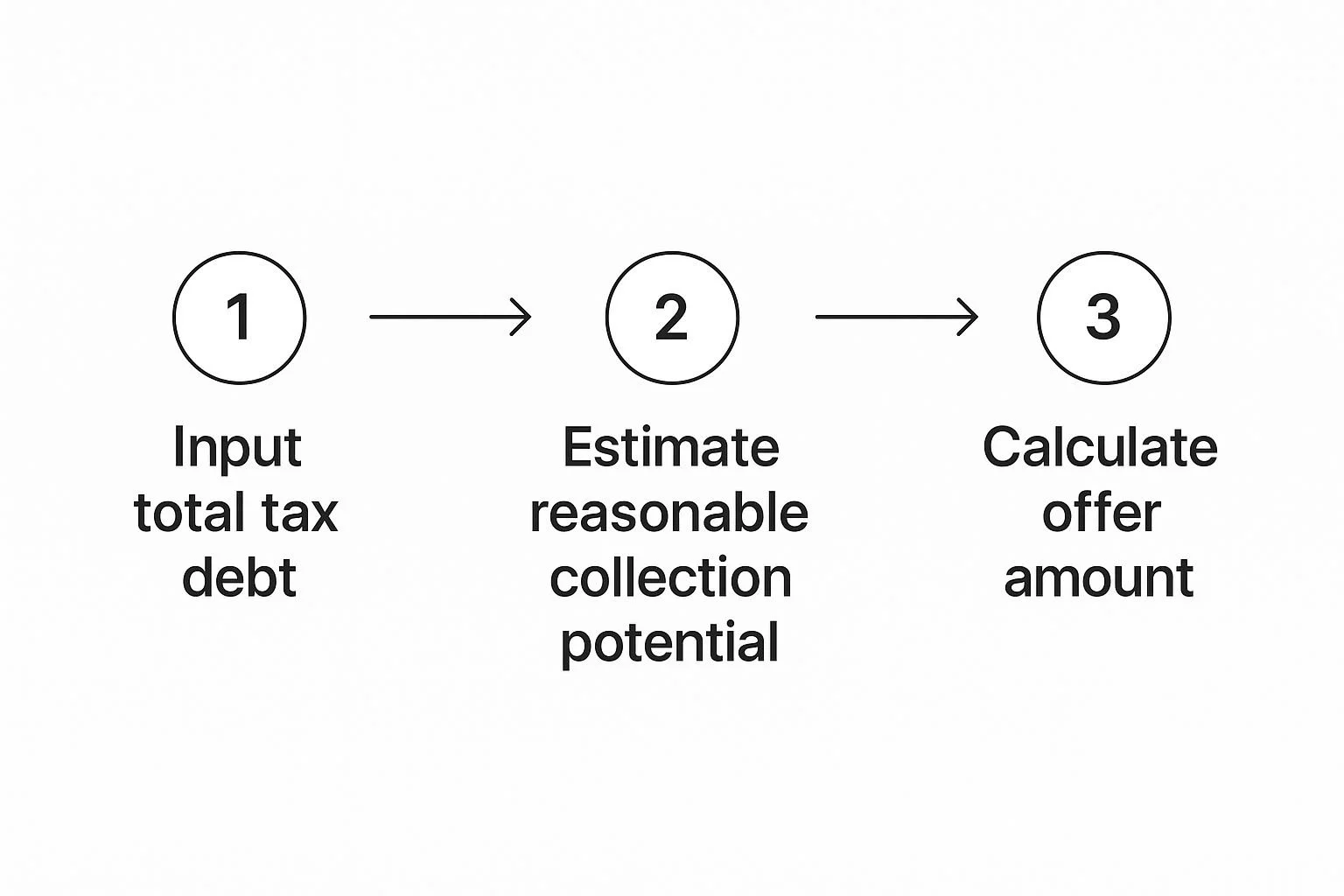
Essentially, the tool weighs your total tax debt against what it calculates as your ability to pay over time, and that's the number it spits out as a potential offer.
Nailing Down Your Income and Assets
First up, let's talk about what you own and what you earn. When it comes to income, the IRS looks at your gross monthly income—that’s the total before a single dollar is taken out for taxes, health insurance, or anything else. Don't make the common mistake of using your take-home pay.
Now for your assets—things like your house, car, or bank accounts. The IRS has a very specific way of valuing these. They aren't interested in what you paid for your car five years ago or what Zillow says your house is worth today. They use a figure called the Quick Sale Value (QSV).
The QSV is the number that really matters. It’s typically calculated as 80% of an asset's Fair Market Value (FMV). The IRS uses this because it represents what they could get if they had to seize and sell your property in a hurry. For a more accurate result from the calculator, always use this 80% figure for your assets.
Why Allowable Expenses Are a Game-Changer
This is where things get tricky, and where most people get tripped up. You might genuinely spend $900 a month on groceries for your family of four, but the IRS might only allow you to claim $750 based on standardized tables for your area and family size. Understanding this concept is absolutely critical to getting a realistic OIC estimate.
The IRS doesn't just take your word for your living costs. They rely on a strict set of National and Local Standards to determine what’s reasonable for essential expenses.
Food & Clothing: These fall under National Standards, which are based on your income and the number of people in your household.
Housing & Utilities: These are based on Local Standards and can vary significantly depending on which county you live in.
Transportation: This is a hybrid, using a national figure for car ownership costs and a local one for operating costs.
If your real-world spending is higher than these official standards, it doesn't automatically disqualify you. But it does mean you’ll have a much higher bar to clear. You would need to provide rock-solid proof that your higher expenses are essential for your family's health and well-being or to keep your job.
For the purpose of using the Pre-Qualifier Tool, your best bet is to stick to the official IRS standard amounts. This will give you the most conservative—and therefore most realistic—preview of what the IRS will likely calculate.
To see how this plays out in practice, let's look at a comparison.
Your Actual Expenses vs What the IRS Allows
| Expense Category | Your Actual Spending (Example) | IRS Allowable Amount (Example) | Key Consideration |
|---|---|---|---|
| Housing (Rent/Mortgage) | $2,200/month | $1,850 (local standard) | The IRS only allows the standard for your county, regardless of your actual rent. |
| Groceries & Household | $950/month | $780 (national standard) | This is based on household size, not your specific shopping habits or dietary needs. |
| Car Payment | $550/month | $525 (national standard) | The IRS caps what you can claim for a car payment, even if your actual loan is higher. |
| Health Insurance Premium | $600/month | $600 (your actual cost) | Good news: Actual costs for health insurance are generally allowed if they're necessary. |
See the difference? The gap between reality and the IRS's numbers can be huge, and it directly impacts the calculation of your ability to pay.
All of this financial information is what you would officially report on IRS Form 433-A. To get a head start and truly understand what the IRS is looking for, you can learn more by filling out IRS Form 433-A, which is the detailed financial statement required for every Offer in Compromise.
What Your Calculator Results Really Mean

So, you’ve plugged in all your numbers and the IRS Offer in Compromise calculator spit out a final figure. What does it actually mean?
That number is the IRS’s preliminary calculation of your Reasonable Collection Potential, or RCP. This is the single most important concept in the entire OIC process. In simple terms, it's the minimum amount the IRS thinks it can squeeze out of you if it pursues collections.
This figure is your first real glimpse into your chances. It takes the messy reality of your finances—income, assets, and all the expenses the IRS allows—and boils it down to one number that will frame every conversation you have with them from this point forward.
Interpreting the RCP Number
The next move is to put that RCP number side-by-side with your total tax debt. This simple comparison is incredibly revealing and points you toward your most logical next step.
If your RCP is way lower than what you owe: This is exactly what you want to see. It’s a strong signal that you might be a good candidate for an OIC based on “Doubt as to Collectability,” which is the most common path. The IRS's own tool is basically hinting that they probably can't collect the full debt from you.
If your RCP is close to or even higher than your tax debt: This is a major red flag. The calculator is telling you that, by their math, you actually can afford to pay off your debt. Pushing for an OIC in this situation is almost guaranteed to end in rejection. Your time would be much better spent looking into other resolutions, like an Installment Agreement.
Getting a handle on the IRS's formulas is a bit like learning the strategies for calculating various cost savings in a business—it’s all about looking at the numbers from a strategic angle to find the best possible outcome.
Here’s the bottom line: The calculator gives you a very educated guess, but it is not a promise. It's a data-driven starting point. The final decision always rests with an IRS officer who will do a deep dive into your complete financial picture.
A Reality Check on OIC Acceptance Rates
It’s really important to go into this with your eyes wide open. The Offer in Compromise program isn't a get-out-of-jail-free card; it's a demanding process with a high standard for approval.
Let's look at the hard numbers. Historically, the acceptance rate for OICs hovers somewhere between 30% and 40%. To put that in perspective, during the last full fiscal year, taxpayers submitted around 50,000 OIC applications. The IRS only accepted about 15,000 of them.
Why so low? Many applications are rejected for simple mistakes, like incomplete forms or failing to meet the basic eligibility rules. Others fail because the proposed offer amount just doesn't line up with the IRS’s own RCP calculation.
I don't share this to discourage you. I share it to highlight just how critical it is to get every single detail of your application right. That number from the calculator? That's your first piece of evidence in building a rock-solid case for why your offer deserves to be one of the few that gets accepted.
So, What Does the Calculator's Number Mean for You?
Now that you have that initial number from the IRS Offer in Compromise calculator, you’re at a fork in the road. Think of this number not as a final answer, but as a critical piece of intel that guides your next move. What you do from here depends entirely on whether that number was what you hoped for.
Simply put, your path forward will look very different depending on the calculator's verdict.
If the calculator spit out a potential offer that's way less than what you owe, breathe a little easier. That's a strong signal you might be a solid candidate for an Offer in Compromise, specifically under the “Doubt as to Collectability” category. This is your green light to start building your official case.
But what if the number was disappointing? Don't lose hope. A high offer amount just means an OIC probably isn't the best fit for your financial picture right now. It doesn't mean you're stuck; it just means it's time to pivot to other solutions.
Path #1: The Calculator Gives You a Green Light
A good result from the pre-qualifier tool is your cue to get serious. The next step is to assemble the official, in-depth application package for the IRS. This process is far more rigorous than plugging a few numbers into the online calculator.
Your entire focus should now shift to two critical IRS forms:
Form 656, Offer in Compromise: This is the core application where you officially propose your offer amount and how you intend to pay it.
Form 433-A (OIC), Collection Information Statement: This is the financial deep-dive, where you’ll provide exhaustive detail backing up the figures you entered into the calculator.
Get ready to gather a mountain of paperwork. Every single number on that Form 433-A needs to be proven with documents like bank statements, pay stubs, retirement account statements, vehicle registrations, and property appraisals. The IRS will go through this with a fine-tooth comb to confirm their version of your RCP.
A Crucial Choice: You have to decide on your payment structure upfront. The Lump Sum Cash Offer means you pay the full amount in five or fewer installments within five months after the IRS accepts it. The Periodic Payment Offer gives you more breathing room, letting you pay it off in monthly installments over six to 24 months.
Path #2: The Calculator's Verdict Is a "No"
Did the calculator show that your Reasonable Collection Potential (RCP) is nearly as much—or even more—than your total tax bill? That’s not the news you wanted, but it's incredibly valuable feedback.
This result tells you, straight up, that the IRS believes you can afford to pay what you owe. Pushing forward with an OIC application at this point would likely be a waste of your time, effort, and the non-refundable $205 application fee. The smart move is to immediately start looking at other tax relief options.
Here are the most common and effective alternatives:
Installment Agreement (IA): This is the most straightforward alternative. You agree to pay your tax debt in full with monthly payments stretched out over as long as 72 months. If your income can support the monthly payment, this is often the best route.
Currently Not Collectible (CNC) Status: If your financial situation is dire and you genuinely can't afford any monthly payment, you might qualify for CNC. This is a temporary hardship status that pauses IRS collection efforts, giving you breathing room until your finances hopefully improve.
Think of the calculator's result as a compass. Use it to point yourself toward the strategy with the highest chance of success and away from a path that’s almost guaranteed to be a dead end.
Common Questions About the OIC Process
Once you've run the numbers through the IRS offer and compromise calculator, you're bound to have more questions. It's totally normal. Knowing what to expect—the timeline, the potential pitfalls, and the impact on your life—is just as crucial as figuring out that initial offer amount.
Let's walk through some of the most frequent questions people have at this stage. Getting these answers upfront will help you set realistic expectations and move forward with a clear head.
How Long Does the IRS Take to Decide on an Offer?
This is where you need to settle in for a bit of a wait. While the IRS aims to process OIC applications in a few months, the reality is that a final decision can easily take anywhere from six to twelve months. If your financial situation is particularly complex, it could drag on even longer.
The good news? While your offer is under review, the IRS typically puts a hold on aggressive collection actions like levying your bank account or garnishing your wages. But there's a catch: you have to stay compliant.
This means filing all your tax returns and making any required current estimated tax payments on time while your application is pending. Miss a deadline, and that protection can vanish.
Will an Accepted Offer in Compromise Hurt My Credit Score?
This is a big one for most people, and thankfully, the answer is mostly positive. The IRS does not report your Offer in Compromise to the major credit bureaus like Experian, Equifax, or TransUnion. So, the OIC itself won't directly tank your credit score.
However, the tax debt that led you here might have already done some damage. If the IRS filed a Notice of Federal Tax Lien against your property, that lien is a public record and almost certainly shows up on your credit report, which does hurt your score. After you've paid off your OIC in full, it's up to you to request that the IRS release the lien. This is a vital step toward cleaning up your credit history.
An OIC is fundamentally a settlement negotiation with a powerful government agency. Knowing how to navigate that conversation is a skill. Understanding effective dispute resolution strategies can give you a solid framework for handling the back-and-forth and potential appeals.
What Happens If My Offer in Compromise Is Rejected?
Getting a rejection letter is tough, but it’s not game over. The IRS has to tell you exactly why they denied your offer, and you have 30 days from the date on that letter to file an appeal. This sends your case to the IRS Office of Appeals, an independent division that will take a fresh look.
If you choose not to appeal or your appeal is unsuccessful, the IRS will apply your initial payment to your outstanding tax bill. From there, you need to quickly shift gears and look into other solutions, like an Installment Agreement or being placed in Currently Not Collectible status.
At the office of Attorney Stephen A Weisberg, we don't believe in charging a hefty retainer just to see if we can help. We start every potential client with a FREE Tax Debt Analysis to give you a clear, honest assessment of your situation and the best path forward. Contact us today to see if you're a candidate for tax relief.
Want to understand your options before you call anyone?
Download my free book — Freedom From Tax Debt — a plain-language guide to how the IRS collections process actually works and what resolution really looks like.
➥ Contact Attorney Stephen A. Weisberg for a free Tax Debt Analysis.
Contact Me Here: https://www.weisberg.tax/contact-1
Email: s.weisberg@weisberg.tax
Phone/Text: (248) 971-0885
Address: 300 Galleria Officentre, Suite 402, Southfield, MI 48034
