Can the IRS See Your Bank Account? Find Out Now
Let's clear up a common misconception right away: The IRS isn't sitting there watching your bank account in real-time. There's no system that lets an agent monitor your daily coffee purchases or bill payments.
That said, they absolutely can get access to your financial records, but only under specific, legally defined circumstances.
So, How Does the IRS Actually See Your Bank Records?

The question "Can the IRS see my bank account?" isn't a simple yes or no. The best way to think about it is that your financial information is behind a locked door. The IRS doesn't have a master key to barge in whenever it feels like it. Instead, they have to get a specific key for a specific reason, and they have to follow a strict legal process to get it.
This isn't about constant surveillance. It’s about targeted investigation, usually triggered when something on your tax return looks off. The whole process is governed by a dense set of rules designed to protect taxpayer rights and prevent the agency from overstepping its authority.
The Legal Pathways to Your Records
For the IRS to peek into your finances, they need a legitimate reason and must use an official channel. Here are the primary ways they do it:
Audits: This is the most common scenario. If you're selected for an audit, the IRS will formally examine your records to make sure the income and deductions you reported are accurate. Bank statements are a key part of that verification process.
Summons: Think of this as a legal demand. The IRS can issue a summons directly to your bank, legally compelling it to hand over specific financial records as part of an investigation. The bank has to comply.
Levies: This is a much more serious step. A levy isn't about looking; it's about taking. If you have an outstanding tax debt that you haven't paid, the IRS can legally seize funds directly from your account to cover it.
The key takeaway is that IRS access is reactive, not proactive. It's a response to a specific trigger—like a questionable tax filing or unpaid taxes—not a system of ongoing monitoring. Understanding this difference is crucial.
To make this clearer, let's break down the different situations that can give the IRS a legitimate reason to access your bank information.
How the IRS Can Access Your Bank Information
This table summarizes the main ways the IRS gains access, what usually kicks off the process, and what they can see.
| Scenario | What Triggers It | What the IRS Can See |
|---|---|---|
| Routine Audit | Discrepancies on your tax return (e.g., mismatched income, unusually large deductions). | Bank statements, deposit records, and other documents to verify the figures on your return. |
| Third-Party Summons | A formal investigation into a taxpayer (you or someone you did business with). | Specific records requested in the summons, which could include transaction histories, deposit slips, and check images for a defined period. |
| Bank Secrecy Act (BSA) | Cash deposits or withdrawals exceeding $10,000 in a single day, or patterns of suspicious transactions just under that amount. | Currency Transaction Reports (CTRs) or Suspicious Activity Reports (SARs) filed by the bank. |
| Tax Levy | Failure to pay an assessed tax debt after multiple notices and demands for payment. | Your account balance and transaction history, which allows them to seize funds to satisfy the debt. |
| Criminal Investigation | Evidence suggesting serious tax evasion or fraud. | Extensive financial records, often obtained through a court-ordered subpoena, covering multiple accounts and years. |
As you can see, each method is tied to a specific legal cause. The IRS isn't just fishing for information; they are following a trail that started with a specific red flag.
The Legal Pathways the IRS Uses to Access Bank Data
Let's get one thing straight: the IRS can't just wander into your bank account whenever it feels like it. They have to follow strict legal procedures, and these aren't just suggestions—they're the law. Think of it less like a random spot-check and more like a formal, justified request for information.
The most common way this happens is during an audit. An audit is basically the IRS's way of saying, "Hey, we noticed something on your tax return that looks a little off, and we'd like to see your work." It’s a verification process, not an accusation.
Then there’s the IRS summons, which is a more serious step. This isn't a polite letter asking for your records; it's a formal legal demand sent directly to your bank or other financial institution. When a bank receives a valid summons, they are legally obligated to hand over the specified information.
Finally, we have the most forceful tool in their arsenal: the levy. A levy is when the IRS actually seizes funds from your account to pay off a tax debt. This is an absolute last resort, and it only happens after they've sent you multiple notices and warnings. But it’s a stark reminder of the agency's power to collect on debts.
Third-Party Reporting and Summons Power
Even without a specific investigation, the IRS gets a steady stream of information from what's known as third-party reporting. For instance, your bank is required to send the IRS a Form 1099-INT detailing any interest you earned. This gives them a baseline look into some of your financial activity.
Beyond our borders, international agreements also come into play. Treaties such as the US Tax Treaty with Hong Kong create a system for countries to share financial information, all in an effort to clamp down on international tax evasion.
This image breaks down the key legal tools the IRS has at its disposal.
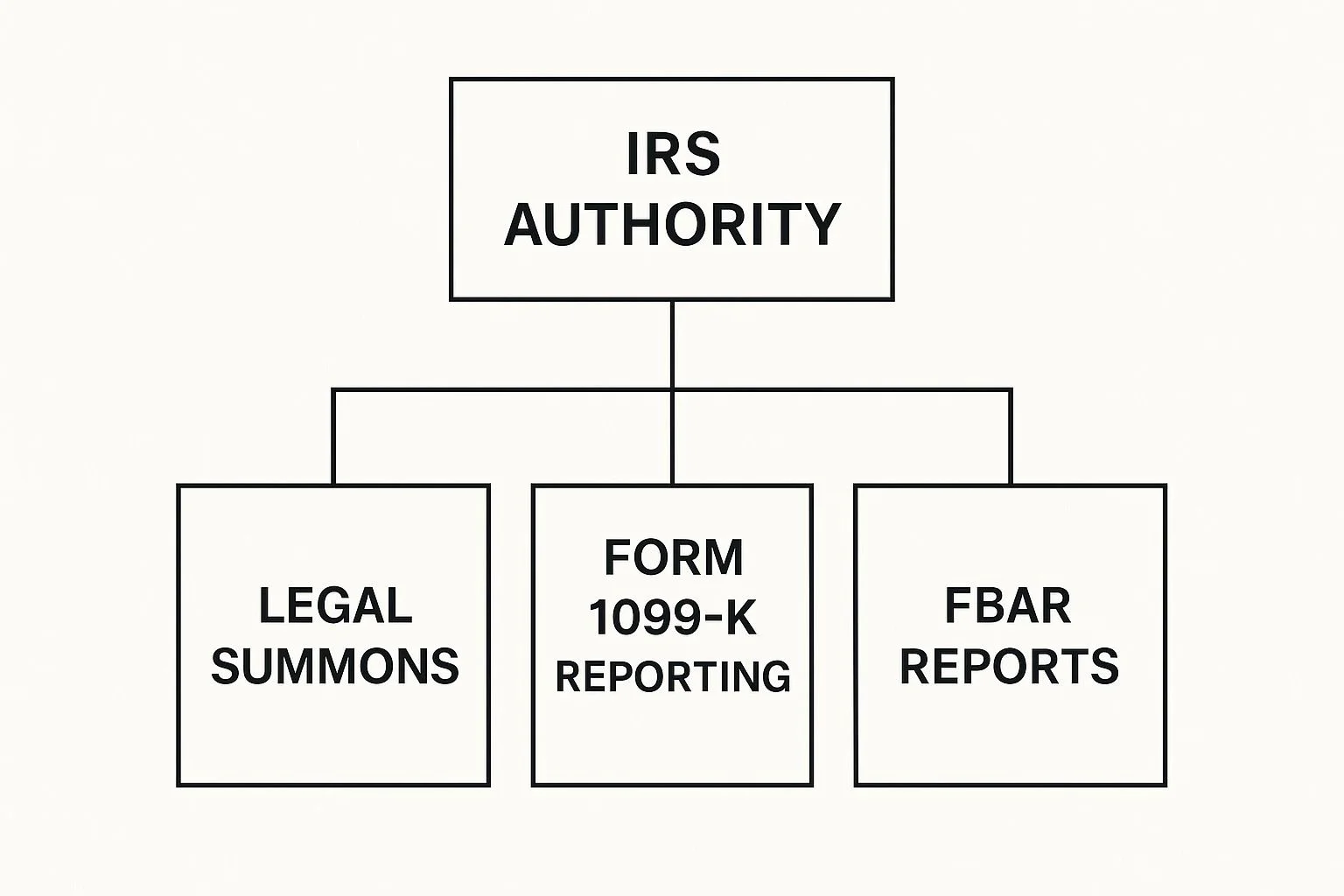
As you can see, the process relies on specific legal instruments, not on any kind of direct, unchecked surveillance.
How These Pathways Work in Practice
Each of these methods has a different trigger and serves a unique purpose. It's not a one-size-fits-all approach.
Audits: These are all about verification. The goal is to make sure the numbers you put on your tax return match your actual financial situation.
A Summons: This is for investigation. The IRS uses a summons to gather specific evidence when they are digging deeper into a potential compliance issue.
A Levy: This is purely for collection. It’s the tool they use to forcibly take payment for a tax debt that has already been confirmed and remains unpaid.
The key takeaway here is that these actions don't happen in a vacuum. You, the taxpayer, are almost always notified when the IRS initiates an audit or is about to issue a levy. The process isn't a secret—it involves formal communication and gives you clear opportunities to respond or appeal.
Understanding the $10,000 Bank Reporting Rules
The number $10,000 tends to set off alarm bells for a lot of people when it comes to banking and the IRS. It's a key figure, but it's important to know it applies to two completely different scenarios—one is an established law, and the other is a controversial proposal that’s currently on hold.
Let's clear up the confusion.
The Bank Secrecy Act: Spotting Large Cash Moves
First, there's the Bank Secrecy Act (BSA). This is a long-standing federal law that requires your bank to file a Currency Transaction Report (CTR) whenever you make a single cash transaction over $10,000.
This isn't about your taxes. Its real purpose is to help the government spot potential money laundering, terrorism financing, or other illegal activities. Think of it less as the IRS peeking into your finances and more as a financial security measure.
If you deposit or withdraw $10,001 in cash, the bank has to report it. They’re also trained to look for a practice called "structuring," where someone intentionally makes several smaller cash deposits—say, two deposits of $6,000—to sneak just under the $10,000 threshold. That kind of pattern is an even bigger red flag for them.
It's crucial to know that these reports are filed with the Financial Crimes Enforcement Network (FinCEN), not sent directly to the IRS. While the IRS can get access to this information if they're already investigating something, a CTR by itself is not a trigger for an audit.
The Stalled IRS Reporting Proposal
The second rule is a much more recent—and highly controversial—proposal that caused a huge public stir. Back in 2021, the Treasury Department floated an idea that would have required banks to report on the total annual cash flow of accounts.
The initial pitch was to report accounts with annual inflows or outflows over a mere $600. After a massive backlash over privacy, the proposal was tweaked. The new version suggested banks should report accounts with more than $10,000 in total non-payroll deposits or withdrawals for the year. This would specifically exclude regular wage and salary income. You can get more details on the proposal and the subsequent changes.
The idea wasn't to track every little transaction. Instead, it was meant to give the IRS a bird's-eye view of an account's total activity. This would help them flag major inconsistencies, like someone reporting $50,000 in income but having $500,000 flowing through their bank account.
So, where does this stand now? Due to widespread opposition, this proposal has not become law. It remains stalled in Congress, and banks are not required to report this kind of aggregate account information to the IRS.
What Triggers an IRS Audit of Your Bank Account?
The IRS doesn’t have an army of agents poring over every single tax return. It’s just not possible. Instead, they use powerful computer programs that act like a sophisticated filter, automatically flagging returns that stick out from the crowd.
Think of it like this: the system knows what a “normal” return looks for someone in your profession and income bracket. When your return deviates too far from that statistical baseline, it gets flagged for a human to take a closer look.
Mismatched Income and Lifestyle
One of the biggest red flags for the IRS is a major disconnect between the income you report and the lifestyle you appear to live. For instance, if you tell the IRS you made $40,000 as a freelance designer but your bank statements show lease payments on a Porsche and charges for a first-class trip to Europe, that’s a problem.
This kind of mismatch screams "unreported income," and it's one of the main reasons the IRS will want to dig into your bank records to see what’s really going on with your cash flow.
Key Insight: Consistency is your best defense. The story your tax return tells should align with the financial life you lead. Drastic differences between reported earnings and known spending habits are what prompt further investigation.
Common Red Flags for IRS Scrutiny
Beyond living large on a reported shoestring budget, a few other specific issues tend to attract unwanted attention from the IRS. Knowing what they are can help you make sure your financial reporting is buttoned up.
Large and Unexplained Cash Deposits: If you’re consistently depositing big chunks of cash without a good business reason, the IRS will get curious. Banks are already required to report any cash transaction over $10,000, and a pattern of these deposits is a classic sign of income that isn't being reported.
Forgetting Foreign Bank Accounts: This is a big one. Hiding money offshore is a major enforcement priority for the IRS. If you have financial interests in accounts outside the U.S. that exceed certain thresholds, you are legally required to file a Report of Foreign Bank and Financial Accounts (FBAR). Forgetting to do so is a surefire way to get on their radar.
Excessively High Business Deductions: Claiming deductions that are way out of line with your industry or revenue is another common trigger. Let’s say your consulting business brings in $80,000 in revenue, but you claim $75,000 in expenses—especially if those expenses are heavy on meals, travel, and entertainment. You can bet the IRS is going to question whether those were legitimate business costs.
Knowing Your Rights as a Taxpayer

It’s easy to feel intimidated when the IRS comes knocking, but it's crucial to remember that you have rights. The government has a rulebook it has to follow, and it's called the Taxpayer Bill of Rights. Think of it as your own personal set of protections when you're dealing with tax matters.
These rights are there to make sure you’re treated fairly and with professional courtesy every step of the way. Knowing what they are changes the conversation from one of fear to one of confidence.
Core Protections You Should Know
Two of the most important rights you have are The Right to Be Informed and The Right to Challenge the IRS’s Position. These two pillars ensure transparency and give you a real voice in the process.
The Right to Be Informed: The IRS can't just operate behind a curtain. They are required to tell you exactly why they need your information, how they plan to use it, and what happens if you choose not to provide it. No secrets allowed.
The Right to Challenge the IRS's Position: You don’t have to just take their word for it. This fundamental right ensures you can object to their findings, submit more evidence to support your case, and appeal their decisions through a fair, impartial system.
These rights act as your shield. They guarantee that even when the IRS wants to peek into your bank account, they must be upfront about it and give you a clear opportunity to dispute their claims.
This whole issue of IRS bank access really touches a nerve with the public. A 2021 poll found that a staggering 67% of voters were against proposals that would increase bank account monitoring, mostly due to privacy and data security fears. You can learn more about the public sentiment on IRS bank monitoring and see just how strong the opposition is.
While knowing your rights is the first step, actually navigating an audit or an appeal can get complicated fast. This is where getting a qualified tax professional involved isn't just a good idea—it's often essential to make sure your interests are fully protected.
Your Top Questions About IRS Bank Monitoring, Answered
Even when you know the rules, real-world situations can get murky. Let's clear up some of the most common questions and myths taxpayers have about the IRS and their bank accounts.
Can the IRS See My Venmo or PayPal Account?
They can't watch your transactions in real-time, but they absolutely get a summary of your business activity. Payment apps like Venmo and PayPal are required by law to send you (and the IRS) a Form 1099-K once you receive payments for goods and services over a certain threshold.
That form is a direct signal to the IRS about your income from that platform. If the numbers on the 1099-K don't line up with what you've reported on your tax return, it’s a major red flag that could easily trigger an audit. At that point, they can and will request your complete transaction history.
Will Opening a New Bank Account Hide Money From the IRS?
This is one of the most persistent and dangerous myths out there. The short answer is no, it won't work.
Every time you open an account at a legitimate U.S. bank, you have to provide your Social Security Number (SSN). That's non-negotiable. Any interest your money earns, even just a few dollars, gets reported to the IRS on a Form 1099-INT, which is tied directly to your SSN. This creates an instant paper trail leading straight back to you.
Trying to shuffle money into new accounts to conceal it isn't just a bad idea—it's considered tax evasion, a crime with severe consequences.
The Bottom Line: When it comes to the IRS, transparency is your best defense. The U.S. financial system is built on reporting, making it virtually impossible to legally hide money. Trying to do so usually creates a much bigger mess.
What Do I Do if the IRS Demands My Bank Statements?
First, take a deep breath. Don't panic, but absolutely do not ignore the letter. Your immediate first step is to confirm the notice is actually from the IRS. Scammers often use scare tactics that look official.
Once you've verified the request is legit, the smartest move is to call a qualified tax professional—think CPA or tax attorney. They can analyze the IRS's request, figure out exactly what it’s about, and make sure you only hand over what's legally necessary. Having an expert in your corner protects your rights and ensures the whole process is handled correctly.
Facing an IRS notice can be incredibly stressful, but you don't have to go through it by yourself. Attorney Stephen A Weisberg offers a FREE Tax Debt Analysis to map out a clear plan before you ever pay a dime. Get the expert guidance you need to protect your financial interests by visiting weisberg.tax today.
Want to understand your options before you call anyone?
Download my free book — Freedom From Tax Debt — a plain-language guide to how the IRS collections process actually works and what resolution really looks like.
➥ Contact Attorney Stephen A. Weisberg for a free Tax Debt Analysis.
Contact Me Here: https://www.weisberg.tax/contact-1
Email: s.weisberg@weisberg.tax
Phone/Text: (248) 971-0885
Address: 300 Galleria Officentre, Suite 402, Southfield, MI 48034
