IRS Revenue Officers: What You Need to Know
When the IRS sends someone to your door, it’s not a situation anyone wants to be in. If that person is an IRS Revenue Officer, it means things have gotten serious. These are highly trained, in-person collection agents for the Internal Revenue Service.
Their job is to collect significant, unresolved tax debts and get taxpayers to file long-overdue returns. Think of them as the IRS's last line of offense—they show up only after all the letters, notices, and automated attempts to collect have failed.
What an IRS Revenue Officer Really Does
Getting an unannounced visit or finding an IRS Revenue Officer's business card on your door can be downright terrifying. But the first step to getting through this is to understand exactly what their job is—and what it isn't.
Don't confuse them with auditors who are there to start an investigation into your tax returns. A Revenue Officer is a specialized financial investigator focused on one thing: collection.
Their appearance is a clear signal that your tax account has been escalated to a critical level. It usually means a large tax debt has been sitting unpaid for a long time, and the IRS's automated systems have given up.
The Core Mission of a Revenue Officer
The purpose of a Revenue Officer is simple: collect delinquent taxes and secure unfiled tax returns. They are the IRS's boots on the ground, tasked with bringing taxpayers back into compliance.
Their day-to-day work often involves:
Direct Contact: Showing up in person at your home or business to discuss the debt.
Financial Investigation: Demanding detailed financial information (like bank statements and pay stubs) to figure out your ability to pay.
Enforcement Actions: Using powerful legal tools like tax liens and bank levies to seize assets if you're uncooperative.
It’s essential to know who you’re dealing with. People often mix up Revenue Officers with Revenue Agents, but their roles are completely different. A Revenue Agent audits your tax returns to see if the numbers you reported are accurate. A Revenue Officer’s job is to collect a tax debt that the IRS has already determined you owe.
To clear up any confusion, here’s a quick comparison of the two roles.
Revenue Officer vs Revenue Agent Key Differences
Understanding the distinction between an IRS Revenue Officer and a Revenue Agent is crucial. This table breaks down their different jobs, so you know exactly who you're talking to and what to expect.
| Aspect | IRS Revenue Officer | IRS Revenue Agent |
|---|---|---|
| Primary Role | Collects unpaid taxes that have already been assessed. | Audits tax returns to verify the accuracy of reported income and deductions. |
| Area of Focus | Collection of delinquent accounts and securing unfiled returns. | Examination and verification of tax returns. |
| Typical Interaction | In-person visits to home or business, phone calls, letters. | Primarily corresponds through mail; may have in-person meetings. |
| Key Authority | Can seize property (levy), place liens on assets, and recommend further legal action. | Can propose changes to your tax liability, resulting in more or less tax owed. |
| Goal | Secure payment for an existing tax debt. | Determine the correct tax liability for a specific tax year. |
In short, if you're meeting with a Revenue Agent, you're being audited. If a Revenue Officer is at your door, the IRS is there to collect.
This infographic gives a clearer picture of their workload and just how effective they are at their job.
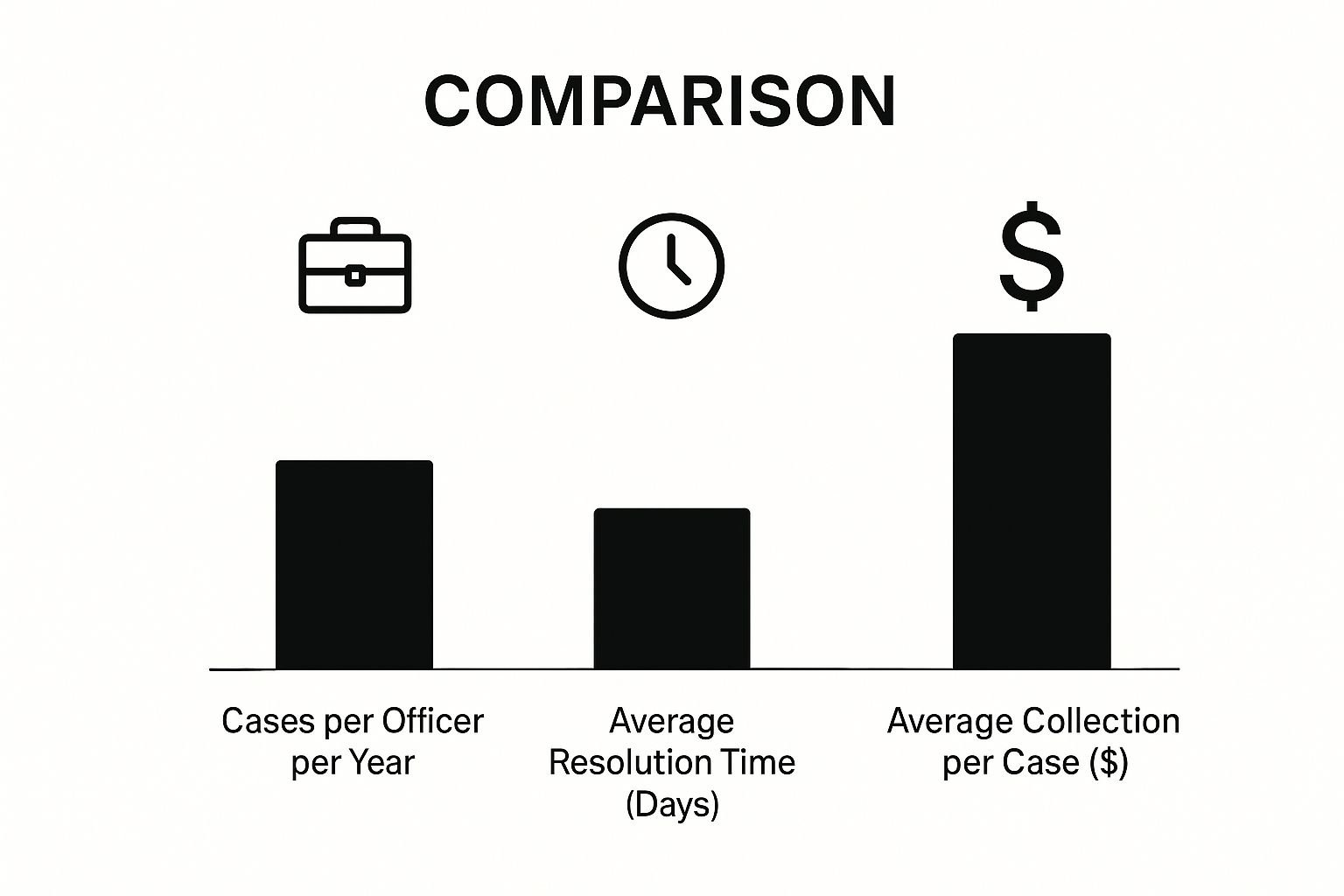
As you can see, each officer handles a specific number of cases but is responsible for collecting a significant amount of money from each one.
A Small but Powerful Force
You might be surprised to learn there aren't that many Revenue Officers compared to the millions of US taxpayers. As of Fiscal Year 2024, the Small Business/Self-Employed Division (SB/SE) at the IRS employed approximately 3,205 revenue officers. You can find more details about IRS enforcement roles and statistics on the official Treasury Inspector General for Tax Administration website.
Despite their small numbers, they are a powerful enforcement arm of the IRS.
Their presence signifies a high-priority collection case that requires direct, human intervention. While the situation is serious, it is also manageable with the right knowledge and a proactive approach.
Ultimately, a Revenue Officer wants to close your case. That can happen through a full payment, an approved payment plan like an Offer in Compromise, or another resolution. How you cooperate and prepare from the very first contact will make all the difference in reaching a successful outcome.
Understanding Their Authority and Your Protections

When an IRS Revenue Officer shows up, it's easy to feel overwhelmed. It’s critical to understand the power they have—but just as importantly, where that power ends. They have a serious job to do and possess significant authority to collect tax debt, but their actions are reined in by strict legal procedures that protect your rights.
Think of their power as a specific set of tools for a specific job. They can’t just do anything they want; there’s a rulebook they have to follow for every single action they take. Knowing what's in that rulebook is your first step toward getting a handle on the situation.
The Scope of Their Power
A Revenue Officer’s toolkit is all about one thing: collection. While they aren't law enforcement—they don't carry guns or make arrests—their financial enforcement powers are incredibly strong.
Here’s what they can do:
Issue a Summons: This is a formal legal demand for you to provide financial documents or testify under oath. You can’t just ignore it; failing to comply can land you in court.
File a Notice of Federal Tax Lien: This is a public legal claim against your property. It tells the world—and other creditors—that the government has a right to your assets, like your house or car, to cover your tax debt.
Serve a Notice of Levy: This is the big one—the actual seizure of your assets. A levy gives the IRS the green light to take money directly from your bank accounts, garnish a chunk of your paycheck, or even take physical property to pay off what you owe.
These actions are intimidating, and they're meant to be. But they don't happen out of the blue. Each one is preceded by a series of legal notices that give you a chance to respond before things escalate.
Knowing the process is your best defense. A Revenue Officer's power is tied to procedure. If you understand that procedure, you can see their next move coming and take steps to protect yourself.
Critical Limitations and Taxpayer Protections
Just as important as what Revenue Officers can do is what they can't. They are civil employees, part of the Treasury Department, not federal agents you see in the movies. This means they have absolutely no authority to arrest you or threaten you with jail time for not paying your taxes.
On top of that, their behavior is highly regulated. A major piece of legislation, the Internal Revenue Service Restructuring and Reform Act of 1998 (RRA 98), completely reshaped how the agency operates.
It put tough standards in place for employee conduct and even mandated firing for serious misconduct, all to hold agents accountable and shield taxpayers from abuse. You can read more about this law and its effects on the IRS's organizational history.
This framework ensures that while an officer's job is to be persistent, it's not to be abusive. You have a right to be treated professionally and with respect.
If you ever feel an officer is crossing a line, you are well within your rights to ask for their manager's contact information and file a formal complaint.
Never forget: your protections are baked right into the system.
How to Handle the First Contact with an Officer

Whether it's a formal letter in the mail or a knock on your door, the first time you hear from an IRS Revenue Officer is a moment you won't forget. An unannounced visit, in particular, is a classic move. It's designed to catch you off-guard and get you talking.
Your response, however, should be anything but panicked. It needs to be calm, professional, and strategic.
Right now, your goal isn't to solve the entire tax problem on your doorstep. It's simply to manage the interaction, protect your rights, and lay the groundwork for a resolution later. Making snap decisions or giving up too much information under pressure can cause a world of trouble down the line.
Verify Their Identity Immediately
Before a single word is exchanged about your taxes, your absolute first step is to confirm you're dealing with a real IRS employee. Scammers love to impersonate IRS agents, using fear to trick people into sending them money.
A legitimate Revenue Officer will always have official credentials and won't hesitate to show them.
You need to ask to see their two official forms of identification:
Pocket Commission: This is their main credential, a small booklet-style ID that looks very official.
HSPD-12 Card: This is a standard, government-issued ID card with their photo and details.
If you feel even the slightest bit unsure, tell them you need to call the IRS to verify their identity. Explain politely that it's a security precaution. Any real officer will understand and respect your caution.
Your Initial Conversation Playbook
Once you've confirmed who they are, keep the conversation short and sweet. The officer will probably ask to come inside your home or business to start digging into your finances. They might even hand you a form, like the Form 433-A, Collection Information Statement.
Crucial Tip: You are under no obligation to let them in. You do not have to answer detailed financial questions or sign anything during an unexpected visit.
Instead of getting pulled into a deep discussion you're not ready for, you need to politely but firmly state that you need time to prepare and find professional representation.
Try saying something like this: "Thank you for stopping by. I fully intend to cooperate, but I need to speak with my tax professional first. Could we schedule a formal meeting for a later date?"
This simple statement accomplishes three critical things at once:
It clearly asserts your right to have representation.
It buys you the time you desperately need to get your documents and your thoughts in order.
It prevents you from saying something inaccurate under pressure that could hurt you later.
A successful first meeting ends with you getting their contact information and setting a future appointment. This professional response shows the IRS revenue officers you're taking this seriously while protecting you from making a costly mistake.
Your Rights During the Collection Process

When an IRS revenue officer is on your case, knowing your rights isn't just a good idea—it's your single most important defense. The IRS doesn't have unlimited power; they're bound by a formal Taxpayer Bill of Rights, which provides real, practical protections you can lean on throughout the collections process.
Think of it this way: understanding these rights shifts you from being a passive target of collection demands to an active participant who can ensure the process remains fair. The situation is undoubtedly serious, but you are far from powerless.
The Right to Representation
This is the big one, maybe the most critical right you have when a Revenue Officer gets involved. You absolutely do not have to face them alone. The moment you tell an officer you've hired a tax professional—like a tax attorney or an Enrolled Agent—they must stop talking to you and direct all future communications to your representative.
Here's how it plays out: An officer shows up at your business unannounced and starts asking for financial documents. You can simply and politely say, "I've retained professional representation. Please direct all future questions to my attorney." That's it. The interview stops, and you've just regained a massive amount of control.
This right is your ticket to bringing in an expert who knows the playbook inside and out. It prevents you from making panicked decisions or costly mistakes under duress and immediately levels the playing field.
The Right to Be Informed
A Revenue Officer can't operate in the shadows. You have a fundamental right to know exactly why the IRS is taking a certain action and what you need to do to respond. They are required to explain their decisions and give you clear instructions.
For instance, if they're planning to file a federal tax lien or issue a levy against your bank account, they can't just do it out of the blue. You have to receive a formal, written notice first. That notice is your window of opportunity to pay the debt, get into a payment agreement, or file an appeal before they take your assets.
You are entitled to a clear, plain-English explanation for any decision made about your case. If you disagree with something, you have the right to know why they reached that conclusion. This information is the foundation for any successful appeal you might make.
Rights to Appeal and Pay the Correct Amount
First and foremost, you are only required to pay the correct amount of tax that you legally owe—not a penny more. If you have reason to believe the amount the IRS has calculated is wrong, you have the absolute right to challenge it.
This right goes hand-in-hand with your Right to Appeal an IRS Decision in an Independent Forum. Let's say you disagree with a Revenue Officer's plan to levy your wages, or they reject your proposal for a payment plan. You can start by requesting a conference with their direct manager.
If you still can't find a resolution, you can take it a step further and file a formal appeal with the IRS Independent Office of Appeals.
This office is a completely separate division of the IRS, created specifically to mediate these disputes from a neutral standpoint. It serves as a vital check on the power of IRS revenue officers, giving you a fair shot at being heard.
Your Options for Dealing with Collection Actions
When an IRS revenue officer is on your case, you're at a critical fork in the road. You can either face their powerful enforcement tools head-on, or you can work with them to find a way out. It's crucial to understand that while these officers have serious collection power, their primary job is to close your case. That’s your opening.
Doing nothing is the single worst thing you can do. If you ignore them, they won't just go away—they'll escalate. Aggressive collection actions aren't personal threats; they're standard operating procedure for taxpayers who won't cooperate.
What Happens When You Don't Cooperate
If you’re unresponsive, a Revenue Officer has no choice but to move to enforced collection. This usually means one of two things, both of which can be financially devastating.
Wage Garnishment: This is when the IRS orders your employer to send them a hefty chunk of your paycheck. You don't get a say; the money is gone before it ever hits your bank account, and this continues until the entire tax debt is paid off.
Bank Levy: The IRS can also seize money directly from your bank accounts. Your bank is legally required to freeze your funds and, after a 21-day holding period, send the money straight to the IRS.
These aren't just possibilities; they are the predictable consequences of inaction. The good news? They are almost always preventable if you engage with the officer and work toward a formal resolution.
The surest way to avoid a levy or garnishment is to get ahead of the problem. Show the officer you're serious about fixing the issue, and you can often negotiate a manageable payment solution instead of having one forced upon you.
Finding a Resolution That Works
The IRS actually has several established programs designed to help people get back on track. A revenue officer has the authority to approve these arrangements, provided you meet the qualifications.
The Installment Agreement
The most common path forward is an Installment Agreement (IA). Think of it as a formal payment plan. It allows you to pay off your tax debt in monthly chunks over a period of time, often up to 72 months. You’ll have to open up your books and provide financial details to show you can make the payments, but it’s a reliable way to halt collection actions and get back in good standing.
The Offer in Compromise
If you're facing a true financial crisis, an Offer in Compromise (OIC) might be on the table. This is an agreement with the IRS to settle your tax liability for less—sometimes significantly less—than what you originally owed. Be warned: the standards are incredibly high. You have to prove, without a doubt, that you lack the income and assets to pay the full debt now or anytime soon.
Currently Not Collectible Status
For those in the most dire straits, there's Currently Not Collectible (CNC) status. This is a temporary pause button. If you can prove you have absolutely no ability to make payments, the IRS will stop collection efforts. The debt doesn't disappear, and they will check in on your financial situation periodically, but it provides immediate breathing room when you need it most.
If your business is juggling tax debt alongside other financial obligations, it might be wise to explore debt consolidation strategies to streamline your payments.
Figuring out the best resolution requires an honest look at your finances, and getting some professional guidance can make all the difference in negotiating the best possible outcome.
How to Prepare for a Successful Resolution
When a revenue officer gets involved, the worst thing you can do is bury your head in the sand. This is the time for a proactive strategy, not a panicked reaction. Getting organized is the single best way to turn a stressful, intimidating situation into a manageable financial problem. A clear plan doesn't just reduce your anxiety; it dramatically improves your chances of a good outcome.
Get Your Financial House in Order
First things first: you need to get all your financial documents together. We're talking about the last few years of tax returns, recent bank statements, pay stubs, and a clear list of your assets (what you own) and liabilities (what you owe).
Once you have everything in one place, you can build an accurate, honest budget. This isn't just for you—it’s the document that will show the revenue officer exactly what you can realistically afford to pay each month.
Plan Your Communication
Next, you need to decide how you're going to communicate. The best approach is a mix of cooperation and assertiveness. Never ignore a revenue officer’s letters or calls, but also remember that you have the right to get professional help before you hand over sensitive information or sign anything.
Key Takeaway: Your goal is to paint a complete and honest financial picture. This kind of transparency builds trust and opens the door to negotiating a solution you can actually live with, like an installment agreement.
As you look at different ways to clear your tax debt, you might even consider personal financing. For a detailed look at this option, check out this guide on if you Can Personal Loans Be Used to Pay Off Taxes?.
Frequently Asked Questions About IRS Revenue Officers
When you're dealing with a revenue officer, a lot of questions can race through your mind. Let's tackle some of the most common ones head-on. Getting clear, straightforward answers can make a world of difference, helping you feel more in control and less anxious.
Think of this as your go-to guide for those pressing concerns that pop up when an officer gets involved.
Can a Revenue Officer Really Just Show Up at My House?
Yes, they can, and they often do. An unannounced visit to your home or business is a perfectly legal and standard move for an IRS revenue officer. They're field agents, and showing up out of the blue is a common way they make first contact and get a real-world look at your financial situation.
But here’s the crucial part: you don't have to let them in or answer their questions on the spot. You have every right to stay calm, verify their credentials, and politely tell them you need to speak with a tax professional. Simply ask to schedule a proper meeting for a later date. This simple step buys you invaluable time to prepare.
What’s the Difference Between a Lien and a Levy?
This is a big one. People often use these terms interchangeably, but they mean very different things in the eyes of the IRS. Knowing the distinction is critical.
A tax lien is essentially a public claim. The IRS files a Notice of Federal Tax Lien to secure its interest in your property (like your house, car, or other assets). It’s a warning to other creditors that the government has first dibs. It doesn't mean they are taking your property yet.
A tax levy is the actual seizure. This is when the IRS actively takes your assets to satisfy the debt. They can pull money directly from your bank account, garnish your wages, or even seize physical property. A levy is the action that follows the lien's warning.
Should I Hire a Professional to Deal with the Revenue Officer?
Legally, no, you don't have to. But from a practical standpoint, it's almost always the smart move. You have to remember, revenue officers are highly trained collection specialists. They live and breathe the tax code and IRS internal procedures every single day. The average person is at a serious disadvantage.
Hiring a qualified tax professional—like a tax attorney or an Enrolled Agent—completely levels the playing field. They know the rules, they speak the language, and they can protect you from making costly mistakes under pressure.
An expert takes over all communication, defends your taxpayer rights, and works to negotiate the best possible outcome. They know the officer's playbook and can build a strategy to get your case resolved, often saving you a massive amount of money and stress in the process.
At Attorney Stephen A Weisberg, I know just how overwhelming an IRS problem can feel. I start every case with a FREE Tax Debt Analysis to show you exactly how I can help before you ever pay a fee. If you’re facing a revenue officer, get the expert help you deserve today.
Want to understand your options before you call anyone?
Download my free book — Freedom From Tax Debt — a plain-language guide to how the IRS collections process actually works and what resolution really looks like.
➥ Contact Attorney Stephen A. Weisberg for a free Tax Debt Analysis.
Contact Me Here: https://www.weisberg.tax/contact-1
Email: s.weisberg@weisberg.tax
Phone/Text: (248) 971-0885
Address: 300 Galleria Officentre, Suite 402, Southfield, MI 48034
