Do You Go to Jail for Tax Evasion? Find Out the Truth
Let's cut right to the chase: Yes, you can absolutely go to jail for tax evasion.
It's a common misconception that tax problems only lead to audits and hefty fines. While that’s often true for simple mistakes, the moment the IRS suspects a willful and intentional effort to cheat the government, the game changes completely. This is the bright, red line between a civil penalty and a federal crime.
Yes, Jail Time Is a Real Consequence for Tax Evasion

When federal prosecutors step in, it's not because you made a math error. It's because they believe they have solid evidence you deliberately broke the law. Suddenly, you're not just dealing with an auditor; you're facing the full weight of the U.S. criminal justice system.
A conviction for a single count of federal tax evasion can land you in prison for up to five years. It’s a serious felony with life-altering consequences.
The entire case hinges on one powerful word: willfulness. This is what separates an honest mistake from a criminal act.
An Honest Mistake (Civil Issue): This is when you make an unintentional error. Maybe you botched a calculation, misunderstood a confusing tax code section, or simply forgot to report a 1099. The IRS will come after you for the back taxes, plus interest and penalties, but it stays a financial matter.
Willful Evasion (Criminal Offense): This involves a conscious choice to defraud the tax system. We're talking about intentionally hiding income, inventing fake deductions, using offshore accounts to conceal assets, or keeping a second set of books. This is a deliberate act of deception.
To secure a criminal conviction, the government has to prove—beyond a reasonable doubt—that you knew you had a legal duty to pay taxes and you intentionally chose not to. A careless mistake, even a big one, doesn't meet that high standard.
To really grasp this distinction, it's helpful to see how the IRS and prosecutors look at the evidence. They're trying to figure out your state of mind when you filed (or didn't file) your return.
Tax Mistake vs. Tax Evasion Key Differences
The table below breaks down the critical factors that separate an innocent error from a criminal offense in the eyes of the government.
| Factor | Honest Tax Mistake (Civil) | Willful Tax Evasion (Criminal) |
|---|---|---|
| Intent | Unintentional error or negligence. | Deliberate and voluntary intent to defraud. |
| Typical Actions | Math errors, misinterpreting rules. | Hiding income, claiming false deductions. |
| Consequences | Fines, interest, and back taxes. | Prison, hefty fines, and probation. |
| Burden of Proof | The taxpayer must prove their position. | The government must prove intent beyond a reasonable doubt. |
Ultimately, a one-off math error is almost certainly not going to put you in a courtroom. But a consistent pattern of hiding income or fabricating business expenses tells a very different story. That's when the question, "Can you go to jail for tax evasion?" gets a very firm "yes."
Understanding the Line Between Tax Evasion and Tax Avoidance

To really get why some tax problems end with a fine and others end with jail time, you have to understand the night-and-day difference between tax avoidance and tax evasion. They might sound alike, but legally, they're worlds apart.
Think of it like playing a board game. Tax avoidance is just playing smart. You’re using every rule and loophole in the official rulebook to your advantage to win the game. You're working within the tax code to legally lower what you owe.
Tax evasion, on the other hand, is flat-out cheating. It's hiding pieces under the board, lying about a roll, and just plain breaking the rules to get ahead. This isn't strategy; it's deliberate deceit, and it’s a federal crime.
What Is Legal Tax Avoidance
Tax avoidance is simply the legitimate practice of arranging your finances to minimize your tax bill. It's not just legal—it's what smart financial planning is all about. The U.S. tax code is packed with deductions, credits, and various strategies meant to encourage certain actions, like saving for retirement or investing in your business.
A few everyday examples of legal tax avoidance include:
Claiming all your eligible deductions: This means taking legitimate write-offs like the home office deduction, business mileage, or interest paid on student loans.
Contributing to retirement accounts: Funneling money into a 401(k) or an IRA is a classic way to lower your taxable income for the year.
Using tax credits: Taking advantage of things like the Child Tax Credit or credits for making energy-efficient home upgrades directly cuts down your tax bill, dollar-for-dollar.
These are all above-board moves that the tax code itself allows. You're just using the system the way it was designed.
When Avoidance Crosses into Criminal Evasion
The line gets crossed the second deception and willfulness come into play. Tax evasion isn't about finding a favorable interpretation of the rules. It's about knowingly breaking them and then trying to cover your tracks. The single biggest factor that separates the two is intent.
The government's entire criminal case hinges on proving you acted willfully—that you knew you had a legal duty to pay taxes and you intentionally violated that duty. An honest mistake, even a significant one, doesn't meet this criminal standard.
This is what makes the question "do you go to jail for tax evasion" so incredibly serious. In the United States, tax evasion can bring severe criminal penalties. The IRS has a conviction rate of nearly 90% in criminal tax cases, which shows just how aggressively they prosecute fraud.
The maximum penalty for an individual convicted of tax evasion can be up to 5 years in federal prisonper count, plus staggering fines that can reach $250,000.
Common examples of tax evasion look like this:
Underreporting Income: "Forgetting" to report the cash you made from a side gig or other off-the-books payments.
Falsifying Deductions: Making up business expenses that never happened or inflating the value of what you donated to charity.
Hiding Money: Using offshore accounts or shell companies to keep assets and income hidden from the IRS.
Not Filing a Return: Intentionally deciding not to file a tax return at all to avoid paying the tax you know you owe.
If you've made genuine mistakes on past returns but never intended to defraud the government, it's critical to take action to correct them. For those buried under significant tax debt, looking into options like an IRS Offer in Compromise can be a path forward, allowing some taxpayers to settle their liability with the IRS for less than what they originally owed.
What Triggers an IRS Criminal Investigation?

The IRS doesn’t just throw darts at a board to pick its next criminal case. These are heavy-duty, resource-draining investigations, and they're saved for situations where specific red flags scream "intentional fraud."
A simple math error on your return isn’t going to bring federal agents to your door. But a pattern of behavior or a single, glaring action that points to a willful attempt to cheat the government? That’s a different story entirely.
Knowing what sets off these alarms is key. It shows you exactly how the IRS Criminal Investigation (CI) division separates a routine audit from a full-blown criminal prosecution. These aren't just random checks; they are targeted inquiries sparked by some very specific signals.
Significant Gaps Between Lifestyle and Reported Income
This one is a classic. It’s one of the oldest and most reliable red flags for an IRS investigator: a massive disconnect between how you live and what you claim you earn.
Think about it. You report an income of $50,000 a year, but you're somehow buying luxury cars, scooping up properties, and posting photos from extravagant overseas vacations. That’s going to raise some serious questions.
The IRS isn't blind. They can and do look at public records, social media, and other data sources. A high-flying lifestyle that doesn't match your reported income is practically an invitation for them to start digging into your financial life.
Patterns of Underreporting Income
Anyone can make a mistake once. But when "mistakes" happen year after year, they stop looking like mistakes and start looking like a deliberate strategy. A consistent pattern of underreporting is a hallmark of tax evasion.
This is especially common for people who handle a lot of cash or get paid in ways that don't generate an automatic 1099 form.
The IRS is trained to look for recurring behaviors, like:
Cash-Intensive Businesses: If you own a restaurant, bar, construction company, or laundromat, you’re on their radar. The temptation to skim cash off the top is high, and failing to keep perfect records or deposit all receipts creates a pattern that investigators are experts at finding.
Hiding Income Streams: Consistently "forgetting" to report the money you make from a side hustle, freelance gig, or rental property isn’t an oversight—it’s a clear signal of willfulness.
Fictitious Deductions: Trying to write off personal expenses as business costs or just plain making things up is a quick way to attract attention. This is especially true if your deductions look unusually high for someone in your line of work.
The government's whole goal is to build a case that proves you intended to break the law. A multi-year pattern of shady activity makes it nearly impossible to argue it was all just a string of bad luck. It paints a picture of a deliberate scheme.
Sophisticated Evasion Schemes
While simply not reporting all your income can land you in hot water, using complex schemes to hide money is like waving a giant red flag at the IRS CI division. These elaborate methods are a clear sign of a conscious effort to deceive, making it much easier for a prosecutor to prove you acted "willfully."
These schemes often include things like:
Offshore Accounts: Stashing money and assets in foreign bank accounts, especially in known tax havens, is one of the most serious triggers. The IRS has international agreements and powerful tools to hunt down this money.
Shell Corporations: Setting up fake companies that don't actually do anything—except to hide income or create fraudulent expenses—is a classic tactic that screams fraud.
False Invoices: Creating phony invoices to make it look like you have legitimate business expenses is a direct act of fraud that investigators are always on the lookout for.
These kinds of complex maneuvers take a case way beyond a simple tax disagreement. They are textbook evidence of a criminal mindset, which is exactly what the CI division exists to prosecute. When you're dealing with accusations this serious, it's vital to understand the potential for a severe tax fraud penalty, because the consequences go far beyond just paying the back taxes you owe.
Tips from Informants
Not every investigation starts with a computer algorithm. A surprisingly large number of IRS criminal cases get their start the old-fashioned way: a tip from a real person. These informants usually have firsthand, inside knowledge of the tax evasion.
Where do these tips come from? Most often, it's a disgruntled ex-spouse in the middle of a messy divorce, a former business partner who feels they got burned, or an unhappy ex-employee who knows exactly where the bodies are buried.
Plus, the IRS Whistleblower Office offers big financial rewards for credible tips that help them recover unpaid taxes. That’s a pretty powerful incentive for people to share what they know.
Key Factors That Determine Your Risk of Prison
Once an IRS criminal investigation wraps up and prosecutors land a conviction, the big question is always the same: "Do you go to jail for tax evasion, and for how long?" The answer isn't a simple yes or no.
It's more like a balancing act, where a judge weighs the facts of your case on a judicial scale. Certain actions can tip that scale heavily toward a prison sentence, while others can help lighten the load.
Understanding this balance is everything. The sentencing phase isn't a roll of the dice; it's a structured process where the specific details of your case are put under a microscope. Every single fact and action matters.
Aggravating Factors That Increase Jail Time Risk
Some parts of a tax evasion case are seen as especially serious by the courts. We call these aggravating factors, and they point to a deeper level of intentional deceit and harm. When these are present, a prison sentence becomes much more likely.
The biggest one? The total tax loss. The more money the government was cheated out of, the more severe the crime is considered. A tax loss of a few thousand dollars is a world away from a multi-million dollar scheme.
Other key factors that push the scale toward prison include:
Use of Sophisticated Schemes: This is a big red flag for judges. Creating shell corporations, using offshore bank accounts, or building complex money laundering operations shows a high degree of deliberate fraud. This isn't a simple mistake; it's a calculated criminal enterprise.
Obstruction of Justice: Lying to IRS agents, shredding records, or telling others to lie for you is a direct assault on the investigation itself. This kind of behavior shows a profound disrespect for the law and almost guarantees a tougher sentence.
Long Duration of the Fraud: Evading taxes for a single year is one thing. A pattern of evasion that stretches over a decade paints a very different picture—one of a long-term, intentional commitment to breaking the law.
Role as an Organizer: If you were the ringleader who called the shots and directed others in a tax fraud scheme, your responsibility is much higher. The government always comes down hardest on the people who orchestrate the crime.
When judges see a combination of these things—a huge sum of money hidden through a complex, multi-year scheme—the likelihood of a significant prison sentence skyrockets. These elements prove the evasion wasn't a momentary lapse in judgment but a sustained criminal effort.
This infographic breaks down what typically happens after a federal tax evasion conviction, showing the split between getting locked up and other penalties.
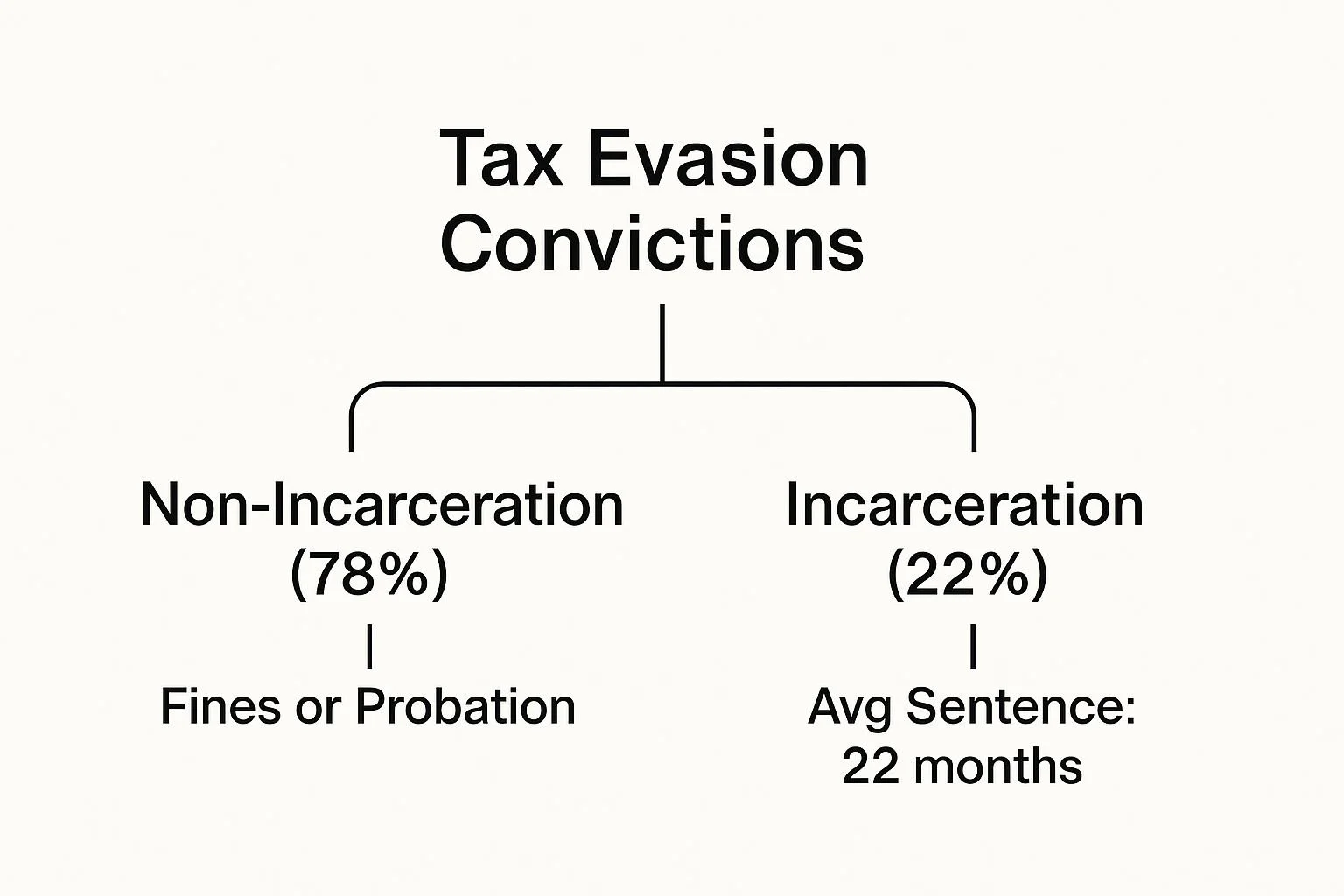
The numbers make it clear. While most convictions end with non-custodial sentences like fines or probation, a big chunk—over one in five—do lead to actual prison time.
Mitigating Factors That Can Reduce Your Sentence
On the other side of the scale are mitigating factors. These are circumstances that might persuade a judge to go with a more lenient sentence, like probation, home confinement, or just a shorter prison term. They don't make the crime disappear, but they provide important context that can work in your favor.
The most powerful mitigating factor is cooperation with the investigation. Voluntarily admitting what you did, providing truthful information, and helping investigators get the full picture can seriously reduce your sentence. It shows you're taking responsibility.
Other factors that can decrease the risk of jail time include:
Voluntary Disclosure: Coming forward to the IRS to fix your past mistakes before an investigation even starts is a huge sign of good faith.
Clean Criminal History: If this is your first time getting into trouble with the law, a judge is more likely to consider alternatives to prison.
Making Restitution: Paying back all the taxes you owe, plus all the penalties and interest, shows a real effort to make things right. It doesn't get you off the hook criminally, but it’s a critical step.
Minor Role in the Offense: If you were just a small fish in a big pond and were just following orders, your sentence may be much lighter than the organizers'.
The table below provides a quick side-by-side look at the factors that push a sentence up versus those that can bring it down.
Aggravating vs. Mitigating Factors in Tax Evasion Sentencing
| Factor | Increases Risk of Jail Time (Aggravating) | Decreases Risk of Jail Time (Mitigating) |
|---|---|---|
| Financial Impact | Very large tax loss (e.g., millions of dollars) | Full and prompt repayment of all taxes owed |
| Complexity | Use of offshore accounts, shell companies, or money laundering | Simple, non-sophisticated methods used |
| Behavior | Lying to investigators, destroying evidence (obstruction) | Full cooperation and truthful disclosure with the IRS |
| History | Long pattern of evasion over many years; prior criminal record | A one-time mistake; clean criminal history |
| Role in Scheme | Mastermind or organizer of the fraud | Minor or peripheral participant acting under direction |
Ultimately, a judge looks at the complete picture. The presence of multiple aggravating factors with few mitigating ones is a recipe for a prison sentence.
Around the world, tax evasion is treated as the serious financial crime it is. In the United States, sentences can be severe and are tailored to the specifics of the case.
For example, recent IRS Criminal Investigation reports show a Florida man getting a 100-month prison sentence for a case involving both wire fraud and tax evasion, while a precious metals depository owner was sentenced to 65 years for a massive fraud scheme that included tax evasion.
Real-World Examples of Tax Evasion Sentences
Legal definitions and sentencing charts are one thing, but where the rubber really meets the road is in the real world. To get a feel for how judges actually hand out sentences, it helps to look at the stories of people who made choices that landed them in a federal courtroom.
These cases aren't just abstract cautionary tales. They show how everything from sloppy bookkeeping to sophisticated offshore schemes can end in the same place: with devastating, life-altering consequences. Let's move beyond the theory and see what tax evasion looks like in practice.
The Small Business Owner Who Mixed Funds
This is a story I’ve seen play out time and time again. It often starts with a small business owner who gets a little too comfortable mixing business with pleasure—financially, that is.
Picture a local contractor. At first, they pay for a few personal things directly from the business account. Groceries, maybe a family dinner, a car payment.
It’s just easier, they tell themselves. But soon, convenience turns into a deliberate strategy. Those personal expenses start getting re-labeled as "business deductions" on the company's tax return to shrink the tax bill.
This isn't an honest mistake. It's fraud. And when the IRS comes knocking for an audit, that pattern is painfully easy to spot.
In these situations, it's not uncommon for the understated income to climb into the tens or even hundreds of thousands of dollars over several years. The sentence? It could be anything from probation to a few years in federal prison, all depending on how much tax was dodged and whether they cooperated with investigators.
The key takeaway here is simple: sloppy can become criminal, fast. The moment you knowingly sign a tax return with false information, you've crossed the line from a civil mistake into potential tax evasion.
If you're in a tough spot with the IRS, burying your head in the sand or trying to cheat the system is the worst possible move. It’s far better to explore legitimate options like the programs available for IRS debt forgiveness, which can provide a real way out without risking your freedom.
The Sophisticated International Scheme
On the other end of the spectrum, you have the high-flyers—the ones who think they can outsmart the government with complex, international schemes. These cases almost always involve wealthy individuals and the professional enablers who help them stash millions in offshore accounts and anonymous shell companies.
But what they fail to realize is that the IRS has a very long reach. A great example is the case of Frank Butselaar, a Dutch international tax advisor. He was sentenced in the U.S. to 30 months in prison for designing an offshore tax fraud scheme for his ultra-rich clients.
On top of the prison time, the court ordered him to pay nearly $15.5 million in restitution. You can read more about this case and the IRS’s international enforcement efforts on their official site.
This case is a powerful reminder that borders and complexity are not a shield. The U.S. has information-sharing agreements with countries all over the world, making it harder than ever to hide.
And the government prosecutes the advisors and facilitators just as aggressively as the tax cheats themselves. The penalties are severe, reflecting just how seriously they take these elaborate attempts to defraud the system.
What to Do If You Are Facing an IRS Investigation
The moment you receive a notice from the IRS Criminal Investigation (CI) division, your world can feel like it's grinding to a halt. This isn't just another audit letter—it's a clear signal that the government suspects you've willfully broken tax laws. How you act in these first few hours and days is absolutely critical and can shape the entire outcome of your case.
The absolute worst thing you can do is ignore it. This isn't a bill you can just set aside and hope it goes away. This is serious, and taking immediate, smart action is the only way to protect your rights and your future.
Your First Call Must Be to a Tax Attorney
Your initial gut reaction might be to phone your CPA, the person who's handled your books for years. That’s a natural instinct, but it’s also a dangerous mistake. While your accountant is a pro at tax prep, they are completely out of their depth in a criminal investigation. More importantly, your conversations with them are not protected by attorney-client privilege.
What does that mean? It means anything you say to your accountant can be used against you in court. An IRS special agent can put them on the stand and force them to testify about every detail of your conversations.
A qualified tax attorney, on the other hand, wraps your conversations in a powerful shield of confidentiality. Everything you discuss is legally protected. This allows you to lay all the cards on the table so your attorney can build the strongest defense possible.
When you're in the crosshairs of the IRS, expert legal counsel is non-negotiable. Understanding the professional landscape, including the digital SEO strategies used by law firms, can provide a broader context on how legal services are presented.
Understand Your Right to Remain Silent
When an IRS special agent shows up at your door or calls you on the phone, they aren't there to help you clear up a simple misunderstanding. Their one and only job is to gather evidence to build a criminal case against you. You have a right to remain silent—and you absolutely should use it.
Be polite but firm. Simply state that you will not answer any questions without your attorney present. Don't fall into the trap of trying to explain yourself, offer up records, or "just clear the air." Anything you say can and will be twisted to build a case that proves willful intent, which is the key ingredient that turns a tax problem into a prison sentence.
Let your attorney handle all communication with the IRS. They know the procedures, understand the legal language, and can act as a buffer between you and the investigators, ensuring your rights are protected at every step.
Gather Your Records and Consider Voluntary Disclosure
While you should never hand over any documents directly to an agent, you do need to start getting your financial house in order for your attorney. Start gathering everything: bank statements, business ledgers, receipts, and copies of past tax returns. Having all your records organized will help your legal team get up to speed fast.
In certain situations, if you get ahead of a formal criminal investigation, a Voluntary Disclosure might be a viable strategy. This is where you proactively go to the IRS to correct past mistakes and pay what you owe.
While it’s not a get-out-of-jail-free card, it can be an incredibly powerful way to avoid the most severe penalties, including jail time. For anyone with unfiled returns, learning how to file back taxes the right way is a crucial first step.
Your attorney is the only one who can properly assess if this strategic move is the right one for you.
Tax Evasion FAQs: The Tough Questions Answered
When you're dealing with the IRS, especially with something as serious as tax evasion, the questions can feel overwhelming. The stakes are incredibly high, and you need clear, straightforward answers from someone who's been in the trenches. Let's cut through the legal jargon and tackle some of the most common questions I hear.
How Long Does the IRS Have to Charge You with Tax Evasion?
People often wonder if they can just wait out the IRS. The government doesn't have forever to press criminal charges, and for tax evasion, the general statute of limitations is six years.
But when does that clock start? It typically begins on the date the fraudulent tax return was filed or when the last act of evasion happened—whichever is later.
It's not always a clean-cut deadline, though. Certain things, like living outside the U.S. for a long time, can pause that six-year timer. Timing is absolutely everything in these cases.
Can You Really Go to Jail for Not Filing Your Taxes?
The short answer is yes, you absolutely can. But it all comes down to one crucial word: intent.
The act itself is a misdemeanor known as "failure to file." But if the government can prove you didn't file on purpose as part of a scheme to hide income and dodge your tax bill, things get much more serious. That willful intent turns a misdemeanor into a felony tax evasion charge.
The real distinction is willfulness. Forgetting to file or filing but not being able to pay right away are usually civil matters. Deliberately refusing to file to avoid your legal tax obligation is a criminal act, and that’s what lands people in prison.
The IRS loves to make an example out of high-profile cases of failure to file. They want to send a loud and clear message that filing your taxes isn't optional; it's the law.
If I Pay Everything Back, Can I Still Go to Jail?
Paying back every penny you owe—the original tax, penalties, and interest—is a huge and necessary step. But here’s the hard truth: it does not give you a get-out-of-jail-free card.
Think about it this way: if someone gets caught shoplifting, returning the stolen goods doesn't magically erase the crime. The theft already happened. It’s the same with tax evasion. The crime was committed the moment you filed that fraudulent return or willfully decided not to file at all.
Making full restitution is a massive point in your favor. It’s a powerful mitigating factor that can significantly help reduce a potential sentence. But it doesn't slam the door shut on criminal prosecution or the possibility of jail time.
If you're staring down an IRS audit or a criminal investigation, you need an expert in your corner. At Attorney Stephen A Weisberg, I offer a FREE Tax Debt Analysis so you can understand exactly how I can help before you spend a dime.
➥ Contact Attorney Stephen A. Weisberg for a free Tax Debt Analysis.
Contact Me Here: https://www.weisberg.tax/contact-1
Email: s.weisberg@weisberg.tax
Phone/Text: (248) 971-0885
Address: 300 Galleria Officentre, Suite 402, Southfield, MI 48034
