Does the IRS Use Collection Agencies? Your Guide
Yes, the IRS does use private collection agencies, but not in the way you might think. This isn't their go-to method for collecting unpaid taxes. Instead, they turn to a handful of authorized private firms only for specific, older tax debts that their own agents are no longer actively working on.
It's a common misconception that a call from a private collector is the first you'll hear about an old tax bill. That's simply not the case. The IRS has a very clear, multi-step process, and you will always receive official written notices long before your phone ever rings.
How Does Private Debt Collection Work?
When the IRS's own collection efforts—like letters and automated calls—don't resolve a tax debt, certain accounts may get flagged for the Private Debt Collection (PDC) program. Congress established this program to give the IRS another tool for recovering overdue taxes, especially for accounts that might otherwise fall through the cracks due to a lack of agency resources.
This isn't a small-scale operation. Since the program kicked off in 2017, the IRS has assigned over 4 million taxpayer accounts to these private firms, representing a staggering $36.8 billion in potential tax debt. You can dig into the official Treasury Inspector General report on these findings for a deeper look.
The scale of the program is significant, but it's also highly controlled.
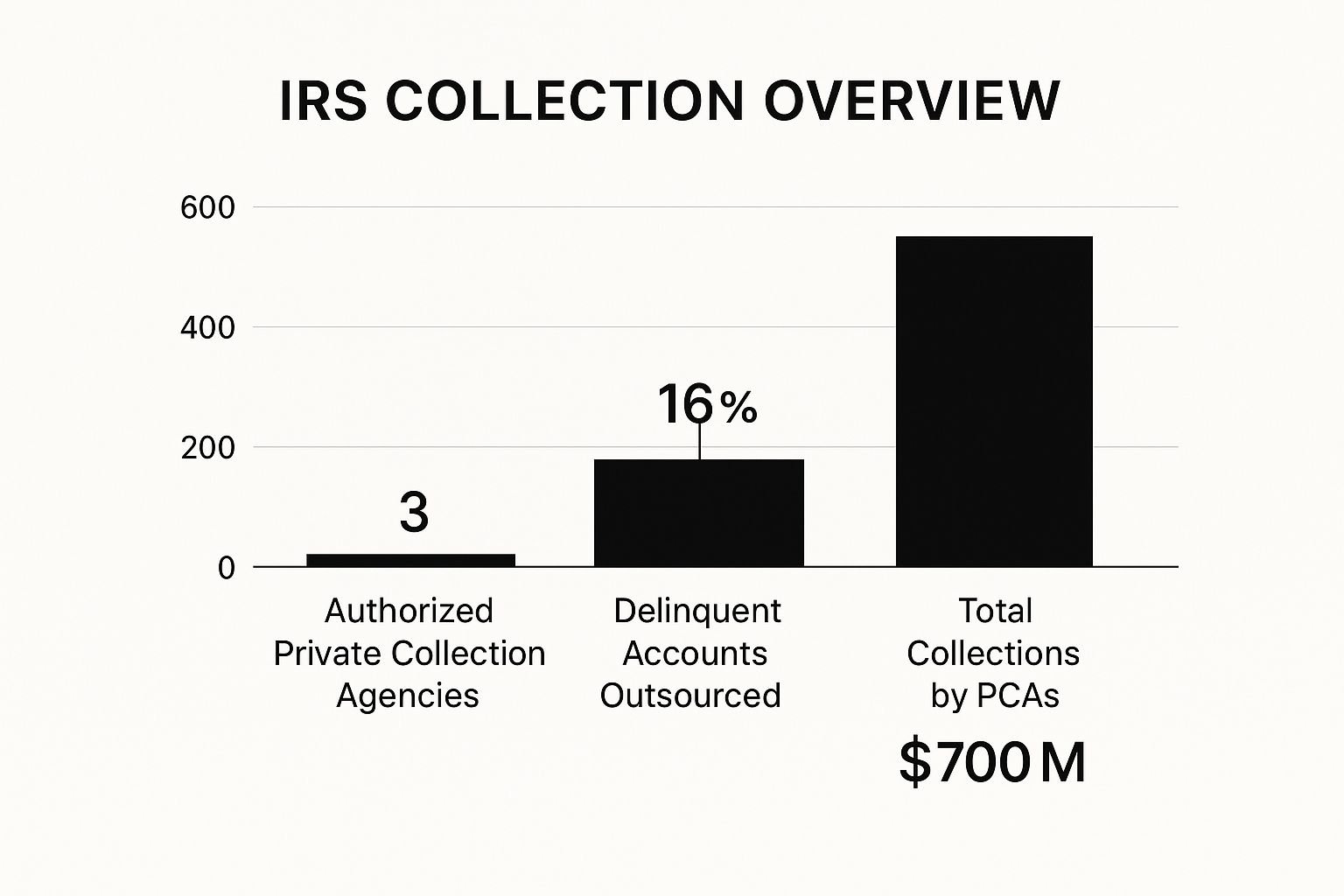
As you can see, even with billions on the line, the work is concentrated among just a few specialized agencies. This isn't a free-for-all where your information is passed around indiscriminately.
Key Takeaway: You will never get a surprise phone call from a private collector about a tax debt out of the blue. The process always, without exception, starts with official letters sent through the mail from both the IRS and the private agency itself.
Before any private collector is legally allowed to contact you, the IRS must first send you a formal notice letting you know your account is being transferred.
IRS Collectors vs Private Agencies At a Glance
It’s crucial to know who you're dealing with. The rules, powers, and processes are very different depending on whether you're speaking with an IRS employee or a contractor from a private agency. This table breaks down the main distinctions.
| Characteristic | IRS Direct Collection | Private Collection Agency (PCA) |
|---|---|---|
| Initial Contact | Official mail (notice or letter) | Official mail first, followed by phone calls. |
| Collection Powers | Can file liens, issue levies, and seize assets. | Cannot take enforcement action. No liens or levies. |
| Payment Method | Payments are made directly to the U.S. Treasury. | Payments are made directly to the U.S. Treasury, never to the agency. |
| Flexibility | Can set up various payment plans and offers in compromise. | Limited ability to discuss payment options; mainly guides taxpayers to IRS.gov. |
| Employee Type | Federal government employee (Revenue Officer). | Private company employee (contractor). |
Understanding these differences is your first line of defense. An IRS Revenue Officer has significant legal authority, while a private collector's power is limited to calling you and helping you find ways to pay the IRS directly.
How the Private Debt Collection Program Works
So, why would the IRS, a massive federal agency, hand over tax debts to private collectors? It's a fair question. The decision wasn't arbitrary; it stems from a congressional mandate and a practical need to manage resources.
Think of the main IRS collection division like a hospital's ER—it's built to handle the most critical, high-priority cases that need immediate intervention. But what about the less urgent accounts?
That’s where the Private Debt Collection (PDC) program comes in. It was created to address older, less active tax debts that the IRS simply doesn't have the staff to pursue directly. This ensures these overdue accounts don’t just fall through the cracks. They get transferred to a small, select group of private contractors who must follow strict federal rules.
Which Accounts Get Sent to Private Collectors?
Don't worry, not every overdue tax bill gets outsourced. The IRS has a very specific checklist, and an account only gets handed over if it meets certain conditions. It's a systematic filtering process, not a random lottery.
Your account might be assigned to a private agency if:
The IRS has stopped actively working on it, often due to its age.
There are more than two years left on the 10-year statute of limitations for collection.
You aren't currently in another resolution, like an installment agreement or an Offer in Compromise.
It’s also important to know what’s off-limits. The IRS will not send accounts to private collectors if they involve innocent spouse relief, pending litigation, or belong to minors or deceased taxpayers. The program is designed to focus only on straightforward, inactive debts.

Before you can figure out a payment plan, you need a realistic view of your financial picture from the IRS's perspective. A good starting point is to understand the IRS Collection Financial Standards, which are the guidelines the agency uses to determine what you can afford to pay.
At the end of the day, the PDC program is really a last-ditch effort to resolve debts that have already gone through the primary IRS channels. It’s a targeted, limited-scope program, not a complete privatization of tax collection.
How to Spot a Scam and Verify a Real Collector
With so many tax scams out there, it can be nerve-wracking to figure out if the person on the other end of the line is a real debt collector or a criminal. Thankfully, the IRS has some very clear rules that make spotting a fake a lot easier.
The single most important thing to remember is this: you will always receive official mail first. Long before a private agency is allowed to call you, the IRS is legally required to mail you a notice—specifically, a CP40 or CP140—letting you know your account is being assigned. Then, the private agency itself has to send you a separate welcome letter.
If you get a call out of the blue demanding money for the IRS, and you haven't received these two letters, that’s a massive red flag.
Know the Authorized Agencies
One of the easiest ways to protect yourself is to know exactly who the IRS works with. It’s not a long list.
The IRS only contracts with a handful of specific companies to handle these accounts. Anyone else who calls is an imposter.
This screenshot from the IRS website confirms the very short list of legitimate agencies.
Official IRS-Authorized Private Collection Agencies
Here are the only three private companies currently authorized by the IRS to collect tax debt. If you receive a call from a company not on this list, it is 100% a scam, and you should hang up immediately.
| Agency Name | Phone Number | Website |
|---|---|---|
| CBE (The CBE Group, Inc.) | 1-800-910-5837 | cbegroup.com |
| Coast (Coast Professional, Inc.) | 1-888-928-0510 | coastprofessional.com |
| ConServe (Continental Service Group, Inc.) | 1-844-853-4875 | conserve-arm.com |
Remember, this is the complete and total list. There are no other "approved" collectors.
A real private collector will never ask for payment to be made directly to them. They will always instruct you to pay the IRS online at IRS.gov or by a check payable to the "U.S. Treasury."
Any demand for payment using gift cards, wire transfers, or cryptocurrency is the hallmark of a scam. A legitimate agent will clearly identify themselves and their agency and will only guide you toward secure, official payment channels directly to the U.S. Treasury.
When in doubt, just hang up. You can always call the IRS directly to verify what's going on with your account.
Knowing Your Rights with Private Tax Collectors

When a private collection agency takes over your IRS account, it's easy to feel like you've been thrown into a whole new, intimidating world. But here’s the most important thing to remember: your fundamental taxpayer rights don't go anywhere.
These agencies are contractors for the government, not actual IRS agents. That means they have to play by a very strict set of rules designed to protect you.
The big one is the Fair Debt Collection Practices Act (FDCPA). This is a powerful federal law that puts a stop to any abusive, unfair, or deceptive tactics from debt collectors.
Under the FDCPA, these private agencies are legally forbidden from doing things like:
Calling you at all hours of the day and night (the cutoff is before 8 a.m. and after 9 p.m.).
Using profane or abusive language.
Lying about how much you owe or who they are.
Making empty threats about arrest or legal action they have no power to take.
Your Core Taxpayer Rights Are Unchanged
Beyond the FDCPA, all your standard IRS taxpayer rights still apply. The private agency's involvement doesn't take away any of your options or your right to due process. Think of the agency as a go-between, not the final authority.
You always have the right to deal directly with the IRS. If you're uncomfortable with the private agency or feel they're mishandling your case, you can simply tell them in writing to send your account back to the IRS.
This is a critical piece of leverage. You can still pursue all the same solutions you could before. The private collector is required to tell you about your options for setting up a payment plan, disputing the debt, or even applying for programs like an Offer in Compromise.
They must also give you clear information about your right to appeal, which includes details on the IRS Collection Due Process Hearing and the protections it offers. Just knowing your rights puts you back in control of the situation.
It's easy to get the wrong idea about the IRS using private collection agencies. When you hear about it, you might imagine a massive outsourcing of the government's tax collection duties. But that's not really what's happening.
To understand the real role of these agencies, it helps to see where they fit into the IRS's overall operation. Think of the main IRS collections division as a huge, bustling factory, handling the vast majority of cases and bringing in billions of dollars every year.
The private collection program, on the other hand, is more like a small, specialized repair shop off to the side, tasked with handling a very specific type of older, hard-to-collect account.
It's All About the Numbers
The scale of the two operations really tells the story. Since the current program started back in 2017, private collectors have brought in over a billion dollars. That sounds like a lot, and it is, but it's just a drop in the bucket compared to what the IRS handles directly.
In a single recent fiscal year, for instance, the IRS’s own collection efforts pulled in nearly $77.6 billion. That’s a 13.6% jump from the year before. Compare that one-year figure to what the private agencies have collected over their entire existence, and you start to see the difference. You can dig into all the details yourself in the IRS's Fiscal Year 2024 Data Book.
The key takeaway here is that private collection isn't a replacement for the IRS; it's a targeted tool for a small slice of old, inactive accounts that the main agency has already moved on from.
Why does this matter? Because knowing this helps dial down the anxiety. It clarifies that you're not dealing with the full force of the IRS, but a secondary program with very strict rules. The core of tax collection is, and remains, a job for the IRS itself.
Common Questions (and Straight Answers) About IRS Private Collectors
Even when you know the basics, getting a call from a private company about your IRS debt can be confusing. Let's clear up a few of the most common questions people have when they find themselves in this situation.
Can a Private Agency Actually Garnish My Wages or Seize My Property?
Let's be crystal clear on this: No, they absolutely cannot. This is the single most important thing to understand. A private collection agency has zero enforcement power.
Think of them as a call center, not law enforcement. They can’t file a federal tax lien against your property, issue a levy to drain your bank account, or take a chunk out of your paycheck. Their job is simply to call you and help you set up payments directly to the U.S. Treasury.
Any threat of seizure or garnishment from one of these agencies is an empty one. Not only that, it's illegal under the Fair Debt Collection Practices Act (FDCPA).
What if I Don't Think I Owe That Much?
Your rights as a taxpayer don't disappear just because your account was handed off. You can still dispute the tax debt. The private collector is just working with the numbers the IRS gave them; they have no power to change the amount you owe.
If the amount seems wrong, here's what you need to do:
Tell the private collector you are formally disputing the debt.
Reach out to the IRS directly to figure out the discrepancy.
You may want to get professional help to file an appeal or provide evidence to get the record corrected.
Once you officially dispute the debt with the IRS, the private agency has to back off. They can't keep trying to collect while the debt is under review.
Do These Private Collection Agencies Even Work?
It's a fair question. While these agencies do bring in some money, their results are pretty modest, especially when you compare them to what the IRS accomplishes on its own. Their main job is to chase down older, lower-priority debts that the IRS doesn't have the staff to pursue.
A report from the Taxpayer Advocate Service put it in perspective. By September 2018, these private agencies had recovered $80.7 million from the $5.7 billion in debts assigned to them. That’s a recovery rate of just 1.4%. During that same time, the IRS's own collection efforts had a success rate of 7.33%.
This shows that while the program exists, the IRS is still far more effective at its own job. Knowing this helps you see that a call from a private collector isn't the same as a call from an IRS Revenue Officer.
Feeling overwhelmed by a notice from the IRS or a private collector? You don't have to face it alone. At Attorney Stephen A Weisberg, I start with a FREE Tax Debt Analysis to determine the best path forward before you ever pay a fee. Contact me today to find a clear solution to your tax problems.
Yes, the IRS does use private collection agencies, but not in the way you might think. This isn't their go-to method for collecting unpaid taxes. Instead, they turn to a handful of authorized private firms only for specific, older tax debts that their own agents are no longer actively working on.
Want to understand your options before you call anyone?
Download my free book — Freedom From Tax Debt — a plain-language guide to how the IRS collections process actually works and what resolution really looks like.
➥ Contact Attorney Stephen A. Weisberg for a free Tax Debt Analysis.
Contact Me Here: https://www.weisberg.tax/contact-1
Email: s.weisberg@weisberg.tax
Phone/Text: (248) 971-0885
Address: 300 Galleria Officentre, Suite 402, Southfield, MI 48034
