How Long Does an IRS Audit Take? Find Out Now
Getting that notice from the IRS is enough to make anyone's heart skip a beat. The first question that always pops into your head is, "How long is this going to take?"
There's no single, simple answer, but we can break it down. A straightforward mail audit, where they just need a document or two, might be wrapped up in as little as three to six months. But if you're looking at a complex, in-person field audit for a business, you could easily be in it for a year or even longer.
Your Quick Guide to IRS Audit Timelines
The time an IRS audit takes really boils down to two things: the type of audit and how complex your tax situation is. Think of it like a vehicle inspection. Checking the tire pressure on a car is quick and easy. A full, bumper-to-bumper diagnostic on a commercial truck? That's a whole different story. The IRS approaches different tax returns with that same logic.
There are three main flavors of IRS audits, and each comes with its own general timeline.
Three Types of Audits
Correspondence Audits (By Mail): These are the most common and, thankfully, the fastest. Everything is handled through the mail. They're usually triggered by a specific, narrow issue—maybe a missing 1099 form or a simple math error on a deduction.
Office Audits (At an IRS Office): This one requires a trip to a local IRS office. It's a step up in seriousness from a mail audit. You'll sit down with an agent to go over your documents in person, which naturally means the process takes more time, often several months.
Field Audits (At Your Location): This is the most comprehensive—and longest—type of audit. An IRS agent comes to your home, office, or your accountant's office for a deep dive into your financial records. These can easily stretch out for a year or more.
To give you a clearer picture, here’s how the timelines generally stack up for each audit type.
Estimated Timelines for Different IRS Audits
This table outlines the typical duration you can expect for the three main types of IRS audits, from the first notice to the final resolution.
| Audit Type | Average Duration | Common Issues |
|---|---|---|
| Correspondence Audit | 3-6 months | Missing documents, unreported income, simple deduction errors |
| Office Audit | 6-12 months | Small business expenses, rental income, itemized deductions |
| Field Audit | 12+ months | Complex business financials, high net worth returns, tax shelters |
As you can see, the more complex the audit, the longer you can expect it to take. Field audits require extensive investigation, which is why their timelines are so much longer.
Learning the truth about IRS audits can take a lot of the fear out of the process. When you know what to expect and how to prepare, you're in a much better position to control the timeline, not just react to it.
Ultimately, how you handle the audit makes a huge difference. Being organized and responsive is your best strategy. If your records are in order and you answer the IRS's questions promptly, you can keep the process from dragging on unnecessarily.
Mapping the Three Stages of an IRS Audit
An IRS audit isn't a single, sudden event. It's a process that unfolds over three distinct stages, and knowing what to expect in each one can take a lot of the mystery—and stress—out of the experience. Think of it as a roadmap; understanding the journey helps you navigate it more effectively.
Stage 1: Notification and Preparation
It all starts with a letter. The audit officially kicks off the moment you receive that formal notice from the IRS in your mailbox. Your first job is to read it carefully to understand exactly what they're asking for and for which tax year. This is your cue to start gathering all the relevant financial records, receipts, and documentation.
Stage 2: The Examination
This is the heart of the audit. An IRS agent will dig into the documents you've provided, and this is where the real back-and-forth begins. They might have follow-up questions or need more information, which can be handled through mail, over the phone, or even in a face-to-face meeting, depending on how complex your situation is.
This infographic breaks down what those initial steps often look like.
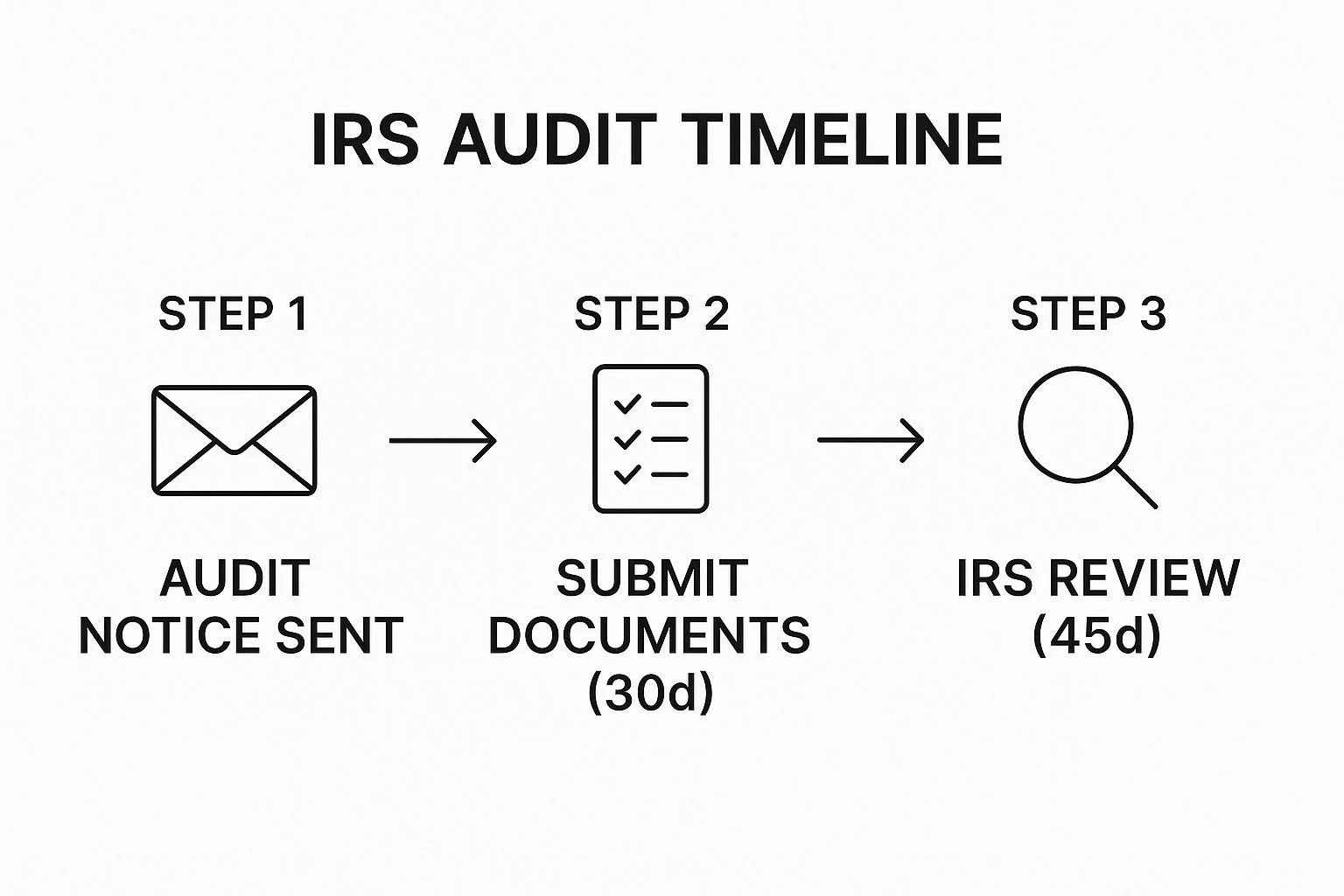
As you can see, just getting through the initial information exchange can take months before the examiner even finalizes their review.
Stage 3: Resolution and Closing
Once the agent has finished their review, you move into the final phase: Resolution and Closing. The IRS will share its findings with you, and at this point, you have two paths forward.
Agreement: If you accept the findings, you'll sign the required forms and settle any additional tax, penalties, and interest that you owe.
Disagreement: If you don't agree with the outcome, you have the right to appeal. Just know that choosing this path will definitely add more time to the overall process.
The audit officially concludes when you receive a closing letter from the IRS. How you handle each step along the way directly impacts how long the entire ordeal lasts.
Being prompt, prepared, and organized is the best strategy you have for controlling the timeline. The first notice really sets the stage, so knowing exactly how to respond to an IRS audit letter is critical to avoiding delays and moving things along as smoothly as possible.
How Long Does the IRS Have to Audit You?

Contrary to popular belief, the IRS doesn't have an infinite amount of time to come knocking on your door about an old tax return. They're working against a deadline, just like the rest of us. This deadline is called the statute of limitations.
Think of it as the government's official countdown clock. For most people, that clock is set to three years from the date you file your return. So, if you filed your 2023 taxes right on schedule on April 15, 2024, the IRS generally has until April 15, 2027, to initiate an audit. Once that date passes, you're usually in the clear for that tax year.
What Can Extend the Audit Timeline?
Now, this three-year rule isn't set in stone. Certain red flags on a tax return can give the IRS a lot more time to dig into your finances. It’s absolutely critical to understand what triggers these extensions.
Here are the main situations that can stretch out the audit window:
Significant Income Understatement: If you leave off more than 25% of your gross income, the IRS gets double the time. The statute of limitations extends from three years to a full six years.
Failing to File: This is a big one. If you don't file a tax return at all for a given year, the clock never even starts. The IRS can come after you for that unfiled return at any point in the future—there's no time limit.
Tax Fraud: When the IRS suspects you've filed a fraudulent return, all bets are off. There is no statute of limitations on fraud. The audit window stays open indefinitely.
The best way to protect yourself is with good habits. That old advice about keeping your tax records for seven years? It's not just a random number. It's a smart practice that ensures you're covered even if the IRS applies the extended six-year statute of limitations.
These rules really highlight the importance of filing an accurate and timely return every single year.
Key Factors That Can Speed Up or Slow Down Your Audit

Have you ever wondered why one person’s IRS audit is over in a few months, while another’s seems to drag on for years? It’s not just luck of the draw. Several specific factors determine how long you'll be under the microscope.
Think of it this way: fixing a simple leaky faucet is a quick afternoon job, but overhauling an entire home's plumbing system is a massive project. IRS audits work the same way. The single biggest variable dictating the timeline is the complexity of your tax return.
An audit for a standard W-2 employee with basic deductions is a sprint. But an audit for a business juggling international sales, intricate expense accounts, and various income sources? That's a marathon.
The type of audit also plays a huge role. A mail audit, or correspondence audit, is typically the fastest and can often be wrapped up in under six months. On the other end of the spectrum is the field audit, where an agent comes to your home or business. This is the most in-depth and almost always takes a year or more.
How You Can Influence the Audit’s Pace
You can’t change how complex your tax return is, but you absolutely have control over how smoothly the audit process goes. Your cooperation and organization are the two most critical elements you bring to the table.
Handing the IRS a complete, well-organized set of records is like giving them a clear roadmap. They can find what they need, verify it, and close the case.
Your preparedness is the most powerful tool you have. A shoebox full of crumpled receipts guarantees delays, while a neatly organized digital folder with every requested document can dramatically shorten the examination phase.
On the flip side, messy or incomplete records will slam the brakes on the entire process. Every time the auditor has to stop and request a missing document or ask you to clarify a jumbled report, the clock effectively stops ticking.
These back-and-forths can easily add weeks, or even months, to the audit, making a proactive and organized approach your best bet for a faster resolution.
How Internal IRS Pressures Affect Your Timeline
The timeline for an IRS audit isn't just about the details of your tax return. It’s also a story about what’s happening inside the IRS itself. Imagine a busy restaurant kitchen that suddenly has half its chefs. The food will still come out, but it's going to take a lot longer. That's essentially what's happening with audits.
Decades of budget cuts and a shrinking workforce mean there are simply fewer agents to work on cases. This creates a serious bottleneck. Each agent is juggling a much heavier caseload, which naturally stretches out how long every single audit takes.
The IRS's own resource problems are one of the biggest, and most overlooked, factors in your audit's timeline. A smaller team forces the agency to be highly selective, which often means a longer, more frustrating wait for anyone already caught in the system.
Strategic Focus on High-Risk Audits
With fewer people on the job, the IRS has to be smart about where it puts its energy. It's now laser-focused on what it considers high-risk audits.
This means pouring resources into complex examinations of:
High-income earners
Large corporations
Complex partnerships
Emerging issues like cryptocurrency
Fewer people are getting audited overall, but if you're in one of these high-risk groups, you can expect a much deeper and longer investigation.
The pace of your audit is directly tied to these big-picture operational challenges. It’s not just about tax law; it’s about resource management. The staffing shortage forces the IRS to prioritize just getting tax returns processed, leaving audits to move at a snail's pace.
To really grasp why these delays are so common, it helps to understand the actual costs of reduced funding for the IRS. It provides some much-needed context for the long waits taxpayers often face.
Why High-Income Earners Face Longer Audits
When you're dealing with the IRS, the size of your income doesn't just raise your audit risk—it also stretches the potential timeline. It's a simple matter of resource allocation for the agency.
The IRS knows that the most complex financial situations, and therefore the biggest potential for recovering unpaid taxes, lie with the wealthiest filers.
So, if you fall into that high-income bracket, don't expect a quick in-and-out experience. These audits aren't just a glance at your W-2.
They are deep, meticulous examinations of everything from sophisticated investments and business write-offs to foreign bank accounts. This level of detail inherently means the process will take a lot longer, often stretching from months into a multi-year affair.
More Money, More Problems (and More Scrutiny)
The statistics paint a pretty clear picture. The higher your income, the more likely you are to find yourself under the IRS microscope, and the more intense that examination will be.
For instance, taxpayers earning over $10 million saw an audit rate of 11% back in 2019, and that figure is projected to climb to around 16.5% by 2025.
That’s a world away from the audit rates for the average taxpayer. Because of the sheer complexity involved, these high-stakes audits can easily last a year or more as agents sift through mountains of financial data.
If you're curious about the numbers, you can find a detailed breakdown of audit rates for different income levels to see how the odds stack up.
Common Questions About IRS Audit Timelines

Going through an audit is nerve-wracking, and a lot of that anxiety comes from the unknown. Let's clear up a few of the most frequent questions people have about how long this whole process actually takes.
Can I Do Anything to Speed Up My IRS Audit?
Yes, you absolutely can influence the pace. Think of it this way: the easier you make it for the auditor to do their job, the faster they can close your case.
Being organized and responsive is your best strategy. When the IRS asks for documents, get them over promptly and make sure they're in order. Answer their questions directly, but stick to the script—don't volunteer extra information that wasn't asked for, as it could just open up a new can of worms.
For anything more than a simple mail audit, bringing in a tax professional can make a world of difference. They speak the IRS's language and know the procedures inside and out, which helps keep things moving forward.
Does the IRS Have to Finish an Audit by a Certain Date?
This is a big one. While the IRS has a deadline to start an audit—that’s the statute of limitations—there's no official deadline to finish one.
That doesn't mean it's a blank check for an endless process. The IRS wants to close cases efficiently, too. If things feel like they're dragging on without a clear reason, you or your representative can always reach out and ask for an update. But at the end of the day, there's no fixed end date they're racing against.
After the auditor finishes their review, they'll issue a report with their findings. If you agree, you sign off, pay what you owe, and it's over. If you disagree, you can appeal. Just know that choosing to appeal will add several more months to the timeline.
If you're facing an IRS audit, you don't have to go it alone. At Attorney Stephen A Weisberg, I start with a FREE Tax Debt Analysis to see exactly how I can help before you ever pay a fee. Get expert representation by visiting weisberg.tax today.
There's no single, simple answer, but we can break it down. A straightforward mail audit, where they just need a document or two, might be wrapped up in as little as three to six months. But if you're looking at a complex, in-person field audit for a business, you could easily be in it for a year or even longer.
Want to understand your options before you call anyone?
Download my free book — Freedom From Tax Debt — a plain-language guide to how the IRS collections process actually works and what resolution really looks like.
➥ Contact Attorney Stephen A. Weisberg for a free Tax Debt Analysis.
Contact Me Here: https://www.weisberg.tax/contact-1
Email: s.weisberg@weisberg.tax
Phone/Text: (248) 971-0885
Address: 300 Galleria Officentre, Suite 402, Southfield, MI 48034
