Guide to Filing Past Due Tax Returns Easily & Quickly
Let's be honest—it’s tempting to shove that stack of unfiled tax returns in a drawer and forget about them. But while they're out of sight, the financial clock is ticking, and the consequences can escalate faster than you might think. The IRS has a long memory, and their system of penalties and interest is designed to get your attention.
Understanding exactly what those costs are is the first, most crucial step to stopping that clock and getting back in control.
The Real Cost of Unfiled Tax Returns

It’s easy to rationalize delaying your tax filing as a problem for another day. The reality is, the moment that deadline passes, the IRS machinery starts assessing penalties that are designed to grow. Two main penalties work in tandem, creating a powerful one-two punch.
The first, and more severe, is the failure-to-file penalty. The government prioritizes getting your tax information above all else, and this penalty reflects that. It's steep, and it's meant to motivate you to file, even if you can't pay.
Then you have the failure-to-pay penalty. While smaller on a monthly basis, it chips away at your finances for as long as a balance is due. If both penalties apply in the same month, the IRS gives a slight break by reducing the failure-to-file portion, but your debt still grows uncomfortably fast.
How Penalties and Interest Compound
The real trap isn't just the flat percentage penalties; it's the compounding interest. The IRS charges interest on the original tax you owe and on the penalties that have been added. This is how a manageable tax bill can spiral into something far more intimidating.
Let's say you owe $5,000 in taxes from a few years back. For the first couple of months, the penalties might not seem catastrophic. But as the months turn into years, with interest piling on top of the penalties, that $5,000 can easily swell to $8,000 or more.
Key Takeaway: The IRS hits you with a failure-to-file penalty of 5% of the unpaid taxes for each month a return is late, maxing out at 25%. The failure-to-pay penalty adds another 0.5% per month. And then, interest accrues on top of it all.
This toxic combination is what turns a minor tax headache into a major financial crisis.
To help visualize this, here's a quick breakdown of how these charges stack up.
IRS Penalty and Interest Rates at a Glance
This table summarizes the primary penalties and interest that apply to late tax filings and payments.
| Penalty Type | Rate per Month | Maximum Penalty | Notes |
|---|---|---|---|
| Failure-to-File | 5% of unpaid tax | 25% of unpaid tax | Applied for each month or part of a month the return is late. This is the more severe penalty. |
| Failure-to-Pay | 0.5% of unpaid tax | 25% of unpaid tax | Applied for each month or part of a month the tax remains unpaid. |
| Interest on Underpayment | Varies (e.g., 8% annually recently) | No Maximum | Rate can change quarterly. It's calculated on the tax owed plus any accrued penalties. |
As you can see, the costs are layered, which is why it's so important to stop the bleeding as soon as possible.
Beyond the Direct Financial Costs
The damage doesn't stop with your IRS balance. An outstanding tax debt can ripple through your entire financial life. Once the IRS files a Notice of Federal Tax Lien, it becomes public record. Creditors see it, and it's a huge red flag.
This can absolutely tank your credit score, making it next to impossible to get a mortgage, a car loan, or even a basic credit card. A lien signals to lenders that you're a high-risk borrower. Understanding the potential reasons your credit score might drop is key, and an IRS lien is one of the big ones.
Ultimately, tackling your unfiled returns isn't just about paying the IRS what you owe. It’s about protecting your ability to achieve your long-term financial goals.
How to Find Your Past Year Tax Documents
Let's be honest, the biggest reason people don't file old tax returns is the paperwork. Life happens. W-2s get tossed, 1099s disappear, and bank records from three years ago feel like ancient history. If your shoebox of receipts is long gone, don't panic. You're not stuck. The secret is knowing where to get the official records the government already has on file for you.
Your first and best move is to go straight to the source: the IRS. They have a fantastic—and free—tool called "Get Transcript" that can be a total game-changer. This system gives you an official summary of all the income and tax information someone reported to the IRS under your Social Security Number for a given year.
Using the IRS Get Transcript Tool
Think of this online portal as your personal tax archive. It’s hands-down the best way to piece together your past income. While you can pull a few different types of transcripts, the one you really need is the Wage and Income Transcript. This document is gold—it lists all the data from your W-2s and 1099s that you need to fill out your old returns correctly.
When you land on the IRS Get Transcript site, this is the page you'll see.
This is your starting point for getting tax records directly from the IRS, which saves you the massive headache of chasing down old employers who might not even be in business anymore.
Once you create an account and verify your identity (it’s a secure process for obvious reasons), you can immediately access and download transcripts for the last 10 years. These documents show the exact income figures the IRS is expecting to see on your return.
Remember, the IRS processed over 266 million returns in fiscal year 2024 alone. Making sure your numbers match their records is the single best way to avoid having your return flagged for review. You can get a sense of their processing scale from their oversight reports.
Gathering Other Essential Records
IRS transcripts are fantastic for income, but they don't tell the whole story. They won't show you the deductions and credits you might be entitled to. For that, you’ll have to do a bit of digging into your own financial history. The good news is that most banks hold onto records for at least five to seven years, even for closed accounts.
You can often find what you need by reviewing the easy ways to get your bank statement online, which will show all your old transaction details.
Here’s a quick list of other records to hunt down:
Bank and Credit Card Statements: These are your best bet for finding deductible business expenses, charitable donations, or significant medical costs.
Mortgage Interest Statements (Form 1098): If you were a homeowner, this form shows every dollar of deductible mortgage interest you paid.
Student Loan Interest (Form 1098-E): Details the student loan interest you paid, which is often a valuable deduction.
Records of Estimated Tax Payments: If you were self-employed and made quarterly payments, you absolutely need the dates and amounts.
It can feel like a scavenger hunt, but every document you find could lower your tax bill or increase your refund.
Pro Tip: Whatever you do, don't just grab a current year's tax form to file an old return. Tax laws, brackets, and even the forms themselves change every single year. You must find the correct form for the specific year you're filing. A quick search on the IRS website for "Form 1040 for 2018" will get you what you need. Using the wrong year's form is a surefire way to get your return rejected.
Completing and Mailing Your Late Returns

Alright, you've gathered all your documents. Now comes the most critical part of the process: actually preparing and filing those old tax returns. This is where meticulous attention to detail really pays off.
One thing to know right away is that you can't just e-file these past-due returns like you would for the current year. We have to go old-school with paper filing, and a few simple missteps can cause major headaches and delays.
First and foremost, you have to use the correct tax forms for the specific year you're filing. Tax laws, deductions, and credits change all the time. If you try to use a 2023 Form 1040 for a 2019 tax year, the IRS will reject it outright. The best place to find what you need is the IRS website; just search their archive for "Prior Year Forms and Instructions" to get the exact PDFs for each year.
Assembling and Finalizing Each Return
Once you've downloaded the right forms, it’s time to carefully transcribe all the information from your W-2s, 1099s, and other financial records. Take your time and double-check everything—especially Social Security numbers and your own math. You’d be surprised how often simple calculation errors can get a paper return flagged.
Before you do anything else, you must physically sign and date your return using a pen. It sounds basic, but a missing signature is one of the most common reasons for rejection, which means you have to start the whole mailing process over.
After it's signed, make a complete copy of every single page—the main form and any attached schedules—for your personal records. Don't skip this step.
Critical Tip: If you owe taxes for that year, include a check or money order made out to the "U.S. Treasury." Never send cash. In the memo line of your check, write the tax year, the form number (e.g., "2019 Form 1040"), and your Social Security number. This ensures your payment gets applied to the right account and tax period.
Mailing Your Returns Correctly
This is another step where people frequently make mistakes. The mailing address for a prior-year return is often different from the one used for current filings. The right address depends on the state you lived in for that tax year and whether or not you’re including a payment.
Don't just guess or use a generic IRS address you found online. You need to look up the exact mailing address in the official instructions for that specific year's Form 1040. It will be listed there.
To make sure your returns are processed without a hitch, follow these two non-negotiable rules:
One Return Per Envelope: Mail each tax year's return in its own, separate envelope. If you bundle multiple years of returns into one big package, you're asking for trouble. It creates a huge risk that one of them will get misplaced or unprocessed at the IRS mail facility.
Use Certified Mail: Send each envelope using USPS Certified Mail with a return receipt requested. This service costs a few extra dollars, but it provides you with legal proof that the IRS received your filing and on what date. Think of it as an insurance policy—it’s your definitive paper trail.
Taking these precautions ensures all your hard work doesn't vanish into a bureaucratic black hole. It provides you with a clear record that you've met your obligations, giving you much-needed peace of mind as you get back into good standing.
What To Do When You Can’t Pay the IRS
You’ve ripped off the band-aid and filed those old tax returns. Great job. But now you’re staring at a tax bill that makes your stomach drop. Don’t panic. This is a common situation, and the IRS has surprisingly flexible ways to handle it.
The reality is, the IRS would much rather work out a plan with you than chase you down. Their goal is compliance, not punishment. So, if you can’t write a check for the full amount, it’s time to look at your options.
Set Up a Payment Plan (Installment Agreement)
The most common and straightforward path is an IRS Installment Agreement. It’s exactly what it sounds like: a payment plan. You agree to pay a set amount each month until the debt is cleared.
If your total bill—including taxes, penalties, and interest—is under $50,000, you can usually set this up online in minutes. No need to spend hours on the phone. This is a great solution for anyone with a reliable income who just needs some breathing room to get caught up. Getting into a payment plan officially stops the scary collection notices.
This handy graphic breaks down the two big penalties you’re likely facing. It really highlights why filing—even when you know you can't pay—is always the right first step.
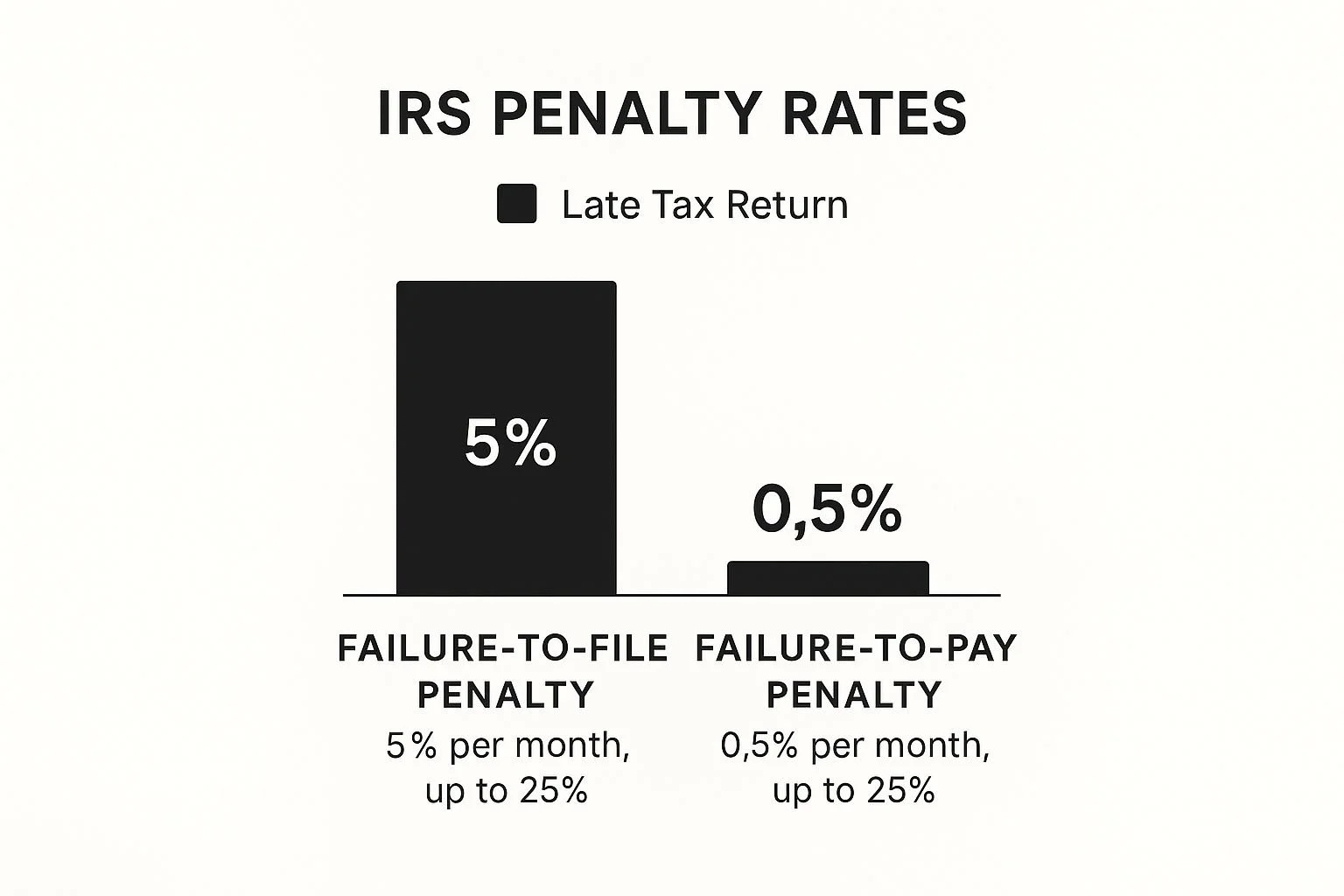
See that? The failure-to-file penalty is a whopping ten times worse than the failure-to-pay penalty. The IRS is serious about getting that paperwork.
Ask the IRS to Waive Penalties (Penalty Abatement)
Take a close look at your bill. How much of it is actually penalties? Sometimes, you can get the IRS to remove them through a process called penalty abatement. The easiest way to do this is with their First-Time Abate (FTA) program.
You might be eligible for FTA if you check these boxes:
You have a clean record for the past three years (no filing requirement or no penalties).
You’ve filed all your required returns now.
You’ve paid the original tax due or have a plan in place to pay it.
Getting a First-Time Abatement can be a game-changer. I’ve seen it erase thousands of dollars in penalties, completely changing a client's financial picture. It's the first thing I look for when helping someone with back taxes.
If you don't qualify for FTA, you can still request abatement based on "reasonable cause." This applies if you went through a major life event like a serious illness, a death in the immediate family, or a natural disaster that kept you from managing your taxes properly.
Negotiate a Lower Bill (Offer in Compromise)
For those in a truly dire financial situation, there’s the Offer in Compromise (OIC). This is a formal program where you can ask the IRS to settle your tax debt for less than the full amount you owe.
Be warned, this is not a simple negotiation. The OIC application is intense. The IRS will put your entire financial life under a microscope—your income, assets, expenses, everything. They only grant an OIC when they’re convinced they can't collect the full debt. It’s a high bar to clear, but for those who qualify, it’s a path to a genuine fresh start.
Comparing IRS Payment and Relief Options
Navigating these programs can feel overwhelming. Each one is designed for a different financial scenario, so it’s important to understand which one fits your situation best.
| Option | Best For | Key Requirement | Complexity |
|---|---|---|---|
| Installment Agreement | People with steady income who need to spread payments over time. | Ability to make consistent monthly payments. | Low |
| First-Time Abatement | Taxpayers with a previously clean compliance history. | Clean tax record for the prior three years. | Low to Medium |
| Reasonable Cause | Those who faced a significant, unavoidable life event. | Documented proof of the hardship. | Medium |
| Offer in Compromise | Individuals with severe, long-term financial hardship. | Proof that you cannot pay the full amount now or in the future. | High |
Ultimately, whether you choose a simple payment plan or pursue a more complex option like an OIC, the most important thing is to take action. Ignoring the problem will only make it more expensive and stressful down the road.
When You Should Call a Tax Professional

Sometimes, you can tackle a single, simple past-due return on your own. But there are definite moments when going the DIY route can cost you way more than a professional's fee. Knowing when to wave the white flag is a huge part of getting back on track.
The most obvious red flag is complexity. Are you staring down a pile of unfiled returns from multiple years? It gets messy fast, especially if you've got business income, self-employment, or rental properties in the mix. Tax laws and forms change from year to year, and a mistake on one return can easily create a domino effect.
Then there’s the money. A small tax bill is one thing, but if you’re looking at a five-figure debt that’s been growing for years, the stakes are so much higher. An expert can look at the big picture and map out the most cost-effective path, potentially saving you thousands in penalties alone.
Signs You Need an Expert
Getting serious mail from the IRS is a massive sign. If a notice mentioning a tax lien, wage garnishment, or a bank levy lands in your mailbox, you're officially past the point of handling it yourself. These are aggressive collection actions, and you need a pro who can step in, talk to the IRS for you, and protect your assets.
If you get an IRS notice that mentions a "Revenue Officer," it's time to call for help immediately. This means your case has been assigned to a specific agent whose job is to collect what you owe. You need someone in your corner who knows exactly how to handle that conversation.
Unfiled business returns, particularly anything involving payroll taxes like Form 941, are another beast entirely. The penalties here are severe, and this is absolutely not an area where you want to be guessing.
Choosing the Right Kind of Help
Not all tax help is created equal. You need the right kind of expert for your specific problem.
Enrolled Agent (EA): These folks are licensed directly by the IRS and live and breathe tax. For representation, complex return preparation, and negotiating payment plans, an EA is often a fantastic and cost-effective choice.
Certified Public Accountant (CPA): While many CPAs handle routine accounting, those who specialize in "tax controversy" are invaluable for complex filings and IRS representation.
Tax Attorney: If you're worried about potential criminal charges (like tax evasion) or your case might end up in Tax Court, you need a tax attorney. They provide attorney-client privilege, a level of legal protection that EAs and CPAs can't offer.
Calling in a professional isn't admitting defeat. It's a smart, strategic move to get an expert on your side, ensuring you get the best possible outcome with the least amount of pain.
Common Questions About Filing Late Taxes
When you're staring at a pile of unfiled tax returns, a lot of questions and worries can start swirling around. It's a stressful spot to be in, but you're not alone. Let's tackle some of the most common concerns I hear from people who are ready to get back on track.
Is There a Deadline for Claiming an Old Tax Refund?
Yes, and this one is critical. The IRS gives you a strict three-year window from the original tax deadline to file a past-due return and claim a refund. This is officially called the Refund Statute Expiration Date.
If you let that three-year period pass, the money is gone for good—it officially becomes property of the U.S. Treasury. Think about it this way: your 2020 tax return was due in April 2021. That means you had until April 2024 to file and get your money back. Time is literally money here, and you don't want to leave yours on the table.
Heads Up: This three-year rule is only for getting your money back. When it comes to the IRS collecting what you owe, there's generally no time limit if you never filed a return in the first place.
What Happens If I Never File My Old Tax Returns?
Ignoring unfiled taxes is a strategy that always backfires. Eventually, the IRS will take matters into its own hands and file what's called a Substitute for Return (SFR) on your behalf.
An SFR is the worst-case scenario for any taxpayer. The IRS prepares it using only the income data they have from W-2s and 1099s, but they give you zero deductions or credits. No dependents, no business expenses, nothing. This almost always results in a much higher tax bill than you actually owe.
Once that happens, the IRS can start aggressive collection actions. This could mean garnishing your wages, putting a levy on your bank account, or slapping a federal tax lien on your property. While it's not common, willful failure to file can even lead to criminal charges. It's always, always better to file voluntarily and control the outcome.
Can I E-File a Past Due Tax Return?
For most older returns, the answer is no. IRS e-filing systems are generally set up for the current tax year and, through a professional's software, maybe the two previous years.
For returns older than that, you'll have to go the old-school route: print and mail. You'll need to find the specific forms and instructions for each year on the IRS website, as they change over time. Fill them out carefully, sign them, and mail them in.
Here’s a pro tip from experience: Mail each tax year in a separate envelope. Sending them all together can create massive confusion during processing at the IRS and delay things significantly.
Why Does Filing Old Returns Matter So Much?
This is about more than just dodging penalties and interest. Getting current with your taxes is fundamental to your overall financial health.
Filing your returns unlocks access to things you might not have even considered:
Protecting Social Security Benefits: If you're self-employed, your filed tax returns are how you get credit for your earnings. No return means no credit toward your future Social Security retirement or disability benefits.
Securing Loans: Trying to buy a house or get a small business loan? Lenders will almost certainly ask for your last few years of filed tax returns. No returns often means no loan.
Peace of Mind: Honestly, this might be the biggest one. Getting caught up finally lifts that constant weight and worry off your shoulders.
Putting off taxes is more common than you think. In fact, one report showed 7.7% fewer returns were filed by early February 2025 compared to the same time the previous year. You can discover more tax season statistics that show just how many people get behind.
Feeling overwhelmed by your tax situation? At Attorney Stephen A Weisberg, I start with a FREE Tax Debt Analysis to find out exactly how I can help before you ever pay a fee. Don't face the IRS alone. Let's find the best path forward for you.
Want to understand your options before you call anyone?
Download my free book — Freedom From Tax Debt — a plain-language guide to how the IRS collections process actually works and what resolution really looks like.
➥ Contact Attorney Stephen A. Weisberg for a free Tax Debt Analysis.
Contact Me Here: https://www.weisberg.tax/contact-1
Email: s.weisberg@weisberg.tax
Phone/Text: (248) 971-0885
Address: 300 Galleria Officentre, Suite 402, Southfield, MI 48034
