Your Guide to First Time Abatement of Penalty
Getting a notice from the IRS is never a welcome sight, but if you have a good track record as a taxpayer, you have a powerful ace up your sleeve. It’s called the First Time Abatement (FTA), and it’s an administrative waiver the IRS offers as a sort of one-time pass for common penalties. Think of it as the agency’s acknowledgment that even the most responsible people can have an off year.
Your One-Time Pass for IRS Penalties

The First Time Abatement is your best tool if you’ve always been compliant but suddenly find yourself staring down a penalty. This isn't about pleading your case with a complex excuse or proving financial hardship. It's about leveraging your history of doing the right thing.
The IRS gets it—life happens. A deadline gets missed, a payment is overlooked, and suddenly you're hit with penalties that can snowball into a real financial headache. FTA cuts through the red tape and offers a straightforward path to relief. With penalties reaching an all-time high, knowing how to use programs like this is more important than ever.
What Penalties Qualify for Abatement?
The good news is that FTA isn't for some obscure, rare situation. It’s designed to help with the most common slip-ups that taxpayers run into. Here’s a quick rundown of what’s covered.
The table below outlines the most common penalties the IRS will waive under the First Time Abatement program. If you've been assessed one of these, you're likely in a good position to request relief.
Key Penalties Eligible for First Time Abatement
| Penalty Type | IRS Code Section | Common Reason for Penalty |
|---|---|---|
| Failure-to-File | IRC § 6651(a)(1) | Not filing your tax return by the due date (including extensions). |
| Failure-to-Pay | IRC § 6651(a)(2) | Not paying the tax you owe by the original due date of the return. |
| Failure-to-Deposit | IRC § 6656 | Businesses not making required employment tax deposits correctly or on time. |
These three penalties account for the vast majority of assessments against individual taxpayers and small businesses, making the FTA a widely applicable form of relief.
What’s truly powerful about this program is that there is no dollar limit on the penalty amount that can be waived. Whether you owe a few hundred dollars or tens of thousands, it’s your compliance history that counts, not the size of the penalty.
By simply understanding that a clean three-year history can get these penalties wiped away, you can turn a stressful IRS notice into a manageable, and often zero-cost, resolution. A single mistake doesn't have to define your relationship with the IRS.
Are You Eligible? The 3 Golden Rules for First-Time Abatement
Before you even think about picking up the phone or writing a letter to the IRS, you need to make sure you actually qualify for a First-Time Abatement (FTA). Getting this wrong is a waste of your time and theirs.
The good news is that the IRS lays out a pretty clear, three-part test. Think of these as the pillars of your eligibility. If you can confidently check all three boxes, you're in a great position to get those penalties waived.
A Solid Filing History: You’ve filed all required tax returns for the past three years.
Up-to-Date on Payments: You’ve paid your taxes, or you’re on a formal payment plan with the IRS.
No Recent Abatements: You haven’t used the FTA waiver in the last three years.
Let's break down exactly what each of these means in the real world.
A Clean Filing History Is Non-Negotiable
This is the big one. The IRS wants to see a consistent track record of you doing the right thing. To qualify, you must have filed all your required returns for the three tax years immediately preceding the year you're asking for relief.
What if you filed an extension? No problem. As long as you filed your return by the extended deadline (usually October 15th for individuals), you’re still considered compliant. The key is meeting the final deadline.
And remember, "all required returns" isn't just about your Form 1040. If you were supposed to file other informational returns, like a Form 5471 for a foreign corporation, those need to be in, too.
A spotless three-year history turns a penalty notice into an opportunity for relief.
You Must Be Current on Your Tax Payments
Being compliant isn't just about filing—it's also about paying. The IRS needs to see that you've either paid your outstanding tax balance in full or you've made arrangements to do so.
This is a straightforward check:
Paid in Full: The simplest scenario is that you've already paid everything you owe for the year in question.
On an Installment Agreement: If you couldn't pay it all at once, being in a formal, active installment agreement with the IRS also counts. The crucial part is that your payment plan must be in good standing, meaning you haven't missed any recent payments.
This Has to Be Your First Time
The name says it all. You can't get a "first-time" abatement if you already received one in the past three years. The IRS will look back and if they see a prior FTA on your record within that window, you'll be disqualified.
However, there's an important distinction here. If you had a penalty waived for a different reason, such as reasonable cause (like a serious illness or natural disaster), that doesn't count against you. This rule is specifically about not using the FTA get-out-of-jail-free card too often.
This infographic gives you a quick visual rundown of the eligibility checklist.
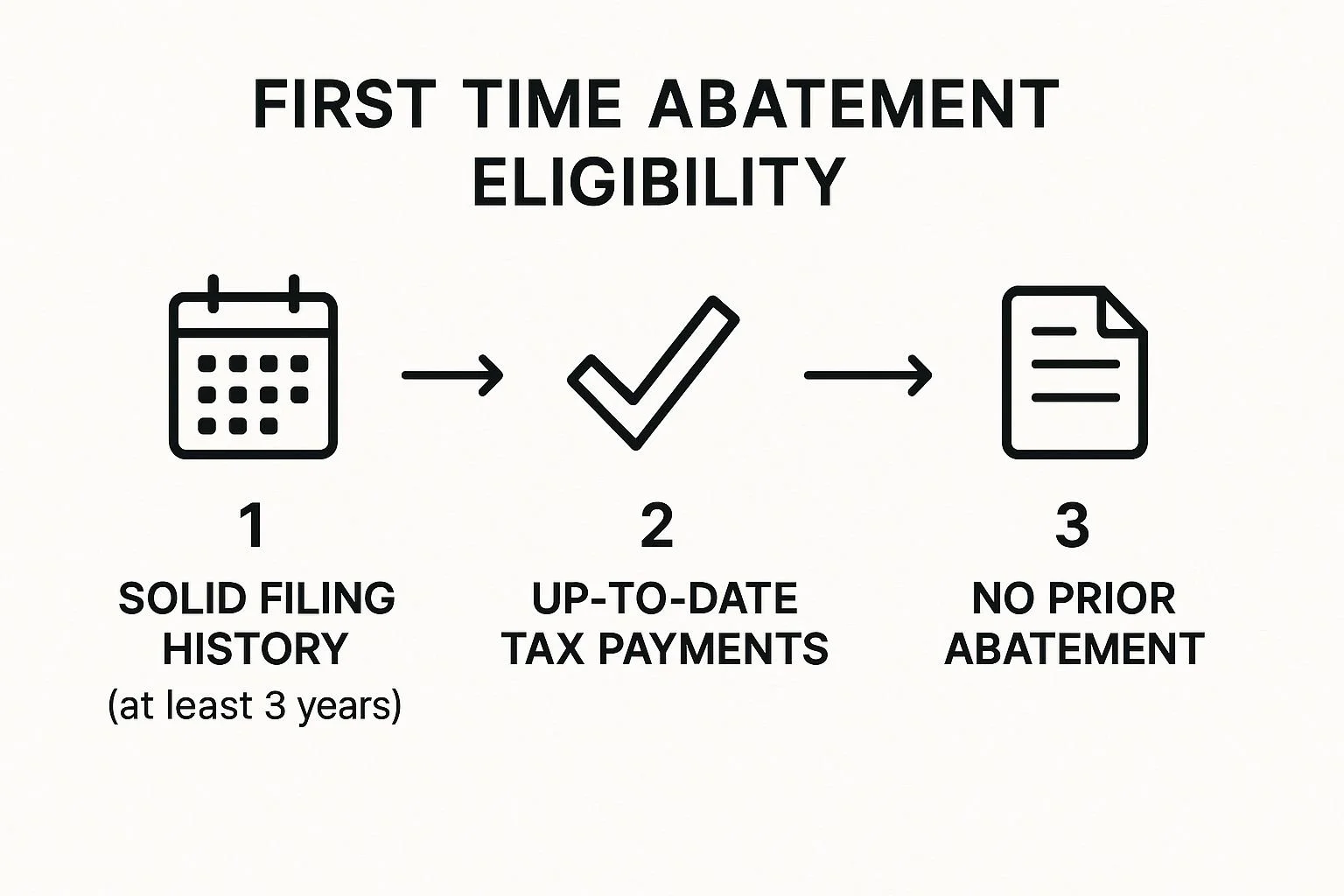
As you can see, the flow is logical: prove your good filing history, show you're current on payments, and confirm you haven't used this waiver recently.
Once you’ve confirmed you meet these three critical rules, you're ready to start building your case.
What to Do If You Don't Qualify (Yet)
Ran through the checklist and realized you have a problem? Don't panic. In many cases, you can fix the issue and become eligible.
If you have unfiled returns from the last three years, get them filed immediately. Don't even think about calling the IRS until those returns are officially processed and on record.
Behind on payments? Your first step is to get current or set up an installment agreement. If you establish a payment plan, I recommend making at least a few on-time payments to demonstrate your commitment before you ask for any favors.
No matter what, document everything. Keep records of when you filed, when you paid, and who you spoke to at the IRS. Note the date, the agent's name, and a quick summary of the call.
A well-documented file can make the difference between approval and denial.
Taking the time to self-assess and fix any compliance gaps puts you in the driver's seat. It dramatically improves your odds of a successful penalty abatement when you finally make the request.
How to Prepare and Submit Your FTA Request

Alright, you've confirmed you qualify for a first-time abatement. Now it's time to actually ask the IRS to waive the penalty.
You basically have two ways to do this: over the phone or by sending a formal letter. Each has its own rhythm and set of challenges, but with a little prep work, either route can get you to the finish line. The secret is being organized, direct, and confident.
The Phone Call Approach: A Direct Line to Relief
Calling the IRS is often the quickest way to get a penalty removed. If the agent on the other end can pull up your records and see you're eligible, they can grant the abatement right there during the call.
Of course, that speed comes at a price—you might be on hold for a while, and you have to be ready to make your case on the spot.
Before you even pick up the phone, get your paperwork in order. You’ll definitely need:
The IRS notice you received. This has all the key info, like the notice number and tax year.
Your Social Security Number (or Individual Taxpayer Identification Number).
A copy of the tax return for the year in question.
When you finally get an agent on the line, be polite but get straight to the point. Introduce yourself and state your purpose clearly: "Hello, my name is [Your Name], and I'm calling about the notice I received for the [Tax Year] tax period. I'm calling to request a first-time penalty abatement." Using that exact phrase leaves no room for confusion.
From there, the agent will dig into your account to check your compliance history for the last three years. Just stay calm, answer their questions, and have your documents handy if they ask for specifics.
Insider Tip: From my experience, the best times to call the IRS are early in the morning—around 8:00 AM your time—on a Wednesday or Thursday. Call wait times are almost always shorter than on Mondays, Fridays, or during the lunch rush.
Crafting a Written Request: The Paper Trail Method
If the idea of a high-stakes phone call with the IRS makes you nervous, or if you simply want an undeniable record of your request, writing a letter is a fantastic strategy. It creates a clear, documented timeline of your communication.
Your letter doesn't need to be fancy or full of legal jargon. Simple and direct is best.
Just make sure to include these key pieces of information:
Your personal details: Full name, current address, and SSN or ITIN.
The tax specifics: Note the tax year, the form number (like Form 1040), and the notice number from the IRS letter.
Your clear request: State explicitly that you are requesting a first-time abatement of the penalty.
A simple justification: Briefly mention that you meet the criteria because of your clean filing and payment history for the prior three years.
The IRS created the first-time penalty abatement program to be fair to taxpayers who generally play by the rules. It's a huge improvement from the old days when penalties—like the failure-to-file penalty that could hit 25% of your unpaid tax—were incredibly rigid. This relief program gives you a way out, though it’s important to remember it only waives the penalty, not any interest that has accrued. For more on the background of this policy, check out this history of penalty relief on thetaxadviser.com.
Once you've written your letter, there's one last step that I consider non-negotiable: send it via USPS Certified Mail with a return receipt.
This is your golden ticket. It provides legally recognized proof of when the IRS received your request.
So, you’ve gone through the First Time Abatement checklist and it looks like you don’t qualify. Maybe you had a penalty removed a couple of years back, or perhaps your recent filing history isn't quite spotless. It's a common situation, but don't worry—it’s not the end of the road. This is exactly when you pivot to another powerful strategy: arguing Reasonable Cause.
Unlike the straightforward, almost automatic nature of the first time abatement of penalty, making a case for Reasonable Cause is more of an art. It's less about your past compliance record and all about the why behind your failure to file or pay on time. You’re essentially explaining to the IRS that you fully intended to meet your obligations, but a serious event completely outside your control got in the way.
How Is Reasonable Cause Different From an FTA?
Think of the FTA as a "get out of jail free" card you get for being a good student. The IRS just looks at your record and, if it's clean, waives the penalty. No deep explanations needed.
Reasonable Cause is different. It requires you to tell your story and, more importantly, prove it. You have to convince the IRS that you acted with what they call "ordinary business care and prudence," but still couldn't manage to file or pay.
The IRS often accepts situations like:
A debilitating illness or the death of an immediate family member.
Your home, business, or essential records being destroyed in a fire, hurricane, or another disaster.
Relying on incorrect advice from a tax professional you had every reason to trust.
The heart of any successful Reasonable Cause argument is proving that your mistake wasn't due to carelessness or "willful neglect." It's about showing that circumstances truly made it impossible to comply.
To help you see the difference at a glance, here’s a quick breakdown:
First Time Abatement vs Reasonable Cause
| Criteria | First Time Abatement (FTA) | Reasonable Cause |
|---|---|---|
| Basis for Relief | Your good compliance history (filing and paying on time). | A specific, unavoidable event that prevented compliance. |
| Eligibility | Must have a clean record for the prior 3 years. | Anyone can argue it, regardless of past tax history. |
| Evidence Needed | None. It's based entirely on your IRS account record. | Extensive documentation is required (e.g., medical records, police reports). |
| Subjectivity | Very objective; you either qualify or you don't. | Highly subjective; depends on the strength of your story and evidence. |
As you can see, the path you take depends entirely on your specific situation. FTA is the easier route if you qualify, but Reasonable Cause is the essential backup for when life throws you a curveball.
Building a Bulletproof Case for Reasonable Cause
Simply telling the IRS you were sick won't cut it. You have to back up your story with hard evidence. If a medical emergency was the reason, you’ll need hospital records or a doctor's letter. If a flood wiped out your records, you’ll need photos, insurance claims, or official disaster declarations. This is where it really diverges from the simple FTA request.
Putting together a strong argument is critical. Data from the Taxpayer Advocate Service shows a concerning trend: about 71% of certain international information return penalties are levied against taxpayers earning $400,000 or less. Yet, larger businesses with expert legal teams often have more success getting penalties abated. This just goes to show how vital a well-documented, persuasive case is for leveling the playing field.
While it demands more legwork, arguing Reasonable Cause is an indispensable tool. It ensures that taxpayers facing real, unavoidable hardships have a fair chance at relief, preventing a single unforeseen event from spiraling into a major tax crisis.
What to Expect After You’ve Sent Your Request

Alright, you’ve put together a solid case for a first-time abatement and sent it off. Now comes the hard part: waiting. Knowing what to expect can take a lot of the stress out of this quiet period. The process really splits into two paths from here—approval or denial—and being prepared for both is the best way to stay in control.
If you were lucky enough to handle this over the phone with an IRS agent who confirmed your eligibility on the spot, you're in a great position. Often, they can process the waiver right then and there. You'll still want to keep an eye on your mailbox for an official notice confirming the penalty removal, which usually shows up in about 4 to 6 weeks.
For those who submitted a written request, get ready to be patient. The IRS mail processing centers are notoriously slow, and it’s not uncommon to wait several months for a response. This is exactly why sending that letter via certified mail was so crucial—it gives you a concrete record of when you sent it, so you're not just waiting in the dark.
If Your Request Is Approved
Getting that approval notice is a huge relief. It will likely come as a formal letter from the IRS, like a CP210 notice, showing that the penalty amount has been adjusted to zero. It’s the official confirmation that your history of good compliance really paid off.
Here's another piece of good news: you don't have to worry about the interest that was tacked onto that penalty.
The IRS automatically recalculates and removes any interest that was charged specifically on the abated penalty. This happens behind the scenes, so there’s no need to file a separate request. The adjustment will simply show up on your account transcript.
If You Receive a Denial (And How to Appeal)
Seeing a denial letter can feel like a punch to the gut, but don't assume it's the end of the road. It isn’t. The IRS is required to explain why they denied your request, and that explanation becomes your roadmap for an appeal.
Timing here is critical. You typically only have 30 days from the date on the denial letter to file your appeal, so you need to move fast.
An appeal is simply a formal letter to the IRS Independent Office of Appeals asking them to take a second look. In your appeal, you’ll need to lay out exactly why you believe the initial decision was wrong.
For smaller penalty amounts, you can often use a Small Case Request (Form 12203).
For larger or more complex cases, a formal protest letter is required.
This is your opportunity to clarify your position and give yourself a second chance at getting the penalty relief you're asking for.
Answering Your Questions About First Time Abatement
When you're dealing with penalty relief for the first time, it's natural to have a lot of specific questions. Let's walk through some of the most common "what if" scenarios I see from taxpayers who are looking into a first time abatement of penalty.
Will FTA Also Get Rid of the Interest on My Penalty?
Yes, and this is one of the best parts about getting an FTA request approved. While the abatement itself technically only removes the penalty, the IRS automatically follows up by removing any interest that was charged specifically on that penalty.
You don't even have to ask for it. Once the penalty is officially wiped out, the associated interest just goes away with it. You'll usually get a second notice from the IRS confirming the interest adjustment, which cleans up your account balance.
Can I Use First Time Abatement for an Estimated Tax Penalty?
This is a common point of confusion, but unfortunately, the answer is no. The First Time Abatement program is narrowly focused on three specific penalties: failure-to-file, failure-to-pay, and failure-to-deposit. It simply doesn't cover the penalty for underpayment of estimated taxes.
If you're facing an estimated tax penalty, you'll have to explore other options for relief. This typically means proving to the IRS you had a valid reason for the underpayment, like a sudden retirement, disability, or a major casualty event that threw your finances into chaos.
First Time Abatement is an incredibly helpful tool, but it's crucial to know its limits. It’s built for procedural slip-ups, not for every type of penalty the IRS might charge.
What if I Have a Perfect Record but I Made an Error on My Return?
This is a really important distinction to understand. First Time Abatement is designed for when you mess up the timing—filing late, paying late, or depositing late. It does not apply to mistakes made on the return itself, like underreporting your income or accidentally claiming a credit you didn't qualify for.
Those kinds of errors lead to what are called accuracy-related penalties. If you get hit with one of these, your only real option is to argue for "Reasonable Cause." This is a much higher bar to clear, as you have to prove you acted with ordinary business care and prudence but still made an honest mistake. Your clean history can certainly help your case, but it doesn't give you the automatic pass that FTA does.
How Long Does It Take for the IRS to Handle an FTA Request?
The wait time really comes down to how you ask.
Calling the IRS: This is by far the fastest way. If you get an agent on the phone who can pull up your records and confirm you're eligible, they can grant the abatement right then and there. You'll get an official confirmation letter in the mail a few weeks later.
Mailing a Request: This is the slow boat. With the IRS still working through backlogs, a written request can easily take several months to get a response. That’s precisely why sending it via certified mail is an absolute must—it gives you a paper trail and undeniable proof of when you sent it, which can be a lifesaver during the long wait.
At Attorney Stephen A Weisberg, I know that facing the IRS can feel overwhelming. If you're dealing with tax penalties or other complex issues, you don't have to navigate it alone. I offer a free, no-obligation Tax Debt Analysis to map out the best strategy for your unique situation. Learn more and schedule your free analysis at weisberg.tax.
Want to understand your options before you call anyone?
Download my free book — Freedom From Tax Debt — a plain-language guide to how the IRS collections process actually works and what resolution really looks like.
➥ Contact Attorney Stephen A. Weisberg for a free Tax Debt Analysis.
Contact Me Here: https://www.weisberg.tax/contact-1
Email: s.weisberg@weisberg.tax
Phone/Text: (248) 971-0885
Address: 300 Galleria Officentre, Suite 402, Southfield, MI 48034
