How to Set Up a Tax Payment Plan with the IRS
Getting a letter from the IRS can be one of the most stressful pieces of mail you'll ever receive. But I want to be clear: it's a solvable problem. Yes, you can absolutely set up a payment plan to manage what you owe. Think of this as your first step from feeling overwhelmed to taking back control.
Facing a Tax Bill You Cannot Pay Today

That heart-sinking moment when you open an IRS notice and see a balance you can't possibly pay is a feeling many people know all too well. The good news? The IRS has structured, well-defined paths to help you manage this debt.
The worst thing you can do is ignore the bill. That only guarantees mounting penalties and more aggressive collection actions down the road.
Instead, you can get on the front foot, engage directly with the IRS, and set up a formal agreement to pay your tax debt over time. This process takes an unmanageable lump sum and turns it into a series of predictable monthly payments that actually fit your budget. It’s a common solution that millions of taxpayers use every single year.
Understanding Your Options
The IRS isn't a rigid, inflexible machine; it actually offers several distinct options for taxpayers who need some breathing room. These aren't one-size-fits-all solutions, so it's crucial to understand which one is right for your specific financial situation before you start filling out forms.
Here’s a quick look at the main paths available to you:
Short-Term Payment Plan: Perfect if you just need a little extra time—up to 180 days—to get the funds together to pay in full.
Long-Term Installment Agreement: This is the most common choice, allowing you to make monthly payments for up to 72 months (six years).
Offer in Compromise (OIC): Reserved for taxpayers facing significant financial hardship, this allows you to settle your tax debt for less than the total amount you owe.
To help you see these at a glance, here’s a simple breakdown of the most common ways to resolve a tax bill you can't pay right away.
Quick Overview of IRS Payment Options
| Payment Option | Best For | Key Requirement |
|---|---|---|
| Short-Term Payment Plan | Needing just a few extra months (up to 180 days) to pay in full. | Ability to pay the entire balance, including penalties and interest, within the 180-day window. |
| Long-Term Installment Agreement | Needing to make smaller monthly payments over a longer period (up to 72 months). | Owing a combined total of under $50,000 and being current on all tax filings. |
| Offer in Compromise (OIC) | Severe financial hardship where paying the full amount is impossible. | Proving to the IRS that you lack the income and assets to pay the full tax debt. |
Each of these serves a different purpose, so choosing the right one is the first and most important step.
The key is to act quickly. By understanding your choices, you can stop the cycle of penalties and interest from spiraling and regain control over your financial situation. Proactive communication with the IRS is always the best strategy.
In fact, the installment agreement is one of the most common ways people handle tax liabilities. Roughly 5 million taxpayers are on these agreements at any given time, which proves you're not alone in this and that there’s a well-traveled path waiting for you. For more context on how tax policies are shifting globally, you can learn more about international tax rate updates.
Checking Your Eligibility for a Payment Plan
Before you even think about filling out forms, the very first step is to figure out if you're actually eligible for an IRS payment plan. The last thing you want is to go through the whole process only to be denied on a technicality.
Think of it this way: the IRS has a checklist, and you need to tick the right boxes. The most important one, the absolute non-negotiable, is this: you must have filed all your required tax returns. If you're behind on filing, the IRS won't even consider a payment agreement for what you owe. Get current first, then you can talk about a plan.
The Magic Number for Simplified Approval
The easiest and quickest way to get a payment plan is through the IRS online system. But there's a catch. This streamlined option is generally reserved for taxpayers whose total combined bill—that's tax, penalties, and interest—is less than $50,000.
Let’s say a freelance writer underestimated their quarterly payments and now has a tax bill of $28,000. As long as all their past returns are filed, they're a perfect candidate for the Online Payment Agreement (OPA). It's a relatively straightforward process because their debt is well below that $50,000 mark.
This quick comparison highlights the key differences between the main plan types.
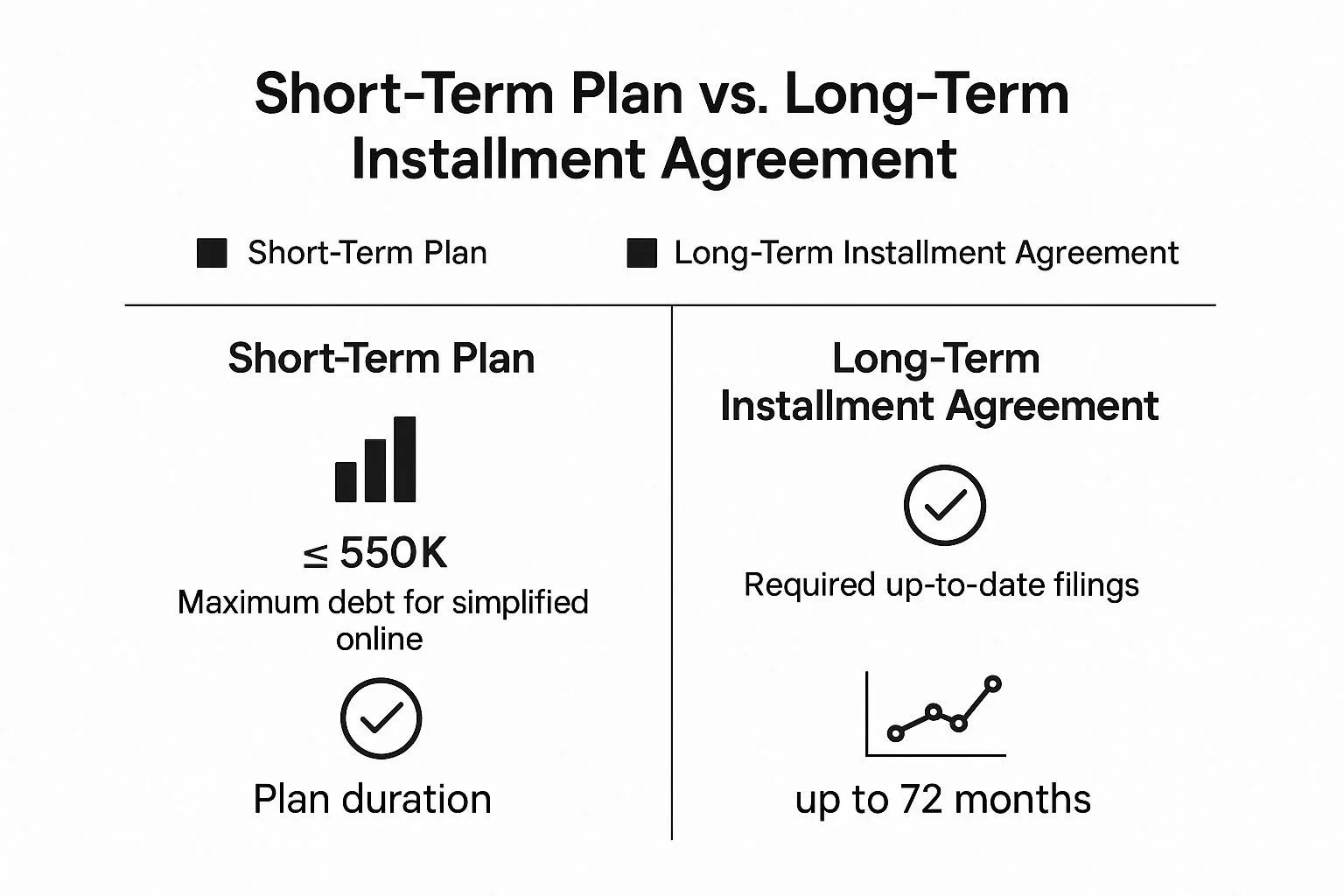
As you can see, the time you get to pay and the total amount you owe are the big differentiators. But that filing requirement? It's the same for both.
What if You Owe More Than $50,000?
If your tax debt is over the $50,000 threshold, don't panic. You can still get a payment plan, but the path isn't as simple. The IRS will need a much closer look at your finances to make sure your proposed payment is reasonable.
This means you'll have to provide a detailed financial statement, essentially opening up your books to the IRS. You’ll be documenting your income, assets, and living expenses on what’s called a Collection Information Statement.
The bottom line is that your eligibility really comes down to two things: how much you owe and whether your filing history is clean. If your debt is under $50,000 and all your returns are in, you’re in a great position.
Clearing these first hurdles is a huge step. Once you've confirmed you qualify, you can confidently move on to picking the right type of plan for your specific situation.
Choosing the Right Plan for Your Finances

The best IRS payment plan isn't a one-size-fits-all solution; it’s the one you can actually stick with without upending your entire budget. The IRS offers a few different arrangements, and your job is to match your specific financial reality to the right one.
Let's walk through the three main paths you can take: the Short-Term Payment Plan, the Installment Agreement, and the Offer in Compromise. Each serves a very different purpose.
To really nail this decision, you need a crystal-clear picture of your current financial health. Using tools like finance dashboards can give you the clarity you need to pick a plan you can manage successfully.
The Short-Term Fix
A Short-Term Payment Plan is exactly what it sounds like. It's a brief extension that gives you up to 180 days to pay your entire tax debt.
This option is a lifesaver if you know the money is coming, you just don't have it in your account right now. Maybe you're a freelancer waiting on a big client to pay up, or you have a year-end bonus on the way. It’s a straightforward solution with no setup fees, but remember that interest and penalties will keep adding up until the balance is paid off.
The Marathon: The Installment Agreement
For those who need more runway, the Long-Term Installment Agreement is the most common path forward. This is the classic monthly payment plan that lets you chip away at your debt over a much longer period.
Typically, the IRS gives you up to 72 months (that's six years) to clear the debt. If you owe less than $50,000 in combined tax, penalties, and interest, you can often qualify without having to submit a mountain of financial paperwork.
There is a setup fee, which can range from $31 to $225, depending on how you apply and your payment method.
An installment agreement is a serious commitment. The IRS expects every payment on time, and you must stay current on all future tax filings and payments. If you fall behind, they can terminate the agreement and resume collection actions.
This plan works best for people with a steady income who can handle consistent monthly payments but simply can't absorb a huge one-time bill. It offers predictability and puts a stop to more aggressive collection efforts.
For Serious Financial Hardship: An Offer in Compromise
An Offer in Compromise (OIC) is a much more complex animal, reserved for taxpayers facing true financial hardship. This route allows you to settle your tax debt for less—sometimes significantly less—than the full amount you owe.
Getting an OIC approved is tough. The IRS has very strict eligibility rules, and you have to prove that paying the full amount would create a severe economic burden. This means a deep dive into your assets, income, and expenses. Think of it as a last resort, not a first choice.
The IRS Fresh Start Program has made it a bit easier for some taxpayers to qualify.
Comparison of IRS Tax Payment Plans
To help you see the options side-by-side, here’s a quick breakdown of the key differences. This table can make it easier to see which lane you might fit into based on your debt amount and ability to pay.
| Plan Type | Repayment Period | Debt Limit (for streamlined process) | Setup Fees | Best For |
|---|---|---|---|---|
| Short-Term Payment Plan | Up to 180 days | N/A | None | Taxpayers who can pay in full soon but need a brief extension. |
| Installment Agreement | Up to 72 months | Under $50,000 | $31–$225 | Those with a steady income who need to make monthly payments. |
| Offer in Compromise | Lump-sum or short-term payments | N/A | $205 application fee | Taxpayers with significant financial hardship who can't pay in full. |
Choosing the right path is the most critical part of this process. An honest assessment of your financial situation will guide you toward a resolution that brings relief, not more stress.
Getting Your Payment Plan Set Up Online

Without a doubt, the quickest way to get an IRS payment plan in place is by using their Online Payment Agreement (OPA) tool. This is the official portal designed to get you from application to approval in a single session, saving you the headache of paper forms and long hold times on the phone.
But before you even navigate to the IRS website, a little prep work goes a long way. Gathering the right documents beforehand is the secret to a smooth, stress-free application. It prevents you from having to hit pause midway through to dig up a missing piece of information.
Your Pre-Application Checklist
Think of this as your mission prep. Having these details at your fingertips will make the whole process much faster and help you get it right on the first try.
IRS Notice or Bill: Grab the most recent one you've received. It has critical details like the notice number and your current balance.
Personal ID: You'll need either your Social Security Number (SSN) or, if applicable, your Individual Taxpayer Identification Number (ITIN).
Key Details: Be ready with your date of birth and the mailing address exactly as it appears on your last tax return.
Bank Info for Direct Debit: If you want to set up automatic payments (which I highly recommend to avoid missed payments), you’ll need your bank's routing and account numbers.
With this information compiled and ready to go, you can confidently start the online process.
These payment plans have become an essential lifeline for many. During the economic instability of 2020-2021, the IRS saw a major spike above its typical 5 million active installment agreements, showing just how crucial these arrangements are. For a deeper dive into these kinds of trends, check out the global tax policy survey on Deloitte.com.
Using the Online Payment Agreement Tool
Once you log into the OPA system, the first thing it does is verify your identity. From there, it walks you through a few screens to confirm the amount you owe and helps you structure a plan. This is your chance to propose a monthly payment amount you can actually afford.
One of the biggest questions people have is, "How much should I offer to pay each month?" The system often takes the guesswork out of it by calculating a minimum required payment. This figure is usually based on your total debt divided by the maximum repayment term of 72 months. If you can swing that minimum amount, your plan will most likely be approved on the spot.
What if you can't afford their suggested minimum? If you propose a lower payment, the tool may ask for more detailed financial information to justify the smaller amount.
After you submit everything, you should get an answer almost immediately. If approved, you’ll receive an official confirmation that your installment agreement has been accepted. Make sure to print or save a copy of this agreement for your records—it's your proof that you’re officially compliant and actively resolving your tax liability.
Managing Your Agreement and Staying Compliant
Getting your IRS payment plan approved is a huge relief, but it's not the end of the road. Think of it as the starting line. The real work is in sticking with the agreement to finally put your tax debt behind you and keep the IRS from knocking on your door again.
Your number one job now is to make every single payment on time, every single month. No exceptions.
The easiest way I've seen clients stay on track is by setting up a Direct Debit Installment Agreement (DDIA). The payment gets pulled from your bank account automatically. It's a "set-it-and-forget-it" method that takes human error out of the equation.
The Two Golden Rules of Compliance
Once your payment plan is active, the IRS expects two things from you. These are non-negotiable if you want to keep your agreement intact and avoid having it revoked.
Make Every Scheduled Payment: That monthly payment is a firm commitment. Missing even one can put your entire agreement at risk and trigger a default notice.
Stay Current on New Taxes: You absolutely must file all future tax returns on time and, just as importantly, pay any new tax you owe in full. Falling behind on a new tax year is the quickest way to have your existing plan thrown out.
Defaulting on your plan is a serious setback. It basically resets the clock, and the IRS can go right back to aggressive collection tactics like levying your bank account or garnishing your wages. They take compliance very seriously, so your diligence is what makes this whole process work.
What To Do If You See Trouble Ahead
Life happens. A sudden job loss, a medical emergency—things can change in a heartbeat. If you realize you’re not going to be able to make an upcoming payment, don't just ignore it and hope for the best.
Be proactive. Call the IRS before you miss the payment.
Explain what's happened. It's often possible to adjust your monthly payment if your financial situation has genuinely changed. Being upfront shows the IRS you're acting in good faith and can prevent your agreement from defaulting.
Recent legislation, like the Taxpayer First Act of 2019, has been pushing the IRS to make managing these agreements easier and more digital-friendly. It’s part of a larger trend you see with tax authorities worldwide, where installment plans are used to encourage people to get back on track voluntarily. For those interested in the bigger picture, you can read more about these evolving strategies in the 2025 tax policy outlooks on Bloomberg Tax.
Common Mistakes That Can Derail Your IRS Payment Plan
Getting an IRS payment plan set up is a massive relief. It feels like you can finally breathe again. But a few simple, and surprisingly common, mistakes can undo all that hard work and land you right back in hot water.
The absolute biggest mistake, of course, is doing nothing at all. But even if you're trying to do the right thing, it's easy to stumble. Let's walk through the most frequent pitfalls I see so you can steer clear of them.
Applying Too Soon or Promising Too Much
Before you even think about applying for a payment plan, you have to be current on filing all your past-due tax returns. This is a non-negotiable prerequisite for the IRS. They won't even consider an installment agreement until every single required return is in their system. It's their way of making sure the slate is clean before working out a payment schedule.
Another classic blunder is suggesting a monthly payment you can't realistically afford. In a panic to get the debt paid off, people often promise a huge chunk of their income. That's a recipe for disaster. If you can't keep up, you'll default on the agreement. That default voids the plan, and suddenly you're facing much more aggressive collection actions all over again.
The Danger of Ignoring IRS Mail
Once your plan is approved, don't assume you're off the IRS's radar. You'll still get mail from them, and it is a critical error to ignore it. These letters aren't junk mail; they could be anything from a simple account update to a formal request for more information or a warning that your agreement is at risk.
The single worst thing you can do is stick your head in the sand. Proactive communication and sticking to the rules are your best friends here. Ignoring an IRS notice is a surefire way to turn a manageable issue into a full-blown crisis.
Failing to respond can get your entire plan terminated. Make it a rule: open and read every single piece of mail from the IRS the day it arrives and take whatever action is needed immediately.
Other Stumbling Blocks to Watch For
To keep your payment plan on track from start to finish, be very careful to avoid these other common tripwires:
Forgetting about new taxes. Your installment plan only covers old tax debt. You are still required to file and pay all your current taxes on time. I've seen countless agreements get canceled because someone fell behind on the current tax year.
Not updating your personal info. Did you move? Did your income change dramatically? You have to tell the IRS. If they don't have your current address, you'll miss crucial notices. If your income drops, you might even be able to get your monthly payment lowered.
Skipping automatic payments. Why leave it to chance? Relying on yourself to remember to make a manual payment every month is just asking for trouble. Setting up a Direct Debit from your bank account is the safest way to ensure your payments are always on time, keeping your agreement in good standing without you having to think about it.
By sidestepping these common mistakes, you're not just setting up a payment plan—you're building a reliable path to finally resolving your tax debt for good.
Common Questions About IRS Payment Plans
Even with all the information laid out, a few key questions always seem to come up when you're thinking about setting up a payment plan with the IRS. Let's tackle some of the most common ones I hear from clients.
Do Interest and Penalties Stop Accruing Once My Plan Is Approved?
This is a big one. The short answer is no, interest and penalties will continue to add up on your outstanding balance while you're making payments.
But there's a significant silver lining. Once your installment agreement is in place, the failure-to-pay penalty is typically reduced by half, dropping from 0.5% to just 0.25% per month. More importantly, getting a plan approved stops the IRS from escalating to more aggressive collection tactics like levying your bank account or garnishing your wages.
What Happens if I Can't Make a Payment?
Life happens. If your financial circumstances take a hit and you can't afford your agreed-upon monthly payment, the absolute worst thing you can do is nothing.
Contact the IRS right away. Simply stopping payments will put your agreement into default, and the collection process will kick back into high gear. It's often possible to renegotiate your plan for a lower payment, but you'll need to be prepared to provide updated financial information to show that your situation has genuinely changed.
The key is to be proactive. In my experience, the IRS is far more willing to work with taxpayers who communicate openly about their financial difficulties than with those who simply stop paying and ignore the notices.
Can I Get a Payment Plan if I'm Self-Employed?
Absolutely. Self-employed individuals, freelancers, and small business owners are definitely eligible for IRS installment agreements.
However, there's a crucial catch: you must remain current on your estimated tax payments for the current year. Falling behind on your new tax obligations while paying off an old one is one of the fastest ways to default on your existing payment plan.
At Attorney Stephen A Weisberg, I help individuals and businesses navigate complex IRS issues with clarity and confidence. Instead of high-pressure sales tactics, I start with a FREE Tax Debt Analysis to find out exactly how I can help before you commit. Get professional guidance by visiting weisberg.tax today.
Want to understand your options before you call anyone?
Download my free book — Freedom From Tax Debt — a plain-language guide to how the IRS collections process actually works and what resolution really looks like.
➥ Contact Attorney Stephen A. Weisberg for a free Tax Debt Analysis.
Contact Me Here: https://www.weisberg.tax/contact-1
Email: s.weisberg@weisberg.tax
Phone/Text: (248) 971-0885
Address: 300 Galleria Officentre, Suite 402, Southfield, MI 48034
