Form 433-A OIC Guide: Master Your Tax Debt Settlement
Understanding Form 433-A OIC and When You Need It
When you’re facing a huge tax bill, an Offer in Compromise (OIC) can feel like your only way out. It’s an agreement with the IRS to settle your tax debt for less than you owe. But getting this deal requires you to pass through a very narrow gate, and the key is Form 433-A OIC.
This isn't just another government form. It’s a complete financial story the IRS demands to see if you genuinely can’t afford your full tax bill. Think of it as a financial deep-dive on paper, where every penny is examined.
The IRS won't even consider your offer without a transparent look at your finances. This is what Form 433-A (OIC), the "Collection Information Statement for Wage Earners and Self-Employed Individuals," is all about. It’s an exhaustive report on your income, expenses, assets, and debts.
The IRS plugs this information into a formula to determine your reasonable collection potential (RCP)—the amount they believe they can squeeze out of you. If your settlement offer is at least that much, you've got a shot.
You can always find the latest version of the form and its rules in the official IRS forms and instructions database.
Real-World Scenarios Demanding Form 433-A OIC
So, who actually needs to go through this intense process? It's for people in situations where paying their full tax debt would cause serious financial hardship. Let’s look at a couple of real-life examples where the form 433-a oic becomes essential.
Imagine a freelance graphic designer who gets hit with a serious medical diagnosis. Her savings are gone, thanks to medical bills her insurance didn't cover, and she can't work nearly as much as she used to.
The tax debt from her better years is still there, but her current financial state makes it impossible to pay. For her, the OIC is the only way to align her old debt with her new reality, and Form 433-A is how she'll prove her case.
Another common situation is a small business owner whose dream goes under. He’s on the hook for business loans he personally guaranteed, plus a pile of payroll and income taxes. With no business income and bleak job prospects, his finances are in ruins.
The OIC, which starts with filling out Form 433-A with painstaking detail, offers him a chance to move on without the crushing weight of a tax bill he can never repay.
Cutting Through the Myths of Qualification
There's a persistent myth that an OIC is an easy escape from tax problems. That’s just not true. The IRS accepts a small percentage of the offers it receives. Success depends entirely on proving real financial hardship, not just wanting to pay less.
The IRS doesn’t care about what you used to make; they are focused on your current ability to pay. To understand the strict requirements, check out our complete guide to IRS tax debt settlement.
To get approved, you have to show that your monthly expenses—by the IRS's rigid definitions—consume most or all of your income and that you don't have significant equity in assets.
Before you even think about downloading Form 433-A, be brutally honest with yourself about your finances. This isn't about asking for a discount; it's about proving you have no other choice.
Gathering Your Financial Documentation Like a Pro
Submitting a Form 433-A OIC is much more than filling out a form; it's about building a case and proving your financial situation to the IRS. This is the single biggest hurdle where many Offer in Compromise applications fail before they even get a serious look.
The IRS works on a "trust but verify" principle, and if your documents don't paint a complete picture, they have nothing to verify. Think of it less like filing your annual taxes and more like applying for a major loan where the lender needs to see everything.
An incomplete package is a one-way ticket to a rejection letter. Even when you submit a perfect application, the IRS can take many months, sometimes even over a year, to review an OIC.
Missing paperwork just adds frustrating delays, and your financial situation could get worse while you're stuck in limbo. Your mission is to hand them a file so thorough and organized that the IRS examiner gets a clear, undeniable view of your financial hardship.
The Non-Negotiable Document Checklist
Before you even think about filling out the form, you need to assemble a comprehensive file of your financial life. This is no time for guessing or using "ballpark" figures. Accuracy is your greatest asset here. Any experienced tax pro would tell you to gather the following documents as a starting point.
To make this process easier, I've put together a checklist that details exactly what you need, the required timeframes, and common mistakes to avoid. This will help ensure you're providing the IRS with exactly what they're looking for.
Essential Documentation Checklist for Form 433-A OIC
Complete list of required documents organized by category with specific timeframes and notes
| Document Type | Time Period Required | Specific Requirements | Common Mistakes |
|---|---|---|---|
| Proof of Income | Last 3-6 months | Pay stubs, P&L statements for self-employed, bank statements showing all deposits. | Forgetting side-gig income or only providing a single month's pay stub. |
| Bank Statements | Last 3 months | All pages of every account (checking, savings, money market), including joint accounts. | "Forgetting" a small savings account or redacting non-essential transactions. |
| Asset Information | Most recent statements | 401(k), IRA, brokerage accounts, whole life insurance cash value statements. | Not including a whole life insurance policy because it's not a "retirement" account. |
| Vehicle Information | Current | Title/registration for all vehicles, plus a valuation from a source like Kelley Blue Book. | Valuing the car at what you think it's worth instead of using a third-party source. |
| Real Estate Info | Current | Deed, mortgage statements, property tax assessments, and proof of homeowner's insurance. | Using an outdated property tax bill that doesn't reflect the current market value. |
| Proof of Expenses | Last 3 months | Mortgage/rent payments, utility bills, car payments, insurance premiums, medical bills. | Submitting credit card statements instead of the actual bills for each expense. |
This table serves as your roadmap. Following it closely prevents you from having to scramble for documents later or, worse, receiving a notice from the IRS asking for information you should have included from the start.
Insider Tips for Assembling Your File
Just having the right documents isn't the whole story; presentation is key. Organize everything logically into categories: Income, Assets, and Expenses. It’s also a great idea to create a simple cover sheet that lists every single document included in your submission.
This small step makes the IRS reviewer's job much easier, which can only work in your favor.
One of the most frequently missed items is the whole life insurance policy. Unlike term life insurance, a whole life policy builds cash value over time, and the IRS views that cash value as a liquid asset.
Overlooking this can completely sink your OIC. Likewise, if you earn occasional income from a side hustle or freelance work, document it perfectly.
You never want the IRS to find it on their own—that instantly damages your credibility and puts your entire form 433-a oic settlement at risk.
Navigating the Asset Reporting Minefield

The asset section of Form 433-A OIC is where many good Offer in Compromise applications go to die. It's more than just a simple list of what you own; it's a financial deep-dive where the IRS's perspective is the only one that matters.
You have to learn to see your belongings not for their sentimental value, but through the objective lens of an IRS examiner.
The gap between what you believe an asset is worth and what the IRS determines it’s worth can be a deal-breaker. This difference directly inflates the amount the IRS thinks you can afford to pay, putting your entire settlement at risk.
A classic trip-up is undervaluing assets. You might think your decade-old car is only worth its low trade-in value, but the IRS will likely use a higher "private party value" from a source like Kelley Blue Book.
That small difference can add thousands to your calculated ability to pay. The same logic applies to your home; the IRS looks at its current fair market value, not what you paid for it or its outdated tax assessment.
Decoding Fair Market Value and Asset Categories
Getting a handle on fair market value (FMV) is absolutely essential. For every single asset on your list—from your checking account to your retirement fund—you need to provide a realistic and justifiable FMV. This is defined as the price a willing buyer would pay to a willing seller, where neither party is pressured to make the deal. When filling out your form 433-a oic, this means you have to do your homework.
Financial Accounts: This covers everything from checking, savings, and money market accounts to Health Savings Accounts (HSAs). Their value is simply the current balance.
Retirement Accounts: For any 401(k), IRA, or similar plan, you start by listing the total current value. The IRS then calculates its quick sale value (QSV), which is a reduced amount that accounts for potential taxes and penalties on an early withdrawal. This lower QSV figure is what's used in your settlement calculation.
Investments: Stocks, bonds, and mutual funds are valued based on their current market price on any given day.
A new and growing challenge is reporting digital assets correctly. The 2025 revision of Form 433-A makes it mandatory to disclose all digital assets and provide recent statements.
This includes cryptocurrencies like Bitcoin and Ethereum, NFTs, and stablecoins. This change shows how seriously the IRS is taking this financial frontier.
In fact, the agency has increased its enforcement, opening over 10,000 digital asset cases annually in recent years. You can find the specific requirements in the latest IRS guidance on Form 433-A (OIC).
Exempt vs. Non-Exempt: What Can the IRS Actually Count?
The good news is that not everything you own is on the table. Both federal and state laws protect certain assets from IRS collection efforts. Understanding these exemptions is crucial for accurately completing your form 433-a oic.
Exempt Assets: This category usually includes necessary clothing, school books, basic furniture, and a limited value of tools needed for your job. Some states also have a "homestead exemption" that shields a portion of your home's equity from creditors, including the IRS.
Non-Exempt Assets: This is what the IRS is focused on. It includes the equity in your primary home (above any exemption amount), any vacation homes, investment portfolios, the cash value of life insurance policies, and valuable art or collectibles.
The equity from these non-exempt assets gets added to your income calculation to determine your Reasonable Collection Potential (RCP)—the total amount the IRS believes it could collect from you.
Being completely honest and accurate when reporting and valuing these assets is non-negotiable. Hiding or misrepresenting assets is the fastest way to get your OIC rejected and can even lead to severe penalties.
Mastering Income and Expense Calculations
The income and expense sections of your Form 433-A OIC are where the IRS makes its decision. This isn't about what feels fair to you; it’s about what the IRS considers an allowable expense.
The gap between your actual spending and the IRS’s strict national and local standards often seals the fate of your Offer in Compromise. For many people, this is a harsh reality check. The budget that feels essential for your life might look like a series of lifestyle choices to an IRS examiner.
Your job is to bridge that gap. You need to present your financial reality with complete honesty, but frame it within the IRS's rigid guidelines. It's a delicate balance, but getting it right is the key to a successful application.
Calculating Your True Monthly Income
When your income isn't a steady paycheck every two weeks, things get tricky. The IRS needs to see a reliable monthly average, even if your earnings are all over the place. Just submitting a single paystub from a slow month won't cut it; they will immediately ask for more history.
Fluctuating or Seasonal Work: If you're a contractor, work in a seasonal industry, or have variable commissions, you must average your income over a longer period. This is typically 6 to 12 months. Total your gross income over that timeframe and divide by the number of months to get your average. You’ll need to back this up with bank statements and, if you're self-employed, profit-and-loss statements.
Side Hustle and Gig Economy Income: That extra cash from driving for Uber, selling items on Etsy, or doing freelance projects absolutely must be included. A frequent mistake is thinking small amounts don't matter. They do. The IRS sees all deposits, and hiding income is a fast track to rejection and potential penalties. Document it just like your primary job.
For instance, a freelance photographer might have a fantastic month earning $8,000 followed by a slow one earning just $1,500. On the Form 433-A OIC, they can't just report the low month. They must average their income to show a realistic picture of their earning potential over time.
Justifying Your Expenses: The IRS Standards vs. Reality
This is where most people get stuck. The IRS uses a combination of national and local standards to determine what you're "allowed" to spend on essentials like food, housing, and transportation. Your actual spending is often ignored if it goes over these predetermined caps.
To give you a clearer picture, let's compare what the IRS might allow versus what real life often costs.
| Expense Category | IRS Standard | Common Actual Cost | Justification Strategy |
|---|---|---|---|
| Housing & Utilities | Local standard based on county/metro area (e.g., $1,850/month) | $2,300/month in a high-cost area. | Provide proof that you live in a specific school district for a child with special needs, or need to be near a particular medical facility. A lease agreement and utility bills are a must. |
| Food & Clothing | National standard based on family size (e.g., $1,215 for a family of 3) | $1,500/month due to documented food allergies requiring special, more expensive groceries. | Submit a doctor's letter detailing the medical necessity and receipts from grocery stores showing the higher cost of gluten-free or allergy-friendly items. |
| Vehicle Ownership | National standard for 1 car is $533/month, 2 cars is $1,066/month. | $750/month for one car due to a long commute required for work. | Show a map of your commute, provide fuel receipts, and a copy of your car loan or lease statement. If the job is your only viable source of income, the transportation cost is a necessity. |
| Out-of-Pocket Health | National standard based on age and family size (e.g., $144 for a couple over 65) | $450/month for prescriptions and co-pays not covered by insurance. | Provide pharmacy printouts, Explanation of Benefits (EOB) statements from your insurer, and doctor's bills to prove these are necessary and recurring medical expenses. |
As you can see, the difference between the IRS's "allowable" expense and reality can be significant. The key is to provide undeniable proof for every dollar you claim above the standard.
Let's say the local IRS housing standard for your family size is $1,800 a month, but your actual rent is $2,200. The IRS will only factor in $1,800 for that expense unless you can give them a compelling reason. Successful justifications we've seen include:
Specific Medical Needs: Documented proof that you must live in a certain area for access to a specialized doctor or hospital.
Childcare and Schooling: Needing to be in a particular district for a child's school or special needs program.
Court-Ordered Payments: Alimony or child support are typically allowed as reported, but you must provide the court order.
Simply saying you prefer a safer neighborhood or a shorter commute won't be enough. Your justification must be rooted in something you can prove, like health, safety, or a legal requirement.
For a deeper look into the art of making your case, you might find our guide on how to negotiate IRS debt helpful. Building a strong case here is about providing indisputable evidence for every dollar you claim.
Completing Each Section Without Common Pitfalls

Now, let's get into the weeds of the Form 433-A OIC itself. This is where what look like simple questions can quickly become major traps.
Each part of this form, from your personal info to your assets, has its own set of unwritten rules and potential mistakes that can completely sink an application.
A single miscalculation or something left out can raise red flags and invite a much deeper investigation from the IRS.
We’ll walk through the form's key areas, focusing on real-world challenges and how to handle them the right way. It’s not just about putting numbers in boxes; it's about telling your financial story in a way that is both truthful and makes sense to an IRS reviewer.
Personal Information and Business Details
The first section seems easy enough, but it sets the tone for everything that follows. Double-check that every name, address, and Social Security number is perfect.
If you're self-employed or run a small business, you must provide correct details like your Employer Identification Number (EIN). Any slip-up here can make the IRS doubt the accuracy of the rest of the form.
A common oversight is the household information. The IRS needs to know about everyone living with you, even if they don't contribute to the bills. This information is used to check your claimed expenses against national and local standards. Be honest and complete about who lives in your home and your relationship to them.
Handling Joint and Shared Assets
This is where things often get tricky. Assets aren't always owned by just one person, and the way you report them is absolutely critical.
Joint Bank Accounts: If you share a checking or savings account with your spouse or anyone else, the IRS typically assumes you have access to 100% of the money, no matter who put it there. If you're filing an OIC for just yourself, you'll need strong proof (like separate deposit records) to argue that only a portion of the funds actually belong to you.
Partially Owned Real Estate: What if you and a sibling co-own a property you both inherited? You still have to list it. You’ll need to find the property’s fair market value, subtract any outstanding mortgage, and then figure out your share of the leftover equity. Be ready to show documents like the deed or an inheritance agreement to back up your claim of partial ownership.
Business Ownership: If you own a piece of a small business, its value has to be included. This can get complicated and may require a formal business valuation to figure out what your share is truly worth. Just writing "unknown" won't work and will bring your application to a dead stop.
For instance, let's say you're separated but not divorced and you still have a joint savings account. Your ex just deposited $5,000 for their own personal use. On your Form 433-A OIC, you must report that account and its full balance. Then, you should attach a separate, clear explanation of the situation, providing bank statements that show the source of that specific deposit. Being transparent is much better than omitting the account and letting the IRS find it later.
These complex scenarios are a big reason why professional help can be so important. The pressure of tax debt is immense, especially when the IRS is threatening collection actions. If you're facing something like a wage garnishment while trying to complete this process, knowing your rights is crucial.
You can check out our guide on stopping IRS wage garnishment to see what immediate actions you can take.
Submitting Your Application and What Happens Next
After all the hard work of gathering your financial life and filling out Form 433-A OIC, you might feel like the worst is over. But submitting your application and waiting for the IRS to respond is a journey in itself.
The way you send your package can be just as critical as the numbers you put on the forms. You're not just sending paperwork; you're making your case for a financial fresh start.
Before you even think about heading to the post office, make a complete copy of everything. I mean everything—every page of Form 433-A, Form 656, and all your pay stubs, bank statements, and other support documents. This isn't just a "nice-to-have." It’s your only proof if the package gets lost in the mail or an IRS agent claims a document was never sent.
The IRS Review Gauntlet: What to Expect
Once the IRS has your package, the waiting begins. Don't expect a fast turnaround. Even if your application is perfect, it can take the IRS several months, and sometimes over a year, to fully review an OIC. This long wait can be stressful, especially if your financial situation gets worse while your case is pending.
This flow chart shows where the submission step fits into the bigger picture.
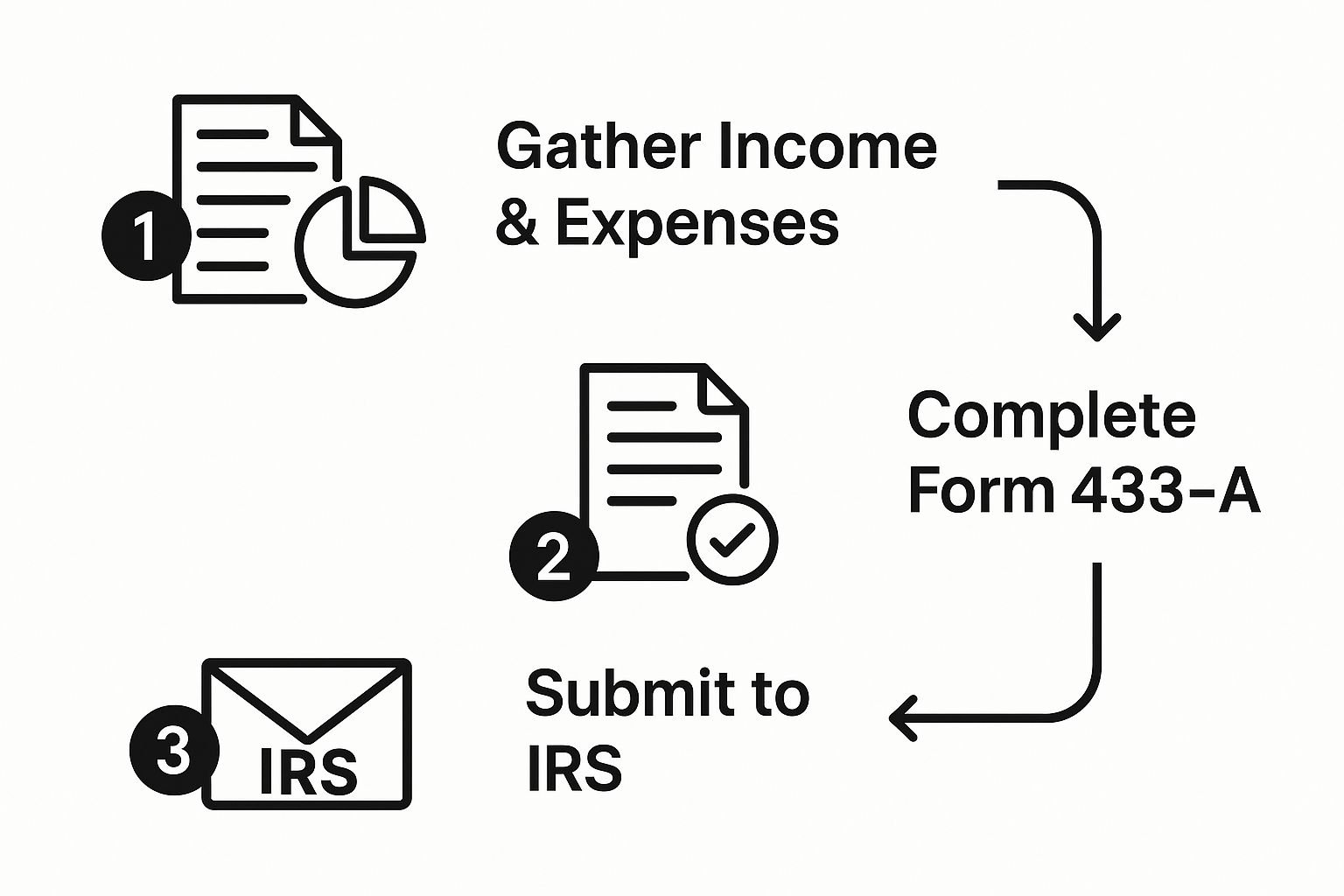
As you can see, sending the package is the last thing you do before the IRS takes over.
Your case will eventually land on the desk of an Offer Specialist or Revenue Officer who will pick it apart. It’s almost guaranteed they will reach out for more information or clarification on a few points. This is completely normal and not a sign that your case is in trouble. The key is to respond quickly and provide exactly what they've asked for. Dragging your feet can make you look uncooperative and might get your offer rejected before it's even properly considered.
Responding to a Rejection
If you get a letter saying your offer was rejected, take a breath. It’s not necessarily the end of the road. The letter will explain why the IRS said no, which is incredibly useful information. You usually have 30 days from the date on that letter to file an appeal, and your appeal must directly challenge the reasons they gave for the denial.
For instance, maybe they rejected your offer because they believe your future income will be much higher than you estimated. Your appeal would need to include solid proof to back up your original numbers, like a new employment contract with a lower salary or data showing a downturn in your industry.
If the appeal doesn't work out, you might be able to submit a brand new offer, but only if your financial situation has changed in a meaningful way. It's a challenging process, but an initial "no" doesn't always close the door for good.
Your Action Plan for Form 433-A OIC Success
Let's tie all this together into a practical game plan. Successfully handling the Form 433-A OIC process is much more than just filling out a form; it's about executing a well-thought-out strategy.
Think of this as your roadmap, guiding you from gathering your documents to knowing when it's time to call for backup. A methodical approach not only keeps you organized but drastically cuts down on mistakes that could get your offer rejected right out of the gate.
The Prioritized Task List
Before you even think about putting pen to paper, your first job is to get your financial life in order. I recommend creating a dedicated folder, either on your computer or a physical one, with three specific sections: Income, Assets, and Expenses. As you collect each document—pay stubs, bank statements, property deeds, car titles, utility bills—file it away immediately. This simple system will save you from that frantic, last-minute search for a crucial piece of paper.
Once you have your documents, it's time to tackle valuation. For every single asset you own, you need to establish its fair market value. This can't be a wild guess. Use real-world tools like Kelley Blue Book for your cars and look at recent comparable sales in your neighborhood for your home.
With all your documents sorted and your assets properly valued, you can finally start completing the form, confident that your numbers are solid and backed by proof. Getting this groundwork right makes everything that follows much easier.
When to DIY vs. When to Call a Pro
While it's certainly possible to handle a Form 433-A OIC on your own, certain situations are major red flags that you might need professional help. If your financial situation involves any of the following, I strongly suggest you consider talking to an expert:
You own a business or a share in one.
You have assets held in trusts or own complex investments.
You share major assets with a spouse who isn't part of the tax debt.
You still have unfiled tax returns or are in the middle of other disputes with the IRS.
The IRS itself offers resources, like its Offer in Compromise page, to help you understand the process.
This official site is a good place to start, but it also reveals how strict and formula-driven the program is. Navigating these complexities alone, especially in tricky cases, can be a real challenge.
Backup Strategies and Alternatives
Finally, you always need a Plan B. An Offer in Compromise is never a sure thing. If the IRS turns down your offer and an appeal doesn't work out, you still have other paths forward.
You can often shift to a Partial Pay Installment Agreement (PPIA), where you make manageable monthly payments for a set time, and the rest of the debt is forgiven.
Another route is being declared Currently Not Collectible (CNC) if your financial hardship is severe. The important thing to remember is that an OIC is just one of several ways to resolve your tax debt.
Dealing with the IRS can feel overwhelming. If your situation is complicated or you're just not sure where to start, don't be afraid to seek expert guidance. I offer a FREE Tax Debt Analysis to review your case and map out the best strategy for you, ensuring you have a clear plan before you owe any fees.
➥ Contact Attorney Stephen A. Weisberg for a free Tax Debt Analysis.
Contact Me Here: https://www.weisberg.tax/contact-1
Email: s.weisberg@weisberg.tax
Phone/Text: (248) 971-0885
Address: 300 Galleria Officentre, Suite 402, Southfield, MI 48034
