How to Calculate Estimated Tax Payments
So, you're earning money outside of a traditional W-2 job. Great! But before you can figure out how to pay your taxes, you need to know if you're on the hook for estimated tax payments in the first place.
The IRS has a simple rule of thumb: if you expect to owe at least $1,000 in tax for the year from income that didn't have taxes withheld, you're expected to pay as you go. This is a common reality for freelancers, small business owners, and anyone with a profitable side hustle.
Figuring Out If You Need to Pay Estimated Taxes

The U.S. tax system is built on a "pay-as-you-go" principle. If you're a traditional employee, you never really think about this. Your employer handles it for you by withholding taxes from each paycheck and sending that money to the IRS.
But when you work for yourself or have other income streams—like from investments or a rental property—there's no employer to manage that process. The responsibility falls squarely on your shoulders. That’s where estimated tax payments come in.
Who Usually Has to Pay?
You'll almost certainly need to make these quarterly payments if you fit into one of these categories:
You're self-employed: This is the big one. It covers freelancers, independent contractors, and gig economy workers.
You're a small business owner: This includes sole proprietors, partners in a partnership, and most S corporation shareholders.
You have other untaxed income: This could be earnings from interest, dividends, rent, or even alimony where no tax was withheld at the source.
Basically, if you have a significant amount of income that isn't being taxed automatically, the IRS wants you to send in your tax payments in four installments throughout the year.
The whole point is to prevent a huge, shocking tax bill when you file your annual return. Paying quarterly helps you manage cash flow and keeps you from having to come up with a giant lump sum in April.
Trying to skip this isn't a good strategy. If you don't pay enough tax throughout the year, the IRS can hit you with underpayment penalties and interest—even if you pay the full amount when you file your return.
The penalty is calculated for each quarterly period you came up short, so falling behind early can be an expensive mistake. The first step toward staying compliant and financially sound is simply understanding your responsibility.
Gathering the Right Financial Documents

Before you can even think about calculating your estimated taxes, you need to get your financial house in order. Trying to pull numbers out of thin air is a classic mistake that can lead you to overpay—or worse, get hit with an underpayment penalty from the IRS.
The goal here is to build a clear, accurate picture of your financial life for the year so far.
Your best friend in this process is last year's tax return. This document, probably a Form 1040 with a Schedule C if you're a sole proprietor, is your roadmap.
It shows exactly what you earned, what you deducted, and what your final tax bill looked like. It's the perfect starting point, especially if your business is chugging along similarly to last year.
Your Essential Document Checklist
Of course, last year's return is just a guide. You need current, real-time numbers to make an accurate estimate. It's time to gather the specifics for this year.
Proof of All Your Income: This isn't just invoices. Pull together statements from payment processors like Stripe or PayPal, look at your bank deposits, and don't forget any capital gains from investments.
A Complete List of Business Expenses: Every dollar you spend to run your business can lower your tax bill. Track it all—software subscriptions, office supplies, client lunches, mileage, you name it.
Details on Personal Deductions: Are you paying student loan interest? Contributing to an HSA? These personal deductions reduce your taxable income, so make sure they're accounted for.
I've seen it time and again: a good system for tracking income and expenses is what separates a smooth tax season from a frantic, stressful one. This isn't just about taxes; it's a core part of running a smart business.
Getting these documents together really highlights how tax structures can affect your bottom line. It's easy to forget that rates change. For a bit of perspective, the top U.S. marginal tax rate was over 90% in the 1950s before eventually falling to its current level of 37%. Seeing these shifts really drives home why accurate, current calculations are so important.
You can explore more of these historical taxation trends on Our World in Data if you're curious.
Getting a Handle on Your Annual Income and Deductions
Estimating your yearly earnings is the starting point for figuring out your quarterly tax payments. If you're self-employed, I know this can feel like gazing into a crystal ball, especially when your income ebbs and flows. The trick is to ground your forecast in reality.
Start with what you’ve earned so far. Let's say you pulled in $30,000 in the first quarter. A straight-line projection suggests you're on track for $120,000 for the year.
But we know it's rarely that simple. You have to be honest about seasonality—is summer a slow period for you? Did you just land a big project that will skew the numbers? Factor in those peaks and valleys to get a more realistic number.
From Gross Revenue to Your Actual Profit
Once you have a ballpark income figure, it's time to subtract what you spent to earn it. This is precisely why keeping good records all year isn't just busywork; it's a critical step that directly lowers your tax bill. Every dollar you spend on legitimate business costs—software, supplies, a portion of your home office, travel to meet a client—reduces your net profit.
Let's look at a real-world example. Imagine Sarah, a freelance marketing consultant, estimates she'll bring in $90,000 this year. She’s been tracking her expenses meticulously and anticipates they’ll hit around $20,000.
Projected Gross Income: $90,000
Estimated Business Expenses: -$20,000
Estimated Net Profit: $70,000
That $70,000 is her estimated net profit—the number that really matters for her tax calculations.
This infographic breaks down how you get from that total income number all the way down to your final tax liability.
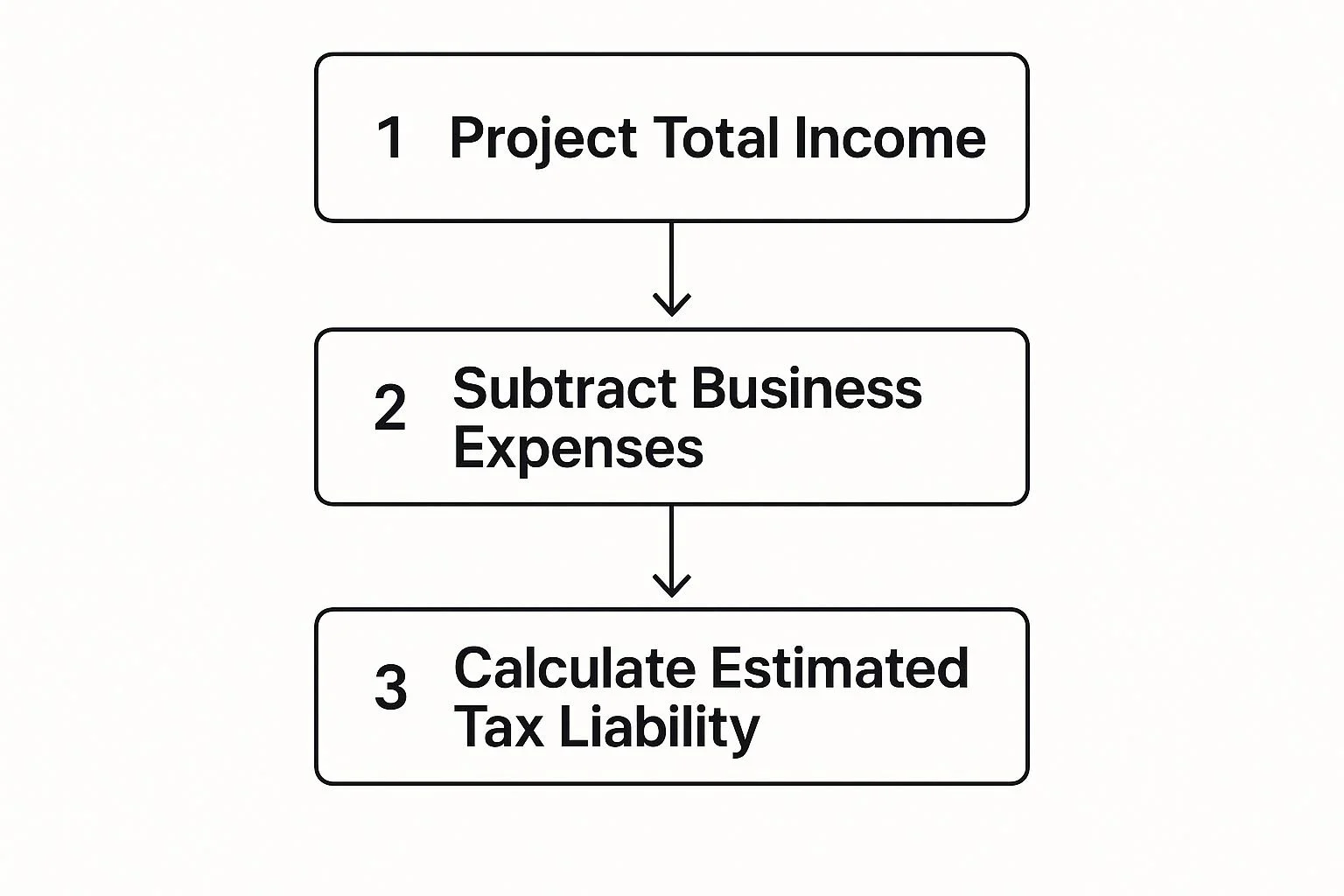
As you can see, each piece of the puzzle builds on the last, giving you a clear path to what you'll owe.
Don't Forget Personal Deductions and Self-Employment Tax
Your business profit isn't the final number the IRS uses. Before you get there, you have to account for the self-employment (SE) tax. Think of it as playing the role of both employee and employer for your Social Security and Medicare contributions. It’s a flat 15.3% tax, but it's applied to 92.35% of your net earnings, not the full amount.
After that, you can lower your income even more with personal deductions. The most common ones for freelancers include:
One-Half of Your Self-Employment Tax: The IRS gives you a break by letting you deduct half of what you paid in SE taxes.
The Standard Deduction: For 2024, the standard deduction is $14,600 for single filers. Most people take this unless their itemized deductions (like mortgage interest and state taxes) are higher.
Retirement Contributions: Money you put into a SEP IRA, solo 401(k), or traditional IRA can often be deducted, lowering your taxable income while you save for the future.
Getting these projections right is so important for avoiding underpayment penalties. For many, turning to services that provide support for creators in financial planning can be a huge help in navigating this.
By looking at both your business profit and your personal tax situation together, you get a complete financial picture. This holistic view is the secret to calculating your estimated payments correctly and avoiding a nasty surprise come tax time.
Once you’ve nailed down your final estimated taxable income, you can apply the current tax brackets to figure out your income tax liability.
Your total estimated tax for the year is simply your income tax liability plus your self-employment tax. Divide that number by four, and you have your quarterly payments.
Quarterly Estimated Tax Payment Deadlines
Staying on top of your deadlines is just as important as getting the numbers right. The IRS doesn't follow a neat three-month calendar, so it's easy to get tripped up. Here are the standard due dates to mark in your calendar.
| Payment Period | Due Date |
|---|---|
| January 1 – March 31 | April 15 |
| April 1 – May 31 | June 15 |
| June 1 – August 31 | September 15 |
| September 1 – December 31 | January 15 (of the next year) |
Remember, if a due date falls on a weekend or holiday, the payment is due on the next business day.
Getting to Grips with IRS Form 1040-ES
Once you’ve wrestled with your income and deduction projections, it’s time to put those numbers onto the official IRS worksheet. That’s Form 1040-ES, Estimated Tax for Individuals.
Don't let it intimidate you. At its core, the form is just a guided calculator. It methodically walks you through calculating your adjusted gross income, factoring in deductions and credits, and tacking on the self-employment tax we discussed earlier. It’s the IRS's way of making sure you connect all the dots.
Here’s a look at the official IRS page where you can find the form and its instructions. It's your home base for this process.
What If Your Income Is All Over the Place?
Let's be real—most freelance or small business income isn't a neat, predictable salary. What if you land a huge project in the fall and make 80% of your money in the last four months of the year? Simply dividing your total estimated tax by four doesn't make sense for your cash flow.
This is exactly why the IRS created the Annualized Income Installment Method.
This approach lets you pay estimated taxes based on what you actually earned in each specific payment period. So, your first-quarter payment might be tiny, while your fourth-quarter payment is much larger. It’s a bit more work, and you absolutely have to keep detailed records, but it's a lifesaver for managing lumpy income and avoiding penalties.
It's interesting to see how tax systems handle this globally. Direct taxation is a primary revenue driver for governments everywhere, a point driven home by the OECD's Global Revenue Statistics Database. The data shows just how differently countries approach tax collection, which really puts our own system into a broader perspective.
The Easiest Way to Avoid Penalties: Safe Harbor Rules
If tracking income quarter by quarter sounds like a headache you don't need, there's a much simpler way to stay on the IRS's good side. It’s called the "safe harbor" rule.
Think of it as a simple benchmark. As long as your total estimated tax payments hit this target, you generally won't face an underpayment penalty.
You’re in the clear if you pay the lesser of these two amounts:
90% of the tax you’ll owe for the current year.
100% of the tax you paid for the previous year.
There's one small exception. If your adjusted gross income (AGI) last year was over $150,000, that second option changes. You’ll need to pay 110% of last year's tax bill to qualify for the safe harbor.
For most people, just paying 100% of what you paid last year is the simplest, most straightforward way to handle estimated taxes without any complex calculations or guesswork.
Making Payments and Steering Clear of Common Mistakes

Alright, you've done the hard work of calculating your estimated payment. Now it's time to actually send the money to the IRS. You have a few solid options here.
Many people still prefer mailing a check with a Form 1040-ES payment voucher. It’s a classic for a reason.
But for a faster, more modern approach, I often recommend IRS Direct Pay. It lets you make a secure payment right from your bank account for free, and you get an immediate confirmation. No more wondering if your check got lost in the mail. You can also look into the Electronic Federal Tax Payment System (EFTPS) or pay with a debit or credit card, though card payments usually come with a processing fee.
Common Pitfalls and How to Sidestep Them
Knowing how to pay is just one piece of the puzzle. The real trick is avoiding the common errors that can trip people up year after year.
One of the most frequent mistakes I see is completely forgetting about state-level estimated taxes. It’s easy to do! But most states have their own "pay-as-you-go" systems with entirely separate rules and deadlines that you need to stay on top of.
Another major tripwire is miscalculating your income, especially if your earnings are unpredictable. If you land a huge project or have a surprisingly slow quarter, your initial estimate can become obsolete pretty fast. The key is to think of your estimate as a living document, not something you set in stone.
Don't just set your payments in April and forget about them. I always tell my clients to review their income and expenses before each quarterly deadline. A quick check-in lets you see if you need to adjust your payment up or down, which can save you from a massive, unexpected bill (or a big overpayment) come tax time.
This is where understanding the estimated tax payment schedule is so important—it gives you those built-in checkpoints. For a bit of perspective, it's interesting to compare the US system with others; for example, you can learn about similar concepts through resources like Understanding UK Payments On Account.
International business can throw another wrench in the works. The U.S. government's net taxes from international business activities hit over $183 billion in January 2024, which shows just how much money and complexity is involved. If this is you, make sure you're accounting for things like taxes withheld from foreign recipients to keep your estimates accurate. The IRS offers some deep dives on international tax statistics if you want to learn more.
Answering Your Top Estimated Tax Questions
Once you get the hang of estimated taxes, you’ll find a rhythm. But along the way, plenty of questions pop up. Let's walk through some of the most common ones I hear from freelancers and small business owners.
What Happens If I Blow a Deadline?
It happens. If you miss a payment deadline, the first thing to know is not to panic, but to act quickly. The IRS will likely hit you with an underpayment penalty.
This isn't some flat fee; it's calculated based on how much you underpaid and exactly how long that money was overdue. The best thing you can do is pay what you owe as soon as you remember. The sooner you pay, the less interest racks up. In rare cases, like a federally declared disaster, the IRS might cut you some slack and waive the penalty, but don't count on it.
Can't I Just Pay It All at the End of the Year?
Technically, you can send the IRS a big check in January, but it's a terrible idea. The U.S. has a pay-as-you-go tax system, which means they expect to get their money throughout the year, not all at once.
Think of it this way: even if you pay the correct total for the year, waiting until the last minute means you've technically underpaid for the first, second, and third quarters. The IRS will penalize you for each of those missed periods. Timing is just as important as the total amount.
My Income Spiked! How Do I Adjust My Payments?
Freelance and business income is rarely a straight line—it’s full of peaks and valleys. If you land a huge project or have a slow month, you need to adjust your tax payments accordingly.
The best practice here is to recalculate your estimated tax for the rest of the year. Grab a fresh Form 1040-ES and run the numbers again with your new income projection. Adjusting your remaining payments helps you avoid a nasty surprise tax bill or an unnecessarily large refund. It's all about keeping your cash flow as smooth as possible.
Do I Owe State Estimated Taxes, Too?
This is the one that trips up so many people: yes, you almost certainly do. If your state has an income tax, it will have its own system for quarterly estimated payments.
Don't assume the rules are the same as the federal ones. States have their own deadlines, their own forms, and their own penalty calculations. Make sure you check your specific state's tax agency website. Ignoring this can leave you with a whole separate batch of penalties and headaches.
At Attorney Stephen A Weisberg, we understand that navigating the complexities of IRS and state tax issues can be overwhelming. If you're facing tax debt or compliance challenges, start with a FREE Tax Debt Analysis to see how we can help you find the best possible outcome. Learn more at weisberg.tax.
Want to understand your options before you call anyone?
Download my free book — Freedom From Tax Debt — a plain-language guide to how the IRS collections process actually works and what resolution really looks like.
➥ Contact Attorney Stephen A. Weisberg for a free Tax Debt Analysis.
Contact Me Here: https://www.weisberg.tax/contact-1
Email: s.weisberg@weisberg.tax
Phone/Text: (248) 971-0885
Address: 300 Galleria Officentre, Suite 402, Southfield, MI 48034
