Your Guide to an IRS Taxes Owed Payment Plan
That feeling when you see the final number on your tax return and your stomach drops? It’s a stressful moment, but it’s more common than you think. The good news is the IRS has a structured way to handle it: an Installment Agreement.
Think of it as a taxes owed payment plan. It lets you break down a daunting lump-sum bill into manageable monthly payments, giving you the breathing room to get things sorted without the threat of more severe collection actions.
What to Do When You Owe the IRS

First thing's first: don't panic. And definitely don't ignore it. An IRS notice is one piece of mail that won't just go away. Letting it sit just means penalties and interest start piling up, and what was once a manageable problem can quickly spiral.
The smartest move is to get ahead of it by setting up a formal arrangement. An IRS payment plan is simply an agreement to pay off your tax liability in monthly installments, often for up to 72 months. It’s built for people who fully intend to pay what they owe but just can't do it all at once.
A Common Scenario for Freelancers
I see this all the time with self-employed folks. Take a freelance graphic designer who has a fantastic year, landing one big project after another. She's so wrapped up in the work that she forgets to make her quarterly estimated tax payments. Come April, she's hit with a $12,000 tax bill she simply doesn't have in the bank.
Instead of letting that debt snowball, she looks into her options and realizes she's a perfect candidate for an IRS payment plan. She sets up a long-term installment agreement, works out a monthly payment of $200 that fits her budget, and instantly gets that weight off her shoulders. It gives her a clear, manageable path forward.
And she’s not alone. In 2022, the IRS had about 1.4 million active installment agreements, covering roughly $51 billion in tax debt. It’s a standard tool that millions of Americans use to get back on solid ground.
Understanding Your Main Options
When you owe the IRS, you generally have two main paths to choose from. Your decision really comes down to how much you owe and how fast you think you can pay it off.
Short-Term Payment Plan: This gives you up to 180 extra days to pay your bill in full. It’s a great fit if you just need a few months to pull the money together, maybe from a bonus or a client payment you’re waiting on.
Long-Term Installment Agreement: If 180 days isn't nearly enough time, you can apply for a long-term plan. This lets you make monthly payments for up to six years (72 months), making it a much more sustainable option for larger debts.
IRS Payment Plan Options at a Glance
Use this quick comparison of IRS payment plans to see which approach might best fit your financial situation.
| Feature | Short-Term Payment Plan | Long-Term Installment Agreement |
|---|---|---|
| Payment Period | Up to 180 days | Up to 72 months (6 years) |
| Best For | Smaller tax bills; temporary cash flow issues | Larger tax debts; needing extended time to pay |
| Setup Fees | No setup fee | Fees apply (can be reduced or waived for some) |
| Application Process | Simple online request | Online application or forms (Form 9465) |
Deciding between these options depends entirely on your personal circumstances. The key is to pick the one that you can realistically stick with.
Key Takeaway: The absolute most important thing you can do is file your tax return on time, even if you know you can't pay the full amount. The penalty for failing to file is much, much worse than the penalty for failing to pay.
Trying to figure all this out can feel overwhelming, especially when you're already stressed about the debt. This is where professional tax preparation services can be a huge help. An expert can walk you through the pros and cons, ensure you choose the best plan for your situation, and help you get back to a place of financial stability. Making an informed choice is your first step toward peace of mind.
Checking If You're Eligible for a Payment Plan
Before you even think about filling out an application, you need to make sure you actually qualify for an IRS payment plan. The IRS has a few hard-and-fast rules, and meeting them is your first step toward getting a plan approved. Think of it as a quick reality check to avoid wasting time and energy.
The two biggest hurdles are your total tax debt and your filing history. These rules are in place to make the process smoother for most taxpayers and to ensure everyone is playing by the same book.
The Debt Threshold: How Much Do You Owe?
First, let's talk numbers. To get into the streamlined, online application process, your total bill—including tax, penalties, and interest—has to be less than $50,000.
This cap covers the vast majority of individual taxpayers and many small businesses. It lets the IRS automate the approval process without digging deep into your financial life right away. If you owe more than $50,000, you can still get a payment plan, but be prepared for a more hands-on process. You'll likely need to submit detailed financial statements and negotiate directly.
The Golden Rule: Get Your Filings in Order
This next point is non-negotiable and often trips people up: you must have filed all your required tax returns. The IRS won't even talk about a payment plan for this year's taxes if you're behind on previous years' filings.
It makes sense from their perspective. Why would they set up a payment arrangement for a known debt if they suspect you might owe even more from unfiled returns? It's like trying to fix a single leaky pipe while ignoring the fact that the whole basement is flooding. You have to address the entire problem.
This infographic breaks down the core requirements for a streamlined agreement.
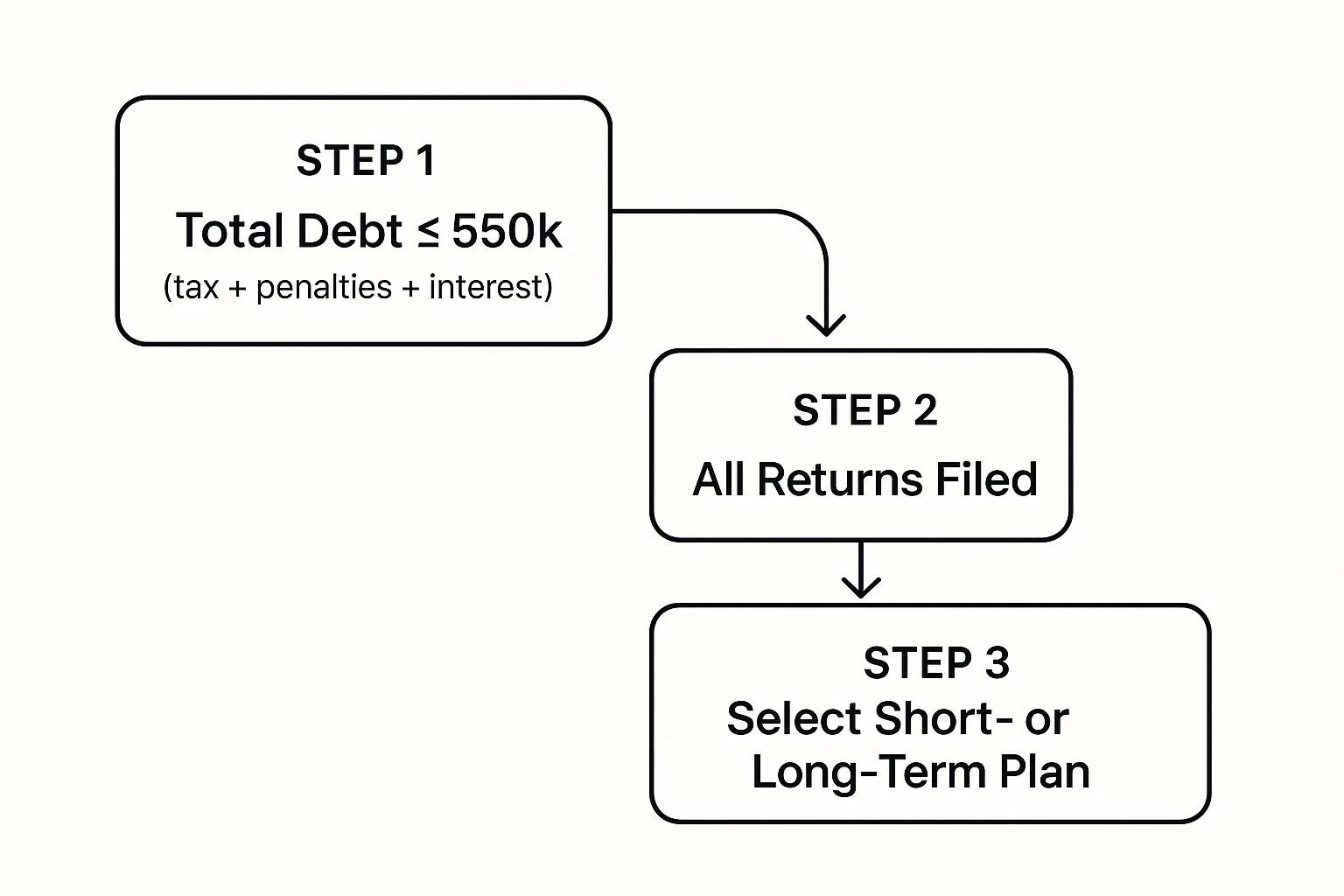
As you can see, clearing these first two hurdles is your ticket to even considering a payment plan. It’s the foundation for everything that comes next.
What This Looks Like in Real Life
Let’s imagine a freelance graphic designer, Sarah. She owes $35,000 for the most recent tax year but got so busy with a huge project two years ago that she completely forgot to file that year's return. It was an honest mistake, but it has consequences.
When Sarah goes online to set up a payment plan, she's stopped in her tracks. The system flags that missing return and denies her application. Even though her $35,000 debt is well under the limit, her failure to file makes her ineligible. The only way forward is for her to prepare and submit that old return. Once the IRS processes it, she can reapply and will almost certainly get approved.
Crucial Insight: Your past compliance dictates your future options. The IRS sees filing all returns as a sign of good faith, making them far more willing to work with you on a payment solution for the debt you've accrued.
Your Pre-Application Checklist
Before you start, run through this quick self-check. If you can answer "yes" to these questions, you’re in a great position to get your plan approved.
Total Debt: Is your combined tax, penalty, and interest balance under $50,000?
Filing Status: Have you filed all mandatory tax returns for all previous years?
Long-Term Plan Debt: If you need more than 180 days to pay, is your total debt under $25,000? (This isn't a hard cap for all plans, but it opens the door to simpler, streamlined options).
Meeting these benchmarks is often a key part of programs designed to help people get back on solid ground. For those who qualify, initiatives like the IRS Fresh Start Program can offer even more flexible payment terms. It's worth looking into these relief options to see if they can provide a better path forward.
By taking a few minutes to confirm you're eligible, you save yourself the headache of a rejected application and can focus on getting your plan in place. It turns a stressful situation into a structured, manageable task.
Applying for a Payment Plan Through the IRS Website
Hands down, the fastest way to set up a payment plan for taxes owed is directly through the IRS's own website using their Online Payment Agreement (OPA) tool. This is your best first move. It’s an automated system designed to give you an immediate answer without ever having to wait on hold.
But before you jump in, a little prep work will make the whole process a lot smoother. Think of it like gathering your ingredients before you start cooking—it prevents a lot of scrambling later.
What to Have on Hand Before You Start
To get through the online application without a hitch, you’ll need to have some specific information ready. The system uses these details to confirm it's really you and to access your tax account.
Here's a quick checklist of what to grab:
Your Name and Address: Make sure it's the exact same one the IRS has on file from your last tax return.
A good Email Address and Phone Number.
Social Security Number (SSN) or Individual Taxpayer Identification Number (ITIN).
Your Date of Birth.
Filing Status (e.g., Single, Married Filing Jointly) from your most recent return.
The total balance you owe. The easiest place to find this is on your most recent IRS notice, like a CP14. That letter has the exact amount and often a notice number you might need.
Once you’ve got all that in front of you, you're ready to tackle the application. The goal is to get in, get approved, and get on with your life.
Walking Through the Online Application
The IRS website will guide you through the process, but the first big hurdle is always identity verification. The IRS is, understandably, very serious about security. You might have to answer some personal financial questions or use their verification partner, ID.me, to prove you are who you say you are.
This is the starting line—the main page for the Online Payment Agreement application.

As you can see, the page itself lays out who’s eligible and what you’ll need, which is why we stress being prepared before you even click "Apply."
After you’re verified, the system will show you what you owe. From there, it's time to propose a monthly payment that you can realistically handle. This is your moment to set terms that work for your budget.
My Pro Tip: When you propose a monthly payment, pick an amount you are 100% certain you can make, no matter what. It is far better to start with a lower, guaranteed payment and pay extra when you can than to aim too high and default on the whole agreement. A default can undo all your hard work.
The system gives you an instant verdict. If your proposed payment is enough to clear the debt within the standard timeframe (usually 72 months), you’ll likely get approved on the spot.
Making Your Offer
When you get to the part where you enter a payment amount, the system will often suggest a minimum payment. If you can afford that number, or even a little more, it’s a good idea to do so. Paying more means you’ll save on penalties and interest in the long run.
But what if you can't afford their suggested minimum? This is where things can get a bit more involved. The IRS may ask you to provide detailed financial information to justify a lower payment. This often means filling out a Collection Information Statement.
Let’s look at a quick, real-world example:
Alex, a freelance writer, owes $18,000. He logs into the OPA tool.
The system calculates a minimum payment of $250 per month to satisfy the debt in 72 months.
Alex knows his budget is tight but feels he can safely manage $275 a month. He proposes that amount.
Because his offer meets the IRS's criteria, the system gives him instant approval. Just like that, his payment plan is active.
For Alex, the entire process took less than half an hour.
Common Roadblocks (And How to Get Past Them)
While the online tool is great, it’s not perfect. The most frequent snag people hit is with identity verification. If the info you type in doesn't perfectly match what the IRS has on file, it will lock you out for security. If that happens, take a breath, double-check every character on your documents, and try again.
Another common stop sign is having unfiled tax returns or owing too much money. As mentioned before, the OPA tool has its limits. The system will simply deny applications that fall outside its core criteria. The only way forward is to tackle the root problem first—get those back taxes filed—and then return to set up your taxes owed payment plan.
Understanding the True Cost of Your Payment Plan
Getting an IRS payment plan approved is a massive weight off your shoulders. But here’s something most people don’t realize: the amount you owe isn't frozen. The IRS continues to tack on costs until that balance is finally paid in full.
Think of it like a loan from the government. Just like any other loan, it comes with fees and interest that build up over time. Knowing exactly what these costs are from the get-go is the only way to manage the debt without any nasty surprises later on.
Breaking Down the Setup Fees
The moment you lock in a long-term installment agreement, the IRS hits you with a one-time setup fee. How much you pay depends on how you apply and what your income level is.
Online Application: This is your cheapest route. Applying online and agreeing to direct debit payments from your bank account will get you the lowest fee.
Phone, Mail, or In-Person: Going the old-school route will cost you quite a bit more. The fee is significantly higher for these methods.
Low-Income Taxpayers: Good news here. The IRS might reduce or even waive the fee entirely if your income is below a certain threshold, so it's always worth checking if you qualify.
Setting up automatic withdrawals (Direct Debit) is a smart move. Not only does it lower that initial setup fee, but it also ensures you never miss a payment and trigger a whole new set of problems.
Penalties and Interest Don't Just Vanish
This is the single biggest misconception about IRS payment plans. While having an approved plan stops the really scary collection actions like wage garnishments, it absolutely does not stop penalties and interest from growing.
Here's the deal: The Failure to Pay penalty—which is normally a painful 0.5% of your unpaid tax bill every single month—gets a nice discount. Once your installment agreement is active, that penalty rate drops to 0.25% per month. It's a big help, but it's not zero.
Interest is a different beast. It keeps compounding daily on your entire outstanding balance. That means you’re paying interest on the original tax, the penalties, and the interest that’s already been added. The rate also changes quarterly, so your total cost isn't fixed.
Key Insight: A payment plan doesn't stop penalties; it just slows them down. The only way to truly minimize these costs is to pay off the core tax debt as aggressively as your budget allows.
A Real-World Cost Example
Let's make this real. Say you owe the IRS $10,000 and get set up on a long-term plan.
Original Debt: $10,000
Monthly Payment: $200
Setup Fee (Online, Direct Debit): $31
Reduced Failure to Pay Penalty: 0.25% per month on the remaining balance
Interest: Compounding daily (we'll use a 7% annual rate for this example)
By the time you make your final payment, the added penalties and interest will have easily tacked on hundreds, maybe even thousands, of dollars to that original $10,000. This is exactly why throwing extra money at the principal whenever you can is so important.
Interestingly, broader economic trends can have a real impact here. For instance, when inflation rises, some countries adjust their tax policies to help people cope. In one recent case, a country indexed its tax brackets to inflation, resulting in a tax cut for everyone. Changes like that can free up cash, making it easier for people to handle tax debts and maybe even avoid a payment plan altogether.
You can read more about how global tax rates are changing on airshare.air-inc.com.
What to Do After Your Payment Plan is Approved

Getting an IRS payment plan locked in is a huge relief, but it’s not the end of the road. Life is unpredictable, and your financial situation can shift. Staying on top of your agreement means paying on time, every time, and knowing exactly what to do if your circumstances change.
Think of your installment agreement as an active commitment. If you let it slide, you risk undoing all your hard work and landing right back in the thick of IRS collections.
Staying in Good Standing with the IRS
Keeping your agreement active comes down to two non-negotiable rules. If you break either one, the IRS can default your plan, which cancels the agreement and brings back the threat of aggressive collection actions like liens and levies.
Make Every Payment on Time. This one’s the most straightforward. Whether you’re mailing a check, paying online, or using direct debit, your payment has to be on time, without exception. A missed payment is the quickest route to a default notice.
Stay Current on All New Taxes. This is the one that catches so many people off guard. Your payment plan only covers past tax debt. You are still required to file and pay all your future taxes in full and on time. If you owe the IRS again next year and can't pay, it can jeopardize your existing agreement.
An IRS payment plan isn't a "set it and forget it" deal. It’s an ongoing financial responsibility that demands you manage both your old debt and your current tax obligations.
To stay organized and avoid missing a due date, it's worth the time spent on setting up effective email reminders. This simple habit can save you a world of headaches.
When You Can't Afford the Monthly Payment Anymore
Let's be realistic—things happen. A sudden job loss, a medical emergency, or a steep drop in business revenue can make that once-manageable payment feel impossible.
If you find yourself in this situation, the absolute worst thing you can do is nothing. Just stopping your payments and hoping the IRS doesn't notice is a recipe for disaster.
The good news is the IRS is often willing to work with taxpayers who communicate proactively. If your income takes a hit, contact them immediately to talk about modifying your agreement. You have options for revising the terms of your taxes owed payment plan, which could mean lowering your monthly payment to something you can actually handle.
You can often request these changes right through the Online Payment Agreement (OPA) tool on the IRS website. When you log in to your account, you should see an option to revise your plan. For more complicated situations, you may need to call the IRS directly or submit a new financial statement (Form 433-F) to prove your change in circumstances.
A Real-World Example: What a Job Loss Looks Like
Take Mark, a freelance marketing consultant. He set up a plan to pay $400 a month on a $20,000 tax bill. Six months in, he lost his largest client, and his income plummeted by 60%.
Instead of panicking and missing payments, Mark went straight to his IRS online account. He used the revision tool to propose a new payment of $150 per month, reflecting his new reality. Because he was proactive and didn't wait until he was already in default, the IRS approved the change. That one move kept his account in good standing and saved him from a flood of collection notices.
What Happens to Your Tax Refunds?
Here’s a detail that often comes as a surprise: as long as you have a taxes owed payment plan, you won't be seeing any tax refunds.
The IRS will automatically seize any refund you're due and apply it directly to your tax debt. This isn't optional—it's a standard condition of the agreement. While it’s tough to miss out on that expected cash, look at it as a forced lump-sum payment. It helps you clear the debt faster, which ultimately saves you money on penalties and interest.
Once your tax bill is paid in full, your refunds will start coming to you again as usual.
Your Top Questions About IRS Payment Plans, Answered
Feeling overwhelmed by tax debt is normal, and it's natural to have a lot of questions. Getting the right answers is the first step toward finding a solution and getting peace of mind. Let’s break down some of the most common things people ask when they're looking into a payment plan for taxes owed.
I'm Self-Employed. Can I Still Get a Payment Plan?
Yes, absolutely. The IRS doesn’t distinguish between W-2 employees and self-employed individuals when it comes to payment plans. Freelancers, contractors, and sole proprietors are all eligible under the same rules as everyone else.
The real trick for self-employed folks is keeping up with your future taxes while paying off the past ones. You absolutely must stay on top of your quarterly estimated tax payments. Falling behind on those is one of the quickest ways to default on your installment agreement and undo all your hard work.
What’s the Maximum Time I Can Get to Pay Everything Off?
How long you have really depends on which type of plan you qualify for.
If you just need a little breathing room, a short-term payment plan gives you up to 180 days to clear the entire balance. This is a great option if you're just facing a temporary cash crunch and expect to have the money soon.
For bigger balances that require more time, a long-term installment agreement is the way to go. These plans can stretch out as long as 72 months (that’s six years). The IRS will calculate a minimum monthly payment designed to get you paid in full within that window. Of course, the sooner you can pay it off, the more you'll save on interest and penalties.
A Quick Expert Tip: The 72-month term is tied to something called the Collection Statute Expiration Date (CSED). This is the 10-year legal deadline the IRS has to collect what you owe. Your payment plan will always be structured to end before that 10-year clock runs out.
The Minimum Payment Is More Than I Can Afford. What Now?
Don't panic if the monthly payment proposed by the IRS—either through their online tool or an agent—is just not realistic for your budget. This is a common hurdle, and you have options.
This is where you may need to show the IRS your full financial picture by completing a Collection Information Statement (Form 433-F). By documenting your income and necessary living expenses, you can often negotiate a lower, more manageable payment. In severe hardship cases, the IRS might even agree to put your account in Currently Not Collectible status, which temporarily halts collections until your financial situation improves.
Will Setting Up an IRS Payment Plan Ruin My Credit Score?
This is a huge relief for most people: an IRS payment plan, by itself, does not get reported to credit bureaus like Equifax, Experian, or TransUnion. Your credit score won't take a direct hit just for entering into an installment agreement.
But here’s the important catch. If the amount you owe is substantial, the IRS might file a Notice of Federal Tax Lien. A tax lien is a public record, and it will show up on your credit report, which can do serious damage to your score.
The best way to avoid a lien is to be proactive. Getting into a payment plan before the IRS takes that step is key, especially for debts under $25,000 where you agree to automatic Direct Debit payments. It’s a powerful incentive to tackle the problem head-on.
At Attorney Stephen A Weisberg, we know that tax problems are personal, not one-size-fits-all. We start every case with a FREE Tax Debt Analysis to map out the best strategy for your specific circumstances. If you need a professional in your corner to negotiate with the IRS, we’re ready to help. Find out how we can help at weisberg.tax.
Want to understand your options before you call anyone?
Download my free book — Freedom From Tax Debt — a plain-language guide to how the IRS collections process actually works and what resolution really looks like.
➥ Contact Attorney Stephen A. Weisberg for a free Tax Debt Analysis.
Contact Me Here: https://www.weisberg.tax/contact-1
Email: s.weisberg@weisberg.tax
Phone/Text: (248) 971-0885
Address: 300 Galleria Officentre, Suite 402, Southfield, MI 48034
