How to Know If You Owe Taxes
The quickest way to know for sure if you owe the IRS is to go straight to the source: your IRS Online Account. This is your personal dashboard, and it gives you a direct, up-to-the-minute look at your balance, payment history, and return details. Logging in or creating an account is the single best first step to get a clear answer.
How to Quickly Find Out If You Owe the IRS
Think of your IRS Online Account as your command center for federal taxes. Instead of playing a waiting game for a letter to show up in your mailbox, you can log in anytime and see exactly what you owe for each tax year. It completely removes the guesswork.
You end up owing the IRS when your total tax bill for the year is higher than the sum of what you paid through withholdings and any tax credits you claimed.
If you find yourself in this boat, you're not alone. In fact, about 43 million Americans—or nearly 27% of taxpayers—owed money when they filed their 2023 returns. This often happens because not enough tax was withheld from a paycheck or estimated tax payments were too low.
Your IRS Dashboard Explained
Once you get into your account, you’ll find a straightforward summary of your tax situation. The IRS designed it to be user-friendly, placing the most important info—like your balance—right where you can see it.
The image below gives you a peek at what you might see inside the payment section of your account, specifically the tool for setting up a payment plan.

This shows that even when you owe, the IRS gives you accessible, self-service options to manage the debt right from your dashboard.
Fastest Ways to Check Your Tax Status
Here's a quick comparison of the most direct methods to see if you have a tax balance.
| Method | What It Shows | Best For |
|---|---|---|
| IRS Online Account | Real-time balance, payment history for the last 24 months, key details from your most recent return. | A quick, clear summary and managing payments or plans. |
| Account Transcript | A detailed log of all transactions for a specific tax year, including payments, penalties, and interest. | Seeing the full financial history for a single tax year. |
| Recent IRS Notice | The specific amount owed for a particular tax year, including penalties and interest as of the notice date. | Understanding a specific issue the IRS has flagged. |
While an IRS notice is a clear indicator you owe, proactively checking your Online Account or pulling a transcript gives you the power to get ahead of any potential issues.
Get Answers Straight From the Source: Your IRS Online Account
Think of your IRS Online Account as your personal dashboard for all things federal taxes. It’s hands-down the most direct way to see exactly where you stand with the IRS, cutting through the guesswork and giving you immediate answers.
Getting in requires a secure login, usually through the ID.me verification system, which is standard practice now for government sites. Once you’re logged in, you get a clear, year-by-year summary of your tax situation. You can see any outstanding balances, check your payment history, and even view digital copies of certain notices the IRS has sent you.
Finding What You Owe
After logging in, your first stop should be the "Balance" section. This is where the magic happens. It shows you a summary of any money you owe for each tax year, broken down into the original tax amount plus any penalties and interest that have been added on.
Pro Tip: Don't just glance at the most recent year. I've seen it happen where a small, forgotten balance from a few years back snowballs with penalties. Take a moment to click through each tax year listed to make sure you have a complete picture.
Next, head over to the "Payment History" tab. This is your reality check. If you think you’ve paid off a balance but it’s still showing as due, you can cross-reference your own records with what the IRS has logged. You’ll see the exact date and amount for every payment they've processed.
This is a great starting point for understanding the basic calculations that determine if you owe in the first place.
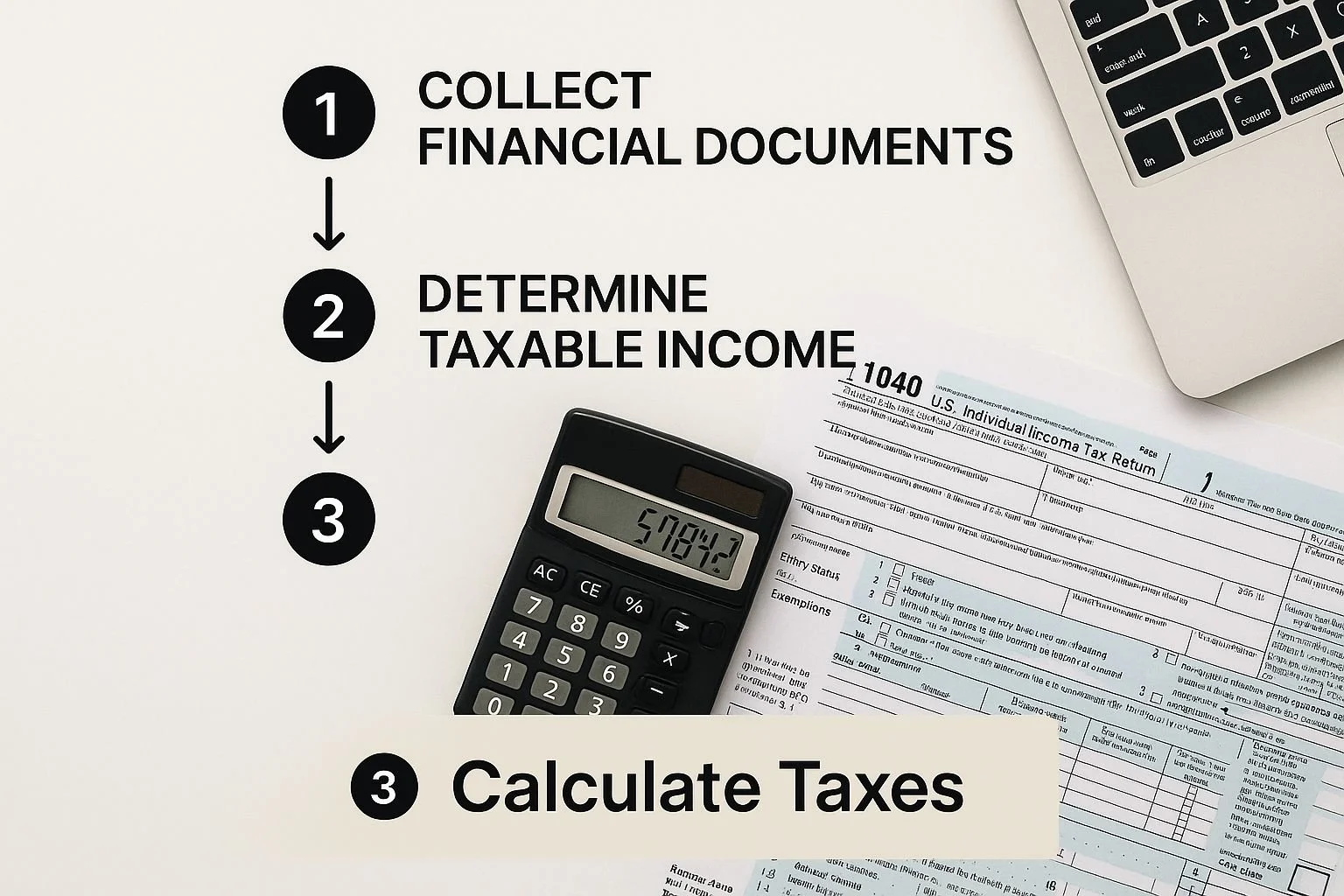
Ultimately, the online account is your best tool for getting definitive answers without waiting weeks for a letter to arrive in the mail. It puts you in control.
If your IRS online account gives you the big picture, tax transcripts deliver the fine print. Think of a transcript as the complete, unabridged story of your tax year, detailing every single action the IRS has on record for your account. It's an indispensable tool for figuring out not just if you owe taxes, but exactly why.
Diving into Tax Transcripts
While the IRS offers a few different types of transcripts, the Account Transcript is the one you'll want for this task. It won't show every line from your 1040, but it does provide a chronological log of all transactions. This includes every payment you've made, any penalties that were added, and every notice the IRS mailed out. I've seen cases where a tiny, forgotten balance from years ago has ballooned with interest, and the Account Transcript is where that story comes to light.
How to Get the Right Transcript
When you head over to the IRS website to pull your records, you'll be presented with a few choices. Let’s cut through the noise:
Account Transcript: This is your go-to. It gives you the full transaction history and is the quickest way to see if you have a current balance due.
Record of Account Transcript: This one is a combination of your tax return data and your account activity. It's much more comprehensive and often contains way more detail than you need just to check for a balance. Stick with the Account Transcript to keep things simple.
You can grab these directly from the IRS through their online Get Transcript tool.
This is the landing page you'll see when you go to request your records.

From here, you can log in and get direct access to your detailed tax history.
Once you have the transcript in hand, you'll see a series of codes and dates. It can look a bit intimidating at first, but you only need to focus on a few key entries. For example, transaction code 150 ("Tax Return Filed") establishes your initial tax liability for the year, and code 846 confirms a "Refund Issued."
Pro Tip: Look for codes related to assessments or penalties. A positive dollar amount next to a transaction like "Additional Tax Assessed" is a dead giveaway that you owe the IRS. Conversely, a negative number usually means you've made a payment or received a credit. Learning to read these codes turns a dense government document into a clear map of your financial history with the IRS.
Start With a Look at Your Own Records
Sometimes the fastest way to figure out if you owe the IRS is to simply check the documents you already have. Before you even think about logging into any government websites, a quick review of your own records can often clear things up, especially if you have a specific, recent tax year in mind.
Your most recent tax return is the best place to start. Pull out your completed Form 1040 and find the line that says "Amount you owe." If that line has any number greater than zero, you had a tax bill at the time you filed. Simple as that.
Did You Actually Pay What You Owed?
Seeing that "Amount you owe" is only half the story. The real question is, did the IRS get the money? This is where you need to put on your detective hat for a moment.
Pull up your bank statements from around the tax deadline (usually April 15th) and look for a payment made out to the "U.S. Treasury." If the amount withdrawn from your account matches the amount on your Form 1040, you’ve got a good confirmation that you paid.
A Word of Caution: Just because you scheduled a payment doesn't mean it went through. I've seen it happen where an electronic payment fails for some reason, and the taxpayer doesn't realize it until a notice with penalties shows up months later. Always double-check that the money actually left your account.
A Special Note for Self-Employed and Gig Workers
This step is crucial if you're a freelancer, run a small business, or have any income where taxes aren't automatically withheld. You're the one responsible for sending in those quarterly estimated tax payments.
Take a look at your payment records for the year in question. Did you make all four quarterly payments? Did you have a surprisingly good quarter and forget to adjust your payment accordingly? It only takes one missed or underestimated payment to leave you with a balance due when you file.
It's also good to remember the basic filing thresholds. For the 2023 tax year, for example, a single person under 65 generally had to file if their gross income was $13,850 or more. Knowing these fundamental rules helps you stay on top of your obligations from the start. For a broader look at government fiscal responsibilities, you can explore more about government financial frameworks on IMF.org.
Common Reasons for an Unexpected Tax Bill
Nothing throws a wrench in your financial plans quite like a surprise tax bill. It's a stressful, yet surprisingly common, situation. The good news is that by understanding what causes these shortfalls, you can adjust your strategy and avoid the same shock next year.
More often than not, the culprit is pretty simple: you didn’t have enough tax withheld from your paychecks throughout the year.
This is a classic issue after getting a raise or switching jobs. That new, higher income can easily push you into a different tax bracket, but if your W-4 withholdings aren't updated to match, you'll be left with a gap come tax time. Another major blind spot? Side hustles. If you're freelancing or doing gig work, you're the one responsible for setting aside money for taxes, since it’s not being done for you.
Major Life and Income Changes
Big life changes almost always have tax implications. Events like getting married, going through a divorce, or even a child aging out of dependent status will directly impact your filing status, the deductions you can take, and the credits you qualify for.
Investment income is another area that can catch people off guard. Selling stocks for a profit can create a significant tax liability if you haven't planned for it.
While you're figuring out what you owe, it's also smart to look ahead. Learning about effective tax loss harvesting strategies is a great way to proactively manage your tax bill by offsetting capital gains.
Expert Tip: Don't get caught off guard. I always tell my clients to use the IRS's Tax Withholding Estimator tool mid-year, especially after any major financial or personal change. It’s a five-minute check that can save you from a massive headache next spring.
While the specifics vary, these principles hold true in many places. Taxpayers in countries like Canada, the UK, and Australia also file annually, reconciling their income and life events against progressive tax rates. Recognizing these common pitfalls is the first real step toward smarter, more predictable tax planning.
When It's Time to Call a Tax Professional
The IRS online tools are fantastic for getting a quick look at your account, but let's be real—sometimes, you're in over your head. Knowing when to wave the white flag and bring in an expert isn't a sign of defeat; it's a smart move to protect your finances before a small hiccup snowballs into a full-blown crisis.
If an IRS notice lands in your mailbox and the language looks like something out of a legal textbook, it’s probably time to call for backup. A classic example is the CP2000 notice. This isn't a bill, but it's the IRS saying, "Hey, the income we have on file for you doesn't match what you reported." Trying to untangle that on your own can be a real headache.
Tackling the Tough Stuff
Some tax problems are just too thorny to handle by yourself. These are the situations where an expert's deep knowledge is not just helpful, but essential. You're moving beyond a simple balance check and into serious tax strategy.
You should seriously consider getting professional help if you're:
Buried under several years of unfiled tax returns.
Staring at a massive tax bill from the IRS that you're sure is wrong.
Worried you've become a victim of tax-related identity theft.
Struggling with a tax debt so large you need to negotiate a payment plan or settlement.
A seasoned tax pro does more than just fill out forms. They can translate cryptic IRS letters, spot errors you’d miss, and go to bat for you. That kind of expertise can save you a ton of stress, time, and, most importantly, money.
Tax debt can pop up for all sorts of reasons—maybe you had a side hustle with no withholding or you miscalculated your estimated tax payments. For a broader look at how governments manage their finances, you can read about global tax debt on IMF.org. And if you're on the fence, it's worth exploring the value of using an accountant to see how they can make a real difference in complex situations like these.
Common Questions About Tax Balances
Getting to the bottom of your tax situation often brings up more questions. Here are a few common ones I hear from clients, along with some straight-to-the-point answers.
What if I received a Form 1099-K?
Seeing a Form 1099-K in your mailbox can be confusing, but don't panic—it's not a bill. This is simply an informational form that reports income you received through third-party payment networks. Think of platforms like Upwork, Etsy, or even ticket resale sites.
You absolutely have to report this income on your tax return, but getting the form doesn't automatically mean you owe more taxes. It's just a record of transactions you need to account for.
How long do I have to pay if I owe?
Your tax bill is officially due on the tax filing deadline, which is usually around April 15th. If you don't pay by that date, the IRS will start tacking on interest and penalties to whatever you owe.
A Word of Advice: Ignoring a tax debt is the worst thing you can do. Penalties and interest compound, and I've seen small balances balloon into significant problems. It's always better to face it head-on, even if that just means getting a payment plan in place.
What happens if I can't afford to pay my tax bill?
This is a really common fear, but the IRS is more willing to work with you than you might think. They have several options available, from short-term payment plans that give you a few extra months to more formal, long-term installment agreements.
The key is to be proactive. Don't just ignore the bill and hope it goes away. Your best move is to contact the IRS directly or speak with a tax professional to figure out which payment option makes sense for your situation.
If you're staring down a tax problem that feels like too much to handle on your own, Attorney Stephen A Weisberg can give you the expert guidance you need. A great first step is a FREE Tax Debt Analysis to map out your options and find the best path forward. You can learn more at weisberg.tax.
Want to understand your options before you call anyone?
Download my free book — Freedom From Tax Debt — a plain-language guide to how the IRS collections process actually works and what resolution really looks like.
➥ Contact Attorney Stephen A. Weisberg for a free Tax Debt Analysis.
Contact Me Here: https://www.weisberg.tax/contact-1
Email: s.weisberg@weisberg.tax
Phone/Text: (248) 971-0885
Address: 300 Galleria Officentre, Suite 402, Southfield, MI 48034
