Mastering S Corp Estimated Tax Payments
When you own an S-corp, the responsibility for estimated tax payments falls squarely on your shoulders as the shareholder, not on the business itself. Because of the S-corp's "pass-through" nature, all profits and losses flow directly to your personal tax return. The IRS wants its cut throughout the year, not all at once, which is why they have a pay-as-you-go system.
Why S Corp Owners Must Pay Estimated Taxes

Let's tackle one of the most common—and costly—misunderstandings I see with new S-corp owners. While your corporation itself doesn't typically pay federal income tax, you absolutely do. This is the entire point of a pass-through business structure.
Every dollar of profit (or loss) your S-corp generates gets reported on your personal return. This is a massive advantage because it helps you avoid the "double taxation" that hits C-corps, where the company pays taxes and then shareholders get taxed again on their dividends.
The Pay-As-You-Go Mandate
So many new entrepreneurs think they can just wait until April 15th and settle their entire tax bill in one go. That's a huge mistake. The IRS operates on a strict pay-as-you-go system, meaning they expect you to pay tax on income as you earn it during the year.
If you ignore this, you're setting yourself up for a nasty surprise tax bill and, even worse, steep underpayment penalties.
As an S-corp owner, you have to start thinking of estimated taxes as a regular, predictable business expense. It's essential for keeping your cash flow healthy and staying on the right side of the law.
A Growing Trend for Small Business
The S-corp structure has exploded in popularity for this exact tax-saving reason. It's not a new trend, either. Back in 2003, S-corps had already become the most common corporate entity in the U.S., accounting for 61.9% of all corporation tax returns. That year alone saw nearly 3.3 million S-corp returns filed, showing just how much entrepreneurs value this structure.
With so many businesses operating this way, figuring out estimated taxes is no longer a niche skill for accountants—it's a core competency for any serious owner.
Avoiding Common S Corporation Pitfalls
Missing your estimated tax payments is just one of many potential traps. For S-corp owners, getting a handle on these quarterly payments is crucial for your overall financial health and long-term goals, like retirement planning for business owners. A solid tax strategy is the bedrock of building wealth.
Managing your tax obligations properly prevents financial shocks and builds a more stable foundation for your company's future.
How to Calculate Your Estimated Tax Payments
Figuring out your S-corp estimated tax payments can feel like trying to hit a moving target, but it's more straightforward than you might think.
I tell my clients all the time that the process boils down to four key actions: projecting your income, accounting for deductions, estimating your total tax bill, and then breaking that bill into four manageable pieces.
It's a rhythm you'll get used to each year. The goal isn't perfection down to the last dollar; it's about making a reasonable, good-faith estimate to stay compliant and avoid a nasty surprise from the IRS.
Let's walk through this process with a realistic example to show you how the numbers actually work in the real world.
Project Your Annual S-Corp Income
Your first task is to get a handle on your total personal income for the year, which includes everything you'll pull from your S-corp. This isn't just your profit; it's a specific combination of two key elements.
Your Reasonable Salary: This is the W-2 wage your S-corp pays you for the work you do. From this salary, payroll taxes like Social Security and Medicare are automatically withheld, just like a regular job.
Shareholder Distributions: This is the profit you take out of the business after your salary has been paid. Distributions are not subject to self-employment taxes, which is the primary reason so many business owners opt for the S-corp structure.
To start, combine your planned annual salary with the distributions you expect to take. My advice? Look at last year’s performance and your projections for this year to land on a solid estimate.
Meet Alex, a Fictional Business Owner
Let's follow Alex, the owner of a successful graphic design S-corp. Based on last year's profits and a few new client contracts, Alex projects the following for this year:
Reasonable Salary: $70,000
Projected Shareholder Distributions: $90,000
Total Projected S-Corp Income: $160,000
This $160,000 figure is the starting point for all of Alex's tax calculations.
Identify and Subtract Your Deductions
Next, we need to lower that taxable income by accounting for deductions. For S-corp owners I work with, these often include contributions to retirement accounts (like a solo 401(k) or SEP IRA), health insurance premiums, and half of the self-employment taxes paid on their salary.
Let’s say Alex plans to contribute to a SEP IRA and will take the standard deduction.
Projected SEP IRA Contribution: $17,500
Standard Deduction (Married Filing Jointly): $29,200 (for tax year 2024)
Total Deductions: $46,700
Subtracting these from the total income gives us Alex's projected taxable income: $160,000 - $46,700 = $113,300.
Having a robust system for managing your deductions is absolutely critical. If you're struggling, check out this practical guide on how to track business expenses.
Calculate Your Total Estimated Tax Liability
With your projected taxable income in hand, it's time to estimate your total tax bill for the year. This just means applying the current federal income tax brackets to your taxable income. Remember, this is a personal tax liability, so you'll use the rates for your filing status (e.g., Single, Married Filing Jointly).
This visual below really simplifies the core steps involved in turning your projected income into actionable quarterly payments.
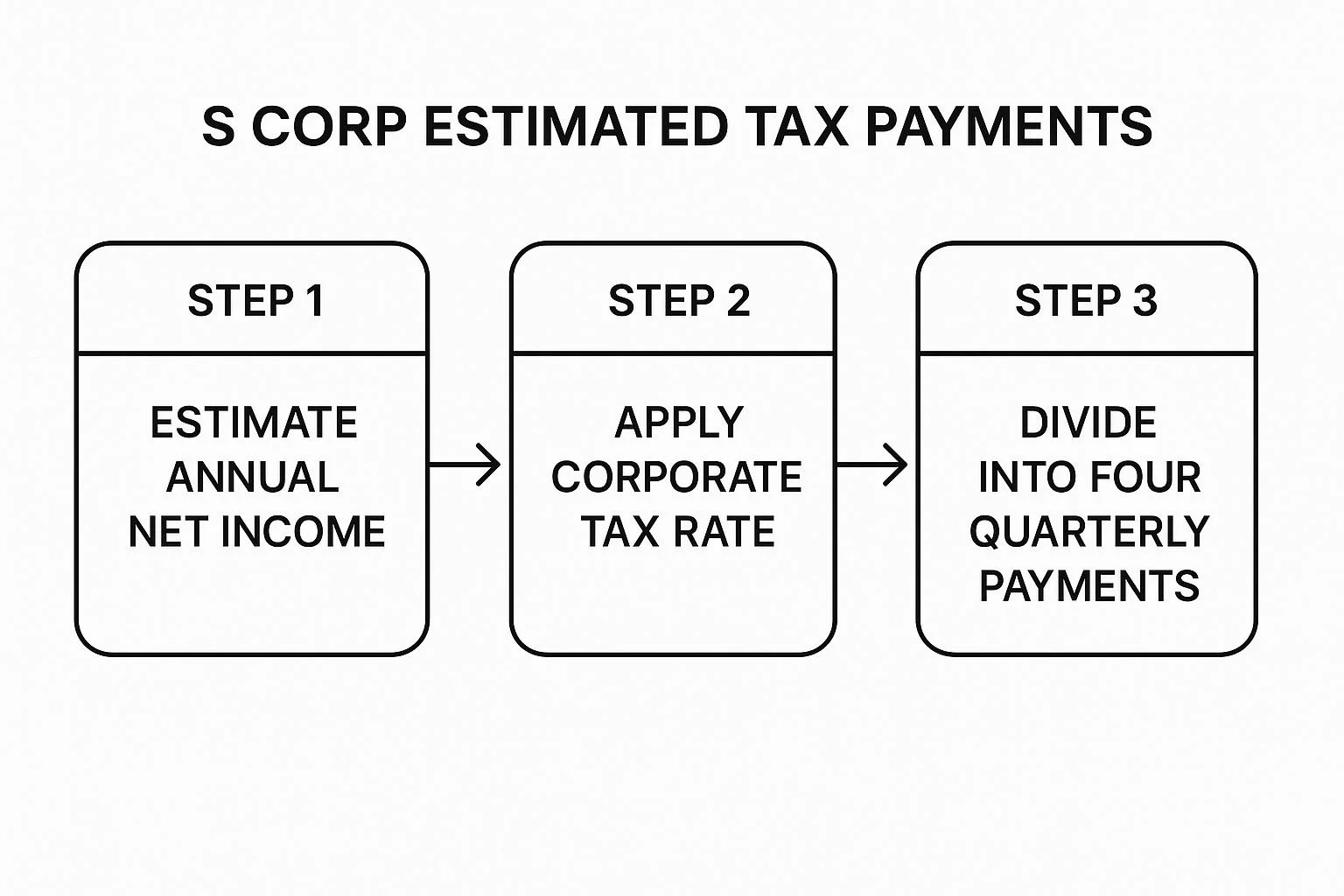
As the infographic shows, the logic is simple: estimate your annual net income, figure out the tax, and then divide it by four.
Let's calculate Alex's estimated tax liability based on the 2024 tax brackets for a married couple filing jointly.
10% on the first $23,200 = $2,320
12% on income between $23,201 and $94,300 = $8,532
22% on the remaining income ($113,300 - $94,300 = $19,000) = $4,180
Total Estimated Federal Income Tax: $2,320 + $8,532 + $4,180 = $15,032
This is the total amount Alex needs to plan for in federal income taxes for the year.
Staying on top of quarterly estimated taxes is fundamental for S-corps. The IRS will generally hit you with a penalty when you owe $1,000 or more in taxes after accounting for your withholding and estimated payments. It's a threshold that's surprisingly easy to cross.
Determine Your Quarterly Payment Amount
Now for the easy part. Just take your total estimated annual tax liability and divide it by four. This gives you your required payment for each quarter.
For Alex, the calculation is simple:
$15,032 (Total Tax) ÷ 4 = $3,758 per quarter
This is the amount Alex needs to send to the IRS by each of the four quarterly deadlines. It’s also crucial to remember that any tax withheld from your W-2 salary can be subtracted from this total.
If Alex's payroll withholding amounts to $5,000 over the year ($1,250 per quarter), the quarterly estimated payment would drop to $2,508 ($3,758 - $1,250). This proactive approach ensures you're consistently meeting your tax obligations without facing a huge bill or penalties when you file your annual return.
How to Pay on Time and Choose the Right Method

Calculating your estimated taxes is a huge step, but it’s only half the job. The other, equally crucial, part is getting your payments to the IRS on time and through the proper channels.
Missing a deadline—even by a day—can mean penalties and interest charges that start eating into your profits. The good news is that the logistics aren't overly complex, but they do demand attention to detail. Let's walk through the "when" and the "how" so you can pay with confidence.
The Four Crucial Tax Deadlines
Here’s a common mistake I see S-corp owners make all the time: assuming the tax deadlines follow standard calendar quarters. They don't. The IRS marches to the beat of its own drum, and learning these four dates is absolutely non-negotiable for staying out of trouble.
These deadlines correspond to specific income periods throughout the year. It's vital to match your payment to the right income window to keep your records clean and avoid any confusion with the IRS.
Here’s a quick overview of the key dates you need to have on your calendar.
Federal Estimated Tax Payment Deadlines
| Payment Period | Due Date |
|---|---|
| January 1 – March 31 | April 15 |
| April 1 – May 31 | June 15 |
| June 1 – August 31 | September 15 |
| September 1 – December 31 | January 15 of the following year |
Remember, these are the standard deadlines. Keep in mind that if any of these dates land on a weekend or a holiday, the deadline automatically shifts to the next business day. It’s always smart to double-check the exact dates each year. For a more detailed breakdown, our complete estimated tax payment schedule has you covered.
How to Submit Your S Corp Estimated Tax Payments
Once you've marked your calendar, you need to decide how you're actually going to send the money. The IRS gives you a few options, each with its own quirks. The best choice usually comes down to what you find most convenient and what gives you the best records.
I always tell my clients to pick one electronic method and stick with it. Consistency makes it so much easier to track your payments and cuts down on the chances of a simple mistake, like sending a payment to the wrong agency or applying it to the wrong tax year.
Here are the most common ways S-corp shareholders get their payments in.
Online and Electronic Payment Options
For most business owners I work with, paying electronically is the way to go. It’s fast, secure, and gives you an instant confirmation and a clean digital paper trail.
IRS Direct Pay: This is a fantastic, free service right on the IRS website. You can pay directly from your checking or savings account without needing to register for an account. It’s my go-to recommendation for its sheer simplicity and reliability.
Electronic Federal Tax Payment System (EFTPS): Another great free service from the U.S. Treasury. This one requires enrollment, which can take a few business days to process, so don't leave it to the last minute. The payoff is more powerful features, like the ability to schedule payments up to 365 days in advance and see your full payment history. It's a game-changer for long-term planning.
Debit Card, Credit Card, or Digital Wallet: You can also pay using a third-party payment processor approved by the IRS. It’s certainly convenient, but be ready for a processing fee. This option is usually best for last-minute payments when the convenience outweighs the extra cost.
Traditional Payment by Mail
If you’re more comfortable with the old-school approach, you can still mail a check or money order. Just know that this method requires you to be extra careful to make sure everything gets processed correctly.
When paying by mail, you have to include a payment voucher from Form 1040-ES, Estimated Tax for Individuals. You’ll need to fill out the voucher for the correct quarter, make your check payable to the "U.S. Treasury," and—this is critical—write your Social Security number and the tax year (e.g., "2024 Form 1040-ES") on the memo line.
While mailing a check is still a valid option, it opens the door to postal delays or the risk of it getting lost. Frankly, for peace of mind and faster processing, I almost always steer clients toward one of the electronic methods.
Navigating the Maze of State Tax Requirements
One of the biggest mistakes I see S corp owners make is focusing all their energy on federal estimated taxes while completely ignoring the states.
It's a dangerous assumption. While the IRS rules are the same for everyone, state tax laws are a jumbled mess of different regulations, deadlines, and forms. If you overlook them, you could be in for a nasty surprise with unexpected tax bills and penalties.
Many entrepreneurs I work with are genuinely shocked when I tell them their state doesn't treat their S corp the same way the federal government does.
Sure, some states mirror the IRS pass-through model, where all the income flows to the shareholders who then pay the tax. But plenty of others hit the S corp itself with entity-level income taxes, franchise taxes, or minimum taxes.
Assuming you're good with the state just because you're good with the IRS is a costly mistake. Every state has its own playbook, and it's on you to learn the rules where you do business.
Why Are State Rules So All Over the Place?
The heart of the issue is that states have total control over their own tax systems. They don't have to follow the Internal Revenue Code. A state might decide to tax an S corp's net income directly, slap on a franchise tax based on its net worth, or charge a flat minimum tax simply for existing.
This creates a tricky situation where you’re essentially fighting a two-front war—one federal, one state. You have to be proactive on both.
If there's one piece of advice I hammer home with S corp owners, it's this: never, ever assume anything about your state taxes. You have to actively check every single detail, from payment thresholds to due dates, directly with your state's revenue department.
Taking that extra step is the only way to be certain you're compliant and to shield your business from liabilities that can pop up out of nowhere.
A Real-World Example of State Complexity
To show you just how different things can be from one state to the next, let's look at a specific case. Some states have incredibly particular rules that change based on your company's revenue or how much tax you owe.
New Jersey, for instance, throws a few curveballs. The state says that S corps with prior year gross receipts under $50 million and a tax bill over $375 have to make four equal installment payments. But for bigger companies with gross receipts over $50 million, the state only requires three payments. It’s a perfect example of how nuanced—and frankly, confusing—these regulations can get. You can learn more about New Jersey's unique payment schedules right from their treasury site.
This really drives home why a one-size-fits-all strategy just won't work. What keeps you compliant in one state could get you fined in the one next door.
How to Figure Out What Your State Requires
So, where do you even start? Your first and most important stop should always be the official website for your state's department of revenue or taxation. That’s the only place you’ll find truly accurate, up-to-date information.
Once you're on their site, you need to hunt down the answers to a few key questions:
Does my state even recognize the S corp election? Most do, but you have to confirm this first.
Is there a tax on the business itself? Search for terms like "franchise tax," "business entity tax," or "minimum tax" that the corporation is responsible for paying.
What's required of me as a shareholder? Do you need to make personal state estimated tax payments on the income that passes through to you?
What are the payment thresholds? Find out the minimum tax liability that triggers the requirement to pay in quarterly estimates.
What are the due dates? State deadlines often don't line up perfectly with the IRS schedule.
Make sure you write all of this down. State income taxes can be a minefield, and having the right information is your best defense. Keeping on top of these rules is the only way to steer clear of compliance headaches later on.
Sidestepping Common Mistakes and IRS Penalties
Knowing the mechanics of calculating and paying your S-corp estimated taxes is one thing. Actually navigating the real world without getting tripped up is another. It's surprisingly easy for a simple miscalculation or a missed deadline to blossom into a frustrating and expensive IRS penalty.
Think of this part of your tax strategy as playing defense. If you understand where most business owners go wrong and know the rules the IRS plays by, you can build a system that protects both your business and your bank account.
The Most Common Pitfalls I See
After years of helping S-corp owners, I've seen the same handful of mistakes derail even the most organized entrepreneurs. These aren't obscure tax code violations; they're simple oversights that can pack a financial punch.
Underestimating Your Income: This is the big one. A fantastic, unexpectedly profitable year is a great problem to have, but it can wreak havoc on your tax plan if you don't adjust your payments as you go.
Forgetting About State Taxes: It’s a classic error. Many owners assume that being square with the feds means they’re covered on the state level. As we've discussed, that's a costly assumption.
Ignoring Self-Employment Tax on Your Salary: Remember, your W-2 salary is hit with Social Security and Medicare taxes. While your payroll service usually handles this, it's on you to ensure the withholding is actually enough to cover the liability.
Missing a Deadline: The IRS calendar is not a suggestion. A late payment, even if you pay the full amount a day later, will almost always trigger a penalty.
These issues usually come from a "set it and forget it" mindset. Your business isn't static, and your tax planning can't afford to be either.
What is the Underpayment Penalty, Really?
The IRS isn't trying to be malicious; they just want their money on a predictable schedule. If you don't pay enough tax throughout the year, they'll charge you an underpayment penalty. It's essentially just interest on the amount you should have paid by each quarterly deadline.
The penalty is a moving target, calculated using the amount you underpaid, how long the payment was late, and the fluctuating quarterly interest rate the IRS sets. It might not sound like much, but it can easily add up, especially if you underpaid by a large amount for the entire year.
The threshold for getting hit with this penalty is lower than you'd think. The IRS generally applies it if you owe $1,000 or more when you file your return. For a profitable S-corp, it's incredibly easy to blow past that mark without a solid plan.
Your Best Defense: The IRS Safe Harbor Rules
So, how do you avoid this penalty, especially when your income feels like a rollercoaster? Thankfully, the IRS provides a solution with its "safe harbor" rules. Think of these as your get-out-of-jail-free cards.
If you meet just one of these conditions, you generally won't owe an underpayment penalty, even if you still have a big tax bill when you file. This is your single most powerful tool for managing estimated tax payments.
The 90% Rule: Pay As You Go
The first safe harbor is pretty straightforward. You're in the clear if you pay at least 90% of your current year's total tax liability through withholding and on-time estimated payments.
Who it's for: Business owners with fairly stable or predictable income.
How it works: You do your best to project your 2024 total tax bill and make sure your combined payments reach at least 90% of that final number. The catch is you won't know that final number until the year is over.
This method demands that you keep a close eye on your income and are ready to adjust your payments if you have a much better-than-expected quarter.
The 100%/110% Rule: Look to the Past
For many S-corp owners, this second safe harbor rule is the easiest and safest bet. It allows you to base your payments on last year's tax bill—a known, fixed number.
Here's the breakdown:
Pay 100% of the total tax shown on your prior year's tax return (that's line 24 on your Form 1040).
There's a catch for higher earners: If your Adjusted Gross Income (AGI) last year was over $150,000 (or $75,000 if you're married filing separately), you have to pay 110% of last year's tax liability.
Who it's for: Business owners with fluctuating income or those in a high-growth phase.
How it works: Let's say your 2023 tax return showed a total tax of $20,000 and your AGI was under the limit. Your goal for 2024 is simple: pay a total of $20,000 through estimated taxes, which works out to $5,000 per quarter. Done.
This strategy gives you a predictable, easy-to-calculate target. Even if your business income doubles this year, as long as you've paid 100% (or 110%) of last year's tax, you're shielded from the underpayment penalty. You'll still have to pay the extra tax you owe when you file your return, but you won't be penalized for it.
Your S Corp Tax Questions, Answered

Even with the best planning, tricky "what if" scenarios always seem to pop up when it's time to handle S corp estimated taxes. Let's walk through some of the most common questions I hear from business owners to clear up any confusion and help you manage your tax obligations with confidence.
What If My S Corp Income Is Uneven Throughout the Year?
Very few businesses earn their income in four neat, equal quarters. If your revenue is seasonal or just unpredictable, you're not stuck making payments that don't match your cash flow. The IRS offers the annualized income installment method for this exact situation.
This approach lets you align your quarterly tax payments with when you actually earned the money. A classic example is a landscaping business that sees most of its income in the spring and summer; they'd make much larger payments for Q2 and Q3 compared to the slower Q1 and Q4. This keeps you from overpaying early in the year and putting a strain on your finances.
Just be aware that if you use this method, you'll need to file Form 2210, Underpayment of Estimated Tax by Individuals, Estates, and Trusts, with your annual return. This form shows the IRS your work, proving you calculated each payment based on that period’s income and weren't just trying to skip payments.
Do I Still Owe Estimated Taxes If I Take a Small Salary?
Yes, you absolutely do. This is a crucial point that trips up a surprising number of S corp owners. Your total tax liability is based on all the money you get from the business—that means both your W-2 salary and any shareholder distributions.
The withholding from your paycheck covers the taxes on your salary, but it almost never covers what you owe on your profit distributions. You have to calculate the tax on those profits separately and pay it through your quarterly estimated payments. Overlooking this is one of the fastest routes to an unexpected tax bill and an underpayment penalty.
What Happens If I Realize I Overpaid My Estimated Taxes?
First, congratulations—overpaying is a much better problem than underpaying! When you file your annual return and discover you've sent the IRS too much cash, they give you two straightforward options.
Get a Refund: You can simply ask for the overpayment back. The IRS will issue it as a check or a direct deposit.
Apply It to Next Year: Alternatively, you can have the IRS roll the overpayment forward and apply it as a credit toward the following year's estimated taxes.
Many business owners I work with prefer to apply the credit to the next year. It’s a simple way to get a jump-start on the first payment for the new year and makes cash flow planning just a little bit easier.
Choosing to apply an overpayment to next year's taxes can be a smart strategic move. It ensures you have a buffer for your first quarterly payment and keeps that capital working for you within the tax system, rather than waiting for a refund to be processed.
Can My S Corp Pay My Personal Estimated Taxes Directly?
No, this is a definite no. Your S corporation cannot pay your personal estimated tax bill directly from the business bank account. Doing so pierces the "corporate veil" and co-mingles funds in a way the IRS does not like.
Estimated tax payments are a personal obligation of the shareholder, not a deductible business expense for the corporation.
If the business writes the check for you, the IRS will almost certainly reclassify that payment. It will be treated as a shareholder distribution, which in turn increases your personal taxable income for the year. The correct way to handle this is to take a distribution from the S corp to your personal account, then make the payment to the IRS from your personal funds.
Navigating the complexities of S corp taxes can be challenging, but you don't have to do it alone. If you're facing tax debt issues or have questions about IRS compliance, Attorney Stephen A Weisberg can help. Start with a FREE Tax Debt Analysis to understand your options and find the best path forward.
Want to understand your options before you call anyone?
Download my free book — Freedom From Tax Debt — a plain-language guide to how the IRS collections process actually works and what resolution really looks like.
➥ Contact Attorney Stephen A. Weisberg for a free Tax Debt Analysis.
Contact Me Here: https://www.weisberg.tax/contact-1
Email: s.weisberg@weisberg.tax
Phone/Text: (248) 971-0885
Address: 300 Galleria Officentre, Suite 402, Southfield, MI 48034
