How to Prove Financial Hardship The Definitive Guide
When you need to prove financial hardship, you’re essentially telling a story backed by facts. You have to show that a serious, involuntary event has upended your financial stability, making it impossible to keep up with your obligations. Think of it less as a temporary cash crunch and more as a sustained inability to pay your bills.
This usually stems from life-altering circumstances like a sudden job loss, a major medical crisis, divorce, or an unexpected and steep rise in essential living expenses.
What Really Qualifies as Financial Hardship?

Before you can build a case, you need to understand what lenders, the IRS, and other institutions actually consider a legitimate hardship. They're looking for verifiable events that have fundamentally wrecked your ability to manage your money. A single high utility bill won't cut it. They need to see a significant, ongoing deterioration of your financial health.
Pinpointing a Qualifying Event
Your entire claim hinges on what’s known as a “qualifying event.” This is the specific trigger for your financial distress—something that was typically sudden, unforeseen, and completely out of your control.
A lot of situations can fit this description, but some of the most common ones include:
Loss of Employment: Being laid off or terminated, wiping out your main source of income.
Drastic Income Reduction: This could mean your hours were severely cut, a major client disappeared (if you're self-employed), or you were forced into a much lower-paying role.
Serious Illness or Injury: A medical emergency for you or a dependent that brings a mountain of bills and might prevent you from working.
Divorce or Separation: The end of a marriage often means losing a second income while your own living expenses shoot up.
Death of a Spouse or Partner: Losing a primary breadwinner can instantly destabilize a household's finances.
Unexpected Jump in Essential Costs: This could be a massive rent hike, an urgent and expensive home repair (like a failed foundation), or new, costly caregiving duties.
This feeling of financial instability is widespread. A recent Pew Research Center survey highlighted that nearly 28% of American adults believe their financial situation will get worse in the coming year. That’s a real reflection of how vulnerable many households feel right now.
To help clarify, here’s a quick look at common qualifying events and the kind of proof you’ll typically need to provide.
Common Qualifying Events for Financial Hardship
| Qualifying Event | Description | Primary Evidence Required |
|---|---|---|
| Job Loss | Involuntary termination or layoff from your primary employment. | Termination letter, final pay stub, proof of unemployment benefits. |
| Medical Emergency | A significant illness or injury affecting you or a dependent. | Medical bills, doctor's notes, insurance statements, disability records. |
| Divorce/Separation | Legal dissolution of a marriage, impacting household income and assets. | Divorce decree, separation agreement, court filings. |
| Death of a Spouse | The loss of a co-borrower or primary wage earner in the household. | Death certificate, proof of prior shared finances. |
| Sudden Expense Spike | An unavoidable and substantial increase in necessary living costs. | Repair estimates, new lease showing rent increase, medical care receipts. |
Having the right documentation from the start is absolutely crucial for making a convincing case.
Key Takeaway: Financial hardship isn't just about being broke. It's about demonstrating a clear, negative turn from a previously stable financial life, directly caused by a specific, qualifying event.
Sometimes, a severe hardship might force you to consider tapping into retirement funds early. If you find yourself in that position, it's vital to understand the rules around hardship withdrawals, as each has its own documentation requirements.
Getting Your Paperwork in Order

When you’re making a hardship claim, your documentation is everything. Think of it as building a case where the paperwork does the heavy lifting. The goal isn’t just to dump a pile of bills on a reviewer's desk; it's to tell a clear, compelling story about your financial reality.
You need to strategically gather documents that create a complete before-and-after picture of your finances. This is how you show, not just tell, what happened.
Proving Your Income—And Its Loss
First things first, you have to clearly show how your income has changed. Lenders and government agencies need to see a definite, quantifiable drop in the money coming into your household. This isn't the time for estimates; it's the time for hard proof.
Here’s what you’ll want to pull together:
Recent Pay Stubs: This is your A-to-B comparison. Grab pay stubs from right before your hardship started and from right after. For example, if your hours were cut in June, find your stubs from April and May (your normal income) and compare them to June and July (your new reality).
Unemployment Benefits Statement: If you were laid off, the official letter from your state unemployment office is a golden ticket. It's third-party verification of your employment status and exactly how much you're receiving.
Past Tax Returns: Your W-2s or 1099s from the last year or two are perfect for establishing your normal earning power. This provides a baseline that makes your current situation much more impactful.
Hard data is what substantiates your claim. Financial hardship is typically measured by income loss, rising necessary expenses, and the draining of any savings. As the World Bank's Global Findex Database shows, only 40% of adults in developing economies even saved formally in the last year, which underscores how few people have a buffer for emergencies. Creditors need to see concrete proof like bank statements to verify these situations.
Laying Out Your Essential Expenses
Next, you need to show exactly where your money is going. It’s not enough to say things are tight; you have to document every essential cost. The key here is to focus on the non-negotiable expenses required to live.
Get your bills and statements organized for the last few months, covering these core areas:
Housing: Mortgage statements, your lease agreement, or proof of rent payments. Did your rent just go up? Include the notice from your landlord.
Utilities: Your gas, electric, water, and internet bills. These show the baseline cost of just keeping the lights on.
Medical Bills: This is absolutely critical if a health crisis triggered your hardship. Gather every hospital bill, doctor’s invoice, pharmacy receipt, and insurance statement you can find.
Transportation: Car payments, auto insurance, and reasonable estimates for gas. You need to show what it costs you to get to work (if you still have a job) or to doctor's appointments.
Your documentation needs to tell a simple, powerful story: "This was my income before. This is my income now. And here are the essential bills that I can no longer cover."
When you're dealing with the IRS for something like an Offer in Compromise, they have extremely specific requirements.
Showing the Big Picture
Bank and credit card statements are what tie your whole story together. They provide a transparent, day-by-day look at your financial life. Plan on providing at least the last 3-6 months of statements for every account you have.
This is what reviewers are looking for in those statements:
Bank Statements: They confirm your income deposits (or the lack of them) and illustrate your cash flow. More importantly, they show you’re spending your limited funds on necessities.
Credit Card Statements: These are powerful. If they show you’ve started using credit cards for groceries, gas, or other basic needs, it’s a huge red flag that you’re in serious financial trouble.
To make sure you don't miss anything, using a financial audit checklist can be a lifesaver. It acts as a guide to ensure you’ve covered all your bases.
By organizing your documents this way—income, expenses, and overall financial health—you build a powerful case that’s easy to understand and backed by undeniable evidence.
How to Write a Hardship Letter That Actually Works
Your financial documents tell a story with numbers, but your hardship letter is where you give that story a human voice. This isn't just a formality; it's your opportunity to connect with the person reviewing your file and explain the why behind your financial struggles. A thoughtfully written letter can genuinely be the deciding factor in getting the help you need.
Think of this letter as your chance to guide the reviewer through the events that led you here. It needs to be sincere, professional, and straight to the point.
The Best Way to Structure Your Letter
I've seen countless hardship letters over the years, and the most effective ones always tell a clear, concise story with a beginning, middle, and end. You want to avoid rambling or getting lost in emotional details. Honesty and clarity are your most powerful tools.
A simple three-part structure works best:
The Opening: Don't bury the lede. In the very first paragraph, state who you are, provide any relevant account numbers, and explain why you're writing. For example: "I am writing to formally request a loan modification for account #12345 due to a significant and unforeseen financial hardship."
The Explanation: This is the heart of your letter. Briefly explain the event that caused your financial distress, like a job loss, a medical emergency, or a divorce. The key is to draw a straight line from that event to your current inability to pay.
The Request: End on a proactive note. Clearly state what you are asking for—be it a temporary forbearance, a loan modification, or an installment agreement. This shows you're serious about finding a resolution.
Following this framework ensures the reviewer immediately understands who you are, what happened, and what you're asking for.
Getting the Tone Just Right
It’s tough to write about financial problems, but the tone of your letter is critical. You need to convey the gravity of your situation without sounding desperate, angry, or entitled. Aim for a tone that is respectful, factual, and responsible.
For example, instead of writing, "I have no money and can't pay my bills," which can come across as panicked, frame it more professionally: "Due to a recent layoff, my household income has decreased by 70%, making it impossible to cover my monthly mortgage payment and essential living expenses at this time."
My Two Cents: The letters that get results are always factual and forward-looking. They spend less time on blame or despair and more time clearly explaining the circumstances and proposing a reasonable path forward.
Keep it short and sweet—one page is the gold standard. Reviewers have huge caseloads, and a letter that is clear and brief is far more likely to be read carefully.
What to Put In and What to Leave Out
Your letter needs to be a focused summary, not a diary of every misfortune. Stick to the facts that directly support your case for hardship.
A great guide for what information matters most is to look at what the IRS asks for on its collection forms.

As you can see on a form like the IRS 433-F, the focus is on the core facts: contact info, employment, income, assets, and liabilities. Your letter should reflect that same laser focus on what's most important.
Here’s a quick list of do's and don'ts I always share with clients:
Do Include:
Your full name, address, and account/case number.
The specific date your hardship began.
A single, clear sentence explaining the cause (e.g., "My hardship stems from a medical diagnosis in May that required me to take unpaid medical leave.").
A quick mention of steps you've already taken to cut costs.
Your specific request (e.g., "I am requesting a 6-month forbearance...").
Don't Include:
Long, emotional backstories that don't add factual support.
Blame directed at your lender, your employer, or anyone else.
Details about non-essential spending.
Vague statements like "I'm having a hard time." Get specific with numbers.
Proving financial hardship, especially when you're up against the IRS, requires a solid strategy.
In the end, your letter is the final piece that ties all your documentation together into a coherent story. Always proofread it carefully—typos look unprofessional—and make sure to sign it before you send it off. A polished letter shows you're taking this seriously and are ready to work toward a solution.
Presenting Your Financial Data Clearly
Your personal story of hardship is powerful, but when you're dealing with a lender or the IRS, the numbers have to do the talking. This is where you translate your situation into the black-and-white language they understand. It’s not just about filling out a form; it's about building an undeniable, math-based case that proves your hardship.
Think of this process as creating a clear financial snapshot. By organizing your income and expenses the right way, you’re showing them, in no uncertain terms, that you simply don’t have enough money coming in to cover your basic, essential obligations.
This graphic gives you a simple, high-level view of how to turn your proof into a formal submission.
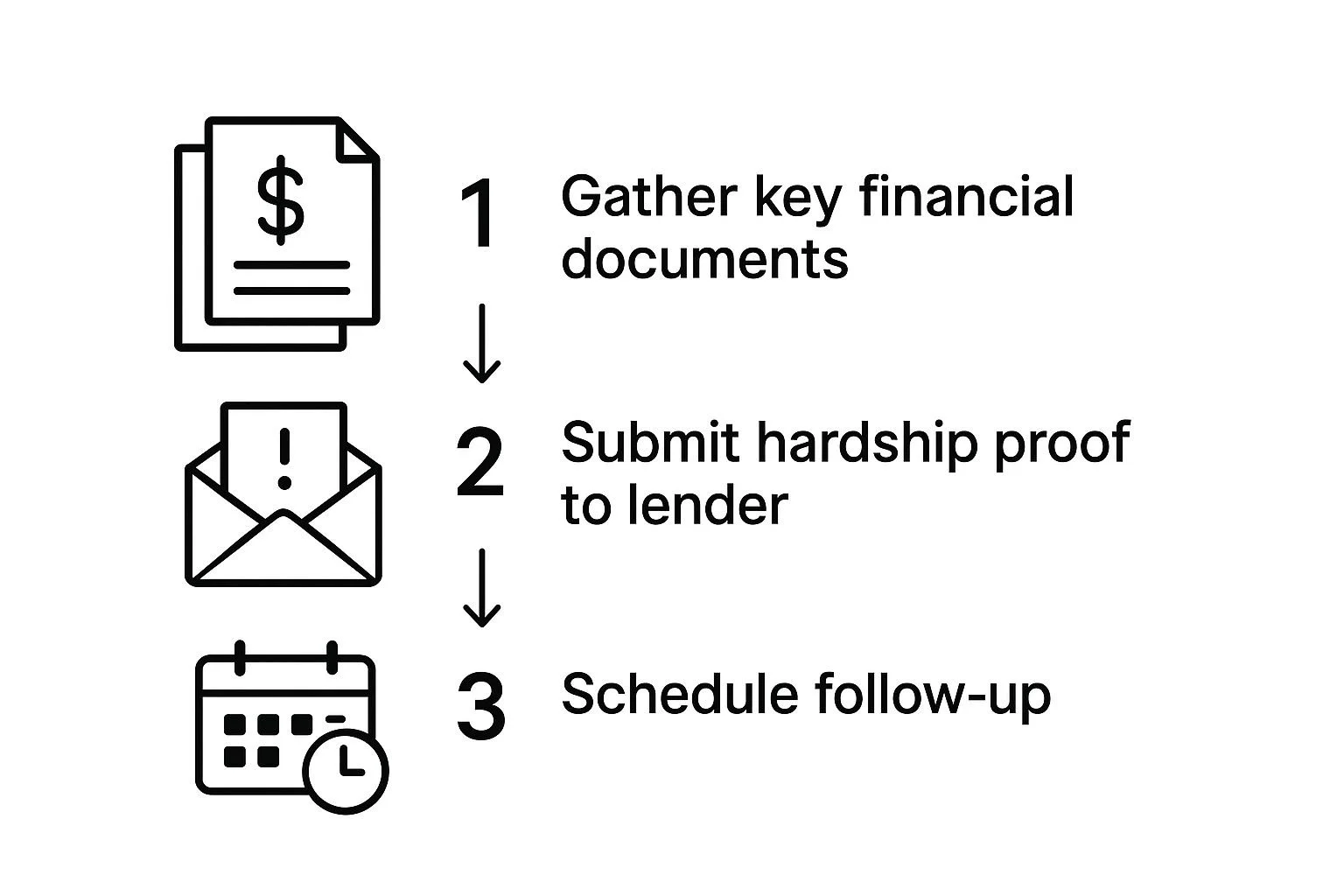
As you can see, the path is straightforward: gather your evidence, submit it, and then stay engaged with the process until you get a resolution.
Using Standard Forms As Your Guide
Institutions, especially big ones like the IRS, need a consistent way to evaluate everyone's situation fairly. That’s why they rely on standardized forms. For federal tax debt, the go-to document is IRS Form 433-F, the Collection Information Statement.
Even if you’re not dealing with a tax issue, this form is an incredibly useful roadmap. It forces you to categorize your income, assets, and living expenses exactly how a reviewer is trained to see them. I often tell clients to use it as a practice worksheet, because if you can fill it out correctly, you're prepared for almost any hardship application out there.
Tallying Up Your Total Monthly Income
First things first, you need to account for every dollar coming into your household. This isn't the time to be vague; total transparency is non-negotiable. You have to list every single source of income, not just your main paycheck.
Be sure to include:
Wages and Salaries: Your gross pay before taxes and other deductions.
Self-Employment Income: What’s left from your business revenue after you’ve paid for necessary business expenses.
Unemployment Benefits: The total monthly amount you’re receiving.
Pensions or Social Security: Any retirement funds or government benefits you collect.
Other Sources: This bucket covers everything else, like child support, alimony, or any other regular payments you receive.
Add all of these up to get your total monthly gross income. This is the top-line number that anchors your entire financial picture.
Itemizing Your Allowable Living Expenses
This is where I see people get tripped up all the time. A lender doesn’t consider your Netflix subscription or weekly pizza night an essential expense. They are looking for your allowable expenses—the reasonable and necessary costs of keeping your head above water.
The entire point of this exercise is to show that your necessary, allowable monthly expenses are greater than your total monthly income. That negative cash flow is the mathematical proof of your hardship.
You'll need to break down your spending into specific categories. The IRS, for example, sets national and local standards for things like food and housing costs to determine what's "reasonable." Sticking to these categories is your best bet.
Here’s how to structure your cost breakdown:
Housing and Utilities: This is your rent or mortgage, property taxes, insurance, and basic utilities like electricity, gas, water, and trash.
Food and Personal Care: Calculate a realistic monthly budget for groceries, toiletries, and other basic household necessities.
Transportation: Include your car payment, auto insurance, and a reasonable estimate for fuel and routine maintenance. If you rely on public transit, list that cost instead.
Healthcare: Tally up your monthly health insurance premiums and any regular out-of-pocket costs for prescriptions, co-pays, or ongoing treatments.
Other Secured Debts: If you have another loan secured by an asset, like a second vehicle needed for work, list that payment here.
To prove your hardship, you need to show exactly how your income and expenses stack up. The table below breaks down the key calculations that lenders and agencies like the IRS use to determine your financial standing.
Key Financial Metrics for Proving Hardship
| Financial Metric | How to Calculate It | What It Demonstrates |
|---|---|---|
| Total Monthly Gross Income | Sum of all income sources (wages, benefits, self-employment, etc.) | Establishes the total funds available to your household each month before any expenses are paid. |
| Total Allowable Expenses | Sum of all necessary living costs (housing, food, transport, healthcare) | Shows the minimum amount you need to spend to maintain a basic standard of living. |
| Debt-to-Income (DTI) Ratio | (Total Monthly Debt Payments / Total Monthly Gross Income) x 100 | A high DTI ratio (over 40%) shows that a large portion of your income is already committed to debt. |
| Monthly Net Income / Shortfall | Total Monthly Gross Income - Total Allowable Expenses | This is the bottom line. A negative number here is the clearest indicator of financial hardship. |
These metrics aren't just numbers on a page; they tell a story. A negative monthly shortfall, combined with a high DTI, paints a very clear picture of an unsustainable financial situation.
The Final Calculation That Makes Your Case
Once you have your total income and your total allowable expenses, the last step is simple subtraction.
Total Monthly Income - Total Allowable Monthly Expenses = Your Monthly Net Income (or Shortfall)
If your income is $3,500 and your essential expenses add up to $4,100, you have a -$600 monthly shortfall. That single number—negative $600—is the factual, powerful core of your entire hardship claim.
When you present this straightforward equation, backed by all the documents you’ve gathered, you’re no longer just asking for a break. You are providing cold, hard proof that your financial situation simply isn't working.
Getting Your Application Across the Finish Line and Following Up
You’ve sent it in. That’s a huge step, but don’t relax just yet. What you do next is just as important as putting the package together in the first place. When you're trying to prove financial hardship, you need to be persistent and organized to make sure your application doesn't get lost in a sea of paperwork.
A few days after you submit everything, your first move is to confirm they actually have it. Don't just sit and wait.
Give them a call or check their online portal to make sure every single document arrived safe, sound, and readable. It’s a simple check that can save you weeks of headaches down the road from a lost fax or a blurry scan.
Staying on Top of Things While You Wait
Once you know they have your application, the waiting game begins. This is where all that careful record-keeping you've been doing really pays off. You'll want to start a communication log to track every single interaction you have with the institution.
It doesn’t need to be fancy—a simple notebook or spreadsheet works perfectly. For every phone call, email, or letter, make sure you jot down:
The date and time you connected.
The name and title of the person you spoke with.
A quick summary of what you talked about, including any promises they made or what they said the next steps were.
Any reference numbers they gave you for the call or your case.
This log is more than just a way to remember things. It's your proof. If you get conflicting information from two different people—which happens more than you’d think—your notes become the evidence of what was said, who said it, and when. It’s how you hold them accountable.
My Go-To Tip: After an important phone call, I always send a quick, polite email to recap. Something like, "Hi [Agent's Name], thanks for your time today. Just wanted to confirm you said my file is now with the review department and I should hear something in the next 15 business days. My case number is [Your Case #]." This creates a paper trail that’s almost impossible to argue with.
How to Follow Up Without Being Annoying
There’s a real art to being persistent without becoming a pest. The trick is to be consistent but professional. I usually recommend my clients set a reasonable schedule for checking in, maybe every 7 to 10 business days, and then stick to it.
When you do reach out, be ready. Have your log and reference numbers in front of you. Be polite and get straight to the point.
Starting with, "Hello, my name is Jane Doe, and I'm calling for a status update on my hardship application, case number 12345," works so much better than an emotional or demanding rant. It keeps the tone professional and the conversation focused on getting you answers.
It also helps to keep the bigger picture in mind. Your situation, while personal, is part of a larger economic story. Institutions are well aware of broader trends that cause financial strain for many people.
Reports on the global financial system from organizations like the International Monetary Fund often highlight these vulnerabilities, which can shape how lenders approach hardship assistance programs.
Getting Ready for What Comes Next
While we're all hoping for a quick and easy "yes," you have to be ready for any outcome. The review process can go a few different ways, and knowing the possibilities can help you stay calm and plan your next move.
Here are the usual results you can expect:
Approval: The best possible news. You'll get a formal letter outlining the assistance—maybe a forbearance, a loan modification, or a new payment plan. Read every word of that agreement to make sure you understand the terms before you sign anything.
Request for More Information: This happens all the time, so don't be alarmed. They might need another bank statement, an updated pay stub, or just some clarification. Get them what they need as quickly as you can to keep things moving.
Denial: It’s a gut punch, for sure, but a denial isn’t necessarily the end of the line. The letter has to tell you exactly why you were denied. That reason is your roadmap for an appeal.
If they say no, take a deep breath. A lot of initial denials get overturned on appeal, especially if it was because of a simple misunderstanding or a missing document. Use the information in the denial letter to build a stronger case, gather any new evidence you need, and get that appeal submitted.
Answering Your Questions About Financial Hardship
Once you've started pulling your documents together and drafting your letter, you'll inevitably hit a few nagging questions. It's completely normal. The process can feel overwhelming, and a few lingering uncertainties can really add to the stress.
Let's clear up some of the most common questions people have when they're in your shoes. My goal here is to give you straightforward answers based on real-world scenarios so you can move forward with confidence.
"Can I Prove Hardship If I Still Have a Job?"
Yes, you absolutely can. This is a huge misconception. Financial hardship isn't just for the unemployed. The real test is whether you have a significant, verifiable gap between your income and your essential living expenses.
Many people who successfully prove hardship are still employed. Their situations often fall into one of two buckets:
A big drop in income. Maybe your hours were slashed, a major client left, or you had to take a lower-paying job just to stay afloat. The point isn't that you have zero income, but that your current earnings are drastically lower than they were before.
A major spike in unavoidable costs. Your income might be the same, but a new, massive expense has completely torpedoed your budget. Think of a sudden medical crisis, a foundation crack in your home, or becoming the sole caregiver for an ailing parent.
In either case, it all comes down to the numbers. You have to clearly show that even with your paycheck, your income simply can't cover your basic living costs and your debt payments anymore.
"Will This Destroy My Credit Score?"
This is probably the number one worry I hear, and it's a fair one. The answer isn't a simple yes or no.
Just asking for hardship assistance won’t hurt your score. Lenders don't report these requests to the credit bureaus. However, the remedies that come with a hardship plan often can.
For instance, if you get a mortgage forbearance, the lender might add a note to your credit report saying payments are deferred. While that’s way better than a missed payment, future lenders might see it as a red flag. If you settle a debt for less than what you owe, that will definitely have a significant negative impact on your credit history for years.
The most important thing to remember is this: A temporary dip in your credit from a hardship program is almost always better than the alternative. Defaulting on a loan or racking up a string of late payments will do far more severe and lasting damage to your credit.
"What’s the Single Most Important Document to Include?"
If I had to pick just one, it would be the financial hardship letter.
Think of it this way: your bank statements, pay stubs, and medical bills are the raw data. They show what happened. But your letter is the only thing that explains why. It’s your chance to tell your story and connect the dots for the person reviewing your file.
A powerful letter turns a stack of cold documents into a compelling, human narrative. It explains the specific event that triggered your crisis and shows exactly how it upended your ability to pay your bills. Without that context, you're just a bunch of numbers on a page.
"How Long Do These Hardship Programs Actually Last?"
There's no standard answer here—it really depends. The duration of a hardship program can vary widely based on the lender, the type of debt, and your personal circumstances.
Here are a few common timelines to give you a general idea:
Mortgage Forbearance: These often start with an initial period of three to six months, but it's not uncommon for them to be extended up to a year or even longer.
Credit Card Plans: For credit cards, you might get a reduced interest rate or lower minimum payment for a set term, usually somewhere between six and 12 months.
IRS Relief: If the IRS agrees that you can't pay, they might place your account in "Currently Not Collectible" status. This isn't permanent; they will typically review your financial situation every year or so to see if things have improved.
Before you agree to anything, get the terms in writing. You need to know exactly how long the relief lasts and what's expected of you when the program ends.
Navigating tax debt while proving financial hardship adds another layer of complexity. At Attorney Stephen A Weisberg, we specialize in representing individuals and businesses with complex IRS issues. Instead of demanding a large upfront retainer, we start with a FREE Tax Debt Analysis to determine precisely how we can help you achieve the best possible outcome. Find out more at weisberg.tax.
Want to understand your options before you call anyone?
Download my free book — Freedom From Tax Debt — a plain-language guide to how the IRS collections process actually works and what resolution really looks like.
➥ Contact Attorney Stephen A. Weisberg for a free Tax Debt Analysis.
Contact Me Here: https://www.weisberg.tax/contact-1
Email: s.weisberg@weisberg.tax
Phone/Text: (248) 971-0885
Address: 300 Galleria Officentre, Suite 402, Southfield, MI 48034
