How to Stop Bank Levy — Protect Your Funds Today
That feeling of dread when you see your bank account has been levied is something else. It feels like the floor just dropped out from under you. But this is not the time to panic—it's the time to act. Stopping a bank levy comes down to a few critical moves you need to make, and you have to make them fast.
The clock starts ticking the second your bank gets that levy notice. You generally have a very small window, often just 24-48 hours, to get the ball rolling before your funds are gone for good.
How To Stop A Bank Levy: Your First Steps
When a creditor levies your bank account, they're not just asking for the money; they have a legal order to seize it. Whether it's the IRS for back taxes or a private creditor who won a lawsuit, the bank is legally obligated to freeze your funds up to the amount you owe.
This infographic lays out the basic timeline for an IRS bank levy, which is one of the most common types.
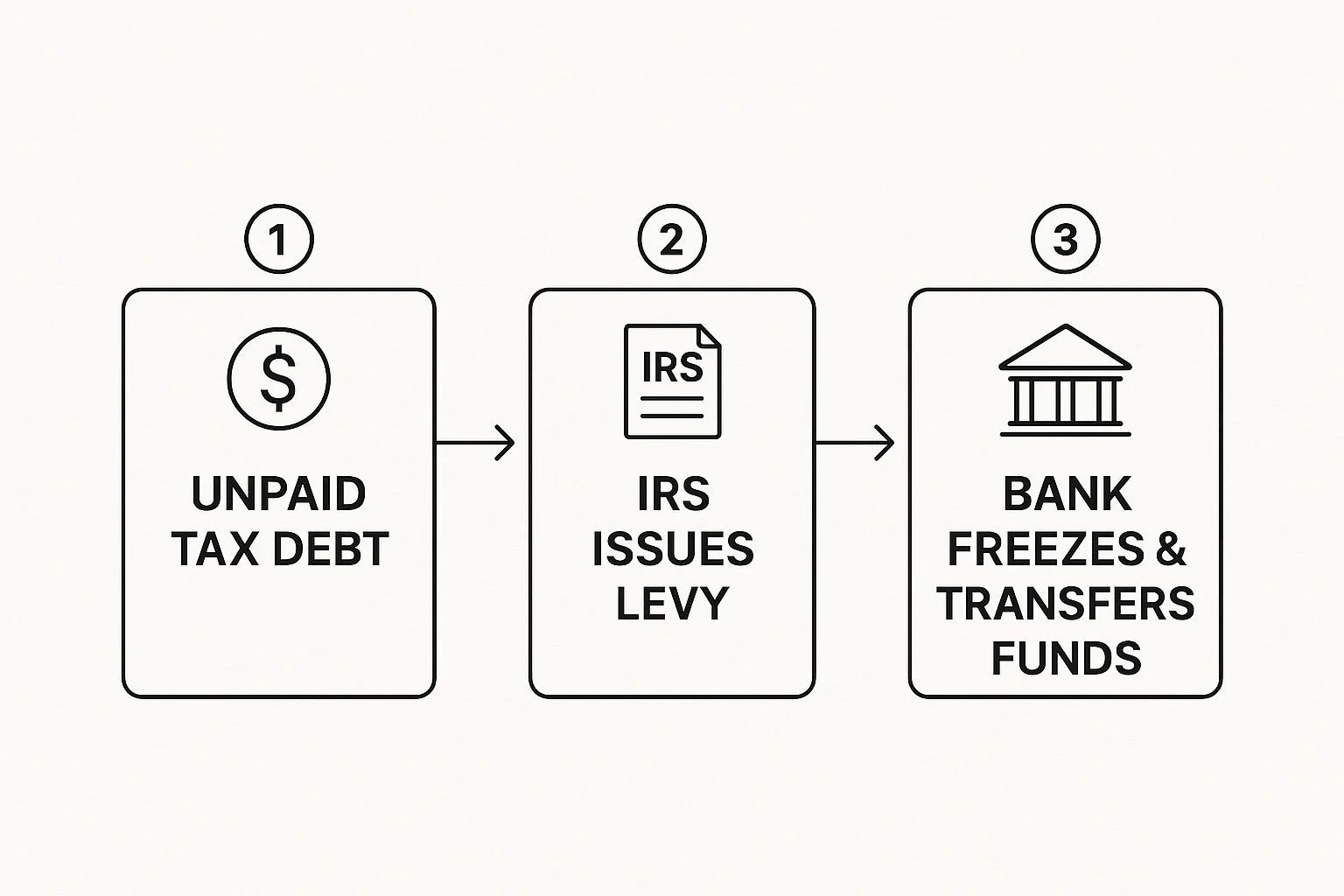
While the graphic looks simple, don't be fooled. It shows a rapid progression from an unpaid tax bill to the IRS taking your money. The good news is that there are specific points in that process where you can intervene and stop it cold.
Figure Out Who Levied Your Account
Your very first phone call should be to your bank. Tell them you've noticed a levy and need a copy of the official levy order. This piece of paper is your roadmap—it tells you exactly who is coming after your money.
Was it the IRS? Your state's department of revenue? Or a private creditor with a court judgment?
Knowing the source is absolutely crucial because the rules of the game change depending on who's on the other side:
IRS Levies: These come with a federally mandated 21-day hold period. Your bank will freeze the funds immediately, but they can't actually send the cash to the IRS for three weeks. This is your lifeline—a grace period to negotiate a release.
Private Creditor Levies: These are governed by state law, and the timelines are often much, much shorter. You have to move even faster in these situations.
This table breaks down exactly what to do in those first critical hours.
Your Immediate Bank Levy Action Plan
Here’s a checklist of the first things you need to do within the first 24-48 hours of discovering a levy. This is your game plan for taking control of the situation.
| Action Item | Why It Matters | Information to Get |
|---|---|---|
| Call Your Bank | This confirms the levy is real and tells you who initiated it. | Get a copy of the levy order. Ask for the date and time the levy was placed. |
| Identify the Creditor | The rules and timelines differ for the IRS vs. a private creditor. | Note the creditor's name, contact info, and any case/account numbers. |
| Verify the Amount | You need to know the exact amount the bank has frozen. | Ask the bank for the total dollar amount of the hold. |
| Understand the Hold Period | This is your window of opportunity to act before the money is sent. | For IRS levies, confirm the 21-day hold. For others, ask the bank for the state-specific timeline. |
Acting on these steps immediately will arm you with the information you need for your next call, which will be to the creditor.
Pull Your Financials Together
Once you know who levied you, it's time to prepare for battle. Before you pick up the phone to call them, get your financial documents in order.
You'll want to have things like recent pay stubs, other bank statements, and any notices you've already received from the creditor. If you're dealing with the IRS, having your last couple of tax returns on hand is a smart move.
The goal here is to paint a clear, honest picture of your financial reality. Walking into a call with the IRS or a creditor's attorney with all your information ready shows them you're taking this seriously. It also helps to understand the IRS Final Notice of Intent to Levy, as this is the document that typically precedes the levy itself.
Your ability to stop a bank levy hinges on being fast, prepared, and proactive. These first steps are the most important ones you'll take.
Understanding Why Your Bank Account Was Levied

The first step in fighting a bank levy is figuring out exactly what happened and why. A levy never comes out of the blue; it's the last move in a long game of collection efforts that you might not have even noticed were happening. Pinpointing who hit your account and for what reason is the cornerstone of your strategy to stop the process and reclaim your funds.
Generally, you're dealing with one of two opponents: the government or a private creditor. Each one takes a completely different road to get to your bank account, and the warning signs look very different.
Government and IRS Tax Levies
More often than not, the government entity freezing your account is the Internal Revenue Service (IRS). An IRS levy is almost always the consequence of unpaid back taxes. This isn't a snap decision on their part—it’s preceded by a string of official letters sent directly to your mailbox.
The one you absolutely cannot ignore is the "Final Notice of Intent to Levy and Notice of Your Right to a Hearing." Once that letter arrives, a timer starts. The IRS is legally required to give you a 30-day window after sending this final notice before they can reach out to your bank and seize your money.
Key Takeaway: The IRS wields incredible power because they don't need a court order. Their own internal procedures give them the green light to take your assets, which is why you have to act the moment you see one of their notices.
Court-Ordered Levies from Private Creditors
The other common source of a levy is a court judgment won by a private creditor. Think credit card companies, medical facilities, or personal lenders you've fallen behind with. Unlike the IRS, these creditors can't just help themselves to your money. They have to sue you first and win.
The path for a private creditor typically looks like this:
The Lawsuit: A creditor files a lawsuit against you over the unpaid debt.
Getting Served: You are then legally "served" with the court documents.
The Judgment: If you don't show up to court or you lose the case, the judge issues a judgment for the creditor.
That court judgment is the golden ticket that allows the creditor to come after your assets, including every dollar in your bank account.
Imagine a forgotten medical bill for a couple of thousand dollars. It’s easy to ignore the initial bills and maybe even the court summons. But if you do, the hospital's lawyers can get a default judgment, giving them the legal power to levy your entire checking account to cover the debt. Suddenly, a manageable bill has become a full-blown financial emergency, proving just how critical it is to respond to any legal notice from a creditor, regardless of the amount.
Proven Strategies to Get a Bank Levy Released
Once a levy hits, the game changes. Your focus immediately shifts from prevention to damage control. The good news is you have several powerful ways to get that levy released and get your money back. The trick is to act fast and pick the right strategy for your specific financial situation.
The most direct route is often proving the levy is causing you a serious, immediate financial crisis. We're not talking about simple inconvenience here—this means showing you can't cover your basic, day-to-day living expenses.
Making a Case for Economic Hardship
To get a levy released based on economic hardship, you have to prove to the IRS that taking this money leaves you unable to pay for absolute necessities.
Think of things like:
Your rent or mortgage payment
Keeping the lights and water on
Putting food on the table
Critical medical bills
You can't just say it's a hardship; you have to show it. This means getting your documents in order—bank statements showing a near-zero balance, copies of past-due bills, and recent pay stubs. For an IRS levy, this information is usually submitted on Form 433-F, the Collection Information Statement.
Negotiating a Path Forward
If the hardship argument doesn't quite fit, or if you're looking for a more permanent fix, it's time to negotiate. Believe it or not, creditors—including the IRS—would often rather get a steady stream of payments than a one-time seizure that might not even clear the entire debt.
An Installment Agreement is one of the most common resolutions. You and the IRS agree on a set monthly payment to chip away at the debt over time. Before they'll even consider it, you have to be caught up on all your tax filings. The payment you propose also needs to be realistic, backed by the numbers from your income and expenses.
Another powerful option is the Offer in Compromise (OIC). This is an agreement that lets you settle your tax debt for less than the full amount you owe. The IRS typically only grants these when it's pretty clear they'll never be able to collect the full balance from you.
Insider Tip: When you propose a payment plan, don't pull a number out of thin air. Do the math. Figure out what you can genuinely afford each month after covering your essential living costs. Coming to the table with a well-thought-out offer shows you're serious and makes them far more likely to say yes.
Looking for Procedural Mistakes
There are strict rules creditors have to follow before they can levy your account. Any slip-up on their part can invalidate the entire thing. For example, did the IRS send you a "Final Notice of Intent to Levy"? They're required to send it to your last known address at least 30 days before they can touch your bank account.
It’s interesting to see this concept play out on a massive scale. The UK, for instance, introduced a bank levy in 2011 as an annual charge on bank liabilities to promote financial stability. They’ve had to adjust the rates over the years to balance tax revenue with economic health, showing that even government-level levies are open to review and change.
You can read more about how these major financial policies evolve on obr.uk. For you, finding a simple procedural error could be the key that unlocks your frozen funds.
Claiming Exemptions to Protect Your Funds
It’s a common misconception—and a costly one—that a bank levy gives the IRS a blank check to every dollar in your account. That’s simply not true. Both federal and state laws have put protections in place for certain types of income, meaning a good portion of your money might be legally off-limits.
Knowing which funds are protected is one of the most powerful tools you have. If you can prove the money in your account comes from an exempt source, you can often get a portion, or sometimes all, of the levied funds released back to you.
Identifying Your Protected Income
So, what money is actually untouchable? Governments have carved out these exemptions to make sure a levy doesn't leave you completely destitute. While the specific rules can differ from state to state, many of the most important protections are federal.
Here are some of the most common types of income that are shielded from an IRS levy:
Social Security Benefits: This includes retirement, disability (SSDI), and survivor benefits.
Veterans' Benefits: Payments from the Department of Veterans Affairs are generally protected.
Child Support and Alimony: Money you receive for the support of a child or former spouse is often exempt.
Federal Employee and Railroad Retirement Benefits: These specific pensions have strong federal protections.
Disability Insurance Benefits: Many forms of private and public disability income are shielded from seizure.
These protections can also extend to cerounts.
A Pro Tip From Experience: Banks are often required to automatically identify and protect a certain amount of directly deposited federal benefits. But don't rely on them to catch everything. You must be proactive and claim exemptions for any money above their automatic hold or for benefits that weren't directly deposited.
How to File a Claim of Exemption
Once you know you have exempt funds in your account, you have to formally claim your rights. This isn't automatic. You'll need to file a "Claim of Exemption" form, usually with the sheriff's department or court that issued the levy. This is a legal document with a strict deadline, so time is of the essence.
To build a solid claim, you need undeniable proof that the money is from a protected source. The best way to do this is by gathering bank statements that clearly show the direct deposits coming from, say, the Social Security Administration or the VA. You want to create a paper trail that's impossible to argue with.
For example, imagine a retiree's bank account gets levied. Their only income is a monthly Social Security check for $2,200. By providing bank statements showing that deposit each month, they can prove the origin of the funds. This evidence is the backbone of their Claim of Exemption and can stop the levy from taking the money they need to live on.
How to Prevent Future Bank Levies

Getting a bank levy released is a huge relief, but it’s really just winning a single battle. The real goal is to win the war—to make sure you never have to face one again. This means shifting from playing defense to taking a proactive approach to your finances.
Preventing future levies is all about getting ahead of your financial obligations before they spiral out of control. Whether you're dealing with the IRS or a private creditor, the core principle is the same: don't wait for the problem to find you.
Stay on Top of Your IRS Obligations
When it comes to the IRS, consistent compliance is your best armor. The IRS levies accounts because of unpaid tax debt, which almost always starts with a failure to file or pay on time. The key is to build your tax obligations right into your financial routine.
A few simple adjustments can make all the difference:
Adjust Your Withholdings: If you're a W-2 employee, use the IRS Tax Withholding Estimator to make sure the right amount is being taken from each paycheck. This is the easiest way to avoid a huge, unexpected tax bill in April.
Make Estimated Tax Payments: For the self-employed or those with other income sources, you’ve got to make those quarterly estimated payments. I tell my clients to treat them like a recurring utility bill—it prevents a massive liability from building up all year.
Key Insight: The IRS is surprisingly willing to work with taxpayers who communicate. It's when you ignore the notices that things escalate. A simple phone call to discuss your options can often stop collection actions before they even start.
Proactively Manage Your Private Debts
With private creditors, early and open communication is everything. Remember, a creditor can’t just levy your account out of the blue. They first have to sue you and win a court judgment. You can often avoid that entire legal mess just by talking to them.
If you know you’re going to miss a payment, call the creditor before it's due. So many of them are willing to work with you on a temporary payment plan or offer some kind of forbearance. It's ignoring their calls and letters that forces them to get aggressive. Learning about effective debt management strategies can give you the tools you need to handle these situations correctly.
It’s also crucial that you know your rights. The Fair Debt Collection Practices Act (FDCPA) is your shield against abusive or deceptive collection tactics. If a collector is harassing you, you have the right to demand they stop contacting you. This forces them to either drop it or go through the courts, which buys you time to figure out a plan. Taking these steps puts you back in the driver's seat and makes a future bank levy far less likely.
Common Questions About Bank Levies
When your bank account is suddenly frozen, your mind starts racing with questions. It's a jarring and stressful experience, but getting straight answers is the first step to getting back on your feet. Let's walk through some of the most common questions I hear from clients facing this exact situation.
How Long Does a Bank Levy Last?
This is usually the first thing people ask, and for good reason—it’s urgent.
When the IRS issues a levy, your bank is required by law to hold the frozen funds for a mandatory 21-day period. Think of this as your window of opportunity. It's during these 21 days that you or your representative have a chance to negotiate with the IRS to get the levy released before the money is gone for good.
If the levy is from a private creditor (like a credit card company), the timeline is dictated by state law and is almost always much shorter. You might only have a handful of days to act, so speed is critical.
Can I Still Use My Bank Account After a Levy?
It’s a bit of a mixed bag. The levy itself targets the funds in your account at the exact moment it hits, up to the amount you owe. It doesn't shut down your entire account.
This means any new money you deposit after the levy is placed is generally safe and accessible. The problem is that the frozen funds are completely locked. You can't touch them, which often leads to the painful discovery of bounced checks and failed automatic payments for things like your mortgage or car payment.
Key Takeaway: A levy is a snapshot in time. The creditor seizes what's there on that day. To get more money, they have to start the entire legal process over again and issue a brand new levy.
Will I Get a Warning Before the Levy Happens?
Yes, a bank levy should never come out of the blue. There are legal steps creditors must take, which serve as warnings.
For IRS Debt: The IRS sends a series of notices. The final, most serious one is the "Final Notice of Intent to Levy and Notice of Your Right to a Hearing." This is your last official warning shot before they take action.
For Private Debt: A creditor can't just decide to levy your account. They first have to sue you and win a judgment in court. You are supposed to be legally served with the lawsuit papers, giving you a chance to respond.
The shock people feel usually comes from not recognizing or acting on these earlier notices.
Can a Levy Take More Than I Owe?
No, that’s one small piece of good news. The levy is legally limited to the specific amount of your debt, plus any accrued interest and penalties allowed by law.
The bank receives instructions to freeze funds only up to that exact total. If your balance is higher than what you owe, the extra money should remain yours to access.
For example, if you owe $5,000 but have $6,500 in your account, the bank will freeze the $5,000. The remaining $1,500 should still be available to you.
Navigating the complexities of a bank levy requires expert guidance. At Attorney Stephen A Weisberg, we start with a FREE Tax Debt Analysis to determine the best strategy for your unique situation before you ever pay a fee. If you need help resolving your IRS issues, contact us at weisberg.tax.
Want to understand your options before you call anyone?
Download my free book — Freedom From Tax Debt — a plain-language guide to how the IRS collections process actually works and what resolution really looks like.
➥ Contact Attorney Stephen A. Weisberg for a free Tax Debt Analysis.
Contact Me Here: https://www.weisberg.tax/contact-1
Email: s.weisberg@weisberg.tax
Phone/Text: (248) 971-0885
Address: 300 Galleria Officentre, Suite 402, Southfield, MI 48034
