IRS Audit How Long Does It Take? Complete Timeline & FAQs
That dreaded IRS envelope just landed in your mailbox, and your mind is probably racing. The first question on everyone's mind is always the same: "How long is this going to take?"
While there’s no crystal ball, most routine audits wrap up within 12 months. But that's just a ballpark figure. The real timeline hinges on a few key things: the type of audit, how complex your tax return is, and—most importantly—how quickly and thoroughly you respond.
What To Expect From The IRS Audit Process
So, what exactly is an IRS audit? It's simply the IRS taking a closer look at your financial information to make sure everything lines up with the tax code. It's crucial to remember that being selected doesn't automatically mean you're in trouble. Many returns are flagged by statistical formulas, not because of a specific mistake.
Knowing the road ahead helps you manage the stress and stay in control. The process has a clear beginning, middle, and end, and your actions at each stage can genuinely influence the clock.
Being organized and responsive from day one can make a huge difference. Of course, the best strategy is prevention, and understanding how to avoid an IRS audit in the first place is always a smart move.
The image below gives you a bird's-eye view of the three main stages you'll go through, from that initial notice to the final outcome.
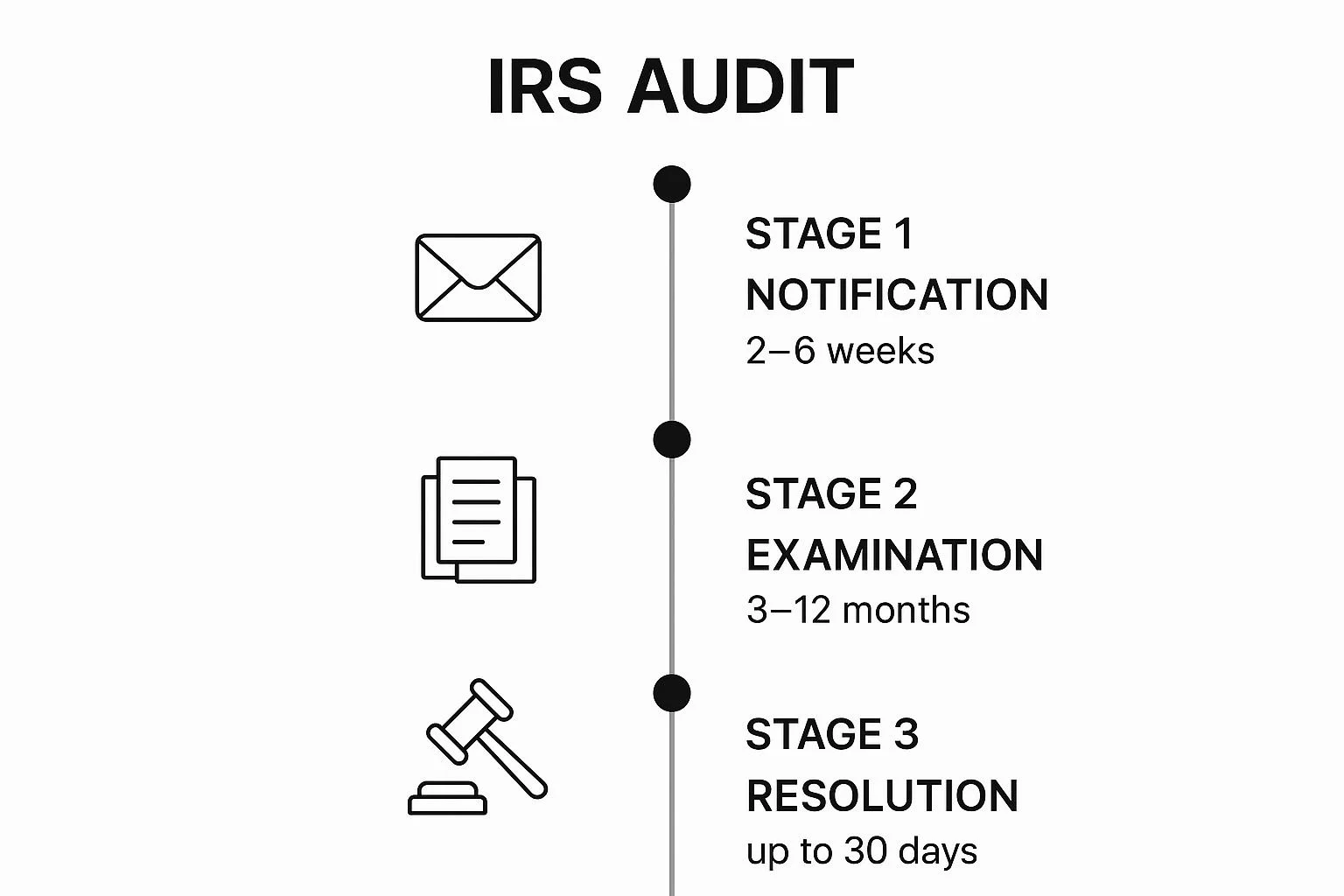
As you can see, the real wild card is the "Examination" phase. This is where the deep dive happens, and it can last anywhere from a few months to a full year depending on how tangled your financial situation is.
The Three-Year Statute of Limitations
One of the most common worries I hear from taxpayers is the fear that the IRS can dig into their financial past forever. Fortunately, that’s not how it works. The IRS has a strict deadline, known as the statute of limitations, which puts a hard stop on how long they have to start an audit.
Think of it as a countdown timer that begins the day you file your tax return. In most cases, that timer is set for three years. This "three-year rule" is crucial because it gives you a clear point of closure, meaning you don't have to constantly worry about a past return being questioned.
Let’s say you filed your 2023 tax return right on time, on April 15, 2024. The IRS generally has until April 15, 2027, to initiate an audit for that specific year.
After that date, the book is closed. This timeframe is a balancing act, giving the agency enough time to ensure compliance without leaving taxpayers in a state of permanent uncertainty.
When The Clock Can Be Extended

But—and this is a big but—that three-year window isn't set in stone. Certain situations can hit the pause button and give the IRS significantly more time to look at your records. Knowing what triggers these extensions is essential.
The most frequent exception is what’s known as the six-year rule. This kicks in if you’ve substantially understated your gross income—and by "substantially," the IRS means by more than 25%.
If that happens, the IRS suddenly has double the normal time to come back and assess more tax. Whether it was an honest mistake or something more, a major reporting error opens you up to six years of scrutiny instead of three.
Situations With No Time Limit
Then there are the extreme cases. In a few specific scenarios, the statute of limitations is thrown out the window entirely. The clock never even starts ticking, giving the IRS an unlimited amount of time to audit you and collect what's owed.
This happens if you:
File a fraudulent return: If you deliberately lie to the IRS, all time limits are off the table.
Fail to file a return: The countdown can't start if a return was never filed in the first place. The audit window stays open indefinitely.
Willfully try to evade taxes: Taking active steps to avoid paying your tax obligations is another surefire way to lose the protection of the statute of limitations.
These exceptions really hammer home the importance of filing honestly and on time. For a more detailed look at these timelines, you can dive deeper into our guide on the IRS statute of limitations.
Understanding the Different Types of Audits
Not all IRS audits are the same, and the type you’re facing is the single biggest factor in how long the process will take. Think of it like a vehicle inspection: some are a quick check of your tire pressure, while others involve taking the whole engine apart. The scope of the audit directly shapes the timeline.
There are three main categories, each with its own level of intensity. Knowing which one you're up against is the first step in setting realistic expectations for the road ahead.
Mail Audits: The Quickest and Most Common
The most common and least scary type is the mail audit, sometimes called a correspondence audit. This is basically the IRS sending you a letter asking for proof of something specific on your tax return, like a large charitable donation or a medical expense deduction.
Because these audits are laser-focused and handled entirely through the mail, they’re usually the fastest to wrap up. If you send back clear, organized documents right away, a mail audit can often be over and done with in just a few months.
An IRS mail audit is like your credit card company asking for a receipt to verify a specific charge. They aren’t questioning your entire spending history, just that one transaction. A quick, clear response usually closes the case.
Office Audits: A Deeper Dive
A step up in intensity is the office audit. This means you (or your tax professional) will need to head to a local IRS office to meet with an agent. These are more involved than a simple letter and tend to focus on more complex items on your return.
For instance, an agent might want to dig into your reported business expenses, income from a side hustle, or rental property deductions. The process naturally takes longer because it involves scheduling meetings, face-to-face discussions, and a more thorough review of your records. An office audit can easily stretch out for six months to a year.
Field Audits: The Most Comprehensive Review
Finally, we have the field audit—the most in-depth and time-consuming examination of them all. In this scenario, one or more IRS agents come directly to your home, place of business, or accountant’s office to perform a top-to-bottom review of your financial records.
Field audits are typically reserved for complex individual tax returns or for businesses. Because agents are looking at your entire financial life, not just one or two items, these can drag on for a year or even longer. The timeline depends heavily on how complicated your finances are and how organized your paperwork is. Understanding what triggers a tax audit can shed some light on why your return might have been flagged for this level of scrutiny.
Key Factors That Can Delay Your Audit

Ever wonder why your friend's IRS audit was wrapped up in a few months, while yours feels like it's dragging on forever? It’s not random. A few specific variables can pump the brakes on the whole process, turning what should be a straightforward review into a marathon.
The biggest culprit by far is the complexity of your tax return. Think of it this way: a simple return with W-2 income and the standard deduction is like a straight, flat road. An auditor can cruise right through it.
But a return with business income, foreign assets, intricate investments, or crypto transactions? That’s more like a winding mountain pass with hairpin turns. It simply takes the IRS more time to navigate every twist and turn.
Responsiveness and Organization
Believe it or not, you have a massive amount of control over the audit’s pace. One of the most common reasons for delays is a slow or incomplete response from the taxpayer. When an auditor sends an Information Document Request (IDR) and has to wait weeks for your documents, the clock doesn't stop. It just keeps ticking.
An audit is essentially a conversation. When you provide prompt, clear, and well-organized information, that conversation moves forward efficiently. But if you’re disorganized or slow to respond, everything grinds to a halt.
This is where good record-keeping pays off. Having your financial house in order isn't just a good habit; it's your best defense against a drawn-out audit. Implementing effective bookkeeping practices ahead of time can make all the difference.
Scope Creep and Disagreements
Sometimes, an audit starts small and then grows a life of its own. An agent might begin by looking at your claimed business expenses, only to spot something that looks off with your reported income. This is called "scope creep," and it can quickly turn a targeted inquiry into a full-blown, multi-year examination.
On top of that, disagreements will always add more time. If you don't agree with the auditor's findings, your case doesn't just end. It moves on to the appeals process, which comes with its own separate timeline.
And if the audit leaves you with a hefty tax bill you can't cover, it's a good idea to learn how to negotiate IRS debt to find a workable solution.
Who the IRS Audits and Why

When that audit notice lands in your mailbox, it’s easy to feel like you’ve been personally singled out. But the truth is, it’s rarely random and almost never personal.
The IRS relies on a powerful, data-driven system to decide which tax returns deserve a second look, and it’s all about putting resources where they’ll make the biggest difference.
Think of it as a massive quality control system. Powerful computers scan every single return, cross-referencing the numbers you reported with the data they get from your employer, your bank, and your brokerage. If your W-2 shows one income figure but your tax return shows another, a digital flag goes up. It's that simple.
This automated process catches discrepancies for taxpayers at all income levels. That said, the IRS is also strategic, focusing a good chunk of its enforcement power on returns with the highest potential for recovering unpaid taxes.
This often means high-income individuals and large corporations are more likely to get tapped for a review.
Shifting Enforcement Priorities
While you may have heard that audit rates have dropped over the years, the IRS is now making a very clear strategic pivot: it's sharpening its focus on the wealthiest taxpayers. The agency's own projections show a plan to increase audit rates for individuals earning over $10 million from 11% in 2019 to roughly 16.5% by 2026.
The change is even starker for large corporations with assets over $250 million. Their audit rates are projected to skyrocket from 8.8% in 2019 to as high as 22.6%. This move underscores the agency’s goal to tackle complex financial structures where the biggest tax gaps are often found.
You can discover more insights about IRS audit targets on taxesforexpats.com.
At the end of the day, understanding what triggers an audit helps demystify the process. It’s not a personal attack; it’s a numbers game designed to keep the entire tax system fair and accurate.
Common Questions About the Audit Process
When that letter from the IRS arrives, your mind probably starts racing with questions. It's a daunting process, and a little clarity can go a long way in calming your nerves and helping you prepare. Let's tackle some of the most common worries people have right out of the gate.
The biggest fear is usually, "Does this mean I'm in trouble?" Not necessarily. An audit isn't an accusation; it's just a review. While some audits are triggered by clear red flags, many are selected by a computer system using statistical formulas to spot returns that look different from the norm.
It’s also possible your return was simply connected to another taxpayer's return that's under examination. The bottom line? Don't panic. The reason for the audit matters less than how you handle it.
What Are My Next Steps
So, what do you do now? People often wonder if the deadlines are set in stone. The good news is, you can ask for more time to get your documents together.
The IRS is usually reasonable about granting an extension, but communication is everything. You need to contact your assigned agent right away, explain your situation, and suggest a new deadline you can actually meet.
Ignoring the notice is the worst thing you can do. It sours the relationship with the examiner and just drags things out.
And what happens at the very end? The agent will close the case with a final report showing one of three possible outcomes:
No change: This is the best-case scenario. The IRS accepts your return as it was filed.
Agreed: You accept the agent's proposed changes and arrange to pay any extra tax, penalties, and interest.
Disagreed: You don't accept the findings. This is where you can challenge the decision and begin the appeals process, which will add a significant amount of time to the timeline.
Knowing these potential paths from the start helps you set realistic expectations for how long this whole process might take.
Facing an audit can be complex, but you don't have to go through it alone. Attorney Stephen A Weisberg starts with a FREE Tax Debt Analysis to determine the best path forward for your specific situation.
➥ Contact Attorney Stephen A. Weisberg for a free Tax Debt Analysis.
Contact Me Here: https://www.weisberg.tax/contact-1
Email: s.weisberg@weisberg.tax
Phone/Text: (248) 971-0885
Address: 300 Galleria Officentre, Suite 402, Southfield, MI 48034
