IRS Audit Representation Your Guide to Expert Tax Help
That thick, official envelope from the IRS sitting on your counter is enough to make anyone’s stomach drop. This is precisely where IRS audit representation comes in.
Think of it as your professional shield—a qualified expert like a Tax Attorney, CPA, or Enrolled Agent who steps in to take over the entire process for you.
They become your voice. They handle all the stressful communications, strategically field every inquiry, and vigorously defend your rights. It transforms what feels like a personal confrontation into a professionally managed procedure.
Why You Need an IRS Audit Representative

Trying to face an IRS audit on your own is like walking into a complex legal maze blindfolded. This isn't just about showing a few receipts; it's a high-stakes process where every single word you say and every document you provide carries significant weight.
Even a small, completely unintentional mistake can snowball. It could trigger an expanded investigation, rack up much larger penalties, or in the worst-case scenarios, lead to criminal charges. This is where the true, indispensable value of an IRS audit representative shines through.
Think of your representative as your seasoned guide and personal diplomat. Their first job is to create a professional buffer between you and the auditor.
This immediately dials down your stress and, crucially, prevents you from saying something off-the-cuff that could inadvertently damage your case.
They live and breathe the intricate nuances of tax law and IRS procedures, which allows them to protect your rights from the very first phone call.
The Shifting Audit Landscape
The reality is, the need for expert representation is only growing as the IRS sharpens its focus on enforcement. We're seeing a clear trend: audit rates for high-income earners and large corporations are on the rise. For instance, individuals earning over $10 million are projected to see their audit rate jump from 11% in 2019 to 16.5% by 2026.
The increase for large corporations is even more dramatic, with a projected leap from 8.8% to a staggering 22.6% over the same period. You can read more about who the IRS is likely targeting and why this shift is happening.
What does this mean for you? If you fall into one of these higher-risk categories, the audit you face won't be a simple review. It will likely be far more intense and sophisticated. Having an expert in your corner is no longer a luxury; it’s a strategic necessity.
Beyond the Initial Audit
A great representative’s value doesn’t just stop when the initial audit concludes. They provide a forward-looking defense, always thinking two steps ahead. Should the initial outcome be unfavorable, they're already prepared for what comes next.
Even after a decision has been made, there are often avenues for appeal. For example, the process of an IRS audit reconsideration is a specific path your representative can pursue to continue fighting for a better, fairer outcome on your behalf.
The Common Triggers That Flag an IRS Audit

Ever wondered what makes the IRS single out one tax return from the pile? It’s almost never random. The truth is, the IRS uses a powerful, data-driven system to spot returns that just don't look right.
Think of it like a massive digital comparison tool. It analyzes your return against millions of others, looking for figures that seem out of place for someone with your income, in your profession, and living where you do.
When a number on your return stands out as a statistical outlier, a human agent takes a closer look. That’s often the first step toward an audit. Knowing what these red flags are is the first line of defense.
High-Risk Filing Scenarios
Let's be clear: the IRS doesn't have the resources to audit everyone. They focus their energy where they’re most likely to find significant errors or unpaid taxes. Their approach is increasingly targeted, zeroing in on high earners, large corporations, and anyone with complicated finances.
While the average taxpayer's audit risk hovers between a low 0.2% and 0.5%, this targeted strategy has big implications for IRS audit representation, as professionals need to be prepared for intense scrutiny. You can learn more about the current IRS audit risk warnings to get a better sense of these trends.
So, what are some of the classic red flags?
Unusually High Deductions: Claiming deductions on your Schedule C (for business) or Schedule A (itemized) that seem way too high compared to your reported income is a surefire way to get noticed.
Significant Charitable Contributions: It's great to be generous, but if you're donating a huge percentage of your income, the IRS might want to see the receipts to make sure everything is legitimate.
Reporting Major Business Losses: A business that loses money year after year starts to look less like a genuine enterprise and more like a hobby designed to generate tax write-offs for personal expenses.
Other Key Audit Triggers
Beyond those big-picture issues, a few other specific items can trigger an audit. The IRS has gotten incredibly good at cross-referencing information, and any mismatch is an easy catch for their systems.
It’s also important to realize that employing certain tax strategies, especially complex ones, can naturally lead to more IRS scrutiny.
One of the most common and easily avoidable mistakes is simply failing to report all your income. The IRS gets copies of the same W-2s and 1099s that you do. If the numbers you report don't match what they've received from your employer, bank, or brokerage, their computers will flag the difference instantly.
Other hot-button issues include cryptocurrency transactions—a major focus for the IRS lately—and incorrectly claiming popular tax credits like the Earned Income Tax Credit (EITC).
By understanding what the IRS is looking for, you can be much smarter about how you prepare your return and, if the time comes, how you handle an audit.
Navigating the Audit Process with a Representative
Getting that audit notice from the IRS can feel like you've been dropped into a stormy sea without a life raft. It's confusing, stressful, and chaotic.
But with professional IRS audit representation, that overwhelming experience transforms into a structured, predictable journey. An expert turns the ordeal into a manageable process with clear, distinct stages.
The moment you hire a representative, they take the helm. They aren't just giving you advice from the shore; they become your advocate, your strategist, and your shield.
Think of them as a seasoned captain navigating you through treacherous waters. Their entire mission is to calm the storm and steer every step toward the best possible outcome for you.
The Initial Takeover and Strategy Formation
The very first thing your representative will do is file IRS Form 2848, the Power of Attorney and Declaration of Representative. This is a game-changer. It’s the official document that tells the IRS, "Talk to my guy, not me."
Once that form is on file, all communications from the IRS—every letter, phone call, and demand for information—get routed directly to your representative.
This instantly puts a professional buffer between you and the auditor, stopping the stressful calls and preventing you from saying something under pressure that could hurt your case.
From there, your representative gets to work, dissecting the audit notice, poring over your tax return, and building the foundation of your defense strategy.
This early stage is all about getting organized. The infographic below shows the key steps your representative will handle to get everything in order.
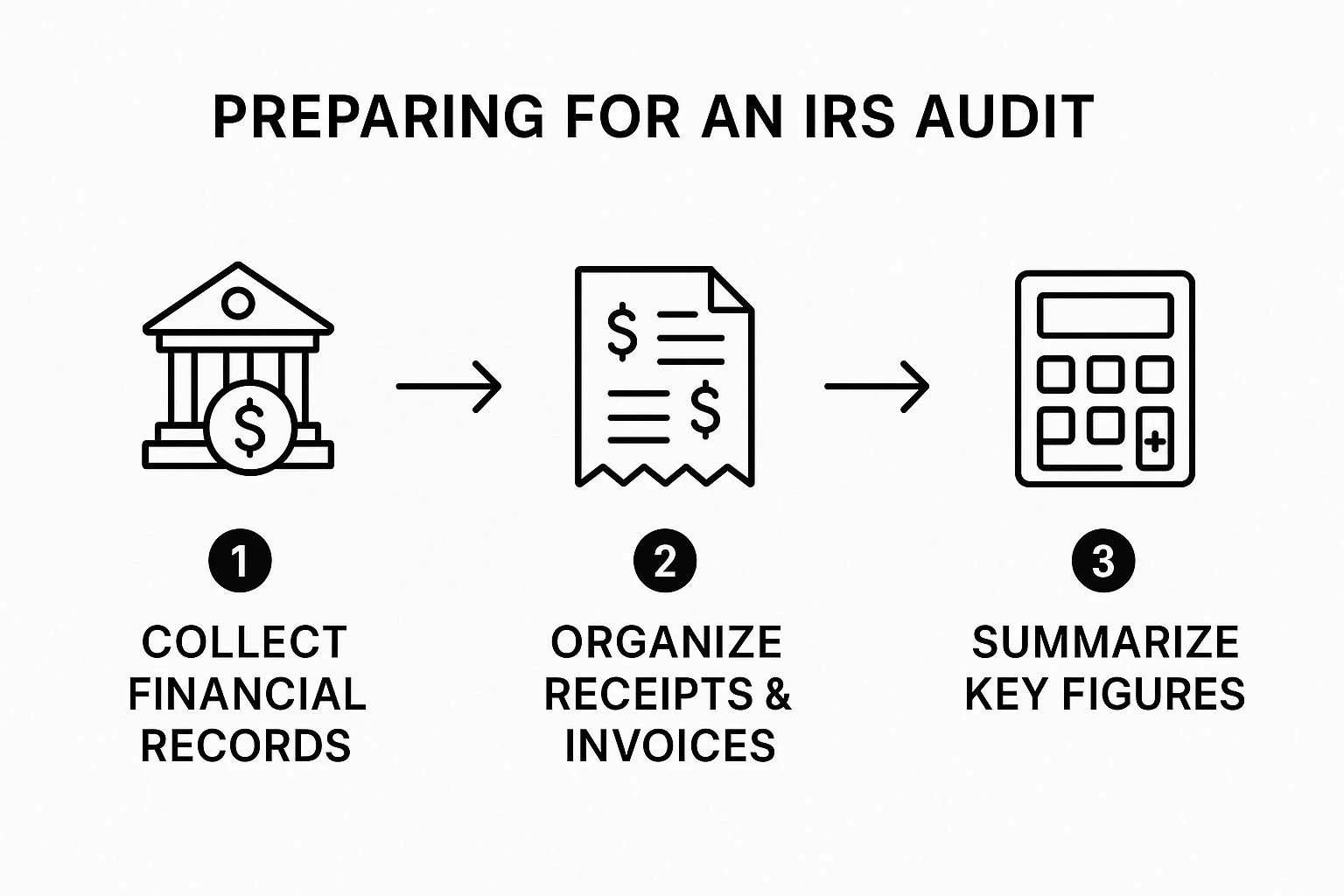
As you can see, the process starts with meticulously gathering all your financial records. Then, they’ll organize that documentation and, finally, prepare clear summaries of the essential figures for the IRS.
Managing the Examination and Negotiation
With a solid strategy in place, the real work of the audit begins. The IRS will start sending out Information Document Requests (IDRs), which are just formal requests for specific records and proof. A huge part of your representative's job is to handle these IDRs strategically.
They will:
Review Each Request: They'll scrutinize every IDR to make sure it’s relevant to the audit's scope and that the auditor isn't on a fishing expedition.
Gather and Vet Documents: They'll work with you to collect the needed documents, reviewing each piece of paper to ensure it actually helps your case before it ever gets sent to the IRS.
Handle All Meetings: Your representative attends all meetings with the auditor. In most situations, you’ll never have to speak directly with the IRS agent yourself.
This is where their negotiation chops really shine. If the audit turns up proposed changes or penalties, the fight isn't over. Your representative will negotiate directly with the agent, armed with legal arguments and case law to challenge any unfair adjustments.
The goal is always to minimize your tax liability and abate penalties whenever possible. An experienced representative knows the common ground where agreements can be reached and how to present your case in the most favorable light.
If a fair deal can't be struck with the examiner, your representative is ready to take the fight to the next level: the IRS Office of Appeals, where a fresh set of eyes will review your case. For those who might end up with a large tax bill even after the audit, it's also smart to understand.
Finally, streamlining collaboration with your tax professional is absolutely essential for a smooth process; clear and open communication gives them the ammunition they need to build your strongest defense.
The Strategic Advantages of Professional Representation

Trying to decide whether to hire an expert for an IRS audit can feel like a tough call. It's easy to see it as a major expense when you're already facing a stressful situation. But what if you viewed IRS audit representation not as a cost, but as a crucial strategic investment?
The most immediate benefit is something you can't put a price on: relief. The moment you hand the case over to a professional, that crushing weight of anxiety starts to lift. You can finally get back to your life and work, knowing a seasoned expert is handling the entire ordeal.
This isn't just about convenience. It’s about putting a buffer between you and the IRS—a buffer that prevents you from making emotional decisions or costly mistakes under pressure. They are the calm, objective voice in a process that is anything but.
Expertise in Navigating the Tax Code Maze
Let’s be honest, the U.S. tax code is a labyrinth. It’s a dense, ever-changing world of rules, obscure regulations, and past court rulings that is nearly impossible for the average person to navigate on their own. This is where a tax professional's experience becomes your greatest asset.
They've spent their careers in these trenches. They know precisely which arguments will resonate with an auditor and, just as importantly, which ones will fall flat. They can spot subtle opportunities for your defense that you would almost certainly overlook.
For example, a skilled representative might unearth a specific tax court decision or a little-known provision in the Internal Revenue Manual that perfectly supports your position. Suddenly, your defense is no longer just a pile of receipts; it's a solid, legally-grounded argument.
This expertise, sometimes supported by modern tools that aid in audit compliance, can completely change the dynamic of your audit.
Superior Negotiation and Financial Outcomes
Perhaps the most concrete advantage is a professional's skill in negotiation. They deal with IRS agents and auditors every day. They understand the agency’s internal culture, know what auditors are trained to look for, and can often anticipate the IRS's next move before it happens.
An experienced representative doesn't just react to the IRS; they proactively manage the conversation, shaping the narrative of your case to secure the best possible outcome.
This isn't just about feeling more confident; it leads to real, measurable financial results. Their seasoned negotiation skills can lead to:
Reduced Tax Liability: Successfully challenging the IRS's proposed changes to your income or deductions.
Penalty Abatement: Crafting a compelling argument for "reasonable cause" to get costly penalties waived.
Preventing Audit Creep: Skillfully keeping the audit confined to the original issues, stopping it from expanding into a much broader, more painful examination of your finances.
Take a look at how handling an audit yourself stacks up against bringing in a professional. The differences in potential outcomes, risks, and responsibilities are stark.
DIY Audit vs Professional Representation Outcome Comparison
| Audit Aspect | Handling It Yourself (DIY) | With Professional Representation |
|---|---|---|
| Communication | Direct, often stressful communication with the IRS. | Your representative handles all communication. |
| Risk of Error | High. You might miss key defenses or say something incriminating. | Low. The expert knows what to say and what to avoid. |
| Emotional Stress | Extremely high. The burden is entirely on you. | Significantly reduced. You can focus on your life. |
| Time Commitment | Massive. Requires extensive time for research and meetings. | Minimal. Your representative manages the entire process. |
| Financial Outcome | Often results in higher tax liability and penalties. | Frequently leads to reduced liability and penalty removal. |
| Future Risk | Audit might expand due to mistakes or unclear answers. | The audit is contained, reducing the risk of future issues. |
Ultimately, hiring a professional isn't just about outsourcing paperwork. It's a powerful strategic move to protect your money, dramatically reduce your liability, and give yourself peace of mind during one of life's more challenging events.
How to Choose the Right Tax Representative for You
Let’s be blunt: choosing the right professional for your IRS audit representation is the single most important decision you'll make in this entire ordeal. This isn't like picking a plumber from an online search.
You are selecting an advocate who will literally stand between you and one of the world's most powerful government agencies.
The right choice directly impacts the stress you feel and, just as importantly, the financial outcome you secure. A good representative brings technical expertise, of course, but the best ones also bring you genuine peace of mind.
Finding that person means vetting your candidates carefully, focusing on credentials, specific experience, and how they communicate.
Credentials and Specialization
Not all tax professionals are built the same, especially when an audit is on the line. You need someone who has unlimited representation rights before the IRS. This isn't negotiable. This exclusive group includes:
Enrolled Agents (EAs): These are tax specialists, pure and simple. They are licensed directly by the IRS and live and breathe taxation. For most tax issues, they are exceptionally well-qualified.
Certified Public Accountants (CPAs): While many CPAs focus on general accounting or financial planning, those who specialize in tax controversy are fantastic choices. You want the CPA who thrives on tax law, not just balance sheets.
Tax Attorneys: These are lawyers who specialize in tax law. They become absolutely essential if your case has any chance of turning criminal or if you might end up in Tax Court.
A critical point here is making sure their experience aligns with your specific problem. A pro who is a master at handling simple mail audits might be completely out of their depth in a complex field audit that requires in-person negotiation and a granular understanding of your business operations.
When you speak with potential representatives, be direct. Ask them point-blank how many cases just like yours they've managed in the past year. Their answer will tell you everything you need to know about their real-world, relevant experience.
Key Questions for Your Consultation
Think of the initial consultation as your chance to interview them, not the other way around. Don't just sit there and listen. Come armed with a checklist of questions to see if they're the right fit for your case and your personality.
Here are the questions I'd be asking:
What’s your experience with an audit of this type and complexity?
Who will be my main point of contact? Am I hiring you, or will my case be handed off to a junior associate I've never met?
How do you structure your fees? Is it a flat fee, an hourly rate, or a retainer? Get the answer in writing. No surprises.
What’s your communication style? How often will I get updates, and how will I get them?
Based on what you know so far, what’s your initial assessment? Be very suspicious of anyone who guarantees a specific outcome.
This vetting process isn't just about finding someone with the right qualifications; it's about finding an advocate whose working style gives you confidence when you need it most.
A strong representative can also uncover resolution strategies you didn't even know were on the table. For example, if a large tax debt is the root of the problem, you might benefit from learning about a complete guide to the IRS Offer in Compromise.
Picking the right professional ensures every possible strategic option is considered.
Answering Your Top IRS Audit Questions
When that dreaded letter from the IRS arrives, your mind can start racing with questions and what-ifs. It’s a stressful situation, no doubt. This section is designed to cut through the noise and give you straight, clear answers to the most common concerns I hear from clients, so you can feel more in control.
What Is the First Thing I Should Do?
When you get an audit notice, the very first thing to do is stop, take a deep breath, and do not call the IRS. That knee-jerk reaction to pick up the phone is understandable, but it's the last thing you should do.
Read the letter carefully. It contains crucial details, like the tax year they're looking at and exactly what items are under review. Your next step isn’t to frantically dig up a mountain of receipts; it's to get a professional consultation.
An expert in IRS audit representation can look at the notice, understand what the IRS is really asking for, and lay out a calm, strategic game plan.
Your biggest advantage is being proactive, not reactive. Getting a professional involved right away prevents you from making costly mistakes and ensures you never have to speak directly with the IRS—a critical layer of protection.
Can a Representative Actually Get My Penalties Reduced?
Yes, absolutely. In fact, this is one of the most powerful reasons to hire a professional. Experienced representatives are experts in a process called penalty abatement, and we know how to argue for penalties to be reduced or even removed entirely based on specific legal grounds.
The most common argument we use is for "reasonable cause." This is where your representative builds a case showing that you genuinely tried to follow the tax laws but were tripped up by circumstances you couldn't control. It's a nuanced legal argument that's incredibly difficult for a taxpayer to win on their own.
How Long Will an IRS Audit Take?
This is the million-dollar question, and the honest answer is: it depends. The timeline for an audit can vary wildly based on a few key things:
Audit Type: A simple mail audit might wrap up in a few months. A complex field audit, where agents visit your business, can easily stretch out for a year or more.
Case Complexity: An audit focused on a single deduction will be much quicker than one digging into an entire small business with years of complex records.
Your Responsiveness: When your representative can provide well-organized documents, it helps move things along much faster.
Don't forget, the IRS is dealing with a massive workload. In just the first two months of the 2025 filing season, they processed over 52.4 million individual returns and sent out nearly 37 million refunds.
You can see more about the IRS's filing season workload to get a sense of the scale. This backlog can directly affect how quickly your case moves, making professional management even more critical.
Do I Have to Attend Meetings with the IRS?
For most of my clients, the answer is a relieving no. When you hire a representative and sign a Form 2848 (Power of Attorney), you give them the legal authority to speak and act for you. This means your representative handles every meeting, every phone call, and every piece of correspondence.
This is the ideal setup. It shields you from the stress and emotional pressure of facing an auditor. You get to focus on your work and your family while your advocate manages the entire complex process. Of course, knowing how to avoid an IRS audit in the first place is always the best strategy.
Are you facing an IRS audit or struggling with tax debt? Don't go it alone. I’m Attorney Stephen A Weisberg, and I offer a FREE, no-obligation Tax Debt Analysis to assess your situation and explain exactly how I can help. Let’s create a clear path to resolving your IRS issues.
➥ Contact Attorney Stephen A. Weisberg for a free Tax Debt Analysis.
Contact Me Here: https://www.weisberg.tax/contact-1
Email: s.weisberg@weisberg.tax
Phone/Text: (248) 971-0885
Address: 300 Galleria Officentre, Suite 402, Southfield, MI 48034
