What Is a IRS Levy? Important Facts You Need to Know
Few things from the IRS can make your heart sink faster than an official notice. When that notice mentions a "levy," it's time to pay very close attention. An IRS levy isn't just a threat or a warning letter; it's the legal seizure of your property or assets to cover an unpaid tax debt.
This is the government reaching directly into your accounts and taking what it's owed. It's a serious collection tool, backed by the full force of federal law.
Understanding the Power of an IRS Levy
When the IRS says "levy," they mean business. They are actively taking your property. This isn't a step they take lightly; it comes after they've sent multiple notices about your tax debt that have gone unanswered. At this point, they shift from just notifying you to actively collecting.
This power comes straight from the U.S. Internal Revenue Code, specifically section 6331. This law gives the IRS the authority to seize your property to settle a tax bill—and they can do it without getting a court order first. You can find more details on this powerful enforcement authority on Wikipedia.
What Can Be Seized in an IRS Levy
The IRS can cast a very wide net with a levy. They're looking to recover the full amount you owe, including all the penalties and interest that have piled up.
Commonly targeted assets include:
Wages and salaries: The IRS can take a portion of every single paycheck until your debt is paid off. This is a continuous garnishment.
Bank accounts: They can freeze the funds in your checking and savings accounts and then seize them.
Social Security benefits: Yes, even a percentage of your monthly benefits can be levied.
Retirement accounts: Your 401(k) or IRA isn't necessarily safe.
Real estate and personal property: In more extreme situations, the IRS can seize and sell your house, car, or other valuable possessions.
It's easy to confuse a levy with a lien, but they are very different. A lien is a legal claim against your property that secures the government's interest. A levy is the actual, physical seizure of that property.
To help clarify, here's a quick overview of what an IRS levy entails.
IRS Levy at a Glance
| Aspect | Description |
|---|---|
| What It Is | The legal seizure of property or assets to satisfy an unpaid tax debt. |
| Legal Basis | Authorized by Internal Revenue Code Section 6331. |
| What Can Be Levied | Wages, bank accounts, Social Security, real estate, personal property. |
| Key Precursor | A Final Notice of Intent to Levy must be issued. |
| Taxpayer's Window | 30 days to respond to the Final Notice before seizure begins. |
This table shows just how serious a levy is and underscores the importance of the final notice period.
The Purpose of a Levy
You might think a levy is purely punitive, but that’s not the whole story. The IRS would much rather you work with them voluntarily to set up a payment plan or another resolution. The levy is their last resort—the ultimate tool to force collection when a taxpayer simply won't respond.
The process has built-in safeguards, like the "Final Notice of Intent to Levy." This notice gives you a critical 30-day window to act before they seize your assets.
It is your absolute last chance to prevent the levy. Ignoring it is a near-guarantee that the IRS will move forward, causing massive financial disruption.
The key thing to remember is that an IRS levy is a real, forceful action, not just another piece of mail to ignore.
The Difference Between an IRS Levy and a Lien

When the IRS is on your case, you'll hear the words "lien" and "levy" tossed around a lot. People often use them interchangeably, but in the world of tax collection, they mean two very different things.
Knowing the difference isn't just a matter of semantics—it tells you exactly how serious your situation is and how fast you need to move.
Let’s break it down with an analogy. Think of an IRS tax lien as a public claim. The government is essentially putting a "reserved for the IRS" sign on all your property, including things you might buy after the lien is filed. It’s their way of securing their interest in your assets as collateral for the tax debt you owe.
A lien doesn't mean the IRS is hauling your car away tomorrow. But it still packs a punch. It wrecks your credit score, making loans nearly impossible to get.
It also "clouds the title" on your assets, meaning you can't sell your house or transfer property without paying off the IRS first. It’s a public record declaring to the world that you owe the government money.
The Shift From Claim to Seizure
An IRS levy, on the other hand, is the action that follows the claim. This is the moment the government shows up to actually collect on the property that the lien has "reserved." A levy is the real deal—an aggressive, tangible action where the IRS actively takes your assets to satisfy your tax bill.
Here’s the critical distinction: a lien secures the debt, while a levy settles it by force. A lien is a passive notice attached to your assets; a levy is an active and immediate confiscation. With a lien on your car, you still get to drive it. With a levy, the IRS can tow that car away and sell it.
A Notice of Federal Tax Lien is a public announcement that can harm your credit. A Notice of Intent to Levy is a final warning that seizure of your wages or bank account is about to happen.
The two are directly connected. The IRS almost always files a lien first to establish its legal right to your property. If you continue to ignore the debt, that’s when they escalate to a levy to enforce their claim.
IRS Levy vs. IRS Lien Key Differences
To make this crystal clear, let’s put these two collection tools side-by-side. Seeing the differences laid out like this can help you understand exactly what’s happening in your case and what the IRS is trying to do.
| Feature | IRS Tax Lien | IRS Tax Levy |
|---|---|---|
| Purpose | To secure the government's claim to your assets. | To seize your assets to pay the tax debt. |
| Action Type | A legal claim against your property. | The actual seizure of your property. |
| Impact on Possession | You keep your property. | The IRS takes possession of your property. |
| Example | A public notice attached to your house's title. | Draining your bank account or garnishing your paycheck. |
Ultimately, a lien is a warning shot across the bow, while a levy is the cannonball hitting the deck. Both are serious, but a levy demands immediate, urgent action to prevent the loss of your property.
The Official Step-by-Step IRS Levy Process
Let’s get one thing straight: the IRS doesn’t just show up on your doorstep and start taking things. A levy is the final, powerful move in a long game of notices and warnings.
The entire process follows a strict, legally required timeline, and understanding this roadmap is the key to knowing exactly how much time you have to act.
It all starts long before you even see the word "levy." The journey begins the moment a tax debt goes unpaid, which automatically triggers a series of official letters from the IRS.
The Initial Notices and Demands
First, the IRS has to assess the tax you owe and send you a Notice and Demand for Payment. Think of this as the initial bill that lays out what you owe and why. If you don't pay up, the notices will keep coming, and each one gets a bit more serious.
These aren't just friendly reminders; they are legal steps the IRS must take before they can escalate to more forceful collection actions.
Ignoring these early warnings is a surefire way to make a bad situation worse. All the while, penalties and interest are piling up on top of your original debt. This is the best time to engage with the IRS, because your options for a resolution are at their widest.
The Critical Final Warning
The single most important piece of mail you’ll get is the Final Notice of Intent to Levy and Notice of Your Right to a Hearing. This is the big red flag. The moment this notice is sent, a 30-day countdown officially begins.
You have precisely one month from the date on that letter to either pay the debt in full or set up an alternative plan before the IRS can legally start seizing your property.
This notice is a critical milestone. To get a better handle on its importance and what it means for you, check out our ultimate guide to the Notice of Levy for taxpayers. It breaks down everything you need to know about this document.
The IRS must deliver this final warning properly—either by handing it to you in person, sending it via certified mail, or mailing it to your last known address.
Once that's done, they can start notifying third parties like your bank or employer, putting them on alert to comply with the levy when it comes.
This is your last chance to get ahead of the problem. That 30-day window is non-negotiable for preventing the seizure of your bank accounts, wages, and other assets.
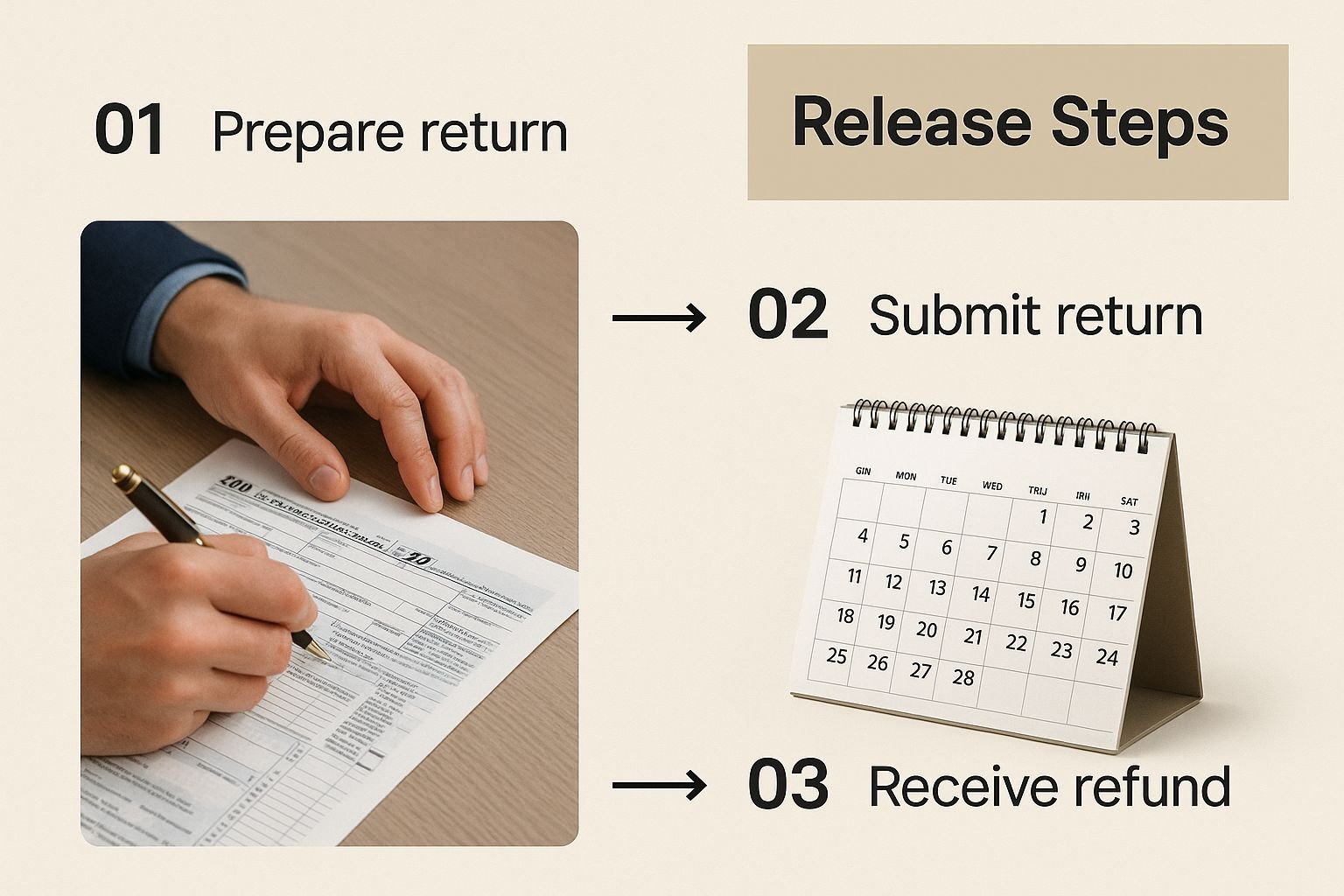
As you can see, taking proactive steps like negotiating an agreement is the key to resolving the issue and getting the levy released.
What Happens After 30 Days
If that 30-day period comes and goes without a resolution, the IRS is officially cleared to take action. At this point, they can:
Contact your bank and order them to freeze your accounts and send the money directly to the IRS.
Notify your employer to start garnishing a significant chunk of your paycheck.
Seize other assets, including Social Security benefits, retirement funds, or even physical property like your car or home.
Knowing where you are in this timeline is your biggest advantage. If you've only received the initial bills, you still have time. But if that Final Notice is in your hand, the clock is ticking—loudly.
What Assets the IRS Can Actually Seize
When you get an IRS levy notice, the first question that probably pops into your head is: what can they actually take? It's a scary thought, but understanding the scope of the IRS's power is the first step toward protecting yourself.
Let's be clear: the IRS has far-reaching authority. They can go after both your financial accounts and your physical property.
The easiest targets are always liquid assets. That’s why the IRS typically starts with your checking and savings accounts. When your bank gets a levy notice, they are legally required to freeze your funds (up to the amount you owe, of course) and hold them for 21 days. After that waiting period, the bank sends the money directly to the IRS.
Your paycheck is another prime target. The IRS can slap a continuous wage garnishment on your income, forcing your employer to send a chunk of every single paycheck to the government. This doesn't stop until the tax debt is paid in full.
Broader Seizure Capabilities
Beyond your bank account and wages, the IRS can get more aggressive by seizing and selling off other valuable assets to satisfy your debt.
Here’s a look at what else is on the table:
Retirement Funds: Your 401(k) or IRA isn't automatically safe. While it’s a more complex process for the IRS, these accounts are absolutely on the list of seizable assets. We cover this in detail in our article on how the IRS can take your 401(k) and what your rights are.
Vehicles: Yes, they can take your car, truck, or boat and sell it at auction.
Real Estate: This includes your primary residence, a vacation home, or even a plot of land. Seizing your main home is usually a last resort for the IRS, but don't assume it can't happen.
Commissions and Payments: If you're a freelancer or independent contractor, the IRS can intercept payments your clients owe you.
The IRS's reach even extends to money the federal government owes you. Through the Treasury Offset Program, they can continuously take from federal payments, like Social Security benefits, to pay down your tax debt.
This program is a powerful example of the IRS's collection muscle. For instance, the Treasury Offset Program can legally redirect up to 15% of your monthly Social Security check until your debt is cleared. You can read more about this directly from the U.S. Department of the Treasury.
What Assets Are Exempt from a Levy
Thankfully, it’s not a total free-for-all. Federal law carves out some specific protections to ensure you aren't left with absolutely nothing. The government recognizes you still need to cover basic living expenses.
Here are some of the key assets that are generally exempt from an IRS levy:
Certain Public Assistance Payments: This includes benefits like Supplemental Security Income (SSI) and some welfare payments.
Specific Disability Benefits: Money from workers' compensation is typically protected.
A Portion of Your Income: The IRS can’t garnish your entire paycheck. A certain amount, which depends on your filing status and number of dependents, is legally off-limits.
Basic Household Goods: They can't take the shirt off your back—or your couch. Necessary items like fuel, furniture, and personal effects are protected up to a certain value.
Tools of the Trade: Books and tools that are essential for you to do your job are also exempt, again, up to a specific dollar amount.
These exemptions create a small but critical buffer. An IRS levy is severe, but these rules are in place to prevent it from becoming completely destitute.
How to Stop an IRS Levy in Its Tracks
Getting that Final Notice of Intent to Levy can make your stomach drop. It feels final, like the end of the line, but it's really the opposite—it's your 30-day window to take charge.
This notice is a critical call to action. The absolute worst thing you can do is ignore it and hope it goes away. Trust me, it won't. The only way to protect your assets is to face the IRS head-on.
Fortunately, you have several powerful strategies to stop a levy before it wreaks havoc on your life. Your main goal here is simple: get the IRS to agree to a different way to handle your debt. Once you're on a formal, approved path, they have to back off.
Set Up an Installment Agreement
The most direct way to stop a levy is to officially agree to pay what you owe over time. This is called an Installment Agreement (IA), and it’s just a formal payment plan with the IRS.
You commit to making manageable monthly payments until the debt is paid in full. As soon as the IRS approves your IA, they are legally required to stop any pending levy action.
This is a fantastic option if you have the means to pay your tax debt but just can't do it all at once. An IA gives you a clear, predictable roadmap to getting out of debt without the heart-stopping shock of a bank account seizure. You might even be able to set one up yourself directly on the IRS website.
Pursue an Offer in Compromise
But what if you genuinely can’t afford to pay the full tax bill, even if it's spread out over several years? This is where an Offer in Compromise (OIC) comes in. An OIC is a formal program that lets certain taxpayers settle their tax liability for less than the total amount they owe.
To get an OIC, you have to prove to the IRS that paying the full amount would cause you serious financial hardship. They will take a magnifying glass to your entire financial picture, looking at your:
Ability to pay based on current income
Monthly living expenses
Total income from all sources
The equity in any assets you own
The good news is that just submitting a valid OIC application automatically puts a stop to levy actions while the IRS reviews your case. It’s a complicated process that demands meticulous financial disclosure, but for those who qualify, it’s nothing short of a lifesaver.
Key Takeaway: An OIC isn't a casual negotiation. The IRS uses strict, non-negotiable formulas to decide who qualifies. A professionally prepared application that ticks all their boxes is absolutely critical for success.
Prove Economic Hardship
If an IRS levy would make it impossible for you to cover basic living expenses—like rent, food, and utilities—you can ask them to stand down. By proving that a levy would cause an immediate economic hardship, you might qualify for Currently Not Collectible (CNC) status.
CNC status is a temporary pause on all collection efforts, including levies. It gives you breathing room. But it's crucial to understand that the debt doesn't vanish. Interest and penalties keep piling up, and the IRS will check in on your financial situation periodically to see if you can start paying again.
Each of these options offers a formal, legitimate path to stopping a levy. For a deeper look at one of the most common types of levies, you can explore our comprehensive guide on stopping IRS wage garnishment. The first and most important step is always to take action.
Protecting Your Rights During the Levy Process
Just because you owe the IRS doesn't mean the process is a one-way street. You are actually protected by a fundamental set of guarantees known as the Taxpayer Bill of Rights.
These aren't just polite suggestions; they are enforceable protections designed to ensure you're treated with fairness and respect throughout the entire levy process.
Knowing your rights completely changes the dynamic. It helps turn that feeling of fear into a sense of control, empowering you to deal with the IRS proactively instead of just reacting to what they do.
Two of the most important rights you have are the right to be informed and the right to challenge the IRS's actions.
Your Right to Challenge and Appeal
You absolutely do not have to just sit back and accept an IRS levy. The law gives you a formal path to dispute the collection action, and it's called a Collection Due Process (CDP) hearing. This is your chance to make your case before the independent IRS Office of Appeals.
At a CDP hearing, you can accomplish a few key things:
Challenge whether the levy is even appropriate in your situation.
Question if the IRS followed all the required legal steps.
Propose other solutions, like an installment agreement or an Offer in Compromise.
To get this hearing, you must file Form 12153, and you have to do it within 30 days of the date printed on your Final Notice of Intent to Levy. That deadline is absolutely critical. Missing it can severely limit your options, so it's a vital first step if you want to learn how to negotiate IRS debt successfully.
The Taxpayer Bill of Rights guarantees every taxpayer the right to confidentiality. The IRS is legally required to protect your personal and financial information, and you have every right to expect that anything you provide will be kept private.
As you navigate the IRS levy process, you'll likely need to share sensitive financial documents. It’s incredibly important to protect these files from anyone who shouldn't see them, which is a key part of safeguarding your privacy and rights.
For some solid advice on keeping your digital information safe, check out these essential tips on shared document security.
Finally, don't forget about your Right to Representation. You are fully entitled to hire an attorney, CPA, or Enrolled Agent to represent you and communicate with the IRS for you.
Facing down an IRS levy on your own is an incredibly stressful experience; having a professional on your side ensures your rights are protected every step of the way.
Common Questions About IRS Levies
When an IRS levy notice lands in your mailbox, a flood of questions usually follows. It's a stressful situation, and getting clear answers fast is the only way to figure out your next move. Let's tackle some of the most common worries taxpayers have.
How Long Does a Bank Levy Last?
This is a big one, and thankfully, the answer isn't "forever." A bank levy is a one-time event, not a constant drain on your account.
The day your bank gets the notice from the IRS, it freezes funds up to the amount of your tax debt. Those funds are then held for a mandatory 21-day period before being sent to the government.
Think of this 21-day window as your last-chance saloon—it's a critical timeframe where you can negotiate with the IRS to get the levy released.
Any new money you deposit after the levy hits is safe from that particular action. But don't get too comfortable; if the tax debt isn't resolved, the IRS can simply issue another levy.
Can the IRS Take My Social Security?
Unfortunately, yes. The IRS has the legal power to garnish a piece of your Social Security benefits through what’s called the Federal Payment Levy Program. They can take up to 15% of your monthly payment.
Unlike a bank levy that happens just once, this is a continuous garnishment. It will keep happening, month after month, until your tax debt is paid in full. It’s a stark reminder of just how far the IRS's collection powers can reach.
Releasing a Levy vs. Returning Money
It's crucial to know the difference between getting a levy released and getting your money returned. They sound similar, but they are worlds apart.
A levy release is your primary goal. This is when the IRS officially tells your bank or employer to stop the seizure. You can usually achieve this by paying the debt, setting up a payment plan, or proving the levy is causing you severe economic hardship.
A release stops the bleeding, but it doesn't automatically get you back the money that's already gone. Having seized property or funds returned is a much tougher battle, usually reserved for rare cases where the IRS made a clear error. Your focus should be on securing a release to protect what you still have.
Navigating an IRS levy is complex, and your financial future is too important to leave to chance. At Attorney Stephen A Weisberg, we start with a free, no-obligation Tax Debt Analysis to determine the best path forward for your unique situation.
➥ Contact Attorney Stephen A. Weisberg for a free Tax Debt Analysis.
Contact Me Here: https://www.weisberg.tax/contact-1
Email: s.weisberg@weisberg.tax
Phone/Text: (248) 971-0885
Address: 300 Galleria Officentre, Suite 402, Southfield, MI 48034
