Your Guide to IRS Form 433 B
When your business falls behind on its taxes, the IRS will want to take a hard look at your books before they agree to any kind of payment arrangement. That's where IRS Form 433-B, the Collection Information Statement for Businesses, comes in. It’s not just another form; it's the financial deep-dive the IRS uses to figure out what your business can realistically afford to pay.
Getting this right is your ticket to negotiating a workable solution, like an installment plan or an Offer in Compromise.
Getting to Know IRS Form 433-B
Think of Form 433-B as a financial x-ray of your business. It’s a comprehensive statement that lays out every detail of your company’s assets, liabilities, income, and expenses. The goal for the IRS is to calculate your "reasonable collection potential" (RCP), which is the number they believe they can actually get from you over time.
An IRS Revenue Officer is going to scrutinize every line of this document. Based on what they find, they’ll decide if your business qualifies for tax relief and, if so, what the terms will be.
When Does the IRS Ask for This Form?
You won't fill this out unless you have a significant tax debt and you're actively trying to resolve it. It’s a mandatory part of the process for several key situations.
Installment Agreements: If your company owes a hefty sum and you need to pay it off over time, the IRS will use the information on this form to determine a monthly payment amount that won't put you out of business.
Offer in Compromise (OIC): This is when you ask the IRS to settle your tax debt for less than you owe. To get an OIC approved, you have to prove that you can’t pay the full amount. Form 433-B is the core evidence you'll use to make that case.
Currently Not Collectible (CNC) Status: If your business is in dire financial straits and simply can't make any payments, this form provides the proof the IRS needs to temporarily halt collection activities.
In short, if you're negotiating with the IRS Collections division over a business tax debt, you can bet Form 433-B will be front and center.
Expert Tip: One of the fastest ways to get a settlement proposal shot down is to submit an incomplete or inaccurate Form 433-B. The IRS doesn't just take your word for it; they cross-reference everything with public records and financial data. Honesty and precision are non-negotiable here.
What Is the IRS Actually Looking For?
The IRS agent reviewing your form is on a mission to build a complete financial profile of your business. They’re hunting for two things: equity in assets that could be sold to pay the debt and disposable income that could be put toward monthly payments.
The official 'Collection Information Statement for Businesses' is the primary tool the IRS uses to gauge the financial health of businesses with tax debt. You can find more information directly on the official IRS page for the form.
Before we dig into the line-by-line details, let's get a high-level view of what the form covers. This will help you start thinking about the documents you'll need to gather.
Form 433-B Key Sections at a Glance
| Section Number | Section Title | Information Required |
|---|---|---|
| Section 1 | Business Information | Basic details like your business name, address, EIN, and contact info. |
| Section 2 | Business Asset Information | A complete list of all business assets, including cash, investments, accounts receivable, real estate, vehicles, and equipment. |
| Section 3 | Business Income Information | A detailed breakdown of your business's average monthly income, usually based on the past 3-12 months. |
| Section 4 | Business Expense Information | A list of all necessary monthly business expenses, such as payroll, rent, utilities, and supplies. |
This table gives you a roadmap for the information you'll need to pull together. The better you understand the structure, the more effectively you can present your financial situation.
While Form 433-B is a specific U.S. document, understanding the general principles of small business tax advice can provide a solid foundation for financial management. The core concept of transparent and accurate reporting is universal. Ultimately, this form is your chance to lay all your cards on the table and make a clear, documented case for a resolution that works for everyone.
Getting Your Financial Ducks in a Row

Before you even touch IRS Form 433-B, the real work begins: gathering and organizing your financial paperwork. I can't stress this enough—a well-documented, organized submission is your single best tool for a smooth process. It immediately tells the IRS you're credible and transparent, which can make all the difference in the outcome of your case.
Think of this prep phase as building the foundation for your negotiation with the IRS. If that foundation is built on flimsy estimates or missing documents, it’s going to crumble under scrutiny. A solid one, backed by hard evidence, gives you the best shot at getting your proposal accepted.
Your Essential Document Checklist
The IRS operates on a simple principle: "prove it." You can't just state your business's income or expenses; you have to back every single number with official records. A Revenue Officer will verify what you provide, so there's no room for error.
Here’s a rundown of the core documents you'll almost certainly need to pull together:
Business Bank Statements: Have the last 3-12 months of statements ready for every business account you have—checking, savings, you name it. The IRS will pore over these to track cash flow and verify your income claims.
Profit and Loss (P&L) Statements: Your income statement for the last year is essential. It paints the picture of your revenues, costs, and expenses over that period.
Balance Sheets: This document is a snapshot of your company’s financial health, laying out its assets, liabilities, and equity at a specific point in time.
Payroll Records: If you have a team, you'll need detailed payroll reports from your most recent filing periods. This means records of wages paid, taxes deposited, and copies of your filed Forms 941 or 944.
Accounts Receivable Aging Report: This report is a list of all unpaid customer invoices and shows how long they've been outstanding. To the IRS, this represents potential incoming cash.
Accounts Payable Aging Report: The flip side of the coin, this report details what your business owes to suppliers and creditors, which helps prove your monthly expenses.
Gathering these is just step one. The real trick is making sure they all tell a consistent story that matches what you put on Form 433-B.
Building Credibility Through Accuracy
Inconsistencies are the biggest red flag you can wave at the IRS. If your bank statements show deposits that don't match your P&L, an agent is going to dig in. If you claim a rent expense but there’s no corresponding regular withdrawal, they'll want to know why.
For example, say your P&L shows an average monthly revenue of $15,000, but your bank deposits for the same months only average $12,000. That discrepancy immediately creates a problem that can delay your case or even get it rejected. You have to conduct a thorough self-audit before you submit anything.
Pro Tip: Triple-check everything. I mean everything. Match bank statement totals to your income statements. Cross-reference payroll expenses with your filed tax forms. This obsessive attention to detail doesn't just prevent delays; it demonstrates good faith.
This part can feel like a mountain of work, but a structured approach makes it manageable. Using a good small business tax preparation checklist can give you a framework so nothing critical slips through the cracks.
Valuing Your Business Assets the Right Way
One of the easiest places to make a mistake is in asset valuation. When you list assets like company vehicles, machinery, or property, you have to use the Fair Market Value (FMV). This isn't what you paid for it or what you wish it was worth; it's what a willing buyer would realistically pay for it today.
How to Pinpoint Fair Market Value:
For Vehicles: Use a trusted source like Kelley Blue Book or Edmunds to find the current private party sale value. Make sure you adjust for the vehicle’s actual condition, mileage, and features.
For Real Estate: A recent professional appraisal is the gold standard. If that's not feasible, a comparative market analysis from a real estate agent or even recent sales data from Zillow can work as a defensible estimate.
For Equipment: Search for what similar used equipment is selling for on industry marketplaces or even eBay. Always document your research by saving screenshots or links to the listings you found.
Whatever you do, don't lowball your asset values. The IRS has its own valuation methods and will absolutely challenge numbers that seem too low. Providing a realistic valuation supported by third-party data shows you’re being upfront and helps build the trust you need to reach a resolution.
A Practical Walkthrough of Form 433-B
Tackling the IRS Form 433-B can feel incredibly daunting. At first glance, it looks like a dense collection of boxes and jargon. But if you understand why the IRS is asking each question, the whole process becomes much clearer. They're not just collecting random data; they are methodically building a complete financial X-ray of your business to figure out what you can realistically pay.
Let's walk through the key sections together, translating the bureaucracy into practical, actionable advice. This isn't just about filling out a form—it's about presenting your business's financial reality in a way that is both accurate and credible to the Revenue Officer handling your case.
This simple infographic gives a high-level overview of the process from start to finish.
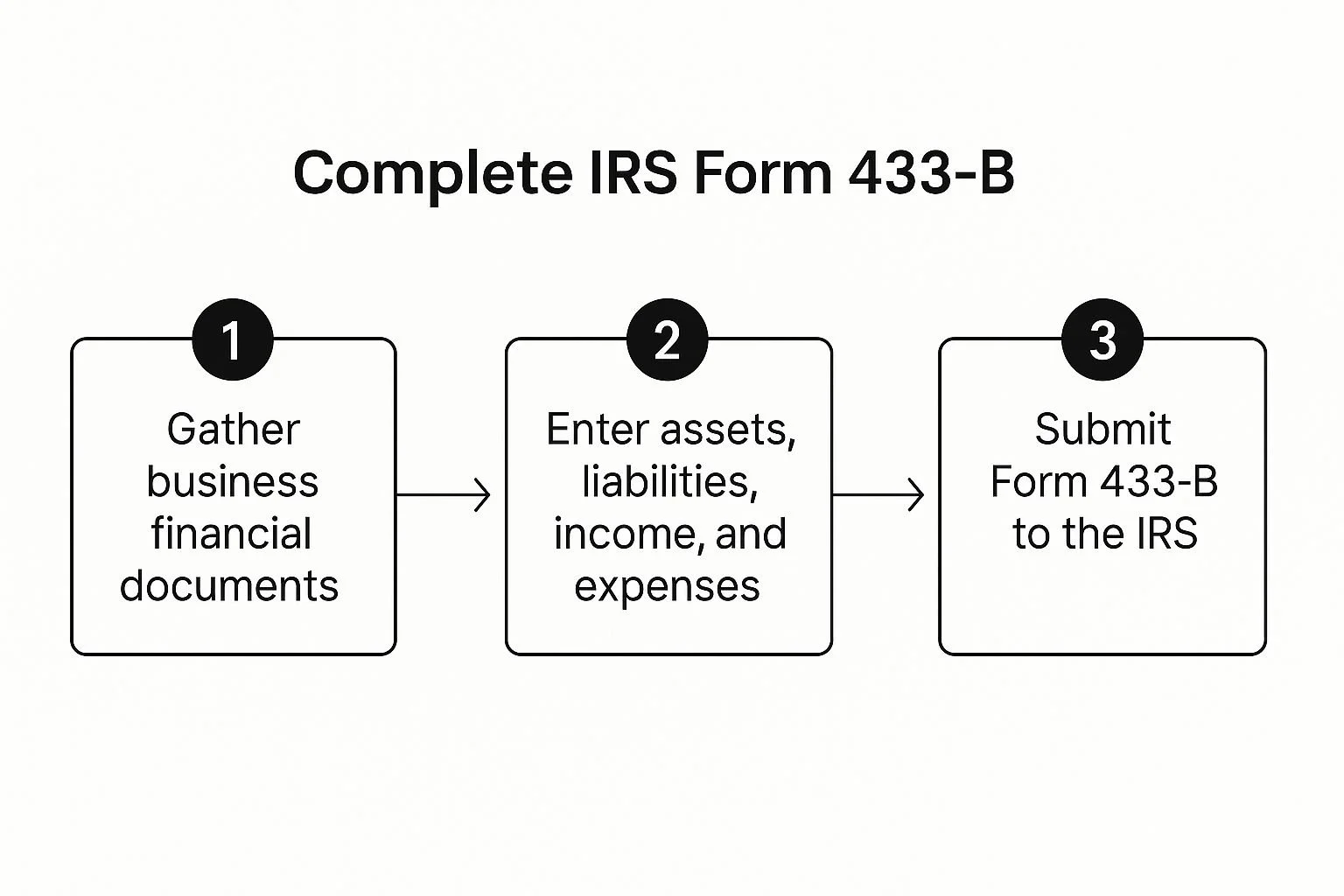
As you can see, a successful submission is all about a logical flow: careful preparation, honest data entry, and a thorough final review before you file.
Navigating Business Assets and Liabilities
This is where the IRS starts its hunt for quick-pay sources. They want a detailed inventory of what your business owns (assets) and what it owes to others (liabilities). The difference between the two gives them a snapshot of your company's net worth.
When you're listing assets, you have to be an open book. I mean everything—from the cash in your register to real estate and even intellectual property. The IRS is especially interested in liquid assets, which are things they know can be turned into cash relatively easily.
Cash and Bank Accounts: You'll need to list every single business bank account you have—checking, savings, money market accounts, you name it. Provide the current balance for each. Don't forget to include any petty cash on hand.
Accounts Receivable: This is a huge one. From the IRS's point of view, your outstanding customer invoices are just cash waiting to be collected. You’ll need a detailed aging report that shows exactly who owes you money and how long they've owed it.
Real Estate, Vehicles, and Equipment: For any physical assets, you must provide the Fair Market Value (FMV), not what you originally paid. Be ready to prove these values with recent appraisals, market comparisons, or quotes from recognized sources like Kelley Blue Book for your company vehicles.
On the other side of the coin are your liabilities. This covers all your business loans, mortgages on property, lines of credit, and any outstanding bills to your suppliers. Documenting these is just as critical, as it demonstrates where your money is already spoken for each month.
The Importance of Accurate Asset Valuation
One of the most common tripwires I see business owners hit is valuing their assets incorrectly. If you understate the value of your equipment or a company truck, it can immediately look like you’re trying to hide something, and that will completely tank your credibility with the Revenue Officer.
For instance, say your construction company has a bulldozer you bought five years ago for $100,000. You might look at the wear and tear and think it’s only worth $20,000 now. But what if a quick search on an equipment marketplace shows similar used models are selling for $40,000? Putting down $20,000 without solid proof is a massive red flag.
Critical Warning: The IRS has access to sophisticated valuation tools. If your numbers are way off from their estimates, they will absolutely challenge you. Always do your homework and keep documentation on how you arrived at your valuations so you can defend your position.
In fact, the IRS has been paying a lot more attention to non-traditional assets lately. The newest version of the form for Offers in Compromise, Form 433-B (OIC), now requires more detail on digital holdings and other intangibles. You can find the latest forms and requirements on the official IRS website.
Reporting Business Income and Expenses
This section is the absolute heart of Form 433-B. It’s where you lay out your business's ability—or inability—to make monthly payments toward your tax debt. The IRS usually wants to see an average of your income and expenses over the last three to twelve months.
You need to paint a crystal-clear picture of your cash flow. That means showing every source of gross income, whether it's from sales, services, rent, or royalties. The key here is consistency. The income you list on this form absolutely must match up with what’s on your profit and loss statements and your bank deposits.
Next up, you'll list your necessary business expenses. The IRS is specifically looking for costs that are essential to keep the lights on and the doors open. These typically include:
Payroll and all associated employment taxes
Rent or mortgage for your business premises
Utilities like electricity, water, and internet
Business insurance policies
Supplies and materials that are critical for your operations
Be warned: the IRS will scrutinize these expenses. If a cost seems unusually high or doesn't feel directly related to your business operations, they’re going to question it. For example, a small contracting business claiming expensive client dinners every night of the week will probably see that expense disallowed for the purposes of this calculation.
Understanding Allowable Expenses
In the eyes of the IRS, not all expenses are created equal. An allowable expense is something they deem truly necessary for producing income or for the basic health and welfare of the business. Any discretionary spending, like a big holiday party or extravagant travel, won't make the cut.
Try to see it from the Revenue Officer's perspective. Their sole job is to figure out how much cash is left over at the end of the month after all the essential bills are paid. That leftover amount is what they believe is available to pay down your tax liability.
Let's look at a real-world scenario. A small marketing agency lists $5,000 a month for "marketing and advertising." While that's a perfectly legitimate business cost for the books, the IRS might argue that during a period of financial distress, that budget could be slashed temporarily to free up cash. You have to be prepared to justify why every single expense you list is non-negotiable for the immediate survival of your business.
For individuals facing personal tax issues, the process is similar but uses a different form.
Finalizing and Signing the Form
The final step is signing the form under penalty of perjury. This isn't just a signature; it's a legally binding oath that everything you've provided is true and correct to the best of your knowledge. Any intentional misrepresentation on Form 433-B can lead to harsh civil penalties and, in serious cases, even criminal charges.
Before you put pen to paper, do one last sweep. Go through the form from top to bottom with all your supporting documents right there with you. Look for simple mistakes like transposed numbers or a missed field. Make sure the financial story the form tells is the exact same one told by your bank statements, P&L, and balance sheets.
This final check is your last opportunity to catch an error that could delay your case or, worse, lead to a resolution that you can't afford. Submitting a complete, accurate, and well-supported Form 433-B is your single best tool for negotiating a manageable solution and getting your business back on solid ground.
Calculating Your Business Income and Expenses
This section of IRS Form 433-B is, without a doubt, where your negotiation with the IRS is won or lost. How you calculate your business's monthly income and necessary expenses will directly determine the final number the IRS expects you to pay.
Get this part wrong, and you could be saddled with a payment plan that’s simply impossible to maintain. But if you get it right, you can land on a resolution that’s fair and manageable. The IRS isn't looking at just one good month or one bad one; they want to see an average that gives a true picture of your business's typical financial health.
Choosing the Right Timeframe
The form will ask you to average your income and expenses over a certain period—usually 3, 6, or 12 months. This isn't just a random choice; it's a strategic one that needs to fit your business’s story.
A 3-Month Period is your best bet if your business just hit a major, and likely permanent, downturn. This shorter window will accurately reflect your current, reduced ability to pay.
A 6-Month Period works well for most businesses. It’s a solid middle ground that smooths out small blips without getting skewed by one weird month.
A 12-Month Period is pretty much non-negotiable for seasonal businesses. Think about a landscaping company—showing only their slow winter months would paint a completely misleading picture of their finances. A full year is the only way to show the whole story.
No matter which timeframe you pick, be ready to explain why you chose it. Your goal is to present an honest average that the IRS agent will accept as a credible snapshot of your financial reality.
Defining and Documenting Allowable Expenses
Here’s a concept that trips up a lot of people: the IRS separates your actual expenses from what they call allowable expenses. An allowable expense is a cost that is both ordinary for your industry and absolutely necessary for the survival of the business. The agent is focused on one thing: what does it cost to keep the lights on and the money coming in?
Think of it this way: your rent, utilities, and employee payroll are obvious "yeses." But discretionary spending like big marketing campaigns, team-building outings, or non-essential travel might get a second look.
Key Takeaway: The IRS isn't trying to help you grow your business right now; they're calculating the bare-bones cost of keeping it afloat. Every single expense you list needs to be justified as essential for day-to-day operations.
You'll need rock-solid documentation to back all of this up. We're talking bank statements, credit card bills, canceled checks, vendor invoices, and payroll records that all line up perfectly with what you put on the form. Staying organized is everything. If you need help, a good guide on how to track business expenses can give you a solid system to follow.
A Real-World Scenario Walkthrough
Let's see how this works in practice. Imagine "Tech Solutions Inc.," a small IT consulting firm, needs to file Form 433-B. They've had a rough patch and decide a 6-month average best reflects their recent situation.
Their gross monthly income averages $25,000. Now, it's time to tally up the necessary monthly expenses.
Clearly Allowable Expenses:
Rent for Office Space: $3,000
Utilities (Internet, Phone, Electric): $800
Gross Payroll (2 employees): $10,000
Payroll Taxes: $1,500
Business Insurance: $500
Essential Software Subscriptions: $700
These expenses come to $16,500. They are the non-negotiable costs of doing business.
Potentially Challenged Expenses:
Marketing & Advertising: $2,000
Client Lunches & Entertainment: $1,000
Professional Development Courses: $500
While these are perfectly legitimate deductions on a tax return, an IRS Revenue Officer reviewing for collections might push back. They could argue that marketing can be paused and client dinners can be cut while the tax debt is being resolved.
To defend these costs, Tech Solutions Inc. must prove they are critical for generating revenue. For example, they could present data showing that 75% of new leads come directly from their advertising spend, making it a vital, not discretionary, expense.
After reviewing everything, the IRS might allow a portion of the marketing budget but disallow the entertainment and training costs. It's this careful process of justifying every dollar that ultimately shapes the net income figure the IRS uses to calculate your payment plan.
Sidestepping Common Pitfalls on Form 433-B
When you submit an IRS Form 433-B, you're making a case for your business's financial situation. An error-filled form doesn't just look sloppy; it gives the IRS an easy reason to question your entire proposal and potentially deny a payment plan.
Think of it this way: even a tiny oversight can completely derail the process, leading to delays you can't afford or an outright rejection. I've seen it happen too many times. Let's walk through the most common traps so you can steer clear of them.
Guesstimates and Bad Math: The Easiest Way to Lose Credibility
It sounds basic, but you'd be surprised how often simple math errors sink an otherwise solid submission. Transposing a couple of numbers or botching the totals for your income and expenses is a huge red flag. The IRS revenue officer will immediately compare your form's figures to your supporting bank statements and financial reports. If the numbers don't line up, your credibility is shot from the get-go.
Just as damaging is the tendency to use guesstimates. The IRS lives in a world of hard facts and documented proof, not ballpark figures. Writing that your monthly utilities are "around $500" looks lazy and suspicious. Providing utility bills that show a three-month average of $487.35 shows you're serious, organized, and honest.
The Temptation to Hide or Undervalue
It can be tempting to fudge the numbers, especially when you're under pressure. A common, and disastrous, mistake is deliberately undervaluing assets or conveniently "forgetting" to list something. Maybe it’s understating the value of a piece of equipment or not disclosing a secondary bank account you rarely use.
Don't do it. The IRS has powerful tools and vast databases to verify asset values and track down accounts you might think are hidden. The same goes for income. Failing to report every source, from cash jobs to payments from a new digital platform, is a critical misstep. All business income, including digital assets like cryptocurrency, has to be on the table.
A Word of Warning: A dishonest form is far worse than an incomplete one. When you sign Form 433-B, you're doing so under penalty of perjury. You are legally swearing that the information is true. Getting caught in a lie can lead to anything from severe financial penalties to a full-blown criminal investigation.
Your Pre-Submission Accuracy Checklist
Before you even think about mailing that form, you need to conduct a final, thorough review. This isn't just a quick glance-over. This is your last line of defense against costly mistakes.
Math Check: Grab a calculator and re-run every single calculation. Every addition, every subtraction. No exceptions.
Document Match-Up: Lay your bank statements, P&L, and balance sheets out next to your form. Go line by line and physically tick off each number on the form as you confirm it against the source document.
Validate Your Valuations: Are your Fair Market Value (FMV) figures for vehicles, real estate, or equipment realistic? Make sure you have third-party documentation (like a Kelley Blue Book printout or an appraisal) to back them up.
Scan for Blanks: Slowly go through the entire form, page by page. Did you accidentally skip a line or leave a required field blank?
Get a Second Pair of Eyes: You've been staring at this form for hours, maybe days. Ask a trusted business partner, accountant, or advisor to review it. A fresh perspective can catch errors you've become blind to.
Steering clear of these specific form errors is vital, but it also helps to understand the most common accounting mistakes made by small business owners in general. Keeping clean books makes this whole process infinitely easier. The IRS uses the data from millions of returns to shape its collection strategies, which you can see in the data provided by the IRS Statistics of Income division. Providing a clean, accurate form is the best way to ensure you're treated fairly.
Common Questions We Hear About Form 433-B
Even after walking through the form line by line, clients always have a few more specific questions. It's completely normal. Let's tackle some of the most common ones that pop up when dealing with the IRS Form 433-B.
What’s the Real Difference Between Form 433-A and 433-B?
This is a big one, and getting it wrong creates immediate problems. The distinction really comes down to who owes the tax.
Form 433-A is the Collection Information Statement for Wage Earners and Self-Employed Individuals. Think of it as the form for personal tax liabilities.
Form 433-B, the Collection Information Statement for Businesses, is built for entities like corporations, partnerships, and LLCs. Where it gets tricky is with sole proprietors. Since the IRS often sees the individual and the business as a single financial entity, they might require both forms or a hybrid of information. Using the wrong form isn't just a simple mistake; it guarantees a rejection and sends you right back to square one.
Do I Really Have to List My Company's Foreign Assets?
Yes, without a doubt. The IRS expects a full, transparent look at your business's entire financial situation, no matter where the assets are located.
Attempting to hide or simply "forgetting" to list assets held in another country is a critical mistake. It's not something you can explain away later.
This isn’t a minor oversight the IRS will brush aside. It's a massive red flag that can get your entire proposal thrown out and may even lead to serious penalties for concealment.
The form has dedicated sections for these assets for a reason. You need to report them with the same detail and honesty as you would for your domestic accounts and property.
I Submitted the Form. Now What?
Once Form 433-B is in the hands of the IRS, a Revenue Officer takes over. Their job is to put your business's finances under a microscope. They'll scrutinize every number on the form and cross-reference it with the pile of documents you submitted. Their goal is to determine your business’s "reasonable collection potential" (RCP)—what the IRS believes you can actually afford to pay.
Don't expect radio silence. The officer will likely reach out with questions, ask for more details about a specific expense, or request an extra bank statement to verify something. Be prepared for this back-and-forth.
After their analysis, one of three things will happen:
They accept your proposed payment plan or Offer in Compromise.
They reject your proposal completely.
They come back with a counteroffer, suggesting different payment terms.
The accuracy and organization of your submission have a direct impact on this outcome. If you’re trying to set up a payment plan, knowing how the IRS views your ability to pay is half the battle.
Navigating IRS collections can be overwhelming, but you don't have to do it alone. Attorney Stephen A Weisberg offers a FREE Tax Debt Analysis to determine the best path forward for your business before you ever pay a fee. Contact us today to find a solution to your tax problems.
Want to understand your options before you call anyone?
Download my free book — Freedom From Tax Debt — a plain-language guide to how the IRS collections process actually works and what resolution really looks like.
➥ Contact Attorney Stephen A. Weisberg for a free Tax Debt Analysis.
Contact Me Here: https://www.weisberg.tax/contact-1
Email: s.weisberg@weisberg.tax
Phone/Text: (248) 971-0885
Address: 300 Galleria Officentre, Suite 402, Southfield, MI 48034
