Understanding Levies and Garnishments: Keys to Your Rights
Getting a notice about levies and garnishments is enough to make anyone’s stomach drop. The good news is, understanding what these terms actually mean is the first step toward getting back in control.
They’re just two different tools a creditor, most often the IRS, can use to collect a debt. Think of a garnishment as a slow, predictable drip from your paycheck. A levy, on the other hand, is a much faster, one-time grab of the cash sitting in your bank account.
What Happens When a Creditor Seizes Your Assets

People often mix up levies and garnishments because they both involve a third party—like your employer or your bank—stepping in to help a creditor get paid. But how they work and the immediate impact they have on your life are worlds apart.
Here’s an analogy: picture your finances as a river. A garnishment is like someone diverting a small, steady stream from that river every single payday. A levy is more like someone building a dam overnight, stopping the flow, and taking a huge chunk of water all at once.
We’re going to pull back the curtain on these powerful collection tactics. By the end, you’ll know who can use them, why they happen, and how to start protecting your financial future.
The Triggers Behind Asset Seizure
A creditor doesn't just wake up one day and decide to seize your assets. Levies and garnishments are typically the last resort after a long, drawn-out collection process. They come into play when debts have been ignored for far too long.
Here are the most common reasons this happens:
Unpaid Federal or State Taxes: The IRS and state tax agencies have serious power. They can often levy or garnish without even needing a court order.
Court Judgments: If a creditor takes you to court and wins, the judge can give them the legal green light to garnish your wages or hit your bank account to settle the debt.
Defaulted Federal Student Loans: The Department of Education has the authority to garnish wages for unpaid federal student loans, again, without having to go to court.
Unpaid Child Support or Alimony: Family support obligations are enforced strictly, and wage garnishment is a standard tool to ensure payments are made.
Why Immediate Action Is Crucial
The moment you get a notice in the mail, a timer starts. For example, once the IRS mails a Final Notice of Intent to Levy, you typically have just 30 days to figure something out before they can legally take your property.
If they levy your bank account, the bank is required to freeze it for 21 days before sending the money to the IRS. That gives you a very narrow window to try and negotiate a release.
The absolute worst thing you can do is ignore these letters. Doing nothing strips you of your power to negotiate and basically invites the creditor to use their most aggressive collection tools, which can cause massive disruption to your life.
This guide will give you a clear roadmap to navigate this mess, starting with the critical differences between these two collection methods.
How Wage Garnishments Impact Your Paycheck
A wage garnishment is a gut punch. It’s a direct hit on your income, siphoning money away before you ever get a chance to see it. This isn't just a creditor asking nicely; it's a formal legal order sent to your employer, forcing them to withhold a piece of your paycheck and send it straight to your creditor.
For most everyday debts—think credit card bills or old medical expenses—a creditor can’t just decide to garnish your wages. They have to take you to court, sue you, and win. That court judgment is the key that unlocks their ability to go after your earnings. Once they have it, your employer has no choice but to comply.
But when it comes to the federal government, the rules of the game change. Agencies like the IRS or the Department of Education often don't need a judge’s sign-off for levies and garnishments. This gives them a much quicker, more aggressive path to your paycheck for things like unpaid taxes or defaulted student loans.
Calculating the Financial Impact
The amount of money taken from your check isn't just a random number. Federal law, specifically the Consumer Credit Protection Act (CCPA), puts a cap on it. The whole calculation hinges on your disposable earnings—that's the money you have left after mandatory deductions like federal, state, and local taxes have been taken out.
For most common debts, a creditor can take the lesser of two amounts:
25% of your weekly disposable earnings.
The amount your disposable earnings exceed 30 times the federal minimum wage.
Let's break that down. Say you have $600 in disposable income each week. A creditor could snatch up to $150 (that’s 25%). The second rule is really a safety net for lower-income workers. It ensures that if you're earning just over the minimum wage, a creditor can't take everything above that line, leaving you with a little breathing room. It’s also worth noting that some states have their own laws that offer even more protection than the federal baseline.
Garnishments for Different Types of Debt
That 25% rule is just a starting point. For certain debts, the government allows creditors to take a much bigger bite out of your paycheck, which can be devastating.
Child Support and Alimony: This is a top priority. They can garnish up to 50% of your disposable earnings if you're supporting another family, and a staggering 60% if you aren't.
Federal Student Loans: The Department of Education has the power to garnish up to 15% of your disposable pay without a court order.
Back Taxes: The IRS plays by its own rules. They can take a significant chunk of your pay, with the final amount depending on things like your filing status and how many dependents you have.
A garnishment isn't a one-and-done deal like a bank levy. It's a constant drain, hitting your income every single payday until the debt is paid in full. This can drag on for months, or even years.
Your Employer’s Legal Role in Garnishments
When a garnishment order lands on your employer’s desk, their hands are tied. They are legally required to follow the instructions, withholding the money and sending it to the creditor. The good news is that federal law protects you from being fired over a single garnishment. The bad news? That protection disappears if you get hit with garnishment orders for two or more separate debts.
This method of using payroll to collect debts isn't just a U.S. thing. Around the world, you’ll find similar systems designed to balance the rights of creditors and the needs of employees. Whether it's called an 'attachment of earnings' in the UK or a 'wage deduction order' in Australia, the goal is the same: legally mandated payroll deductions for everything from taxes to consumer debt. You can learn more about global payroll deductions on cloudpay.com.
At the end of the day, a wage garnishment is a serious financial blow. It shrinks your take-home pay and can throw your entire budget into chaos. The first step toward stopping it is understanding exactly how it works, what the limits are, and what rights you have.
Understanding the Power of a Bank Levy

If a wage garnishment feels like a slow, steady drain on your future income, a bank levy is more like a lightning strike. It’s a sudden, one-time seizure of the funds you have in the bank right now. This makes it one of the most powerful and jarring tools a creditor—especially the IRS—can use.
Think of it this way: a garnishment is a small, recurring leak from your financial tank. A levy is someone pulling the plug and draining a huge chunk of it all at once to cover the debt.
But this doesn't happen out of the blue. The IRS has to follow a strict legal process before it can touch your money, and that process includes plenty of warnings that give you a chance to act.
The Anatomy of an IRS Bank Levy
The road to a bank levy is a long one, paved with official notices. The IRS can't just decide to take your money one day. They must first send a series of letters regarding your unpaid taxes. The final, most serious warning you’ll get is the Final Notice of Intent to Levy and Notice of Your Right to a Hearing.
Receiving this letter starts a 30-day countdown. If you don’t resolve the tax debt or make alternative arrangements within that month, the IRS gets the green light to proceed.
Here’s exactly what happens next:
Levy is Issued: The IRS sends a formal levy notice directly to your bank or financial institution.
Account Freeze: The moment your bank gets that notice, they are legally required to freeze your account. They will lock up an amount equal to your tax debt from the available funds.
The 21-Day Holding Period: Your bank doesn't immediately send the money to the IRS. Instead, they hold it for 21 days. This is a critical, federally mandated window for you to take action.
Funds are Sent: If you haven’t successfully resolved the issue and gotten the levy released within those 21 days, the bank is obligated to transfer the frozen funds to the IRS.
That 21-day hold is your last chance. It’s the time to get on the phone with the IRS, prove that the levy is causing a significant financial hardship, or get into a payment agreement to stop the money from leaving your account for good.
It's crucial to understand that a bank levy is just a snapshot in time. It captures only the funds in your account on the specific day the bank processes the notice. Any money you deposit the next day is safe—unless, of course, the IRS decides to issue another levy.
More Than Just Bank Accounts
While bank accounts are the most frequent target, the term "levy" actually covers the legal seizure of any of your assets. It’s a broad power, and creditors can go after other valuable property to satisfy a debt.
This can include assets like:
Real Estate: Your primary home, a vacation property, or even raw land can be seized and sold.
Vehicles: Cars, boats, trucks, and motorcycles are fair game.
Personal Property: In some situations, high-value items like jewelry or art can be targeted.
Retirement Accounts: While some funds have federal protections, others can be levied.
The idea of a creditor going after your retirement savings is particularly frightening. If you're concerned about protecting your nest egg, it’s worth understanding the rules. You can learn more by reading about whether pensions can be garnished or levied in our detailed guide.
At the end of the day, both levies and garnishments are serious collection actions that show a debt problem has hit a breaking point. But the immediate, all-at-once financial shock of a bank levy often makes it the more urgent crisis to solve.
Comparing Levies and Garnishments
At first glance, levies and garnishments might seem like two sides of the same coin. They’re both powerful collection tools, yes, but they work in completely different ways. Knowing the difference isn’t just academic—it’s crucial for understanding what a creditor might do next and how you can protect yourself.
Think of it this way: a levy is a one-time ambush, while a garnishment is a long-term siege. One hits hard and fast; the other slowly drains your resources over time.
What Sets Them Apart
The real distinction between these two actions comes down to what’s being taken and for how long.
A bank levy is a direct hit on money you already have. It’s a legal seizure of the funds sitting in your bank account right now. It's fast, and it’s a single event.
A wage garnishment, on the other hand, targets money you haven’t even earned yet. It’s an ongoing order sent to your employer, forcing them to divert a portion of your paycheck to the creditor every single pay period. This continues until the debt is paid in full.
The most critical difference is the timing. A levy is a single, powerful event that seizes existing assets. A garnishment is a recurring process that claims your future income stream.
This is a really important concept to grasp, and some of the numbers behind these actions show just how serious they can be.
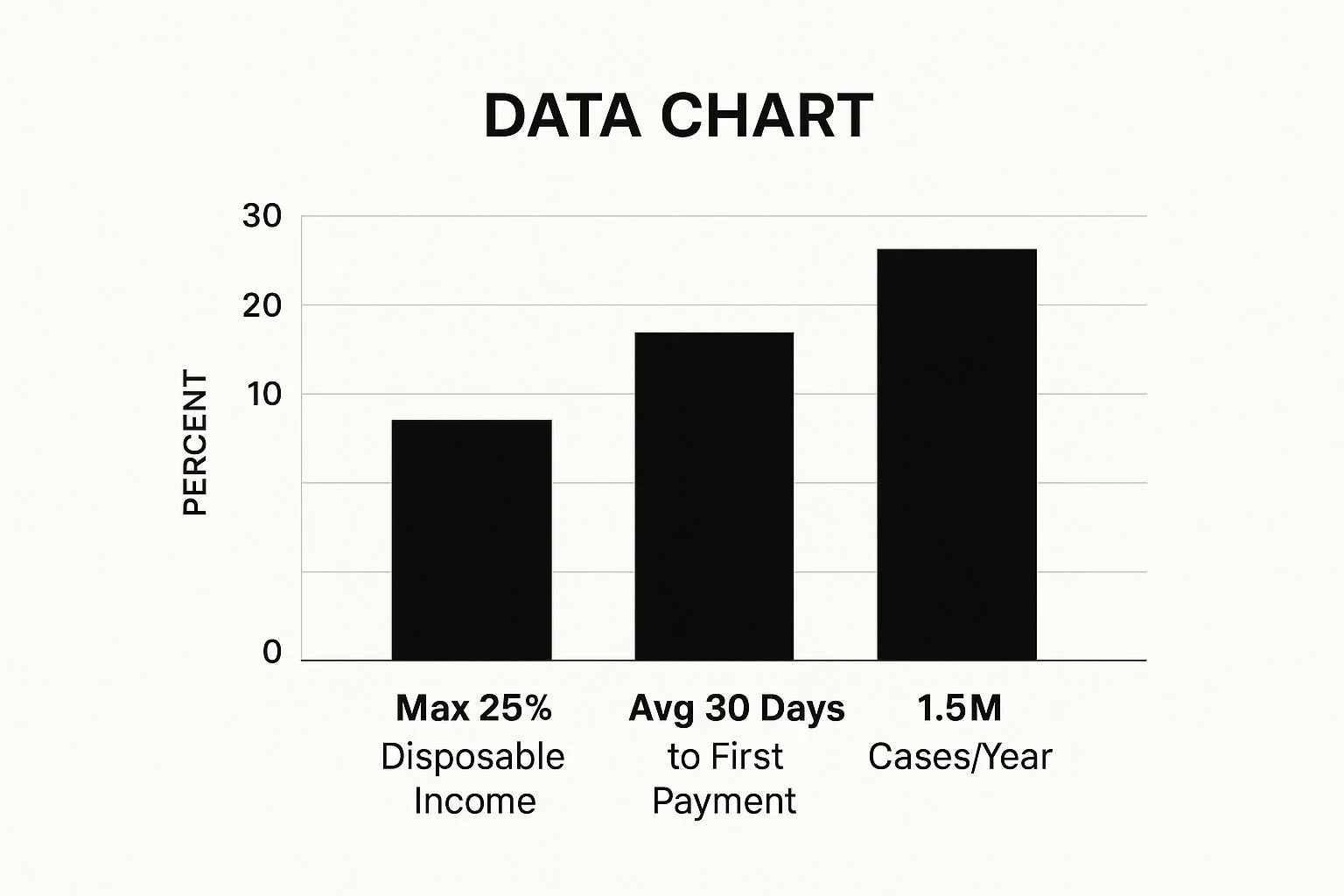
As you can see, a garnishment can take up to 25% of your disposable income, which can have a huge impact on your monthly budget. Millions of these are active every year.
Levy vs Garnishment Key Differences
To really see the contrast, it helps to put them side-by-side. This table breaks down their core features, showing why a creditor might choose one over the other and what it means for you.
| Feature | Wage Garnishment | Levy |
|---|---|---|
| What is Targeted? | Future income. This is money you haven't been paid yet—your wages, salary, or commissions. | Existing assets. Almost always, this means the cash currently in your bank account. |
| How Long Does It Last? | Ongoing. It repeats every pay period until the debt, interest, and any fees are fully paid off. | One-time event. It captures the funds available on the day the bank processes it. A new levy is needed for future deposits. |
| Who is Involved? | You, the creditor, and your employer. Your HR department is legally required to withhold the money. | You, the creditor, and your bank. The bank must freeze your account and send the funds. |
| Typical User | Used by all kinds of creditors, from credit card companies (with a court order) to the IRS. | A favorite tool of the IRS and state tax agencies because it's incredibly effective and immediate. |
Looking at this comparison, you can start to see the strategic angle. One is a slow, steady payment plan (that you didn't agree to), while the other is a swift, lump-sum seizure.
What This Means For You
So, why does this matter? Because the type of notice you receive tells you exactly what kind of financial threat you’re facing.
If you get a notice of intent to garnish, you’re looking at a sustained hit to your take-home pay. It’s a serious problem, but it’s a predictable one. This gives you a small window to try and negotiate a payment plan before the deductions kick in.
A final notice of intent to levy, however, signals a full-blown emergency. It means a creditor—usually the IRS—is about to wipe out your bank account. This can cause checks to bounce and automatic payments to fail, creating a cascade of financial problems. That 21-day hold period after an IRS levy is your absolute last chance to act before the money is gone for good.
How the Federal Government Collects Debt
When you owe money to a private company, there are rules and court proceedings that give you a fighting chance. But when your creditor is Uncle Sam, the entire playbook gets thrown out the window. Government agencies—especially the IRS and the Department of Education—have extraordinary powers to collect what they're owed, and they often don't need a judge's permission to do it.
This unique authority is what makes federal debts so stubborn and the collection methods so aggressive. If you're facing debt from unpaid taxes or a defaulted federal student loan, you have to understand that these agencies can initiate levies and garnishments without ever stepping foot in a courtroom. That’s a power most private creditors can only dream of.
Because of this administrative power, the process moves fast. Instead of filing a lawsuit and waiting for a judgment, the government can often move directly to seizing your assets right after sending the legally required notices.
The IRS and Its Powerful Collection Tools
Let's be clear: the IRS is arguably the most powerful collection agency in the United States. When you owe back taxes, they have the full legal authority to issue a levy against your bank account or garnish your wages directly from your employer. This process, known as an administrative levy or garnishment, is a brutally effective tool.
Now, they can't just do this out of the blue. The IRS has to follow a strict notification protocol, which involves a series of letters that culminate in a "Final Notice of Intent to Levy." This notice gives you a 30-day window to respond. But if you don't act, they can proceed to take your assets without any further court involvement.
The key takeaway here is that the IRS does not need to sue you to take your money. Federal law grants them this administrative authority, making them a formidable creditor that demands your immediate attention the moment collection notices start arriving.
Since federal tax issues can quickly escalate to this point, it's always smart to have solid strategies for preparing for tax season. A little proactive planning can help you avoid the kind of tax debt that triggers these collection actions in the first place.
Federal Student Loan Collections
The Department of Education plays by similar rules when it comes to defaulted federal student loans. Through a process called administrative wage garnishment, it can order your employer to withhold up to 15% of your disposable income—again, without needing a court order.
This is a massive issue for millions of Americans. Collection activities on federal student loans that were paused have now resumed, a move that is expected to cause a sharp spike in wage garnishment orders. With millions of borrowers already in default and some projections showing that number could double, we might see nearly a quarter of all federal student loan borrowers facing garnishment.
Why Federal Debts Are a Different Beast
Several things make federal debts a unique and tougher challenge than private debts. The differences go way beyond collection methods and even affect how long the government can chase you for the money.
Here are the main distinctions:
No Court Order Needed: This is the government's biggest trump card. It cuts out the middleman, making the collection process incredibly fast and efficient for them.
No Statute of Limitations (for Taxes): For many federal tax debts, there’s no expiration date. The IRS can legally pursue you for unpaid taxes for the rest of your life.
Powerful Seizure Authority: The government can take more than just money from your bank account or paycheck. They can levy federal payments like Social Security benefits (for certain debts) and seize your tax refunds through the Treasury Offset Program.
These enhanced powers drive home why federal levies and garnishments must be dealt with immediately. Ignoring notices or just hoping the problem goes away isn't a strategy—not when you're up against a creditor with the full weight of the federal government behind it.
Your Rights and How to Stop a Seizure

When you're facing the threat of levies and garnishments, it’s easy to feel powerless. But here’s the most important thing to remember: you have rights. The IRS and other creditors can’t just swoop in unannounced. They have to follow a strict legal process, which includes notifying you of their plans and explaining your right to appeal.
This knowledge is your first line of defense. That notice in the mail isn't just bad news; it's a window of opportunity. It gives you a chance to challenge the action or work out a deal before your money or property is taken.
Ignoring those letters is the worst thing you can do—it’s like giving up without a fight. By responding quickly, you can often find a way out that avoids the financial shock of a levy or garnishment.
IRS Tax Debt Relief Options
When you're dealing with the IRS, you have several formal programs designed to help taxpayers get back on their feet. These aren't secret loopholes; they are established, legitimate paths for people in real financial trouble.
Here are the main options on the table:
Installment Agreement: This is the most common solution. It’s simply a formal payment plan where you agree to pay off your tax debt in manageable monthly chunks. As soon as this agreement is locked in, the IRS backs off and stops all levies and garnishments.
Offer in Compromise (OIC): An OIC is a powerful tool that lets you settle your tax bill for less than the full amount owed. It's not for everyone, but if you can prove you genuinely don't have the income or assets to pay the debt in full, it can be a lifesaver.
Currently Not Collectible (CNC) Status: If paying your tax debt would leave you unable to cover basic living expenses like rent and food, the IRS can place your account in CNC status. This puts a temporary hold on all collection efforts, giving you breathing room.
A quick heads-up on CNC status: it doesn't make the debt disappear. Interest and penalties keep adding up, and the IRS will check in on your financial situation periodically to see if you can start paying again.
Strategies for Private Debts
When it comes to non-tax debts, the process is a bit different, but you still have options. Most private creditors who have gone to the trouble of getting a court judgment would much rather get a guaranteed payment than keep chasing you.
This puts you in a position to negotiate directly. Often, you or your representative can contact the creditor and work out a deal, like a lump-sum settlement for less than the total balance. Another route is to set up a voluntary payment plan you can actually afford, which can convince them to release the garnishment. Whatever you do, make sure you get any agreement in writing before you send them a dime.
Taking fast, informed action is how you regain control. If you’ve received a Final Notice of Intent to Levy, your absolute first priority should be learning how to stop an IRS levy to protect your financial stability.
Your Top Questions About Levies and Garnishments
When you're facing a levy or garnishment, a million questions probably start racing through your mind. It's a stressful situation, and getting clear, direct answers is the first step toward regaining control. Let’s cut through the noise and tackle the most common concerns people have when their assets are on the line.
Here, we'll get into the nitty-gritty of some specific scenarios to give you the practical information you need to figure out your next move.
Can They Really Take My Social Security?
This is a huge worry for retirees and anyone relying on disability benefits, and for good reason. For the most part, your Social Security benefits are shielded from private creditors trying to collect on debts like credit card bills or old medical expenses.
But here’s the critical exception: the federal government can—and will—garnish those same benefits for debts owed to them. This includes things like:
Unpaid federal income taxes
Federal student loans that have gone into default
Court-ordered alimony or child support
The good news is that federal law puts strict limits on how much they can take, so you won't be left completely high and dry.
While many federal benefits are protected from private creditors, they are often fair game for the federal government itself. This distinction is critical when dealing with government-owed debt.
What Happens If a Levy Hits an Empty Bank Account?
So, a creditor sends a levy to your bank, but there isn't enough money in your account to cover the full debt. What happens then? The bank will simply hand over whatever cash is in the account at that exact moment. A levy is like a snapshot in time.
Because it’s a one-time event, any money you deposit the very next day is safe—for now. But don't get too comfortable. The creditor will likely just turn around and issue a brand-new levy to try and catch those future funds. It's a persistent game of cat and mouse.
Can My Boss Fire Me for a Wage Garnishment?
There's a key federal protection you need to know about. The Consumer Credit Protection Act (CCPA) says your employer cannot fire you just because your wages are being garnished for a single debt. This law exists specifically to stop a garnishment from spiraling into a full-blown financial disaster.
However, that federal shield has its limits. It doesn't protect you if you're hit with garnishments for two or more separate debts. Some states do offer better protections for employees, so it’s always a good idea to check your local labor laws. If you're dealing with a heavy tax burden, it might be time to look into other solutions, like an Offer in Compromise. You can learn more in our complete guide to tax debt settlement.
At Attorney Stephen A Weisberg, we know just how stressful IRS collection actions can be. We don't use high-pressure sales tactics. Instead, we start every conversation with a free, honest assessment of your case to see exactly how we can help. If you're facing tax debt, schedule your free Tax Debt Analysis today at weisberg.tax.
Getting a notice about levies and garnishments is enough to make anyone’s stomach drop. The good news is, understanding what these terms actually mean is the first step toward getting back in control.
Want to understand your options before you call anyone?
Download my free book — Freedom From Tax Debt — a plain-language guide to how the IRS collections process actually works and what resolution really looks like.
➥ Contact Attorney Stephen A. Weisberg for a free Tax Debt Analysis.
Contact Me Here: https://www.weisberg.tax/contact-1
Email: s.weisberg@weisberg.tax
Phone/Text: (248) 971-0885
Address: 300 Galleria Officentre, Suite 402, Southfield, MI 48034
