Settling Debt with IRS: Your Complete Tax Relief Guide
When you owe the IRS, it’s easy to feel overwhelmed. But here’s the good news: the IRS has several established programs to help people get back on track. You might be able to negotiate an Offer in Compromise to pay less than you owe, or set up an Installment Agreement for manageable monthly payments.
The absolute worst thing you can do is ignore the problem. I’ve seen it time and time again—unopened letters pile up, and what was once a manageable issue spirals into aggressive collection actions with steep penalties. Taking that first step, no matter how small, is what matters most.
Your First Moves When Facing IRS Debt
That official-looking envelope from the IRS can send a jolt of panic through anyone. The language is intimidating, and the deadlines seem impossible. But your initial reaction is your most powerful tool. The biggest mistake people make is freezing up and doing nothing. The IRS might be a massive agency, but it’s one that’s built to respond to communication.
This image breaks down the primary routes you can take to resolve your tax debt.
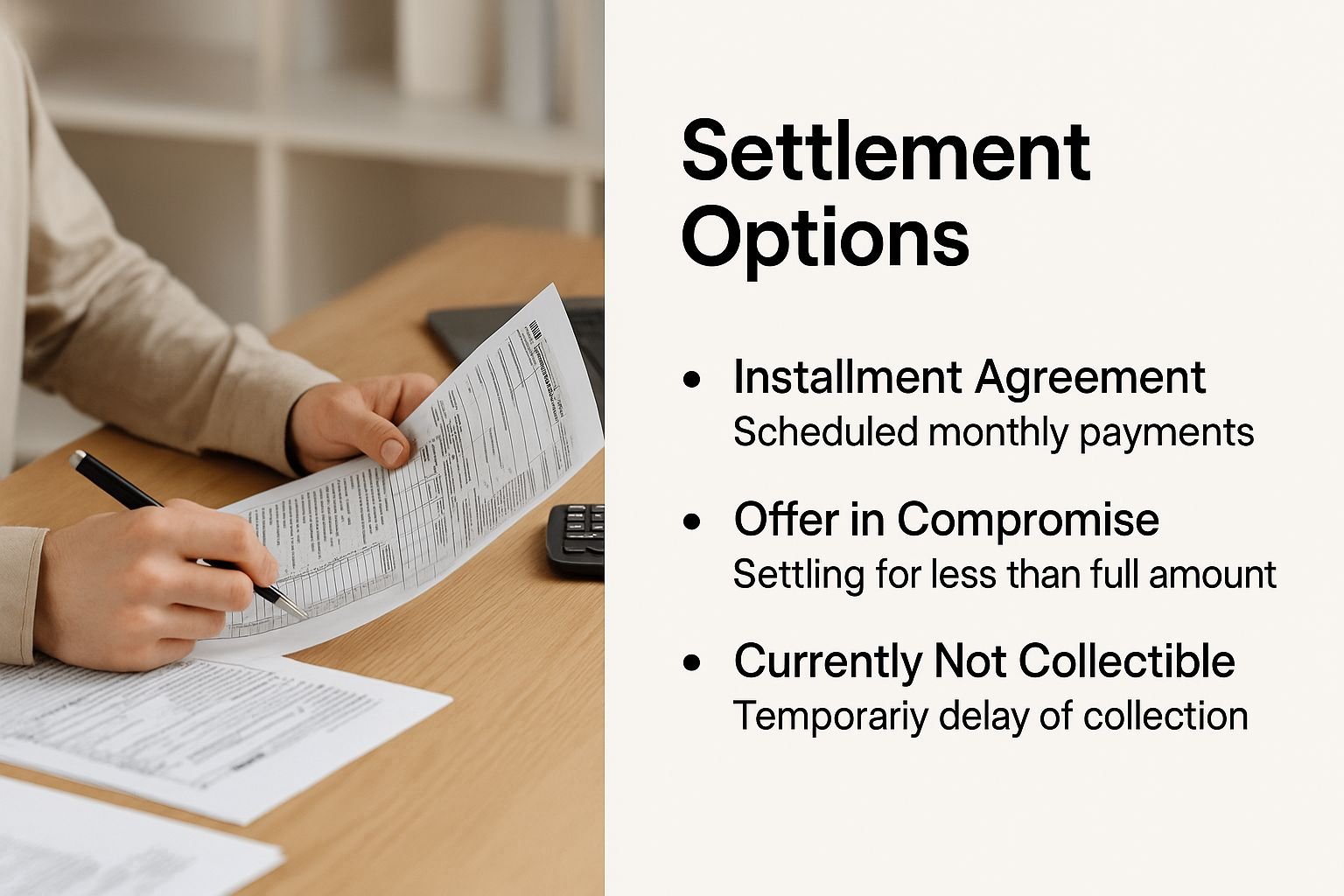
As you can see, there’s a solution for almost every financial reality, from a temporary cash crunch to a more serious, long-term hardship.
Gather Your Financial Documents
Before you can even think about which program fits, you need a painfully clear picture of your own finances. This isn't just about paperwork; it's about building a solid case for the IRS. They run on data, and showing up with organized, complete documentation proves you’re serious.
Start pulling these key items together:
All IRS Notices: Don't throw a single one away. Lay them out in chronological order to get the full story of your debt.
Past Tax Returns: You'll need at least the last 2-3 years of your filed returns. If you have unfiled returns, stop everything and make that your number one priority.
Proof of Income: This means recent pay stubs, W-2s, 1099s, and any records of side gigs or other income streams.
Proof of Expenses: Gather recent bank statements, utility bills, mortgage or rent statements, car payments, and receipts for other essential living costs.
Think of this as creating a detailed financial snapshot. It’s the exact picture the IRS will use to judge your ability to pay. Having it ready from the start gives you a huge advantage.
IRS Debt Relief Options at a Glance
Navigating the different programs for settling debt with the IRS can feel like learning a new language. Each one has its own rules and is meant for a specific kind of financial situation. To simplify things, here's a quick rundown of the main options.
| Settlement Option | What It Does | Best For Taxpayers Who... |
|---|---|---|
| Offer in Compromise (OIC) | Allows you to settle your tax debt for less than the full amount owed. | Have significant debt and can prove they cannot pay the full amount due to severe financial hardship. |
| Installment Agreement (IA) | Sets up a monthly payment plan to pay your tax debt in full over time (up to 72 months). | Can't pay the full amount immediately but have the steady income to make consistent monthly payments. |
| Penalty Abatement | Removes certain penalties if you can show "reasonable cause" for failing to file or pay on time. | Have a valid reason for their tax issue, such as a serious illness, natural disaster, or bad professional advice. |
| Currently Not Collectible (CNC) | Temporarily pauses collection efforts because you cannot afford basic living expenses. | Are facing extreme financial hardship (e.g., unemployment) and cannot afford any payments right now. |
This table should help you quickly see which path might make the most sense for you. Remember, the IRS isn’t trying to leave you with nothing. These programs exist because the government would rather collect something than get stuck with an uncollectible debt. Your job is to present your situation honestly to find a resolution that works.
Many people start their journey by visiting the official IRS payments portal, which provides direct pathways to set up a payment plan or make a direct payment online.
A Closer Look at the Offer in Compromise
The Offer in Compromise (OIC) is what many people think of when they hear about settling tax debt for pennies on the dollar. It’s an agreement with the IRS that lets you resolve your tax liability for less than what you originally owed. But let's be clear from the start: this isn't a casual negotiation or some hidden loophole.
Qualifying for an OIC is tough. It’s designed for taxpayers facing genuine, severe financial hardship. The IRS only says "yes" when the evidence overwhelmingly shows they are unlikely to ever get the full amount from you. Your entire case rests on proving that paying in full would crush you financially.
The Heart of the Matter: Doubt as to Collectibility
The vast majority of successful OIC applications are built on a specific legal justification called "Doubt as to Collectibility." In simple terms, you have to prove to the IRS that, given your income, assets, and necessary living expenses, you just don't have the money to pay them back in full—not now, and not in the foreseeable future.
To figure this out, the IRS calculates something called your Reasonable Collection Potential (RCP). This is the number that makes or breaks your offer. It’s what the IRS believes it could realistically squeeze out of you.
Your RCP is based on two main things:
The value of your assets: Think of what the IRS could get if it sold your stuff. This includes equity in your home, cars, and the money in your bank accounts, after subtracting any loans you have against them.
Your future disposable income: The IRS looks at your monthly income, subtracts your allowable monthly expenses, and projects that leftover amount forward for a set period (usually 12 or 24 months).
Your offer has to be at least as much as your calculated RCP. If the IRS runs the numbers and finds your RCP is more than your tax debt, your OIC will be dead on arrival.
The Bottom Line: An Offer in Compromise isn't about what you feel you can pay. It’s about what the IRS calculates you can pay after a forensic financial audit. Your offer must be a serious reflection of your maximum ability to pay based on their strict formula.
Laying it All Out on Form 433-A
The cornerstone of your OIC is Form 433-A (OIC), the Collection Information Statement. This isn't just a form; it's a complete financial colonoscopy. You have to be incredibly precise and provide documentation for every single number you put down.
If you claim $700 a month for groceries, you better have bank statements to back it up. If you list a car payment, you need the loan documents. Every asset, every debt, every dollar of income, and every expense has to be verifiable. There is no room for guesswork—transparency is everything.
Imagine you’re a self-employed graphic designer with an income that goes up and down. You can't just say, "Business has been slow." You'll need to hand over profit and loss statements for the last six months, plus all your business and personal bank statements. Your job is to paint a clear, undeniable picture with numbers that proves there’s nothing left over for the IRS after you cover essential living and business costs.
Getting Through the Strict Approval Gauntlet
Don't be fooled—getting an OIC approved is an uphill battle. The IRS guards this program closely. In a recent fiscal year, they reviewed 33,591 OIC applications but only accepted 7,199 of them. That’s an acceptance rate of about 21%. Those accepted offers settled $163.4 million in tax debt, but the low approval rate shows just how high the bar is. You can dig into more of these numbers by reviewing collection statistics on the official IRS website.
I don’t share that statistic to discourage you, but to set your expectations. To successfully settle your debt with the IRS this way, you need a rock-solid case built on hard financial data.
Once you submit your application, the process can drag on for months, sometimes even more than a year. During that time, an IRS agent will scrutinize every detail. And while you wait, you absolutely must stay current on all your new tax obligations. That means filing all your returns on time and making any required estimated tax payments. If you slip up, the IRS will automatically deny your offer, and you’ll be right back where you started.
Getting on a Manageable IRS Payment Plan
Let's be realistic: while settling your tax debt for pennies on the dollar sounds great, an Offer in Compromise is a long shot for most people. A far more common and straightforward path is setting up an Installment Agreement (IA) with the IRS.
Think of it as a formal payment plan. It’s a structured way to pay off your entire tax bill through monthly payments you can actually afford.

Unlike an OIC, where you have to prove you're in serious financial trouble, an Installment Agreement assumes you have the means to pay the full debt—just not all at once. It's a practical solution for anyone with a steady income who's been hit with a tax bill too large to pay in a single lump sum.
From the IRS's perspective, this is a win. They're guaranteed to eventually get all the money you owe, plus any penalties and interest that continue to add up until the balance is zero.
Finding the Right Payment Agreement for You
The IRS doesn't offer a one-size-fits-all plan. The best option really depends on your specific situation—how much you owe and how fast you can clear the debt. Getting familiar with the choices is the first step toward getting a plan that doesn't break your budget.
Here’s a quick look at the main types:
Short-Term Payment Plan: This gives you up to 180 extra days to pay your bill in full. It's perfect if you just need a little breathing room, maybe while waiting for a work bonus or a commission check to come through.
Long-Term Installment Agreement (Direct Debit): This is the standard, multi-year payment plan. If your total debt is under $50,000 (that’s tax, penalties, and interest combined) and you’ve filed all your returns, you can usually apply online and get approved on the spot. These plans can stretch out for up to 72 months.
What if you owe more than $50,000? The process gets a bit more hands-on. You won't be able to use the quick online application. Instead, you'll almost certainly need to fill out a Collection Information Statement (Form 433-F) to give the IRS a detailed picture of your finances.
How to Propose a Payment You Can Live With
When you set up a long-term agreement, the IRS typically suggests a minimum monthly payment by dividing your total debt by 72. But you don't have to just accept their number if it's too high.
You have the right to propose a different, more affordable amount. Just be prepared to back it up with your financial information. This is where tools can help. Before you commit, it's a smart move to utilize a debt repayment calculator to see how different monthly payments would affect your overall budget. This gives you a clear-eyed view of what you can realistically handle each month.
Expert Tip: Always propose a payment amount that is sustainable for the long haul. It is so much better to offer a smaller payment you know you can make every single month than to promise too much and default. A default can kill your agreement and bring the IRS's aggressive collection actions right back to your doorstep.
Staying on Track with Your Agreement
Once you’re approved, your job is simple but critical: stay compliant. This boils down to two non-negotiable rules.
First, make your monthly payment on time, every time. No exceptions.
Second, you have to stay current on all your future taxes. This is the one that trips people up. You must file every future tax return on time and pay any new tax you owe in full. If you end up with another balance due, you can't just tack it onto your existing plan. You’d have to go back to the drawing board and renegotiate the whole agreement, which is a hassle you want to avoid.
An Installment Agreement offers a predictable and reliable way to settle your IRS debt. By understanding the rules and committing to the plan, you can create a clear path to finally becoming debt-free.
Digging Into Other IRS Relief Options
When you hear about settling IRS debt, two options usually dominate the conversation: Offers in Compromise and Installment Agreements. But they aren't the whole story. Sometimes, the most effective solution isn't a complex payment plan but a more direct approach that tackles a specific part of your tax bill or gives you breathing room during a crisis.
Let's pull back the curtain on two powerful but less-discussed programs: Penalty Abatement and Currently Not Collectible status. One helps you fight what you believe are unfair penalties, while the other is a temporary shield for those facing severe financial hardship. Knowing how they work is crucial to building a complete debt-relief strategy.
Getting Penalties Wiped Clean with an Abatement
The IRS can add penalties for all sorts of things—filing late, paying late, or even an honest mistake on your return. Before you know it, these penalties can balloon, making up a huge chunk of what you owe. A Penalty Abatement is your formal request to have the IRS remove those penalties.
But you can't just ask nicely. You need to prove you had "reasonable cause" for not meeting your tax obligations. This isn't just a simple excuse; it’s a compelling, often unavoidable situation that got in your way. And it's up to you to build the case.
So, what does the IRS actually consider a good reason? Here are a few examples I’ve seen work:
A Personal Crisis: A debilitating illness or the death of an immediate family member that completely upended your ability to handle finances.
Disaster Strikes: Your home, business, or essential records were destroyed in a fire, hurricane, or another natural disaster.
Bad Professional Advice: You hired a tax pro who gave you demonstrably wrong advice, and you followed it in good faith.
Unavoidable Obstacles: You couldn't file or pay because of circumstances truly beyond your control, like a house fire destroying your records right before the deadline.
Proving reasonable cause is all about storytelling backed by solid proof. A doctor's note, an insurance claim, or emails from your accountant can make all the difference. You're not just making a request; you're presenting a documented case for why you deserve relief.
Finding a Lifeline with "Currently Not Collectible" Status
What if your financial situation is so fragile that you can’t even scrape together a small monthly payment for the IRS? That’s exactly what Currently Not Collectible (CNC) status is for. It’s a temporary hold the IRS puts on your account, effectively pausing all collection efforts.
Once you're in CNC status, the IRS stops. No more wage garnishments, no bank account levies, no aggressive collection calls. Think of it as a safety net—it gives you the critical space to cover essentials like rent and groceries without the constant fear of the IRS taking what little you have.
To get this relief, you have to open your books and show the IRS that your income doesn't even cover your basic allowable living expenses. The agency uses strict national and local standards to determine what’s reasonable for housing, food, and transportation. If your numbers show there’s nothing left over, you’re a strong candidate for CNC.
Just remember, CNC isn't a get-out-of-debt-free card. The IRS will check in on you, usually every year or two, to see if your financial situation has improved. If it has, they'll expect you to start a payment plan. Also, and this is important, interest and penalties keep adding up while your account is on hold.
Still, for someone who just lost their job or is swamped with medical bills, CNC can be a true lifeline. It provides the breathing room you need to stabilize your life. It’s a vital tool for anyone settling debt with the IRS when things feel absolutely impossible.
The Unpleasant Surprise: When Forgiven Debt Creates a New Tax Bill
You’ve finally done it. After months, maybe even years, of stress and negotiation, you’ve settled your IRS debt for less than you originally owed. It’s a massive weight off your shoulders. But then, a few months later, another official-looking envelope from the IRS arrives. It's a Form 1099-C, Cancellation of Debt, and it can feel like a punch in the gut.
This form is a heads-up that you might not be completely out of the woods just yet. It represents one of the most common and frustrating "gotchas" in the world of debt settlement.

Here's the hard truth: the IRS generally considers forgiven debt to be taxable income. It’s a strange concept at first, but their logic is simple. If someone gave you a financial benefit that you don't have to repay—in this case, the portion of the debt that was wiped away—the government sees that as a financial gain, just like your salary or a stock dividend.
This isn’t just some minor accounting detail; it can trigger a significant, brand-new tax bill for the year your debt was settled. The threshold is surprisingly low. Any canceled debt of $600 or more is reported to the IRS and considered taxable. So, if you owed $7,000 and settled for $4,000, that forgiven $3,000 gets added to your income for the year. You can get more background on these debt settlement tax rules to see how it works.
How Canceled Debt Turns into "Phantom Income"
Let's break this down with a real-world example so you can see the impact.
Imagine you had a nagging $25,000 tax liability. You worked with a professional and managed to get an Offer in Compromise accepted, settling the whole thing for a single payment of $10,000. That's an amazing result—you just saved $15,000.
Fast forward to the following January. A Form 1099-C shows up, reporting that $15,000 of your debt was officially canceled. When it's time to file your taxes, you're required to add that $15,000 to your other income sources for the year. If your income puts you in the 22% federal tax bracket, that "phantom income" could create a new tax bill of $3,300 ($15,000 x 0.22).
Suddenly, the victory of settling your debt feels a little less sweet. This extra income can even bump you into a higher tax bracket or make you ineligible for certain tax credits, creating a new financial problem right after you solved the old one.
Don't Panic: There Are Key Exceptions
Receiving a 1099-C doesn't automatically mean you’re on the hook for more taxes. Thankfully, the IRS provides several crucial exceptions that can exclude the canceled debt from your income. Knowing these is absolutely essential.
Here are the most common situations where forgiven debt is not taxable:
Bankruptcy: Any debt discharged in a Title 11 bankruptcy (like Chapter 7 or Chapter 13) is not considered taxable income.
Insolvency: This is the most powerful and frequently used exception outside of bankruptcy. You are considered "insolvent" if your total liabilities (what you owe) were more than the fair market value of your total assets at the exact moment right before the debt was forgiven.
Certain Farm Debts: Specific rules apply to forgiven debt related to the business of farming.
Qualified Principal Residence Indebtedness: This exception can apply to forgiven mortgage debt on your primary home, though the rules have changed over the years.
Crucial Takeaway: The insolvency rule is your best friend here. If you can prove your debts outweighed your assets right before the settlement, you can likely exclude some or all of the forgiven amount from your income. Accurate calculation is everything.
The Final Step: Using Form 982 to Claim Your Exclusion
If you qualify for one of these exceptions, you can't just toss the 1099-C and forget about it. You have to formally tell the IRS why it's not taxable. This is done by filing Form 982, Reduction of Tax Attributes, along with your regular tax return.
This form is your official declaration. On it, you’ll check the box that applies to your situation—in most cases, insolvency.
There's one more catch. For the insolvency exclusion, you can only exclude the forgiven debt up to the amount you were insolvent. Let’s go back to our example: $15,000 was forgiven. If you calculate that you were insolvent by $12,000 (your debts exceeded your assets by that much), you could exclude $12,000. The remaining $3,000 would still have to be reported as taxable income.
Properly documenting your financial state and correctly filing Form 982 is the last, critical step to truly settling debt with the IRS and finally putting it all behind you.
Common Questions About Settling IRS Tax Debt
It's completely normal to have a ton of questions when you're trying to settle a debt with the IRS. Let's face it, the process can be intimidating. Getting straight answers is the first step toward taking control of the situation and finding some peace of mind. Here are the answers to some of the most common concerns I hear from taxpayers.
Can I Settle My IRS Debt on My Own, or Do I Need a Professional?
You can absolutely handle IRS debt yourself. For many people, it's the most sensible option. If your situation is relatively simple—say, you owe less than $50,000 and just need to set up a basic Installment Agreement—the IRS has online tools that make it a pretty straightforward process.
But the moment things get complicated, the game changes. If you're looking at something complex like an Offer in Compromise, need to appeal a rejected offer, or are trying to catch up on several years of unfiled returns, bringing in a professional is a smart move. A seasoned tax attorney, CPA, or Enrolled Agent lives and breathes this stuff. They know precisely how to package your financial story for the IRS, which can make a huge difference in the outcome and save you a world of stress.
What Happens if the IRS Rejects My Offer in Compromise?
Getting an OIC rejection letter is disheartening, but it is not the end of the road. That letter is actually your most important tool, because it spells out exactly why they said no. From the date on that letter, you have a 30-day window to file an appeal.
Filing an appeal sends your case to the IRS Office of Appeals, an independent body that will give your situation a fresh set of eyes. Your job during this time is to directly address the reasons they gave for the denial. For instance, if they claimed your assets were undervalued, you'll need to gather new appraisals or sales records to prove your numbers. If an appeal doesn't seem like the right move, you can immediately pivot to another solution, like an installment agreement or seeing if you qualify for Currently Not Collectible status.
Key Takeaway: A rejection isn't a final "no." It's your chance to regroup, build a stronger case with better documentation, or switch gears to a different relief program that's a better fit.
Does Settling Debt with the IRS Hurt My Credit Score?
This is a tricky one. The IRS itself doesn't report your tax debt to the big three credit bureaus (Experian, Equifax, TransUnion). So, the debt won't show up on your credit report and won't directly drag down your score.
Where you can get into trouble, however, is with a Notice of Federal Tax Lien. If the IRS files a lien against your property, it becomes public record. Credit bureaus often pick up this information, and having an active tax lien on your report can do serious damage to your credit score, making it much harder to qualify for things like a car loan or a mortgage.
The good news is, there's a way back. Once you've paid off your debt or settled it, you can request that the IRS withdraw the lien. A lien withdrawal effectively erases it from the public record, which is a huge step toward helping your credit score recover.
At Attorney Stephen A Weisberg, we understand that every tax situation is unique. Instead of a one-size-fits-all approach, we start with a FREE Tax Debt Analysis to determine the best path forward for you. If you need expert guidance to resolve your tax issues, find out how we can help at weisberg.tax.
Want to understand your options before you call anyone?
Download my free book — Freedom From Tax Debt — a plain-language guide to how the IRS collections process actually works and what resolution really looks like.
➥ Contact Attorney Stephen A. Weisberg for a free Tax Debt Analysis.
Contact Me Here: https://www.weisberg.tax/contact-1
Email: s.weisberg@weisberg.tax
Phone/Text: (248) 971-0885
Address: 300 Galleria Officentre, Suite 402, Southfield, MI 48034
