A Guide to IRS Currently Not Collectible Status
When you're buried under a mountain of tax debt, the constant pressure from the IRS can be overwhelming. The idea of getting them to just stop—even for a little while—can seem impossible. This is where the IRS Currently Not Collectible (CNC) status comes in. Think of it as a temporary timeout, a pause button on aggressive collection efforts like wage garnishments and bank levies.
It's a crucial form of relief for taxpayers who are in a genuine financial bind, giving them the space they need to breathe and get back on their feet.
Unpacking IRS Currently Not Collectible Status

So, what does it actually mean to be "Currently Not Collectible"? Imagine your tax debt is a relentless storm. CNC status is like the IRS agreeing to let you take shelter until the worst of it passes. They recognize that trying to collect from you right now would cause what they call "economic hardship"—meaning you simply don't have enough money to cover basic living expenses and pay your tax bill.
By placing your account in CNC status, the IRS formally agrees to stop trying to force payment from you. This means an immediate halt to stressful actions like seizing your wages, levying your bank accounts, or putting liens on your property.
However, it's critical to remember that while the collections stop, the debt itself doesn't. Penalties and interest continue to pile up, which you can learn more about by getting insights on this temporary relief.
What CNC Status Is (And What It Isn’t)
It’s really important to clear up a common misconception: CNC status is not a get-out-of-jail-free card. It is absolutely not a form of debt forgiveness. Your tax liability doesn't vanish into thin air; it’s just put on the back burner from a collections perspective.
The best analogy is a timeout in a basketball game. The clock stops, and the players get a breather, but the score on the board doesn't change—in fact, in this case, your "score" (the total debt) actually keeps going up because of interest and late-payment penalties. The IRS will also keep an eye on your financial situation, usually by looking at your income on future tax returns, to see if and when you can afford to start paying again.
Key Takeaway: CNC status is a powerful tool for immediate relief from collections, but it's a temporary fix for true financial hardship, not a permanent escape from your tax obligations.
A Quick Overview of CNC Status
To help you get a clear picture, this table breaks down the most important aspects of being placed in CNC status. It covers what happens right away and what you can expect down the road.
Key Aspects of Currently Not Collectible Status
| Feature | What It Means for You |
|---|---|
| Collection Actions | All wage garnishments, bank levies, and property seizures are immediately stopped. |
| Tax Debt | Your tax bill is not forgiven. You still owe the full amount. |
| Penalties & Interest | These continue to add up, increasing your total debt over time. |
| Future Refunds | Any tax refunds you are due will be automatically seized and applied to your debt. |
| IRS Monitoring | The IRS will periodically review your financial status to see if you can resume payments. |
Ultimately, while CNC offers a much-needed reprieve, it’s a temporary status. The IRS fully intends to collect the debt once your financial situation improves, and they will be watching to see when that happens.
Determining Your Eligibility for CNC Status
So, how does the IRS decide who genuinely can't pay their tax bill? It all comes down to a concept called economic hardship. This isn't just about having a tight month; it's an official IRS determination that forcing you to pay would leave you unable to cover basic, necessary living expenses.
Think of your monthly income like a pitcher of water. Your essential costs—rent, groceries, utilities, car payments—are buckets you have to fill first. If there's no water left in the pitcher after you've filled those essential buckets, the IRS may agree you're facing economic hardship and qualify for Currently Not Collectible (CNC) status.
Of course, the IRS doesn't just take your word for it. They'll need to see proof. This involves a detailed financial analysis where they compare your documented income against your expenses, using a specific set of guidelines known as the Allowable Living Expense (ALE) standards.
The IRS Financial Analysis Explained
The heart of the CNC eligibility process is proving that your necessary expenses eat up all of your income, leaving nothing for the tax man. To verify this, the IRS will dig into the financial information you provide on a Collection Information Statement (either Form 433-F or 433-A).
This isn't an arbitrary decision. The legal justification for CNC status is rooted in Treasury Regulation 301.6343-1(b)(4)(ii), which instructs the IRS to release a levy if it creates economic hardship.
This framework ensures their decision is based on a standardized, objective look at your financial reality. For a deeper dive into the rulebook they follow, you can review the official IRS collection procedures.
To make their call, the IRS zeroes in on a few key areas:
Total Monthly Income: This is everything coming in—wages, self-employment income, Social Security, you name it.
Essential Living Expenses: The IRS uses national and local standards to determine reasonable costs for housing, food, transportation, and healthcare.
Other Necessary Costs: This can include things like court-ordered child support payments or other non-negotiable expenses.
Attorney Insight: The IRS is drawing a hard line between necessity and luxury. They'll allow for reasonable housing and food costs based on their official standards, but they’ll almost certainly disallow discretionary spending. Things like streaming subscriptions, expensive vacations, or a high-end car payment will likely be seen as money that could have gone toward your tax debt.
Common Scenarios That Lead to Hardship
Economic hardship isn't just a number on a spreadsheet; it's a real-life situation. It often stems from a sudden event that completely upends your finances.
Take a self-employed graphic designer who gets into a serious accident and can't work for months. Their income plummets to zero, but the mortgage and medical bills don't stop. After covering just the bare essentials, there’s nothing left. This is a classic hardship case where CNC status would provide a crucial lifeline.
Or consider a single parent who gets laid off. Even with unemployment benefits, their income is a fraction of what it used to be and barely covers rent and putting food on the table. The IRS would likely recognize that demanding a tax payment would mean they couldn't provide for their family's basic needs.
If you're self-employed, getting a firm handle on your total tax liability is a critical first step. Using a self-employment tax calculator can help you understand the full picture before you even approach the IRS.
Key Eligibility Indicators
While every person's situation is different, some scenarios are strong signals that you might qualify for CNC status. The IRS frequently grants this relief to taxpayers who find themselves in these positions.
Here are a few common indicators:
Fixed Low Income: You rely solely on Social Security, disability benefits, or public assistance.
Unemployment: You're currently out of work with no other meaningful income streams.
Expenses Exceed Income: After calculating your budget using the IRS's own allowable expense standards, you're in the red each month.
Income Thresholds: While there's no official cutoff, taxpayers earning less than $84,000 per year often receive closer consideration for hardship status.
Ultimately, getting approved for IRS Currently Not Collectible status boils down to one straightforward question: Can you pay your tax debt without sacrificing your ability to keep a roof over your head and food on the table? If the answer is no—and you have the financial documents to prove it—you have a solid case for this powerful, temporary relief.
How to Request Currently Not Collectible Status

Getting the IRS to agree to Currently Not Collectible status isn't something that just happens. You have to be proactive and build a rock-solid case that proves your financial hardship. It’s less like filling out a simple application and more like presenting a detailed financial story to the IRS—one that clearly shows why collecting from you right now is a genuine economic impossibility.
The journey starts with opening a line of communication and then meticulously preparing the evidence they'll need. This means gathering the right documents and knowing how to present your personal financial situation in a way the IRS will understand.
Let's walk through the steps.
Step 1: Make Contact and Gather Your Financial Proof
Your first move is to call the IRS. You can use the phone number on your latest bill or notice. When you get ahold of someone, tell them you believe you qualify for Currently Not Collectible status due to economic hardship and that you want to submit a financial statement.
That first call gets the ball rolling, but the real work is in gathering your proof. The IRS needs a completely transparent look into your finances. You’ll need to collect all the documents that back up the numbers you’re about to provide on their forms.
It’s time to get organized. Start assembling the following:
Proof of Income: Your last three months of pay stubs, any Social Security or disability benefit statements, and records of any other money coming in.
Bank Statements: Plan on providing the last three to six months of statements for every checking and savings account you have.
Monthly Expense Records: Gather up recent utility bills, your mortgage or rent statements, car payment receipts, insurance bills, and even grocery receipts.
Other Financial Documents: Collect the latest statements for any car loans, student loans, credit cards, or other debts you owe.
This paperwork is the foundation of your entire request. Without it, your chances of success are slim to none.
Step 2: Complete the Collection Information Statement
The main event of your application is the Collection Information Statement. This is the official form where you lay out your entire financial picture for the IRS. Most people will use Form 433-F, but sometimes the more detailed Form 433-A is required.
This form requires a complete breakdown of your assets, all your income, and every single one of your monthly expenses. Honesty and accuracy are absolutely critical here. The IRS will cross-reference what you submit with the data they already have, and any little inconsistency can sink your request.
Attorney Insight: The Collection Information Statement is more than just a form—it's your testimony. Treat every line with care. When you list your expenses, be ready to justify them as necessary living costs. The IRS agent will be comparing what you claim against their established national and local standards, so being realistic is essential.
Filling out this form properly is your single best chance to prove that after you pay for basic necessities, there’s simply nothing left for the IRS.
Step 3: Prepare for the Conversation with the IRS
Once you’ve submitted your Form 433-F and all your supporting documents, an IRS collection agent will take a look. This review usually includes a phone call where the agent will walk through your financial statement with you, often line by line.
Be prepared to answer very specific questions. For instance, if your rent or mortgage payment is higher than the local standard for your area, you’ll need a good explanation. The agent's job is to verify everything you submitted and confirm that you truly meet the hardship criteria.
During this call, it’s vital to remain calm, professional, and stick to the facts. You are there to clearly communicate your financial reality.
Having all your documents organized and at your fingertips will let you answer questions with confidence and accuracy, which goes a long way in reinforcing your credibility. This preparation is a crucial final step toward successfully getting that IRS Currently Not Collectible status.
Life After Being Granted CNC Status

Finally getting that letter confirming your IRS Currently Not Collectible status can feel like you can breathe again. It’s a huge weight off your shoulders. The relentless collection calls stop. The threat of a bank levy or wage garnishment is gone. This is the biggest, most immediate upside—it gives you the space to get your life back in order.
For what might be the first time in a long while, you can focus on covering rent, groceries, and other essentials without the constant fear of the IRS swooping in. It’s a pause button, a chance to find your footing, whether that means securing a new job, dealing with a medical crisis, or just creating a workable budget. The relief is real and powerful.
But here’s something I always tell my clients: CNC is a temporary truce, not a permanent peace treaty. Your tax debt hasn’t vanished.
The Debt Does Not Disappear
While the IRS has paused its collection efforts, the meter is still running on your tax bill. Think of it like a high-interest credit card you’ve stopped paying—the balance doesn't just sit there. Every single day, the IRS is adding more penalties and interest to what you owe.
This is a critical point. That $20,000 you owed when you were granted CNC status could easily grow to $25,000 or more within a couple of years. This compounding effect is the single biggest downside of CNC, and you have to keep it in mind. The breathing room is valuable, but it comes at the cost of a growing debt.
Key Insight: CNC status is a strategic pause, not a resolution. While it protects you from enforced collections, it does not stop the financial clock on penalties and interest, which can significantly increase your total liability over time.
This is exactly why you have to use the time wisely to improve your financial situation and find a permanent solution.
The IRS Is Still Watching
The most important word in "Currently Not Collectible" is Currently. This isn't a "set it and forget it" situation. The IRS will periodically review your case to see if your finances have improved, and this review is built right into their system.
When they approve your CNC status, they assign a specific "closing code" to your account, which is basically an income threshold. Each year, when you file your tax return, their automated systems check your new income against that threshold. If you’ve crossed it, your account gets flagged, and they will likely take you out of CNC status.
This is a non-negotiable reason to keep filing your tax returns on time, every single year. Failing to file not only piles on more penalties but also keeps the IRS in the dark about your situation, which will only cause bigger problems down the road.
The IRS collects billions from taxpayers, but they also know when they can’t get blood from a stone. Placing accounts in CNC allows them to focus resources on debts they can collect. You can find more IRS collection activity statistics on their official data page.
What Happens to Your Tax Refunds
Another thing to be prepared for is the fate of your future tax refunds. As long as you owe the IRS, you won't be seeing any refund checks. Whether it's a federal or state refund, the government will automatically intercept it and apply it to your outstanding tax debt.
This is called a refund offset, and it happens automatically. While it’s certainly a letdown to lose a refund you were counting on, it does at least chip away at your debt—reducing both the principal and the interest that’s piling up. Consider it an involuntary, but helpful, payment on your account.
Comparing CNC to Other Tax Relief Options
When you're staring down a tax bill you can't pay, the alphabet soup of IRS programs—CNC, OIC, IA—can feel pretty intimidating. While getting into Currently Not Collectible status provides a much-needed break from collections, it's just one of several tools the IRS has. Picking the right one is crucial for your long-term financial health.
Think of it like this: CNC is the equivalent of the doctor ordering strict bed rest. It stops the immediate bleeding and gives you time to recover, but it doesn't actually cure the underlying issue. The other options are more like active treatments designed to fix the problem for good.
CNC vs. Offer in Compromise (OIC)
An Offer in Compromise (OIC) is a whole different ballgame. With an OIC, you're not just asking for a pause; you're asking the IRS to let you settle your entire tax debt for less than you owe. It’s a deal to wipe the slate clean for a fraction of the original bill.
The Goal: An OIC is all about permanent resolution. CNC, on the other hand, is a temporary hold.
The Outcome: If the IRS accepts your OIC and you pay the agreed-upon amount, your tax debt is gone forever. With CNC, the full debt is still there, quietly racking up more interest and penalties in the background.
The Difficulty: Getting an OIC approved is tough. The IRS only says yes when they're convinced it's the most money they'll ever realistically get from you. CNC is often a more accessible first step for people who can prove they're facing immediate hardship.
CNC vs. Installment Agreement (IA)
An Installment Agreement (IA) is probably the most common and straightforward path. You're simply agreeing to a monthly payment plan to chip away at your tax debt over time, usually for up to 72 months.
Unlike CNC, an IA assumes you have some money left over each month to make payments. If you're wondering what happens if you cannot pay your tax bill, you'll find that payment plans are a common solution. The IA is for people who can pay, just not in one big lump sum. CNC is for people who truly can't pay anything right now without it causing a serious financial crisis.
Attorney Insight: It almost always boils down to your monthly cash flow. If you have any disposable income after paying for essentials like rent and groceries, the IRS will probably steer you toward an Installment Agreement. If you're running at zero or in the negative, CNC becomes the only logical move.
This infographic gives you a snapshot of just how many people are in this exact situation.
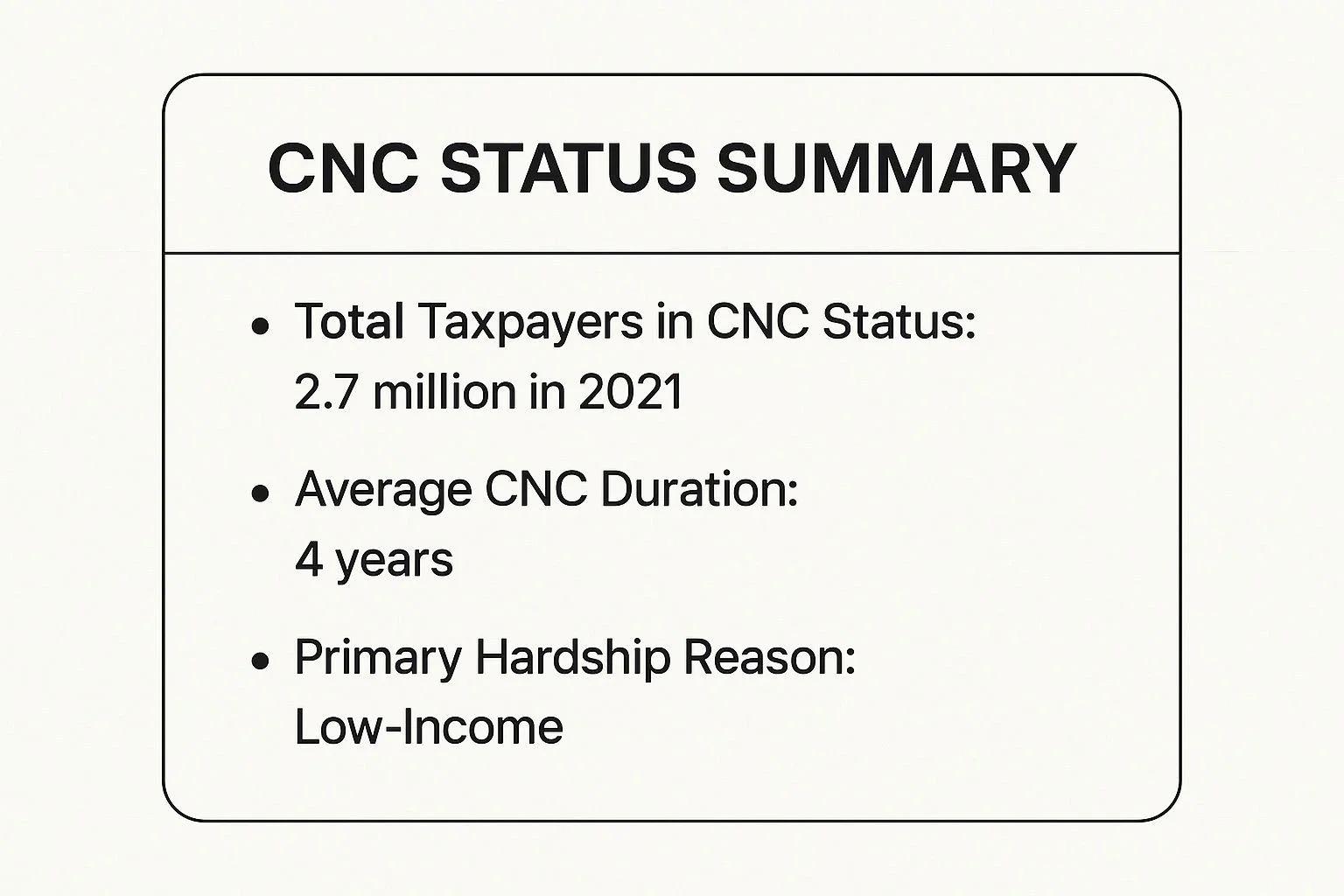
As you can see, millions of taxpayers find themselves in CNC status, many for long stretches because their financial situation just hasn't improved.
Comparing Tax Relief Options: CNC vs. OIC vs. Installment Agreement
So, how do you decide which path is right for you? It starts with an honest look at your finances. This table breaks down the key differences between these three major IRS relief programs, making it easier to see where you might fit.
| Feature | Currently Not Collectible (CNC) | Offer in Compromise (OIC) | Installment Agreement |
|---|---|---|---|
| Primary Purpose | Temporarily pause collections due to financial hardship. | Settle the tax debt for less than the full amount owed. | Pay the full tax debt over time in monthly payments. |
| Who It's For | Taxpayers with no disposable income to cover basic needs. | Taxpayers who cannot pay their full debt in a reasonable time. | Taxpayers who can afford monthly payments to clear their debt. |
| Impact on Debt | Debt remains and continues to grow with interest and penalties. | If accepted and paid, the remaining debt is forgiven. | The full debt must be paid, plus accrued interest and penalties. |
| Duration | Temporary; reviewed periodically by the IRS. | A one-time settlement, though payments can be structured. | A long-term plan, often lasting up to six years. |
| Long-Term Goal | Provides breathing room to improve financial stability. | Achieves a final resolution and a fresh start with the IRS. | Provides a structured path to becoming debt-free. |
At the end of the day, making the right choice means carefully weighing your current income, expenses, assets, and what you realistically see for your financial future. While CNC offers that critical immediate relief, an OIC or an IA could be the more permanent solution that finally puts your tax problems behind you.
Your Top Questions About CNC Status, Answered
When you're staring down a mountain of tax debt, the practical, day-to-day questions are often the ones that cause the most stress. It's one thing to understand the theory of IRS Currently Not Collectible status, but what does it actually mean for your life, your home, and your credit?
Let's cut through the noise and get straight to the answers you need. Think of this as a no-nonsense FAQ, based on years of helping real people navigate these exact issues.
How Long Does IRS Currently Not Collectible Status Last?
This is the big one. First, know this: CNC is not a permanent fix. It's a temporary pause. The IRS will check back in on your financial health, usually every one to two years.
How do they do that? Most often, they simply look at your next tax return. When you're placed in CNC, the IRS often flags your account with an income threshold. If you file a return showing you’ve earned more than that amount, it automatically triggers a review. At that point, they can decide to put you back into active collections.
But here’s a critical piece of the puzzle: the 10-year Collection Statute of Limitations keeps ticking away the whole time you're in CNC. This is the legal deadline the IRS has to collect from you. If your financial situation doesn't improve for a long time, it’s entirely possible for the tax debt to expire before you're ever able to pay it.
Will CNC Status Hurt My Credit Score?
This is a common fear, but the short answer is no—at least, not directly. The IRS doesn't report your tax business to credit bureaus like Experian or TransUnion. You'll never see a line item on your credit report that says "Currently Not Collectible."
The real danger comes from what often happens before you get CNC status: a Notice of Federal Tax Lien. A tax lien is a public claim against your property, and it absolutely gets reported to credit agencies. It can do serious damage to your credit score.
The Bottom Line: CNC status itself is private between you and the IRS. But it doesn't erase a federal tax lien that's already been filed. That lien will stick around, weighing down your credit, until the tax debt is resolved or expires.
Can I Qualify for CNC if I Own a Home?
Yes, you can. Owning a home doesn’t automatically kick you out of the running for IRS Currently Not Collectible status. The IRS is primarily focused on your current ability to pay—your monthly income versus your necessary living expenses.
Of course, they will look at your home equity (what your home is worth minus what you owe). But it's not a simple calculation.
If you have little or no equity, your house isn't a source of cash they can easily tap.
Even with equity, the IRS might grant CNC if forcing a sale would create a significant hardship—like making your family homeless.
The key is to be upfront about all your assets on your financial disclosure forms. But remember, the heart of the CNC decision is whether you have enough cash flow to cover your basic needs and make a tax payment. For most people in this situation, the answer is no, regardless of homeownership.
What Happens if My CNC Status Is Revoked?
If the IRS reviews your file and sees that your income has gone up, they'll move to revoke your CNC status. This won't happen out of the blue. You'll get an official notice telling you that collection efforts are about to restart.
Whatever you do, don't ignore that letter. It's your cue to get back in the game and take control.
Your first move should be to contact the IRS to discuss your new financial picture. With an improved income, you might be a great candidate for a different resolution.
Your next steps will likely be:
Negotiate an Installment Agreement: If you have some breathing room in your budget now, a formal payment plan is a smart, stable solution.
Explore an Offer in Compromise: If your income is better but you still can't possibly pay the full debt (which has likely grown with penalties and interest), you might now be able to settle for a smaller amount.
Doing nothing is the worst option. The IRS will eventually resort to wage garnishments and bank levies. Staying engaged is how you keep your options open.
At Attorney Stephen A Weisberg, we know every tax problem is personal and needs a tailored strategy. If you're overwhelmed by tax debt and wondering if CNC is the right path, start with a FREE, no-obligation Tax Debt Analysis. We’ll help you understand where you stand and find the best possible way forward.
Want to understand your options before you call anyone?
Download my free book — Freedom From Tax Debt — a plain-language guide to how the IRS collections process actually works and what resolution really looks like.
➥ Contact Attorney Stephen A. Weisberg for a free Tax Debt Analysis.
Contact Me Here: https://www.weisberg.tax/contact-1
Email: s.weisberg@weisberg.tax
Phone/Text: (248) 971-0885
Address: 300 Galleria Officentre, Suite 402, Southfield, MI 48034
