Statute of Limitations IRS Debt: Know Your Rights
Here’s a simple truth that sounds almost too good to be real: the IRS can't chase you for old tax debt forever. There's a built-in expiration date. Generally, the statute of limitations for IRS debt is a firm 10 years, starting from the day your tax is officially assessed.
Think of it as a countdown clock. Once that ten-year timer runs out, the IRS is legally blocked from collecting on that specific tax debt. This isn't some tax loophole; it's a fundamental taxpayer right that ensures there's a final end to the process.
What Is the IRS 10-Year Collection Rule?

The idea of a statute of limitations on IRS debt is a core principle in U.S. tax law, officially called the Collection Statute of Limitations.
It puts a hard stop on how long the IRS can use its powerful collection tools—like levying your bank account or garnishing your wages—to get what you owe.
At its heart, this rule is a protection for you, the taxpayer. It’s designed to provide finality and prevent the government from holding a tax debt over your head for the rest of your life.
After 10 years from the date of assessment, if the IRS hasn't collected the money, the remaining balance is essentially wiped clean.
To help you get a clear picture of this timeline, let's break down the key moments.
Decoding Your IRS Collection Timeline
This table simplifies the journey from when a tax debt is created to when the IRS can no longer collect it.
| Event | Governing Rule or Timeframe | How It Affects You |
|---|---|---|
| Tax Assessment | The official start date | This is when the IRS formally records the tax you owe. The 10-year clock starts now. |
| Collection Period | The 10-year statute of limitations | During this time, the IRS can actively pursue collection through liens, levies, and garnishments. |
| CSED (Collection Statute Expiration Date) | The end of the 10-year period | Once this date passes, the IRS loses its legal authority to collect the debt from you. The debt is effectively gone. |
Understanding these stages is the first step toward taking control of your tax situation.
The Countdown Clock Starts Ticking
So, how does this all begin? It starts with something called the assessment date. This is the specific day the IRS officially enters your tax liability into its records. That’s it. That’s the starting gun.
From that moment, a 10-year countdown begins. It's not a suggestion; it's a legal deadline. When that clock hits zero, the IRS’s power to collect that debt vanishes. This final day is known as the Collection Statute Expiration Date, or CSED.
Knowing your CSED is one of the most powerful tools in your arsenal when tackling back taxes. It gives you a clear finish line and transforms a seemingly endless problem into one with a defined end.
Why the Assessment Date Is the Only Date That Matters
This is where many people get tripped up, and making a mistake here can be costly. The 10-year clock does not start when:
You earned the income.
The tax year ended.
You filed your tax return.
Your tax payment was due.
The single most important date is the assessment date. This is when the IRS officially logs the debt. Getting this date wrong can lead to a false sense of security or, just as bad, years of unnecessary stress.
Pinpointing this exact date is your first and most critical move. It takes the abstract 10-year rule and turns it into a concrete timeline you can use to build a strategy and finally find a path to resolution.
How to Find Your Collection Statute Expiration Date

Knowing the 10-year rule is one thing, but it’s just theory until you can apply it to your own situation. The real power comes from finding your specific Collection Statute Expiration Date (CSED).
Think of this date as your personal finish line in the marathon against IRS debt. Pinpointing it is the most critical first step you can take.
You’ll need to do a little detective work on your own finances. The key clue you're looking for is the "assessment date"—that's the day the IRS officially put your tax debt on its books. Once you find that date, you simply add 10 years to it to find your CSED.
Locating the Assessment Date on IRS Notices
Your first move should be to dig through that pile of mail you've probably received from the IRS. The assessment date is often printed right on their official notices, but it's rarely labeled in plain English as "assessment date." You have to know what you're looking for.
Let's imagine a client of ours, a freelance graphic designer who fell a few years behind on her taxes. She’d received a flurry of letters, including a "Notice of Deficiency" and, later, a much more intimidating "Notice of Intent to Levy."
She grabbed the most recent one, a CP504 Final Notice. On that notice, she found a table detailing the tax year in question. Right next to it was a date under a column showing when the tax was officially recorded. That was it—the assessment date she needed to start the clock.
Requesting Your IRS Account Transcript
If you’ve shredded the old notices or just can't make sense of them, don't worry. There’s a far more direct and foolproof method: request your official IRS account transcript. This is the gold standard for confirming the assessment date and getting a clear, detailed history of your account.
You’ve got a couple of ways to get your hands on it:
Online: The quickest route is through the IRS "Get Transcript" tool on their website. You'll have to go through an identity verification process, but once you're in, you can usually view and download your transcript instantly.
By Mail: You can also request a transcript be mailed to you either through the online portal or by submitting Form 4506-T, "Request for Transcript of Tax Return."
Once you have that transcript, scan it for a line item that says "Tax assessed" or a similar transaction code for the specific tax period. The date next to that entry is the official start date for your 10-year countdown.
Key Takeaway: Your IRS account transcript is the definitive, no-nonsense source for your assessment date. It cuts through the clutter of confusing notices and gives you the exact information you need to calculate your CSED.
Calculating Your CSED A Step-by-Step Guide
With your assessment date in hand, the rest is just simple math.
Let's go back to our graphic designer. Her account transcript showed a clear assessment date of May 15, 2017. To figure out her CSED, the calculation was easy:
Identify the Assessment Date: May 15, 2017
Add 10 Years: May 15, 2017 + 10 years
Determine the CSED: May 15, 2027
Suddenly, her vague, overwhelming tax problem had a concrete end date. This simple piece of information transformed her anxiety into a sense of control.
The CSED becomes the anchor for every strategic decision you make from that point forward. Knowing exactly where you stand empowers you to explore your options intelligently, not out of panic.
Of course, if you have unfiled returns, the IRS can't assess a tax in the first place. For those in that boat, our guide on how to file back taxes walks you through getting caught up—the essential first step to starting that 10-year clock and finally resolving your debt.
Actions That Can Pause the 10-Year Collection Clock
That 10-year countdown on IRS debt is a powerful deadline, but it’s not set in stone. Certain actions you take can hit a "pause button" on this clock, a critical concept known as tolling. If you don't understand how tolling works, you could catastrophically miscalculate when your debt actually expires.
Think of it like a stopwatch in a race. It's supposed to run continuously for 10 years. But specific events—usually ones you initiate—force the official (the IRS) to pause the timer. The clock doesn't reset to zero. It just stops ticking until the event is resolved, then picks up right where it left off.
These pauses exist because when you engage in certain legal processes, the IRS is barred from taking collection actions against you. The law protects you during this time, but the trade-off is that it also stops the statute of limitations for your IRS debt from running out.
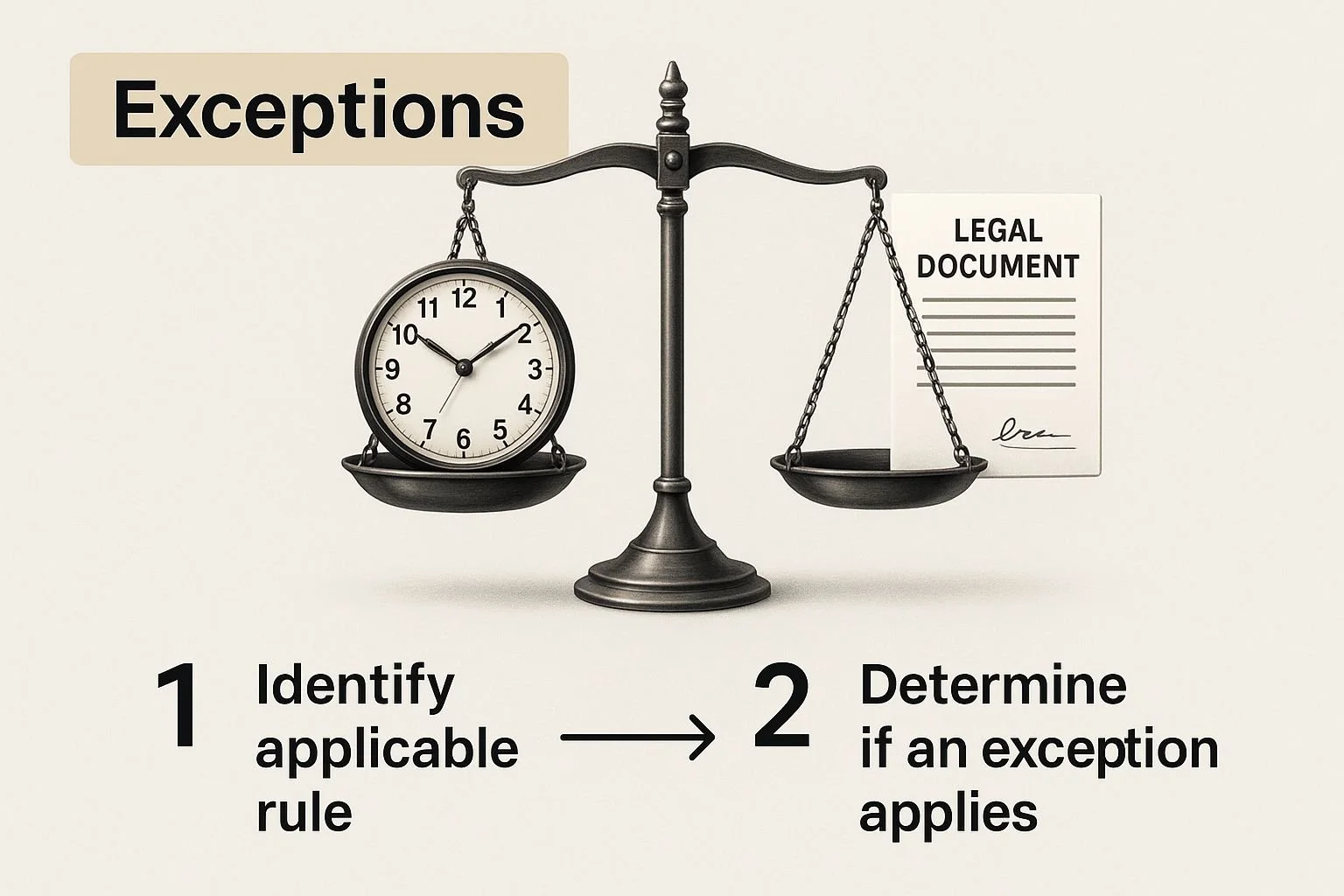
As the image shows, there’s a delicate balance. Your legal rights and the IRS’s collection timelines are directly linked, and taking action on your end almost always impacts how much time the IRS has left.
Common Events That Toll the Statute
Many of the most common tax resolution strategies will, unfortunately, halt the CSED countdown. It’s absolutely vital to know what these are, because in trying to solve your tax problem, you might accidentally give the IRS more time to collect.
Here are the big ones that pause the clock:
Submitting an Offer in Compromise (OIC): An OIC is a formal request to settle your tax liability for less than the full amount owed. The clock stops the moment you submit it and stays paused until the IRS issues a final decision (accepted or rejected) or you withdraw it—plus an extra 30 days for you to appeal.
Requesting a Collection Due Process (CDP) Hearing: After the IRS sends a Final Notice of Intent to Levy, you have the right to a CDP hearing. The statute is tolled from the day you request the hearing until the hearing officer’s determination becomes final.
Claiming Innocent Spouse Relief: If you ask the IRS to absolve you of responsibility for tax debts caused by your spouse or ex-spouse, the collection clock stops ticking for your portion of the liability. It remains paused until the IRS makes its final decision on your claim.
Understanding these triggers is key to smart strategy. For example, if your CSED is just a year away, filing an OIC could be a terrible move. The process itself can take many months, potentially extending the collection window far beyond your original expiration date.
Bankruptcy and Its Impact on the Clock
Filing for bankruptcy is one of the most powerful and immediate ways to pause the collection statute. The moment you file, a federal court order called an "automatic stay" slams the brakes on all creditors, including the IRS. They are legally prohibited from taking any collection action against you.
Because this automatic stay ties the IRS's hands, the CSED clock is frozen for the entire time you are in bankruptcy. But here's the kicker: once your case is discharged or dismissed, the clock not only starts again, but the law tacks on a minimum of six extra months to your CSED.
This provision ensures the IRS doesn't lose its rightful window to collect just because you were under the bankruptcy court's protection.
As you can see, the 10-year limit is anything but absolute. When a taxpayer files for bankruptcy, the statute of limitations on collections is suspended, and you can learn more about how different actions can extend the IRS timeline at Debt.org.
Other Less Common Tolling Events
While OICs, CDP hearings, and bankruptcy are the usual suspects, a few other situations can suspend the clock. It's smart to be aware of these edge cases, too.
Two other notable events include:
Living Outside the United States: If you are out of the country continuously for at least six months, the collection statute is generally paused for the entire time you're gone. The logic is simple: the IRS can't effectively pursue collections when you and your assets are abroad, so the clock stops.
Signing a Waiver: In certain rare negotiations, the IRS might ask you to voluntarily agree to extend the collection period by signing a waiver (Form 900). While this isn't common in most collection cases these days, it’s a powerful reminder to never sign an IRS form without fully understanding what it means for you.
At the end of the day, every move you make has a consequence. Knowing which actions press pause on the statute of limitations for IRS debt is fundamental to finding your way to a final, successful resolution.
Making Strategic Decisions About Your IRS Debt
Once you know your Collection Statute Expiration Date (CSED), everything changes. It’s the difference between reacting to scary IRS notices and proactively taking control of your financial future.
When you can see the finish line, you can start making decisions based not just on what you can afford today, but on how each choice plays out against your specific timeline.
This is where understanding the statute of limitations for IRS debt becomes your most powerful tool. The right move for a taxpayer with nine years left on the clock could be a complete disaster for someone whose CSED is only eighteen months away. Every resolution, from a payment plan to a settlement offer, carries trade-offs that directly affect that clock.
Should You Pursue an Offer in Compromise?
An Offer in Compromise (OIC) often looks like a golden ticket. It's a formal program that lets some taxpayers settle their debt for pennies on the dollar. But there’s a massive catch: the moment you submit an OIC application, the 10-year collection clock stops dead in its tracks.
This pause, or "tolling," lasts for the entire time the IRS is reviewing your offer, a process that can easily drag on for 6-12 months or more.
If your offer gets rejected, the clock stays frozen for another 30 days while you have the right to appeal. The bottom line? Chasing an OIC can tack a huge chunk of time back onto your CSED.
Strategic Consideration: If your CSED is just a year or two out, filing an Offer in Compromise is almost always a bad move. You’re trading a definite, upcoming expiration date for the mere possibility of a settlement, and you could end up extending the IRS’s collection window by more than a year in the process.
Analyzing Installment Agreements
A formal Installment Agreement (IA) is usually a much more direct route. This is simply a payment plan you work out with the IRS to pay down your debt over a set period. Crucially, just setting up an IA doesn't automatically stop the collection statute clock.
There is one important exception to be aware of. If you default on your payments, the IRS might issue a levy notice. If you decide to appeal that levy through a Collection Due Process (CDP) hearing, the clock will be paused for the duration of that appeal.
The key is to negotiate a payment you know you can stick with. For those who need a hand with these conversations, learning how to negotiate IRS debt is an essential skill that can result in a manageable plan that doesn't mess with your CSED timeline.
When Is Currently Not Collectible Status the Right Move?
For taxpayers in a true financial bind, getting placed in Currently Not Collectible (CNC) status offers immediate and powerful relief.
If the IRS agrees you don’t have enough income to cover basic living expenses after a review of your finances, they’ll stop active collections—no more bank levies or wage garnishments.
Here’s the best part: being in CNC status does not stop the 10-year collection clock. This makes it an incredibly valuable strategy for anyone with only a few years left on their CSED.
The IRS will check in on your finances periodically, but all the while, that clock just keeps on ticking, bringing you closer and closer to freedom from the debt.
Comparing Your Options Based on Your CSED
Your personal CSED is the anchor for your entire game plan. Let's break down how you might approach your debt depending on where you are on that timeline.
| If your CSED is... | A Potentially Good Strategy | A Potentially Risky Strategy |
|---|---|---|
| 8-10 years away | An Offer in Compromise could be a great fit. You have plenty of time to get through the process without the clock being a major factor. | Waiting it out. Over such a long period, interest and penalties will balloon into a much larger problem. |
| 3-5 years away | An Installment Agreement is a solid choice. It lets you tackle the debt head-on while the CSED clock keeps running in the background. | Ignoring the debt. This is still more than enough time for the IRS to get aggressive with collections. |
| Less than 2 years away | Seeking Currently Not Collectible status if you qualify. This shields you from collections while the clock runs out. | An Offer in Compromise. The tolling period could easily push your debt past its original expiration date. |
While the IRS has its own playbook, having some context on the wider practices within the debt collection industry can also be enlightening. At the end of the day, the goal is to make a calm, educated decision that works for both your bank account and the time you have left on the statute of limitations for your IRS debt.
Debunking Myths About the IRS Debt Timeline
When you're facing a tax problem, bad advice is everywhere. The internet is a minefield of half-truths and "magic tricks" that promise an easy way out of IRS debt. Unfortunately, this misinformation can lead you down a path that makes a bad situation much, much worse.
Let's cut through the noise and tackle the most common—and dangerous—myths about the statute of limitations for IRS debt. Getting this right isn't just about knowing the facts; it's about building a resolution strategy on solid ground.
Myth 1: The Clock Starts When I File My Taxes
This is easily the biggest misconception out there, and it's a costly one. People naturally assume the 10-year collection timer starts ticking on Tax Day or the moment they drop their return in the mail. This simple mistake can throw off your entire timeline, leading you to think relief is years closer than it actually is.
Here's the reality.
Fact: The 10-year collection clock only begins on the "assessment date." This is the specific day the IRS officially logs your tax bill onto their books. It always happens after you file, and it’s the one and only date that matters for calculating your Collection Statute Expiration Date (CSED).
Getting this date wrong is a foundational error. Always, always pull your official IRS account transcript to confirm the exact assessment date. Don't guess.
Myth 2: Ignoring the IRS Will Make the Debt Go Away
It’s an appealing thought, isn't it? Just bury your head in the sand, ignore the scary-looking envelopes, and eventually, the 10-year clock will run out. Poof, problem solved.
This is a terrible strategy. In fact, it's probably the fastest way to escalate your problem from a simple debt to a full-blown financial crisis. The IRS is the most powerful collection agency on the planet, and ignoring them is like waving a giant red flag that says, "Come get me!"
Fact: Ignoring the IRS invites aggressive collection and can actually pause the clock. While you're busy "waiting it out," the IRS can start garnishing your wages, levying your bank accounts, and slapping federal tax liens on your property. Worse, certain actions people take to hide—like filing for bankruptcy or moving out of the country—can "toll" the statute of limitations, adding even more time until your debt expires.
A proactive strategy is always the winning one. For those in a tough spot, the IRS has official programs designed to help. For instance, looking into your options for IRS debt forgiveness can provide a formal resolution, giving you protection and finality that ignoring the problem never will.
Myth 3: The 10-Year Collection Rule Is the Same as the Audit Rule
It’s easy to get these two timelines mixed up, but they are completely separate worlds. The IRS has different clocks for different jobs, and confusing the time they have to collect a debt with the time they have to audit a return can cause a ton of unnecessary anxiety.
Let's put them side-by-side to make it crystal clear.
IRS Time Limits At a Glance
The table below breaks down the two most important IRS statutes of limitations. They serve very different purposes and have different triggers.
| IRS Action | General Time Limit | Important Exceptions to Know |
|---|---|---|
| Collecting a Tax Debt | 10 years from the assessment date. | Can be paused (tolled) by a bankruptcy filing, an Offer in Compromise submission, and other specific events. |
| Auditing a Tax Return | 3 years from the date you filed the return. | Extends to 6 years if you underreport your income by more than 25%. Becomes indefinite for fraud. |
As you can see, they're not even in the same ballpark. The statute of limitations for IRS debt refers specifically to that 10-year collection window. Knowing the difference helps you focus your energy on the timeline that actually applies to your situation and saves you from worrying about a surprise audit years down the road.
Frequently Asked Questions
When you're dealing with the statute of limitations for IRS debt, a lot of specific questions pop up. Let's tackle some of the most common ones I hear from clients to clear up the confusion and show you how these rules work in the real world.
Does the 10-Year IRS Rule Apply to State Tax Debt Too?
Absolutely not. That’s a common and costly mistake. The 10-year statute of limitations is a federal rule that only applies to federal taxes collected by the IRS.
Every state with an income tax has its own tax agency, its own laws, and its own timeline for collecting back taxes. These timelines can be all over the map—some are longer than the IRS's, and some are shorter. You have to check directly with your state’s department of revenue to know where you stand. Never assume the federal rule covers you at the state level.
What Happens on the Day My CSED Finally Arrives?
The day your Collection Statute Expiration Date (CSED) hits is a big one. At that moment, the IRS legally loses its power to come after you for that specific tax debt. It's over.
Any aggressive collection actions tied to that debt, like wage garnishments or bank levies, have to stop immediately. The law also requires the IRS to release any federal tax liens it filed against your property for that expired debt.
While this should happen automatically, it's always wise to be proactive. A few weeks after your CSED has passed, pull an official IRS account transcript to verify that your account balance is indeed zero.
Is It a Good Strategy to Just Wait Out the 10 Years?
Let me be blunt: trying to "wait out" the IRS is almost always a terrible idea. I've seen it go wrong countless times. It sounds tempting to just let the clock run out, but the reality is brutal. For that entire 10-year period, penalties and interest are piling up, often ballooning a manageable debt into a monster.
Even worse, you're giving the IRS a full decade to make your life miserable. They can and will use their immense power to seize money from your bank account, garnish your paycheck, and slap liens on your property.
Critical Warning: Many of the things people do to dodge the IRS—like filing for bankruptcy, submitting an Offer in Compromise, or even moving abroad—actually pause the 10-year clock. You could suffer through years of hardship only to discover you’ve actually extended the collection period, completely defeating the purpose.
How Does Filing an Amended Tax Return Change My CSED?
Filing an amended return (Form 1040-X) can have a couple of different outcomes for your CSED. If your amendment doesn't change what you owe or even gets you a refund, your original CSED is unaffected. The clock on that initial debt keeps on ticking.
But if that amended return shows you owe more tax, things get more complicated. The IRS will treat that new amount as a separate assessment.
This new assessment starts its own, brand-new 10-year collection clock. Your original CSED stays put for the original debt, but now you have a second CSED to track for the additional amount.
Are you feeling overwhelmed by IRS debt and unsure of your next move? You don't have to face it alone. At the law office of Attorney Stephen A Weisberg, we start with a FREE, no-obligation Tax Debt Analysis to diagnose your specific situation and determine the best path forward. Contact us today to find your clear path to resolution.
➥ Contact Attorney Stephen A. Weisberg for a free Tax Debt Analysis.
Contact Me Here: https://www.weisberg.tax/contact-1
Email: s.weisberg@weisberg.tax
Phone/Text: (248) 971-0885
Address: 300 Galleria Officentre, Suite 402, Southfield, MI 48034
