Tax Fraud vs Tax Evasion: Key Differences You Need to Know
When you hear the terms tax fraud vs tax evasion, it’s easy to think they’re the same thing. The real difference really boils down to scope.
Think of it this way: tax fraud is the broad category for any deliberate deception on a tax return. Tax evasion, on the other hand, is one specific type of tax fraud—the illegal act of not paying taxes you already owe. So, while all tax evasion is tax fraud, not all tax fraud is tax evasion.
Distinguishing Between Tax Evasion and Tax Fraud
While most people use the terms interchangeably, the IRS and federal courts draw a very clear line between them. Knowing these distinctions is incredibly important because they directly impact the charges, potential penalties, and even the defense strategies available to you.
Navigating the tax code requires a knack for decoding legal language, and that’s especially true here.
The key ingredient for both offenses is willfulness. This isn't about an honest mistake or a math error on your return. To be a crime, the government has to prove you intentionally violated a known legal duty.
Key Concepts At A Glance
Tax evasion is all about the final step: the non-payment of an assessed tax liability. It’s the act of escaping a tax bill you know you have.
Tax fraud is much wider. It can happen at any point in the tax process and covers a whole range of dishonest acts. It's about the deception itself. For instance, claiming a fake dependent on your Form 1040 is tax fraud, even if you still end up paying some tax.
To help put things in perspective, here’s a quick breakdown of the core differences between these two serious offenses.
Quick Comparison Tax Evasion vs Tax Fraud
This table gives a high-level overview to clarify the primary distinctions right away.
| Aspect | Tax Evasion | Tax Fraud |
|---|---|---|
| Definition | The illegal act of not paying taxes that are legally owed. | A broad term for any intentional deception on a tax filing. |
| Scope | Specific: A type of tax fraud focused on non-payment. | Broad: An umbrella term for many deceptive acts. |
| Core Action | Avoiding the assessment or payment of tax. | Misrepresenting facts to the IRS. |
| Common Example | Hiding cash income to avoid paying taxes on it. | Falsifying deductions or claiming non-existent dependents. |
As you can see, the core difference lies in the action. Evasion is about avoiding payment, while fraud is about lying to the government, regardless of the final outcome.
The Global Economic Impact of Tax Crimes
Before we get into the nitty-gritty legal definitions of tax fraud versus tax evasion, it’s crucial to understand why these concepts matter so much.
Far from being victimless white-collar offenses, these crimes strike at the heart of a country's financial health, weakening the very foundation of its public services and economic stability.
When a person or company intentionally fails to pay their fair share, it creates a massive revenue hole for the government. That lost income is money meant to fund the essential programs we all depend on, every single day.
The Ripple Effect on Public Services
Think about what tax dollars actually pay for. The consequences of tax crimes aren't abstract—they translate directly into underfunded, overburdened systems that impact everyone.
This financial gap creates very real problems, such as:
Healthcare: Less funding can mean fewer hospital beds, agonizingly long wait times for critical procedures, and a weaker ability to handle public health crises.
Education: Schools are forced to make do with less, leading to overcrowded classrooms, outdated technology, and fewer resources for students who need extra help.
Infrastructure: Those crumbling roads, bridges, and public transit systems don't fix themselves. When funds are short, essential maintenance and upgrades get pushed to the back burner.
At the end of the day, every dollar lost to tax evasion or fraud is a dollar that can't be invested back into the community. This shortfall forces governments to make tough choices: either raise taxes on honest citizens or cut the very services that keep society running.
Tax compliance is more than just a legal duty; it’s the bedrock of a functioning society. Widespread tax crime destroys public trust and creates a system where the honest majority is forced to shoulder an unfair burden.
Widening the Economic Divide
Beyond starving public services, tax crimes pour fuel on the fire of economic inequality. When wealthy individuals and massive corporations use illegal schemes to hide income, they are essentially opting out of their civic duty. This pushes the financial load onto middle- and lower-income taxpayers, who rarely have access to the same complex loopholes.
The scale of this problem is staggering. Globally, the combination of corporate tax abuse and private tax evasion costs governments an astonishing $427 billion every year. To put that into perspective, that's enough to cover the annual salaries of nearly 34 million nurses—or losing one nurse’s salary every single second. These figures come from a landmark 2020 study by the Tax Justice Network.
This incredible loss of revenue doesn't just strain public services; it erodes faith in the entire system. Understanding this broader economic context is vital. It highlights just how serious these offenses are and explains exactly why the IRS and global authorities pursue them with such intensity.
Comparing the Legal Elements
When you get down to the nitty-gritty of tax fraud vs. tax evasion, you have to look past the dictionary and see how the government actually proves these cases in court.
The burden of proof is entirely on the prosecution, and each offense has a specific checklist of legal elements they must satisfy. These aren't just technicalities; they are the bedrock of how these financial crimes are charged, defended, and ultimately decided.
For a tax evasion charge, prosecutors need to tick three specific boxes. With the wider net of tax fraud, the focus shifts slightly, zeroing in on the act of deception itself, not necessarily the underpayment of tax. This is a critical distinction because it completely shapes the kind of evidence the IRS Criminal Investigation (IRS-CI) division will hunt for.
The Three Pillars of Tax Evasion
Under federal law—specifically 26 U.S.C. § 7201—the government has to prove three things beyond a reasonable doubt. If they fail on even one, the entire case against you crumbles.
Existence of a Tax Deficiency: First and foremost, there has to be an unpaid tax bill. Prosecutors must show you owed more tax than what you reported and paid. A simple math error or a disallowed deduction that doesn't create an underpayment won't cut it. There must be a real, quantifiable tax shortfall.
An Affirmative Act of Evasion: This is a big one. You must have taken a deliberate, specific action to mislead the IRS or hide your true tax liability. We're not talking about just failing to file a return (that's a separate misdemeanor). An affirmative act is something like stashing assets in offshore accounts, maintaining two sets of books, or dealing only in cash to fly under the radar.
Willfulness: This is often the hardest element for the government to prove and the most crucial part of any defense. They have to demonstrate that you intentionally and voluntarily violated a known legal duty. An honest mistake, simple negligence, or even just being careless doesn't meet this high standard.
This infographic breaks down the maximum penalties for two of the most common tax crimes: tax evasion and filing a false return (a form of tax fraud).
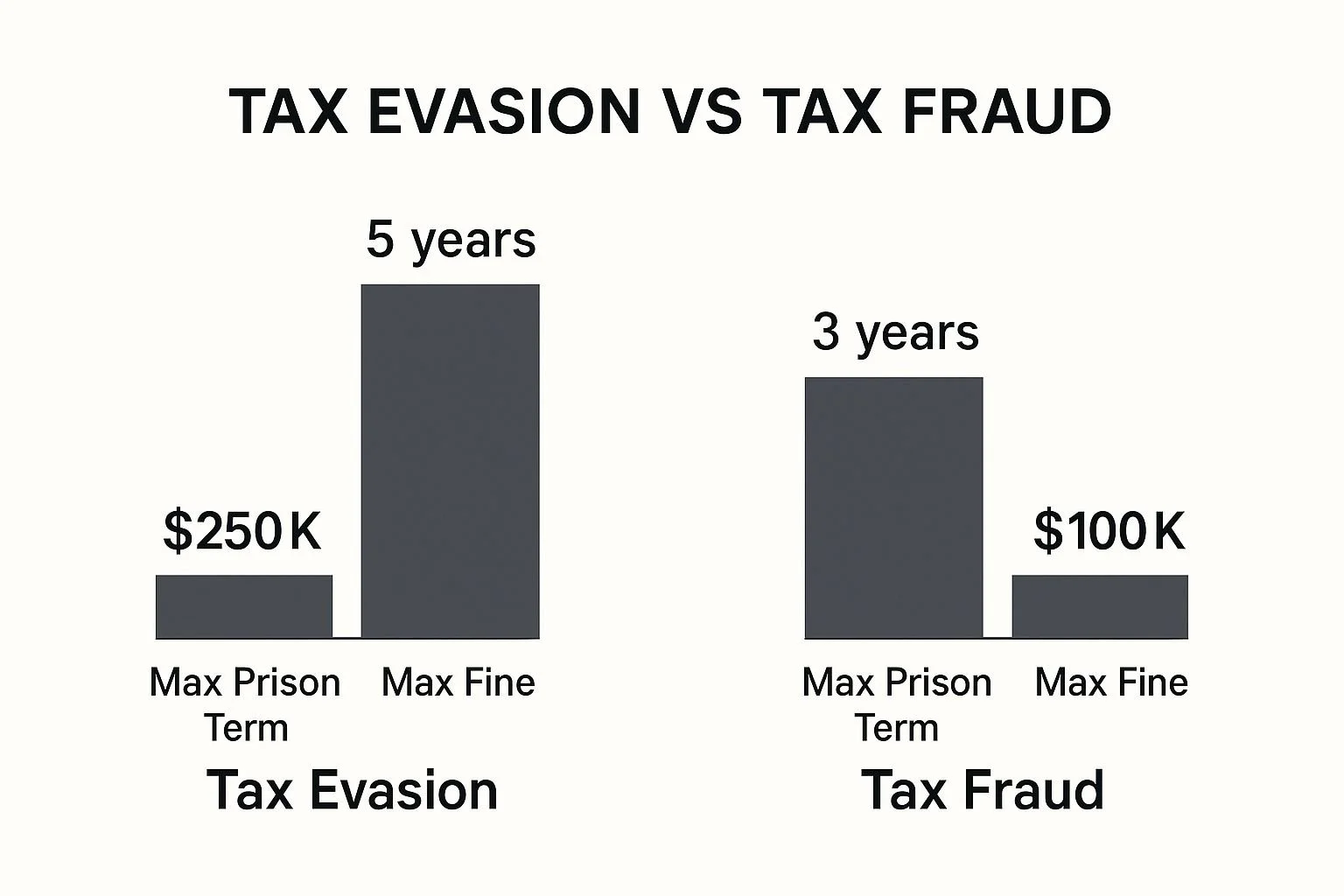
As you can see, the stakes are significantly higher for a tax evasion conviction, which can bring much heavier fines and a longer potential prison term than filing a false return.
Unpacking the Intent Behind Tax Fraud
While tax evasion is laser-focused on the non-payment of tax, tax fraud casts a much wider net, centering on the act of deception. A very common tax fraud charge is filing a false return under 26 U.S.C. § 7206. Here, the government's concern isn't whether you paid the right amount, but whether the information you provided was true.
The legal elements for filing a false return are different:
Making and Subscribing a Return: You had to have signed and filed a tax return or another document under the penalties of perjury.
The Return Was Materially False: The document contained a significant lie. "Material" means the falsehood had the potential to hinder the IRS in its duties.
Knowledge of Falsity: You must have known the information was untrue at the time you filed.
Willfulness: Just like with evasion, the act must have been a voluntary and intentional violation of a known legal duty.
The key difference should jump out at you: prosecutors don't need to prove a tax deficiency for this type of tax fraud charge. Someone could falsely claim a dependent, for instance, but still end up overpaying their taxes. They could still be charged with tax fraud because they willfully submitted a false document to the government.
The Core Distinction: For tax evasion, the government must prove you owed money and intentionally tried to escape paying it. For tax fraud (like filing a false return), they must prove you intentionally lied on a document you signed under penalty of perjury, regardless of whether you owed more tax.
Now, let's take a closer look at what the government actually needs to show to prove these distinct charges.
Legal Elements Compared
This table breaks down the legal elements side-by-side, showing what a prosecutor must establish in court.
| Legal Element | Tax Evasion (26 U.S.C. § 7201) | Tax Fraud (e.g., 26 U.S.C. § 7206) | Key Nuance |
|---|---|---|---|
| The Core Act | An attempt to evade or defeat tax. | Making and subscribing a false document. | Evasion is about the money. Fraud is about the lie. |
| Tax Deficiency | Required. Must prove an underpayment of tax. | Not required. The lie itself is the crime. | This is the most significant legal distinction between the two. |
| Affirmative Act | Required. Must show a specific act of concealment. | The act of filing the false document is sufficient. | Evasion requires an extra step, like hiding assets. |
| Willfulness | Required. Must be an intentional violation. | Required. Must be an intentional violation. | This high standard of intent is the common thread in both. |
Understanding these distinctions is everything. It dictates the entire direction of a government investigation and forms the very blueprint for a successful defense strategy.
Willfulness: The Highest Standard of Intent
In any discussion of tax fraud vs. tax evasion, willfulness is the linchpin. It's the element that transforms a simple mistake into a federal crime. The Supreme Court has defined it as a "voluntary, intentional violation of a known legal duty."
To prove willfulness, prosecutors have to get inside a defendant's head and show they knew their legal obligation and deliberately chose to ignore it. They use circumstantial evidence to paint this picture:
Concealment of Records: Intentionally hiding or destroying financial documents.
Deceptive Behavior: Using fake Social Security numbers or aliases.
Consistent Underreporting: A pattern of understating income over multiple years is much harder to explain away as an accident.
Statements to Investigators: Lying to IRS agents during an audit is often seen as powerful evidence of a guilty mind.
This element is so critical because it's where most legal battles are fought and won. If a strong argument can be made that an error was due to a misunderstanding of the law, a simple mathematical mistake, or bad advice from a tax professional, the element of willfulness can be defeated.
This can mean the difference between a criminal conviction and a civil penalty. It's essential to understand the full range of consequences, which you can explore in our detailed guide to the tax fraud penalty.
Real-World Scenarios of Tax Crimes

Legal definitions are one thing, but seeing them play out in the real world is another. To really get a handle on the difference between tax fraud and tax evasion, you have to look at actual examples. These scenarios show how people commit, get caught, and are prosecuted for these crimes, making the abstract concepts feel much more concrete.
By walking through these cases, you can see how the specific legal elements—like willfulness and affirmative acts—show up in real situations. Whether it’s a small business owner skimming cash or a massive corporation shifting profits, the intent to deceive the IRS is always the common denominator.
The Cash-Based Business Evasion Scheme
A classic, almost textbook, example of tax evasion involves a small business that brings in a lot of cash. Think of a local restaurant owner who deliberately fails to ring up cash sales, effectively hiding that income from their books and the IRS. This isn't just a simple mistake; it's a conscious choice.
To pull this off, the owner keeps two separate sets of books. The first set is the real one, accurately tracking every dollar that comes in, which they use to manage the business day-to-day. The second is a doctored version, with a big chunk of the cash income missing. That’s the version that goes to their accountant to prepare the tax returns.
This situation perfectly illustrates the three legal pillars of tax evasion:
A Tax Deficiency: By underreporting their income, the owner created a tax bill that was far lower than what they actually owed.
An Affirmative Act: The act of creating and maintaining a separate, fraudulent set of books is a clear, deliberate move to hide income.
Willfulness: The dual-book system is smoking-gun evidence that the owner knew their legal duty to report all income and intentionally broke the law.
This kind of scheme often gets flagged during an IRS audit, especially if the business’s reported profits look suspiciously low for its industry. Sometimes, a disgruntled employee turns whistleblower. The fallout is always serious: back taxes, heavy penalties, interest, and the very real possibility of criminal charges and jail time.
The Sophisticated Corporate Tax Fraud Scheme
Tax fraud can get much more complex than just hiding cash under the table. A more sophisticated example involves a business owner who invents fake expenses to slash their taxable profits. This isn't just aggressive accounting—it's a leap into criminal fraud.
Imagine a consulting firm that sets up a shell company, a business that exists only on paper. The firm then creates bogus invoices from this shell company for "services" that were never performed. It makes payments to the shell company and then writes those payments off as legitimate business deductions, artificially tanking its net income.
Here, all the key elements of tax fraud (specifically, filing a false return) are clearly in place:
The business owner willfully created fake documents.
They knew the deductions were fabricated and therefore materially false.
They signed the tax return under penalty of perjury, swearing it was accurate.
The real crime here is the lie itself. Even if the company still paid some taxes, knowingly submitting a return with fabricated information is tax fraud. The deception is the offense, plain and simple.
The IRS often uncovers these schemes using advanced data analytics that can spot strange payments to vendors or transactions with entities that have no real business footprint. Once caught, the consequences can include civil fraud penalties up to 75% of the tax owed, plus criminal prosecution.
If you've fallen behind on your filings because of a complicated financial picture, it's vital to handle it the right way. Getting expert help on how to file back taxes can keep honest mistakes from spiraling into much bigger trouble.
Multinational Profit Shifting and Tax Havens
On a global scale, some of the most audacious tax evasion schemes are run by large multinational corporations. These companies exploit complex international tax laws to shift profits from high-tax countries where the real work happens to jurisdictions with low or zero taxes—the infamous tax havens.
A common tactic is for a subsidiary in a high-tax country to pay outrageous fees for "intellectual property" or "management services" to another subsidiary based in a tax haven. This maneuver artificially deflates profits in the high-tax country while letting untaxed cash pile up offshore.
This practice has a staggering impact on national economies. Multinational corporations are at the center of a global tax evasion problem that costs governments an estimated $492 billion every year.
A huge piece of that, about $347.6 billion, comes directly from corporations shifting profits to tax havens simply to duck the taxes they owe.
While some of these strategies flirt with the line of legality, many cross deep into illegal evasion when they lack any real business purpose and are designed purely to defeat tax laws.
Penalties for Tax Fraud and Evasion
When the government decides you've crossed the line from a mistake to intentional deceit, the consequences are severe. This isn't just about paying what you owe; it's about punishment. Both tax fraud vs tax evasion can trigger a two-front battle, with civil penalties and criminal charges often pursued at the same time.
Make no mistake: the government views these offenses as a direct attack on the integrity of the entire tax system. The punishments are designed to reflect that, ranging from financially devastating fines to years behind bars. What you'll face depends entirely on the specific charge, how much tax the IRS lost, and how blatant your actions were.
Civil vs. Criminal Consequences
The IRS has a couple of ways to come after you. Civil penalties are all about the money—they get tacked onto your original tax bill. Criminal penalties are far more serious, involving prosecution by the Department of Justice and the very real possibility of prison.
Civil Penalties: The heavy hitter here is the civil fraud penalty. It can be a staggering 75% of the underpaid tax that resulted directly from the fraud. And yes, that's on top of paying back the original tax you owe, plus interest.
Criminal Penalties: These are saved for the most egregious cases where prosecutors feel they can prove you acted willfully beyond a reasonable doubt.
The financial hit alone can be crippling. To get a clearer picture of just how bad it can get, you can learn more about the extensive penalties for tax fraud in our detailed guide.
Examining Specific Criminal Charges
Federal law lays out the punishments pretty clearly, and the statutes show how the government treats different actions.
Tax evasion, defined under 26 U.S.C. § 7201, is a felony with some of the harshest consequences:
Up to five years in prison for each offense.
Fines climbing as high as $100,000 for individuals ($500,000 for corporations).
You'll also be on the hook for the costs of your own prosecution.
Filing a false return (26 U.S.C. § 7206) is another common felony charge. The focus here is on the lie itself, not just the failure to pay. A conviction can still mean:
Up to three years in prison per offense.
Fines of up to $100,000 for individuals ($500,000 for corporations).
Here's the critical thing to understand: The government has a whole toolkit for prosecuting tax crimes. Even if they can't prove you actually evaded a specific amount of tax, the act of knowingly lying on a return is a serious felony with its own severe penalties.
Beyond Fines and Prison Time
The damage from a tax crime conviction doesn't end when you leave the courtroom. The ripple effects can follow you for the rest of your life.
A felony conviction means you have a permanent criminal record. Good luck finding a job, renting an apartment, or getting a loan.
For professionals like doctors, CPAs, or attorneys, a conviction is almost always a career-ender, leading to the revocation of their professional license. The reputational harm alone can be impossible to repair, shattering trust with clients, colleagues, and family.
Defense Strategies and IRS Investigations
Getting a notice from the IRS is enough to make anyone's stomach drop, but it’s crucial to know exactly what you're up against. There's a world of difference between a routine civil audit and a full-blown criminal investigation.
They're triggered by different red flags and demand completely different responses. How you handle things from the very start can literally change everything.
A standard audit is usually just the IRS double-checking your financial records to make sure your tax return was accurate.
But if that auditor starts seeing patterns that look like intentional deceit, they can refer your case to IRS Criminal Investigation (IRS-CI). That pivot from a civil matter to a criminal one is a massive escalation, and you need to recognize the warning signs that things are getting serious.
Common Defenses Against Willfulness
The government’s whole case for tax fraud or evasion hinges on one word: willfulness. They have to prove you intentionally violated a known legal duty. Because of that, the best defense strategies are designed to pick that argument apart. The burden of proof is on them, and a good tax attorney will focus on demonstrating that any mistakes were just that—mistakes.
A few common arguments work well to challenge the idea of willfulness:
Honest Mistake or Negligence: This is about showing that an underpayment wasn't a conscious choice to deceive. Maybe it was a simple math error, a misunderstanding of a ridiculously complex tax code, or just plain carelessness.
Reliance on a Professional: If you handed over all your documents to a CPA who then made a mistake, you’ve got a solid defense. It shows you acted in good faith and trusted an expert to handle things correctly.
Lack of Knowledge: You can argue that you were genuinely unaware of a specific tax rule or filing requirement. This is especially effective if the rule in question is obscure or particularly complicated.
Of course, the best defense is proactive compliance. For those just looking for general guidance, resources like this one on simplified UK tax advice for small businesses can be a good starting point.
The Role of Voluntary Disclosure
What if you know you've made some significant errors on past returns? The IRS actually has a path back to compliance that can help you avoid criminal prosecution. It’s called the Voluntary Disclosure Program, and it's built for people who willfully messed up but want to come forward before the IRS finds them first.
Coming clean voluntarily is a powerful mitigating factor. While you will still owe back taxes, interest, and penalties, a timely and complete voluntary disclosure can often mean the difference between facing civil fines and criminal charges.
The days of hiding assets offshore are numbered. Thanks to the automatic exchange of financial information between countries that started around 2017-18, it's harder than ever to stay hidden.
To give you an idea of the scale, data leaks showed that around 90%-95% of offshore financial wealth went unreported in 2007-08. That's why global cooperation is now such a huge priority for tax agencies.
The Critical Need for Legal Counsel
If you find yourself under investigation for tax fraud or evasion, the single most important thing you can do is hire a qualified tax attorney. Immediately. Never, ever speak to IRS agents without your lawyer present.
An attorney will manage all communications, protect your rights, and start building a defense strategy based on the specifics of your case. They can also explore solutions you might not even know exist, like negotiating a settlement or a payment plan.
For those facing a mountain of tax debt, it pays to explore every option. You might want to check out our guide on how to qualify for an Offer in Compromise, a program that can help resolve overwhelming tax liabilities for a fraction of what is owed.
Frequently Asked Questions
When you're dealing with something as complex as tax law, it’s natural to have questions. Getting straight answers is critical, especially when the conversation turns to serious topics like tax fraud and tax evasion.
Let's clear up a few of the most common concerns taxpayers run into. Knowing the facts can help you tell the difference between a simple mistake and a criminal act, understand how to legally lower your tax bill, and figure out what to do if you realize you’ve made a major error on a past return.
Can I Go to Jail for a Simple Mistake on My Tax Return?
No, you won't go to jail for an honest mistake. The IRS draws a very clear line between a simple error and deliberate deception.
For the government to press criminal charges for tax evasion or fraud, they have to prove willfulness—that you intentionally violated a law you knew existed.
A math error or a genuine misunderstanding of a complicated tax rule might get you civil penalties, like fines and interest, but it won't land you in a courtroom for a criminal case. That said, claiming ignorance won't always save you, particularly if the mistakes are large or happen year after year.
What Is the Difference Between Tax Avoidance and Tax Evasion?
This is one of the most important distinctions in tax law, separating smart financial planning from a federal crime.
Tax Avoidance: This is just the legal use of the tax code to lower your tax liability. Think of things like contributing to your 401(k), claiming deductions you're entitled to, or investing in tax-free municipal bonds. It's all above board.
Tax Evasion: This is the illegal part. It involves deceit, like intentionally underreporting your income, making up fake business expenses to write off, or stashing cash in an offshore account you don't report.
It all boils down to legality and intent. Tax avoidance is using the rules to your advantage. Tax evasion is breaking them.
What Should I Do if I Realize I Committed Tax Evasion?
If it dawns on you that you’ve filed a bad return or haven't filed at all, the absolute worst thing you can do is nothing. The problem won't go away. In fact, penalties and interest will just keep piling up, and the odds of the IRS finding out on their own only increase with time.
Your very first step should be to speak with a qualified tax attorney. They can review your situation under the protection of attorney-client privilege and lay out your options.
This might include participating in the IRS's Voluntary Disclosure Program or filing amended returns. Coming forward before the IRS comes looking for you can dramatically reduce penalties and is often the key to avoiding criminal charges altogether.
At Attorney Stephen A Weisberg, we know how stressful it is to face the IRS. We don't start by demanding a huge retainer. Instead, we offer a FREE Tax Debt Analysis to see exactly how we can help you.
Want to understand your options before you call anyone?
Download my free book — Freedom From Tax Debt — a plain-language guide to how the IRS collections process actually works and what resolution really looks like.
➥ Contact Attorney Stephen A. Weisberg for a free Tax Debt Analysis.
Contact Me Here: https://www.weisberg.tax/contact-1
Email: s.weisberg@weisberg.tax
Phone/Text: (248) 971-0885
Address: 300 Galleria Officentre, Suite 402, Southfield, MI 48034
