What Are Back Taxes and How Do You Fix Them?
At its core, back taxes are simply taxes from a previous year that you haven't paid. It's any tax debt that’s past due.
This can happen for a couple of common reasons: you might have missed the filing deadline entirely, or you filed on time but couldn't pay the full amount you owed. Either way, that unpaid balance is now considered back tax debt.
What "Back Taxes" Really Means for You

Think of it like an unpaid credit card bill. The original amount you owed is just the starting point. If you don't pay it, the company tacks on late fees and interest, and your balance swells. The IRS works in a similar way.
What started as a simple oversight can quickly balloon into a major financial headache. The government charges penalties and interest on that unpaid balance, causing the debt to grow bigger and bigger the longer it sits there.
How Does This Debt Pile Up So Fast?
A back tax problem doesn't stay static—it actively gets worse over time. The IRS is legally required to charge interest on any unpaid tax, and they layer on penalties that accelerate the debt's growth.
The two main culprits that inflate the original amount are:
Failure-to-File Penalty: This is what you get hit with for not filing your tax return by the deadline.
Failure-to-Pay Penalty: This penalty applies when you file your return but don't pay the tax you owe on time.
These penalties, combined with compounding interest, create a snowball effect.
To truly get a handle on the situation, you need to understand exactly what makes up the total amount the IRS says you owe. It's rarely just the original tax.
Key Components of Your Back Tax Debt
This table breaks down the different parts of a typical back tax bill.
| Component | Description | How It's Calculated |
|---|---|---|
| Original Tax Liability | The initial amount of tax you owed for a specific tax year but didn't pay. | Based on your income, deductions, and credits from that year's tax return. |
| Failure-to-Pay Penalty | A monthly penalty for not paying the tax shown on your return by the due date. | Typically 0.5% of the unpaid taxes for each month or part of a month the taxes remain unpaid, up to a maximum of 25%. |
| Failure-to-File Penalty | A penalty for not filing your return by the due date, including extensions. | Usually 5% of the unpaid taxes for each month or part of a month a return is late, capped at 25%. It's much steeper than the failure-to-pay penalty. |
| Interest | The IRS charges interest on underpayments, and it compounds daily. | The rate is the federal short-term rate plus 3%. This rate can change quarterly. |
Understanding these individual pieces is the first step toward dismantling the debt and figuring out the best path forward.
The most important thing to remember is that ignoring back taxes is the worst thing you can do. Thanks to compounding interest and stacking penalties, the problem will only get bigger and more expensive to solve.
Facing a growing tax debt is stressful, but it's a fixable problem. The IRS has systems in place to help people resolve these issues, but it all starts with you taking the first step.
Getting a clear picture of your debt and filing any unfiled returns is crucial. Acting now stops the debt from growing and starts your journey back to financial stability.
How a Small Tax Bill Can Quietly Snowball
You’ve probably wondered how a seemingly small, manageable tax bill can explode into a debt that feels completely overwhelming. It’s not magic, and it’s not personal—it’s just math. The IRS has an automated, relentless system of penalties and interest that kicks in the moment a tax deadline is missed.
This process can catch even the most well-intentioned person off guard, turning a minor oversight into a major financial headache.
And it happens more often than you might think. The gap between what taxpayers owe and what they actually pay on time is huge. For recent tax years, the IRS estimated this "tax gap" to be around $406 billion annually. That’s a staggering amount of unpaid tax debt quietly growing across the country. You can see the official tax gap findings on the IRS website.
The Mechanics of a Growing Tax Debt
So, how does it actually work? Let's walk through a common scenario.
Imagine a freelance graphic designer, Alex, has a great year and owes $1,000 in taxes. A little unsure of the process and busy with work, Alex just doesn't file a return or pay the bill. That one decision sets off an immediate chain reaction within the IRS system.
Two key penalties are automatically tacked onto the bill:
Failure-to-File Penalty: This is the big one. It’s a hefty 5% of the unpaid tax for each month the return is late. It keeps adding up until it hits a maximum of 25% of the original bill.
Failure-to-Pay Penalty: This one is smaller, at 0.5% per month, but it also climbs steadily until it caps out at 25%.
But that’s not all. The IRS also charges interest on the entire balance—the original tax owed plus those accumulating penalties. And this interest compounds daily. In other words, you start paying interest on your interest.
A Real-World Example: Watching the Debt Double
Let’s stick with Alex’s $1,000 debt. After just five months of not filing, the failure-to-file penalty alone has already maxed out, adding $250 to the bill (5 months x 5% = 25%). Meanwhile, the failure-to-pay penalty and daily interest are also piling on.
After just one year, Alex’s initial $1,000 debt could easily climb over $1,400. If Alex ignores it for three years, that same debt could approach or even surpass $2,000. It has effectively doubled.
This is a classic trap for self-employed individuals and freelancers who don’t have taxes automatically withheld from a paycheck. It’s on them to set money aside and pay the IRS throughout the year.
The most important thing to understand is that with tax debt, time is not on your side. The IRS system is built to penalize waiting, which is why it’s so critical to face the problem head-on and stop the financial snowball before it gets any bigger.
The Real Consequences of Ignoring Unpaid Taxes
It's tempting to push that tax bill to the bottom of the pile and hope for the best. But when it comes to the IRS, ignoring the problem is the one thing you can't afford to do.
The IRS collection process isn't random—it’s a methodical, escalating series of steps designed to get their money, one way or another. It all starts quietly with a few letters, but it can end with some very real, very painful financial and legal consequences.

The first hint of trouble will land in your mailbox. It’s usually an official notice, like a CP14, which is basically just the IRS’s version of a bill. More letters will follow if you don’t respond, each one a little more insistent than the last. This is your grace period—your best chance to get ahead of the situation before it spirals.
From Legal Claims to Seized Assets
If you continue to ignore the notices, the IRS will stop asking nicely and start taking legal steps to secure what they're owed. This is where you’ll run into two terms you need to understand: liens and levies. They sound similar, but they are worlds apart in what they mean for your finances.
A tax lien is the first major move. It's a legal claim the government places on all your property—your house, your car, your investments, everything.
Think of it as the IRS calling "dibs" on your assets for all the world to see. They haven't taken anything yet, but the lien makes it clear to other creditors that they get paid first. A lien can wreck your credit score and make it nearly impossible to sell property or get a loan.
Key Takeaway: A federal tax lien is a public record that alerts creditors that the government has a legal right to your property. While it doesn't immediately seize assets, it's the foundational step for more aggressive collection actions.
A tax levy, on the other hand, is the real deal. A levy isn't a claim; it’s the actual seizure of your property to pay off your tax debt. This is when the IRS actively takes what you own.
Common types of levies include:
Bank Levies: The IRS can order your bank to freeze your accounts and send the money directly to them, often clearing you out without warning.
Wage Garnishment: One of the most common actions. The IRS forces your employer to send a large chunk of your paycheck to them before it ever hits your bank account.
Property Seizure: In the most serious cases, the IRS has the power to seize physical assets—your car, your boat, even your home—and sell them at auction to cover your debt.
Other Serious Repercussions
Believe it or not, the consequences don't stop there. If your debt crosses the "seriously delinquent" threshold (which was $59,000 in 2023), the IRS can report you to the State Department. This can get your passport application denied or even lead to your current passport being revoked, grounding you from any international travel.
As scary as this all sounds, it's almost always preventable. The IRS's main goal is simply to collect the taxes owed, and they’d much rather work with you than chase you. Ignoring the problem only guarantees it will get worse. By taking action, you can halt the escalation. The key is to respond and start a dialogue before these serious consequences become your reality.
Your First Steps Toward Resolving Tax Debt
Knowing how you got into tax debt is one thing, but figuring out how to get out of it is a whole different ballgame. The good news? There's a clear path forward, and it's less about confrontation and more about clear communication with the IRS.
Taking these initial steps puts you back in the driver's seat. You'll be ready to work out a solution from a position of knowledge, not panic. It all starts with two non-negotiable actions.

First, gather all your financial documents. This means tracking down every W-2, 1099, bank statement, and receipt for business income or expenses related to the years you owe. You're essentially building the complete financial puzzle for the IRS. This groundwork is the foundation for everything that comes next.
Second, you have to file all overdue tax returns. Let me be clear: the IRS won't even talk about payment plans or settlements until you're caught up. Filing shows you're serious about making things right and officially establishes what you actually owe.
Getting a Clear Picture of Your Debt
Before you can tackle the problem, you need to know exactly how big it is. The amount you think you owe and the official number on the IRS's books can be two very different things. Your next move is to find out precisely what the government says you owe.
You can do this by requesting your tax transcripts directly from the IRS. These are the official records for your account and they show a complete history for each tax year, including:
The dates your returns were filed
Any payments you've already made
A full breakdown of assessed penalties and interest
This information is non-negotiable. As you start digging in, you'll need to pore over these documents alongside your own financial records. To speed things up, modern tools that use AI for financial analysis can help you make sense of the numbers much faster.
Getting your tax transcripts is like asking for the official score in a game. It eliminates guesswork and ensures both you and the IRS are working from the same set of facts, preventing surprises down the road.
Once you're caught up on filings and have a firm grasp on your total liability, you're finally ready to explore the different resolution options the IRS offers. This preparation phase is the most empowering part of the whole journey. It moves you from a place of uncertainty to one of readiness.
Exploring Your Tax Resolution Options with the IRS
Once you’re caught up on filing all your past-due tax returns, you can stop looking in the rearview mirror and start focusing on the road ahead. The good news is the IRS has several structured programs designed to help people manage and finally resolve their back taxes.
Getting familiar with these options is the most important step you can take. It’s all about finding the most affordable and sustainable path back to good standing, and thankfully, it’s not a one-size-fits-all demand from the IRS.
The Installment Agreement
For most folks, the simplest and most direct solution is an Installment Agreement (IA). You can think of it just like a payment plan. If you owe a chunk of money but can't possibly pay it all at once, an IA lets you make smaller, manageable monthly payments over time—often up to 72 months.
This is the go-to choice if you have a steady income and can realistically chip away at the debt. The best part? It immediately halts aggressive collection tactics like bank levies or wage garnishments, as long as you stick to the plan.
The Offer in Compromise
But what happens when even a payment plan is out of reach? That’s where the Offer in Compromise (OIC) comes in. This is a formal agreement where the IRS agrees to accept less than the full amount you owe, essentially settling the debt.
Be warned, an OIC is a much higher bar to clear than an Installment Agreement. The IRS will only say yes if they’re convinced that the amount you're offering is the absolute most they could ever hope to get from you. You have to prove, with detailed financial information, that paying the full amount would cause you severe economic hardship. They’ll look at everything—your income, expenses, assets, and future earning potential.
This infographic gives you a quick visual breakdown of how Installment Agreements stack up against Offers in Compromise in the real world.
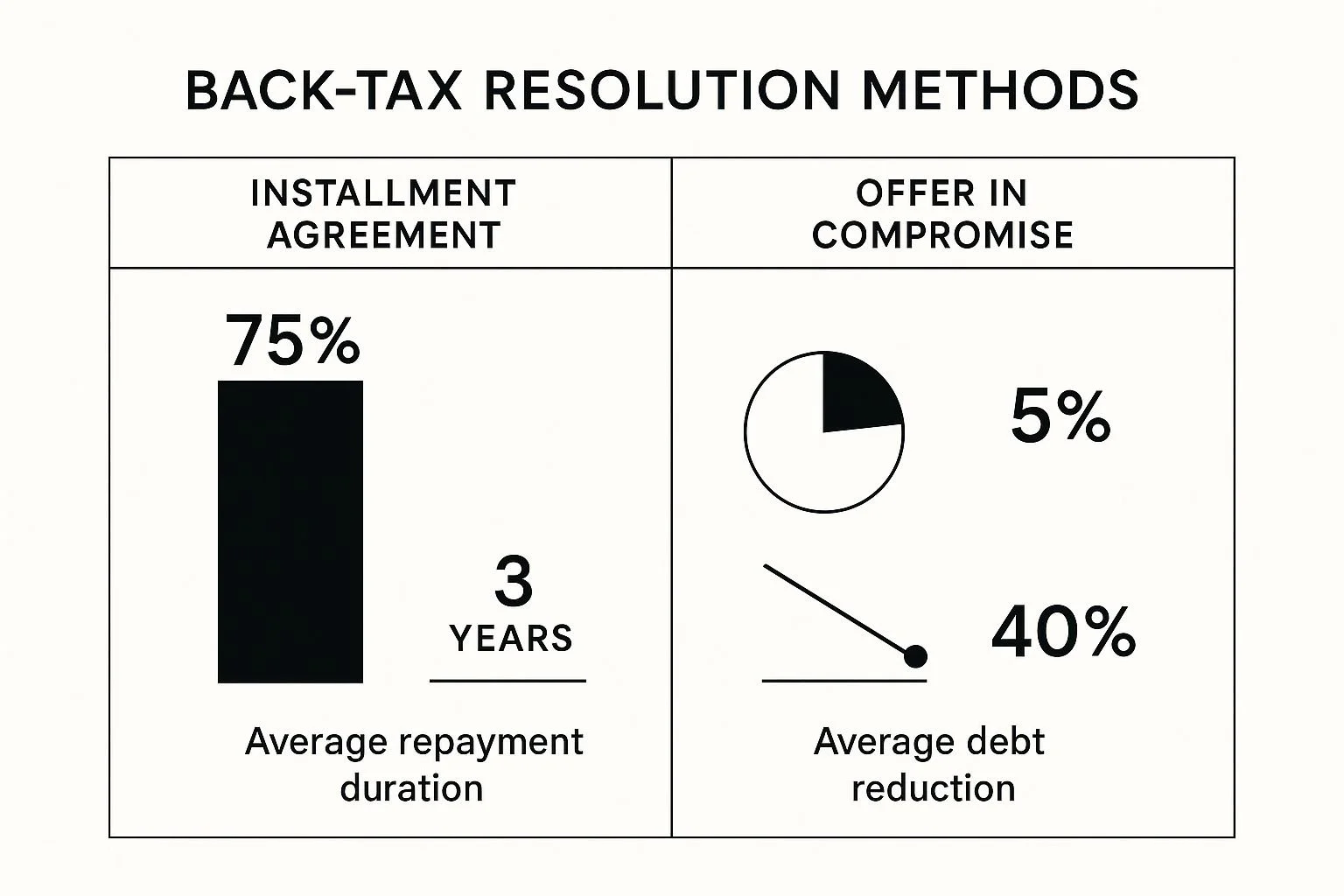
As you can see, Installment Agreements are far more common, but an OIC can be a lifeline for those who truly qualify.
Currently Not Collectible Status
For people in truly dire financial straits, the IRS might place their account in Currently Not Collectible (CNC) status. This isn’t a permanent fix, but it’s a crucial pause button that provides immediate relief. If your income is so low that you can’t even cover basic living expenses, the IRS will stop their collection efforts for a while.
Think of CNC status as putting your account on hold. The tax debt doesn't just vanish—penalties and interest will keep adding up—but the threatening letters and calls will stop. The IRS will, however, periodically check in on your financial situation to see if you're able to start paying again.
Now that we've covered the main options, let's put them side-by-side to make the differences crystal clear.
Comparing IRS Tax Resolution Programs
Choosing the right path depends entirely on your specific financial situation. This table breaks down the three most common programs to help you see which one might be the best fit for you.
| Resolution Program | Best For... | Key Requirement | Potential Outcome |
|---|---|---|---|
| Installment Agreement | Taxpayers who can afford to pay their debt over time with monthly payments. | Having a steady income sufficient to cover payments and living expenses. | Pay the full tax debt, plus interest and penalties, over a period of up to 72 months. |
| Offer in Compromise | Taxpayers facing significant economic hardship who cannot pay their full tax debt. | Proving to the IRS that you lack the income and assets to pay the full amount. | Settle the tax debt for a lower amount than what was originally owed. |
| Currently Not Collectible | Taxpayers with no disposable income after covering essential living expenses. | Demonstrating that paying any amount toward the tax debt would cause economic hardship. | The IRS temporarily pauses all collection activities until your financial situation improves. |
Each of these programs offers a structured way out of tax debt, but they serve very different needs. Your goal is to align your financial reality with the right IRS solution.
Remember, the IRS takes tax obligations seriously. In FY 2024, the Criminal Investigation Division initiated over 2,667 criminal investigations, identified $9.1 billion in tax fraud, and held a 90% conviction rate. These numbers aren't meant to scare you, but to underscore why it's so important to get back on the right side of things through one of these official programs.
Figuring all this out requires a clear-eyed look at your finances and the IRS rulebook. As you explore these options, it can also be helpful to understand the broader world of regulatory compliance solutions to see how your personal tax situation fits into the bigger picture of financial responsibility. Choosing the right path forward is your best bet for protecting your wallet and your peace of mind.
Common Questions About Back Taxes

As you start wrapping your head around a plan to tackle tax debt, a few nagging questions are bound to pop up. Let’s clear the air and address some of the most common concerns people have when they find themselves in this situation.
Think of this as a quick FAQ to help you feel more confident and in control. We'll build on what you've already learned with direct, no-nonsense answers.
Is There a Statute of Limitations on Collecting Back Taxes?
Yes, there is a clock on how long the IRS can chase you for unpaid taxes. Generally, they have 10 years from the date the tax was assessed to collect the debt. This deadline has an official name: the Collection Statute Expiration Date (CSED).
But here's the catch—that 10-year clock isn't always ticking. Certain actions can pause it. For instance, if you file for bankruptcy, submit an Offer in Compromise, or even live outside the country for an extended period, the countdown stops. So, don't make the common mistake of assuming the debt will just magically disappear after a decade; it's a bit more complicated than that.
Can I Go to Jail for Owing Back Taxes?
This is the question that keeps people up at night, and thankfully, the answer is a reassuring one. It is extremely unlikely you'll face jail time just for owing the IRS money. The U.S. tax system draws a very clear line between civil matters and criminal ones.
Jail is reserved for criminal offenses that involve willful intent—things like deliberate tax evasion, knowingly filing a fraudulent return, or making a conscious decision to never file at all. For most people who simply fell behind and couldn't pay, the consequences are financial, not criminal. The IRS would much rather work with you to get paid than pursue jail time.
At its core, the IRS is a collection agency. Its primary goal is to get the money it's owed. They would far prefer to set you up on a payment plan than to initiate a criminal case.
Do Back Taxes Affect My Credit Score?
Not directly, no. The IRS doesn't report your tax debt to the big three credit bureaus (Equifax, Experian, and TransUnion). You won't see it listed as a delinquency on your credit report.
The real impact is indirect. If your debt gets serious enough, the IRS might file a Notice of Federal Tax Lien, which makes your debt a public record.
While tax liens were removed from credit reports back in 2018, lenders still check public records when you apply for a mortgage, car loan, or business financing. Finding a lien could easily cause them to deny your application.
Tax laws are also constantly shifting, which can affect how these issues are treated. For instance, the 2017 Tax Cuts and Jobs Act (TCJA) brought in new international tax rules aimed at curbing tax avoidance, a major source of back tax problems. You can get more details about how the TCJA impacted international taxes on bipartisanpolicy.org.
Working through a back tax issue can feel overwhelming, but you shouldn't have to face it alone. At Attorney Stephen A Weisberg, we focus on finding clear, practical solutions for people and businesses dealing with the IRS. We always start with a FREE Tax Debt Analysis to map out the best strategy before you ever pay a dime. Visit us at weisberg.tax to schedule your free consultation and take the first step toward peace of mind.
Want to understand your options before you call anyone?
Download my free book — Freedom From Tax Debt — a plain-language guide to how the IRS collections process actually works and what resolution really looks like.
➥ Contact Attorney Stephen A. Weisberg for a free Tax Debt Analysis.
Contact Me Here: https://www.weisberg.tax/contact-1
Email: s.weisberg@weisberg.tax
Phone/Text: (248) 971-0885
Address: 300 Galleria Officentre, Suite 402, Southfield, MI 48034
