What Is the Trust Fund Recovery Penalty? Key Facts Explained
The Trust Fund Recovery Penalty (TFRP) is one of the most powerful and personally devastating tools in the IRS’s arsenal. It's a penalty that can make a business's tax problem your personal problem, assessed directly against the individuals who were supposed to handle the company's payroll taxes.
At its core, the TFRP is equal to 100% of the unpaid "trust fund" taxes. These are the income, Social Security, and Medicare taxes you withhold from your employees' paychecks. The penalty essentially transfers the business's tax debt from the company's books straight to the personal assets of owners, officers, or anyone else deemed responsible.
What Happens When Payroll Taxes Go Unpaid

Think of your business as a temporary caretaker for your employees' tax money. The moment you withhold those funds, they no longer belong to the business. They are legally held "in trust" for the U.S. government. That money isn't there to cover payroll, pay suppliers, or bridge a cash flow gap—it has one destination, and one destination only: the U.S. Treasury.
The IRS takes this responsibility very seriously. When a business fails to hand over these trust fund taxes, the TFRP allows the agency to go after the people in charge. This is where it gets personal. The penalty pierces the corporate veil, which means the protections of an LLC or corporation are useless against this specific debt.
For the IRS to impose this penalty, two key elements must be in place:
Responsibility: The person had the power and duty to collect and pay the taxes.
Willfulness: The person knew about the outstanding taxes and deliberately chose not to pay them.
The TFRP was designed to ensure that employers don't use employee tax withholdings as a short-term, interest-free loan. If a company withholds $10,000 in employee taxes but spends that money on rent or inventory, the IRS can come after the responsible person for the full $10,000.
This isn't just a business issue; it's a matter of personal financial survival for anyone with financial authority. Understanding how the TFRP works is absolutely critical to avoiding its life-altering consequences.
Trust Fund Recovery Penalty at a Glance
To quickly break it down, here are the essential components of the TFRP.
| Component | Description |
|---|---|
| Penalty Amount | 100% of the unpaid income, Social Security, and Medicare taxes withheld from employees. |
| Liable Parties | Individuals who are both responsible for collecting/paying taxes and willfully failed to do so. |
| Legal Basis | Internal Revenue Code § 6672. |
| Key Feature | It bypasses corporate liability protections (like an LLC or S-Corp), making individuals personally liable. |
This table shows just how serious the IRS is about collecting these specific taxes. It's a direct line from the business's failure to an individual's personal bank account.
Who the IRS Considers a Responsible Person

When the IRS starts looking for someone to hold accountable for the Trust Fund Recovery Penalty, they don't just glance at the company's org chart. A fancy title on a business card means very little. Instead, they're focused entirely on function and authority—who actually had control over the company's money.
This practical approach casts a surprisingly wide net. Liability can stretch far beyond the CEO or owner, often catching employees and stakeholders who never imagined they could be on the hook for the company's tax debt.
To pin this penalty on you personally, the IRS has to prove two things. First, that you were a "Responsible Person." Second, that your failure to pay the taxes was "willful." Let's dig into what those terms really mean, because the IRS definitions might not be what you expect.
Defining a Responsible Person
So, who is a "responsible person"? In short, it's anyone who had significant control over the company's finances and could decide which bills got paid and which didn't. This isn't about your title; it's about your status, duty, and authority within the business. The IRS will investigate who was in a position to direct financial payments, regardless of whether they were an official officer of the company.
The IRS revenue officers build their case by looking for people who:
Were an officer, director, or a major shareholder.
Had the authority to sign company checks or tell the bookkeeper who to pay.
Controlled the company’s bank accounts.
Were in charge of filing the business’s tax returns, especially the crucial Form 941.
Had the power to hire and fire employees or manage the payroll process.
Think about it this way: a hands-on office manager with check-signing authority could easily be deemed a responsible person. On the other hand, a CEO who completely delegated all financial matters might be able to argue they weren't. It all boils down to who had the real-world power to get those taxes paid.
An individual is considered responsible if they had the effective power to pay the taxes. This means that if a person had the ability to sign checks, they cannot escape liability by claiming they were just following the orders of a superior.
Understanding the Willfulness Factor
Finding a "responsible person" is only half the battle for the IRS. They also have to prove the failure to pay was willful. This is a critical point.
"Willfulness" doesn't mean you had some evil plan to defraud the government. It’s a much lower bar. In the eyes of the IRS, willfulness simply means a responsible person knew the payroll taxes were due but consciously chose to pay other creditors instead.
This could be a deliberate choice to cover rent, pay off a supplier, or even just make sure employees got their net paychecks, all while knowing the IRS was being ignored.
It can also mean acting with "reckless disregard"—basically, sticking your head in the sand. If you saw clear warning signs of financial trouble but failed to find out if the taxes were being paid, that's often enough for the IRS to consider your actions willful.
If you knew—or should have known—the taxes weren't being paid, you're likely to be found personally liable for the full amount.
How the IRS Calculates the TFRP Assessment

It's absolutely critical to understand how the IRS lands on the final penalty amount, because the number can be truly staggering. The calculation itself isn't wildly complicated, but its impact is severe. The IRS laser-focuses its attention on one specific piece of your payroll tax bill—the "trust fund" portion.
This part is made up only of the money you withheld from your employees' paychecks. It’s not about the business's total tax obligation. The IRS is specifically looking at:
Employee's Federal Income Tax Withholding: The money you set aside from each paycheck for your employee's personal federal income taxes.
Employee's Share of FICA Taxes: This is their half of the Social Security and Medicare contributions.
Here’s the key takeaway: the employer's matching share of FICA taxes is completely excluded from the TFRP calculation. While this distinction does bring the personal assessment down slightly, don't get too comfortable. The penalty itself remains a brutal 100% match of whatever trust funds went unremitted.
A Practical Example of TFRP Calculation
Let's walk through a real-world scenario to see how this plays out. Imagine a small business, "Innovate Solutions Inc.," has fallen behind and now has a total quarterly payroll tax delinquency of $20,000.
Now, not all of that $20,000 is considered trust fund money. A typical breakdown would look something like this:
Employee Withholdings (The Trust Fund Part):
Federal Income Tax: $7,000
Employee's FICA Share: $5,000
Total Trust Fund Portion: $12,000
Employer Contributions (The Non-Trust Fund Part):
Employer's FICA Share: $5,000
Federal Unemployment (FUTA) Taxes: $3,000
Total Employer Portion: $8,000
In this situation, the IRS would assess a Trust Fund Recovery Penalty of $12,000. They arrive at this number by taking 100% of the unpaid trust fund taxes and completely ignoring the $8,000 the business owed for its own share. The person deemed "responsible" is now on the hook, personally, for that $12,000.
Other Penalties That Compound the Debt
As if the TFRP wasn't bad enough, it’s just one piece of the financial puzzle. The original business debt doesn't just vanish. The IRS stacks on other penalties that can make the total amount owed spiral out of control.
The calculation of the Trust Fund Recovery Penalty is notably precise, focusing only on the money held in trust. If an employee earns $1,000 and has $176.50 withheld for taxes, the TFRP for failing to remit that amount is exactly $176.50. This is compounded by other fees, like failure-to-deposit penalties, which can range from 2% to 10% of the total amount due. Find more insights on how these penalties are calculated on damienslaw.com.
These extras, like interest and late-filing fees, are piled on top of the business's original tax liability. What you end up with is a financial battle on two fronts: the company faces a rapidly growing debt, while the responsible individual stares down a life-altering personal assessment. This really drives home how severe the consequences are and why a deep understanding of what is the trust fund recovery penalty is so essential.
Navigating an IRS Investigation and Collection
The road to a Trust Fund Recovery Penalty doesn't just appear out of nowhere. It starts the minute a business skips a federal tax deposit or fails to file its quarterly Form 941. That missed deadline is a major red flag for the IRS, often sparking an investigation headed by a Revenue Officer.
Their one and only mission? To pinpoint exactly who was calling the shots with the company's money when the payroll taxes weren't paid. This isn't about job titles on a business card; it’s a deep dive into who really had control.
The Investigation Process
To figure out who fits the bill as a "Responsible Person," the Revenue Officer will start digging. They conduct formal interviews, and they have a specific playbook for this: Form 4180, Report of Interview with Individual Relative to Trust Fund Recovery Penalty or Personal Liability for Excise Taxes. Think of it as a detailed questionnaire designed to uncover the financial power structure of the business.
They’ll want to see everything—bank statements, signature cards, canceled checks, and board meeting minutes. They're looking for evidence of who had the authority to sign checks and, more importantly, who was actively paying other bills while ignoring the company's tax obligations to the IRS.
The IRS is relentless in pursuing this penalty because, from their perspective, the government's money was stolen. A report from the Treasury Inspector General for Tax Administration backs this up, confirming the TFRP is only imposed after a thorough investigation proves someone knowingly and willfully failed to remit the withheld taxes. It's a serious, structured process. You can dig into the specifics of that report on the TIGTA website.
The infographic below gives you a bird's-eye view of how this all unfolds, from the first sign of trouble to the final collection efforts.
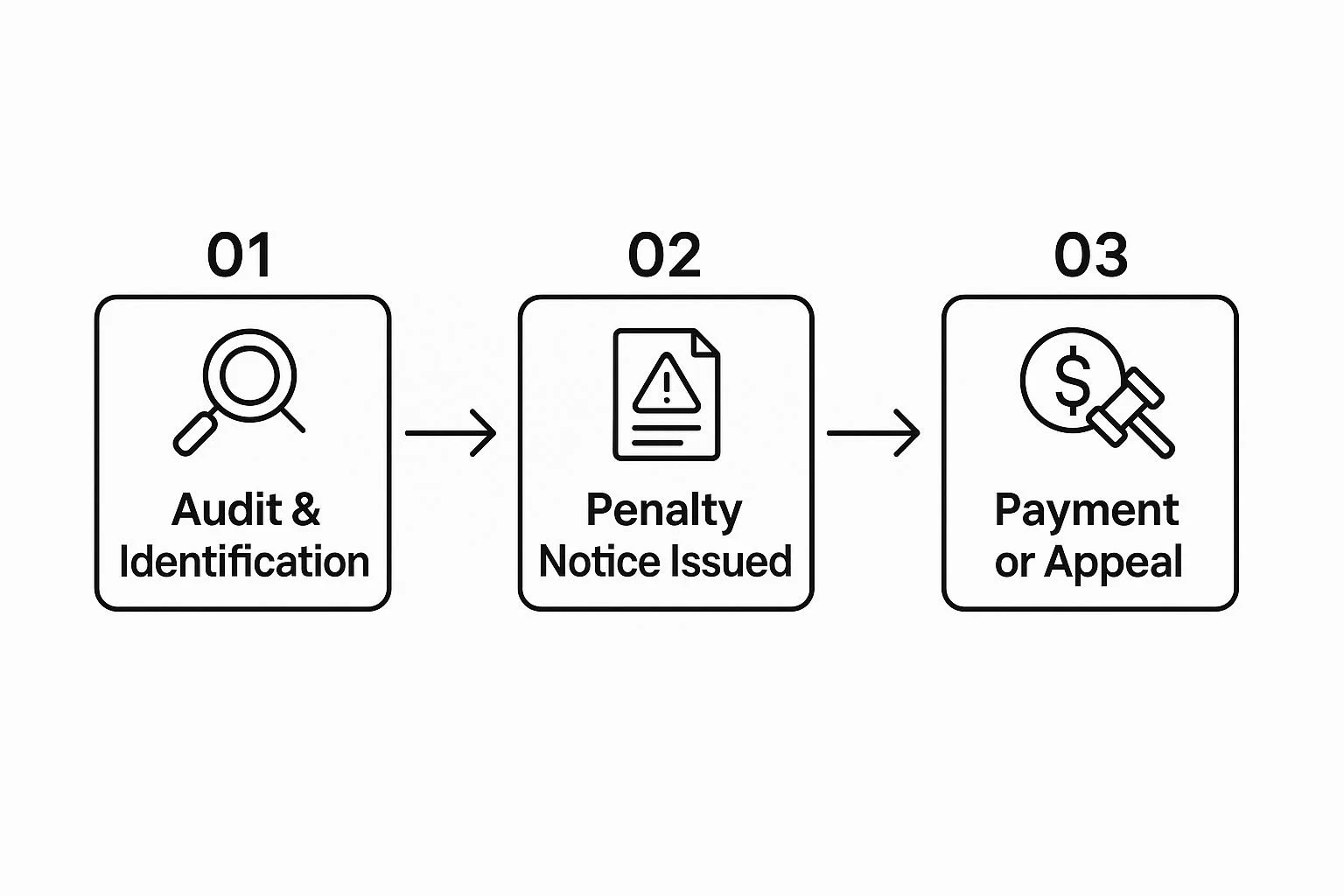
As you can see, the investigation isn't a surprise attack. It's a methodical process that gives you specific points along the way to respond before the hammer comes down.
Receiving the Proposed Assessment
Once the Revenue Officer has a name (or names), the process moves into a critical new phase. You'll receive Letter 1153 in the mail. This document is the IRS officially proposing to assess the TFRP against you personally. It’s not a bill yet—it’s your formal invitation to fight.
You are typically given 60 days from the date printed on Letter 1153 to formally appeal the proposed penalty. Missing this deadline is a disaster. It essentially gives the IRS the green light to assess the penalty, and your options for fighting it shrink dramatically.
If you’ve been targeted unfairly, this 60-day window is your golden opportunity to take your case to the IRS Appeals Office and make your argument.
If you don't appeal, or if your appeal doesn't succeed, the IRS will officially assess the penalty. At that moment, the debt is no longer a proposal; it's a legally enforceable liability tied to you personally. The IRS can then unleash its powerful collection arsenal against your personal assets. This includes:
Federal Tax Liens: A public legal claim against all your personal property, clouding the title to your home, cars, and other assets.
Bank Levies: The IRS can reach directly into your personal checking and savings accounts and take the funds.
Wage Garnishments: They can order your employer to send a chunk of your paycheck directly to them before you ever see it.
This is why understanding what the trust fund recovery penalty is and acting fast when you get that first notice is so incredibly important. Your entire financial future could be on the line.
How to Build a Defense Against the TFRP
Getting an IRS Letter 1153 in the mail is a stomach-dropping moment. It's the official notice that the IRS intends to assess the Trust Fund Recovery Penalty against you personally. But it's not a final judgment—it’s the starting bell for you to build your defense.
A successful defense comes down to a simple strategy: proving the IRS is wrong about one of two things. To hold you liable, they must prove you were both a “Responsible Person” and that your failure to pay was “willful.” If you can knock down just one of those pillars, their case against you crumbles.
Arguing You Were Not a Responsible Person
The most straightforward defense is to demonstrate you simply didn't have the kind of authority the IRS thinks you did. This has nothing to do with your job title on a business card and everything to do with your actual, day-to-day role in the company.
Your mission is to prove you were not in a position to make the final call on financial matters, especially on which bills got paid. Evidence is everything here. You can build a compelling case by showing that you:
Couldn't sign checks: If you weren't an authorized signatory on the company bank accounts, that’s a powerful piece of evidence.
Were cut out of financial decisions: Can you prove you had no influence over which creditors were paid? A sales manager, for example, is focused on bringing money in, not deciding how it's spent.
Were simply following orders: This one is a tougher hill to climb, but if you were a lower-level employee acting under the direct and explicit orders of a superior, you may be able to argue you had no real power to do otherwise.
Think of it this way: if you couldn't have physically written and signed the check to the IRS, you have a strong argument that you weren’t a responsible person.
Proving Your Actions Were Not Willful
Okay, what if the IRS can successfully argue you were a responsible person? Your next move is to attack the second pillar: willfulness. Remember, the IRS definition of “willful” isn't about being malicious. It simply means you knew the taxes were due and intentionally chose to pay other creditors instead.
To fight this, you need to show you had reasonable cause for your actions and weren't just recklessly ignoring your duties. This is a narrow defense, but it can work. For example, did you rely on advice from a qualified tax professional who steered you wrong? That could potentially be a defense.
Ultimately, the clock starts ticking the moment you receive Letter 1153. You have a 60-day window to appeal, and this is your best—and most critical—chance to present your evidence to the IRS Appeals Office before the penalty becomes a finalized debt.
Proactive Strategies to Prevent TFRP Liability
When it comes to the Trust Fund Recovery Penalty, the old saying is true: an ounce of prevention is worth a pound of cure. The absolute best way to deal with the TFRP is to make sure it never gets assessed in the first place.
This means shifting your mindset from defense to prevention. It’s about building a fortress around your business—and more importantly, your personal assets—to protect them from this incredibly aggressive penalty.
It all starts with one simple, non-negotiable rule: never, ever treat withheld payroll taxes as a short-term business loan. When cash gets tight, it's tempting to "borrow" from those funds to pay a critical supplier or cover next week's payroll. This is the single most common mistake that leads directly to a TFRP assessment. Remember, the moment you withhold that money from an employee's check, it belongs to the government. It's not your money to use, even temporarily.
Establish Clear Financial Protocols
Think of it as building your defense before you ever need one. Putting clear, consistent financial processes in place is your first and best line of defense against future IRS scrutiny. Meticulous records and a rigid adherence to tax deadlines aren't just good business practices; they are your shield.
Here are a few fundamental strategies to put into action:
Use a Reputable Payroll Service: Outsourcing your payroll to a trusted provider is one of the smartest moves you can make. They handle the complex calculations, deposits, and filings, which dramatically reduces the chance of an accidental error. It also creates a clean paper trail proving your compliance.
Maintain Scrupulous Records: Keep detailed documentation of everything—payroll ledgers, tax payment confirmations, and any key financial decisions. If the IRS ever questions your actions, this documentation becomes invaluable evidence that you acted responsibly and in good faith.
Define Responsibilities Clearly: If you hand off payroll duties to an employee or bookkeeper, make sure they are competent and trustworthy. But remember, delegating the task doesn't delegate the ultimate responsibility. You must maintain oversight and personally verify that tax deposits are being made correctly and on time.
A fantastic tool for this is the Electronic Federal Tax Payment System (EFTPS). It’s a free service from the U.S. Department of the Treasury that allows you to log in and personally confirm that federal tax deposits have been made. Even if you use a payroll company, you can—and should—use EFTPS to keep an eye on things.
Ultimately, grasping the seriousness of these tax obligations is what separates responsible business owners from those who find themselves in hot water.
By putting these simple strategies into practice, you’re not just managing your business finances—you're building a firewall between your company's potential tax problems and your personal wealth.
Got Questions About the Trust Fund Recovery Penalty? We’ve Got Answers.
When you’re staring down a Trust Fund Recovery Penalty, a lot of questions start swirling. It’s a complicated and stressful situation, so let's cut through the noise and get straight to what you really need to know.
Can the IRS come after both my business and me personally?
Yes, they absolutely can. The IRS can try to collect the unpaid trust fund taxes from the business itself and from any individuals they’ve slapped with the TFRP. But don't panic—this doesn't mean they get to double-dip.
Think of it as the IRS opening up two collection fronts. They can only collect the total amount of the missing tax once. Every dollar the business pays toward the debt reduces what you owe personally, and any payment you make chips away at the business's liability. It’s simply the government’s way of giving itself the best possible chance of getting the money back.
Will filing for bankruptcy make the TFRP go away?
It’s the question on everyone’s mind, but unfortunately, bankruptcy is rarely a get-out-of-jail-free card for this kind of debt. The Trust Fund Recovery Penalty is almost always considered non-dischargeable in bankruptcy.
Because these are trust fund taxes—money you held on behalf of your employees for the government—federal law gives this debt a special, protected status. It can't just be wiped away in a Chapter 7 or Chapter 13 filing. That means the debt will stick with you, even after the bankruptcy process is over.
Is there a time limit for the IRS to assess the TFRP?
Thankfully, the IRS doesn't have forever to act. The agency generally has a three-year window to assess the Trust Fund Recovery Penalty against a responsible person.
This three-year countdown starts on the day the payroll tax return in question (usually a Form 941) was filed. Once that window closes, they've missed their chance.
If you've received a notice about a proposed TFRP assessment or you're worried about your liability, the worst thing you can do is wait. At Attorney Stephen A Weisberg, I offer a FREE Tax Debt Analysis to break down your situation and lay out your options, with no strings attached. Let's work to protect your personal assets. Get the expert guidance you need today at weisberg.tax.
Facing payroll tax debt right now?
Download my free checklist — Behind on Payroll Taxes? What to Do in the Next 48 Hours — and understand exactly what to do before your situation gets any worse.
➥ Contact Attorney Stephen A. Weisberg for a free Tax Debt Analysis.
Contact Me Here: https://www.weisberg.tax/contact-1
Email: s.weisberg@weisberg.tax
Phone/Text: (248) 971-0885
Address: 300 Galleria Officentre, Suite 402, Southfield, MI 48034
