Getting that official-looking envelope from the IRS in the mail is enough to make anyone's heart skip a beat. But here's the thing: an IRS audit isn't an automatic accusation of wrongdoing. It's simply a review of your financial accounts and information to make sure everything lines up with the tax laws.
The process can take a few different forms—some happen through the mail, others at an IRS office, or even at your home or place of business. In the end, it all wraps up in one of three ways: a no-change letter (the best-case scenario), an agreed-upon adjustment to what you owe, or a disagreement, which can lead to an appeal.
Your Roadmap to the IRS Audit Lifecycle
When most people hear "IRS audit," they picture a tense, face-to-face interrogation. The reality is usually far less dramatic. At its core, an audit is just a structured verification process. Each year, the IRS flags a tiny percentage of tax returns to double-check that the reported income, deductions, and credits are all accurate and above board.
Think of it as a quality control check for our country's tax system. It always starts with an official letter—never a surprise phone call or email—letting you know your return was selected. That letter is the first step on a journey that can branch off in a few different directions, depending on how complex your tax situation is.
The Three Paths of an Audit
What actually happens during your audit depends entirely on which type you're facing. The IRS has three main ways of conducting these reviews, each with a different level of intensity.
Correspondence Audit: This is the most common and least intimidating type. It's all handled through the mail and usually focuses on one or two simple issues, like asking for proof of a specific deduction or verifying income from a W-2.
Office Audit: This one requires you to visit a local IRS office. The scope is a bit wider than a mail audit and might cover several related items on your return, like a deep dive into your claimed business expenses or itemized deductions.
Field Audit: This is the most comprehensive and rarest audit. An IRS agent will actually come to your home, business, or accountant's office. These are typically reserved for the most complex individual or business returns.
The infographic below gives you a bird's-eye view of the typical process, from that first notice to the final outcome.
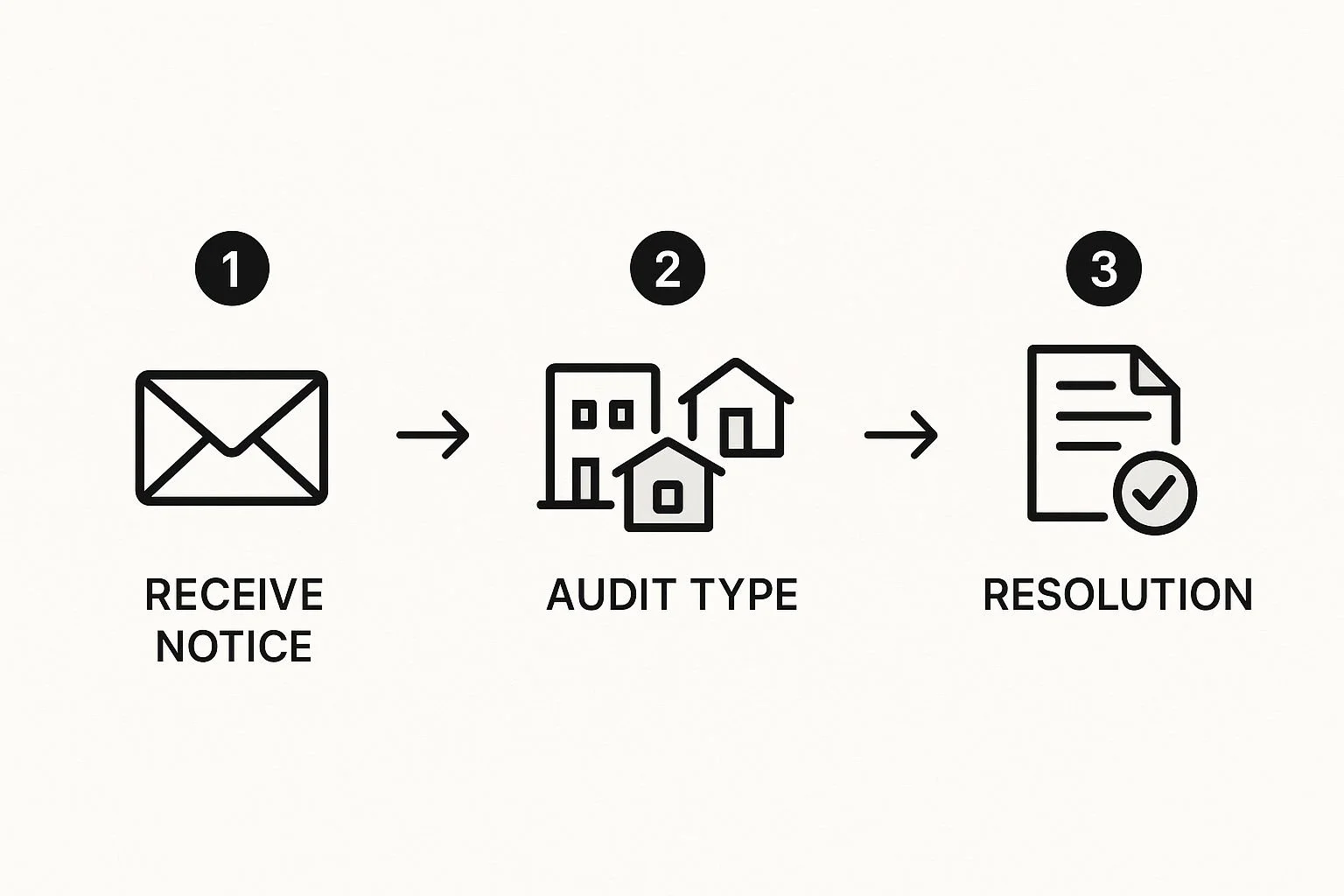
As you can see, every audit follows a predictable pattern: notification, examination, and conclusion.
To help you get a clearer picture of the road ahead, here’s a quick summary of the key stages and what they entail.
The IRS Audit Journey at a Glance
| Audit Stage | What Happens During This Stage | Your Primary Role |
|---|---|---|
| Notification | The IRS sends an official letter (never an email or phone call) to inform you that your tax return is being audited. | Carefully read the notice, note the deadlines, and begin gathering the requested documents. Do not ignore it. |
| Document Request | The auditor will ask for specific records to support items on your return, like receipts, bank statements, or mileage logs. | Provide clear, organized, and complete documentation. Only send what is specifically asked for. |
| Examination | The IRS agent reviews your documents and may ask follow-up questions to understand your financial situation. | Answer questions truthfully and concisely. A tax professional can handle communication on your behalf. |
| Conclusion | The auditor issues a report with their findings. This can result in no change, an agreed-upon change, or a proposed change you disagree with. | Review the findings. If you agree, you'll sign the report and pay any additional tax. If not, you can appeal. |
Understanding this journey—from that first letter to the final report—is the key to getting through it without unnecessary stress.
No matter which type of audit you have, the objective is always the same: to close the gap between the tax you reported and the tax the IRS believes you owe. Your job is to provide the organized documentation that backs up your numbers.
Knowing this framework is the first step to navigating the process with confidence. Each audit path has its own procedures and level of scrutiny. Figuring out which one you’re on helps you prepare the right documents, anticipate the questions you'll be asked, and turn what feels like a crisis into a manageable financial task. This guide will walk you through every step.
Understanding Common IRS Audit Triggers

The first question that usually pops into someone's head after getting an audit notice is, "Why me?" It’s a natural reaction, but it's important to know that most audits aren't random. While a tiny fraction of returns are picked out of a hat, the vast majority are selected for very specific reasons.
The IRS uses a powerful computer system as its first line of defense. This program scans your tax return and gives it what's called a Discriminant Information Function (DIF) score. Think of it as a financial outlier detector. The higher the score, the more your return stands out from the statistical norm for people in a similar financial situation, which increases the odds it gets a closer look from a human agent.
What Raises a Red Flag?
So, what causes a high DIF score? It usually comes down to specific items on your return that just don't look right to the system. Understanding these common triggers isn't just about figuring out why you're being audited now; it's about helping you prepare your future returns more carefully. Most of the time, the flags are tied to deductions or expenses that seem way out of proportion to your reported income.
For instance, imagine a freelance writer who earns $60,000 a year but claims $40,000 in business expenses. The expenses might be completely legitimate, but that high ratio is a classic trigger that makes the IRS want to verify the numbers.
Here are a few of the most common things that can get a return flagged:
Unusually Large Deductions: Claiming charitable contributions or business expenses that are significantly higher than the average for your income bracket is a classic red flag.
Forgetting to Report Income: The IRS gets copies of all your 1099s and W-2s. If the income you report doesn't match what they've been told you earned, their automated system will catch the discrepancy almost instantly.
Claiming 100% Business Use of a Vehicle: This is a tough one to prove. The IRS knows it’s rare for a vehicle to be used exclusively for business without a single personal trip, so this claim often gets a second look.
Excessive Meal or Travel Expenses: Large deductions for business meals, entertainment, and travel can signal that personal expenses might be getting mixed in with legitimate business ones.
Knowing how to spot potential risks is a key part of smart financial management. If you’re a business owner, it’s wise to implement a robust business risk management framework to cover all your bases, including tax compliance.
The Current Focus on High Earners
The IRS also shifts its audit priorities over time. Right now, there's a major focus on high-income individuals and large corporations, while audit rates for the average taxpayer have actually been going down. For example, audit rates for people with incomes over $10 million are expected to climb from 11% in 2019 to 16.5% by 2026.
Big companies are under even more scrutiny. For corporations with assets over $250 million, audit rates are projected to skyrocket from 8.8% in 2019 to 22.6% by 2026. On the other hand, the IRS has stated that taxpayers earning under $400,000 shouldn't see an increase in their audit risk.
At its heart, the reason for an audit is simple: the IRS thinks it might be able to collect more tax from you. The entire DIF system is built to pinpoint returns with the highest probability of errors that would result in more money owed.
Ultimately, understanding the audit process starts with understanding why it began in the first place. By being aware of these common red flags, you can take steps to make sure your tax returns are accurate, well-documented, and less likely to stand out for the wrong reasons.
The Three Types of Audits: Mail, Office, and Field

Not all audits are created equal. When most people hear "IRS audit," they picture agents camped out at their kitchen table, sifting through shoeboxes of receipts. The reality is, that scenario is pretty rare. The IRS actually has a few different ways of examining a tax return, and the one you face depends entirely on the complexity of your situation.
Figuring out which type of audit you're dealing with is your first crucial step. Each one comes with its own scope, intensity, and rules of engagement. Your initial letter from the IRS is your roadmap—it will clearly state how the examination is going to be handled.
Correspondence Audits: Handled by Mail
The correspondence audit, often called a mail audit, is the most common by a long shot. In fact, more than 70% of all IRS audits are handled this way. It's best to think of it as the IRS having a specific, targeted question about your tax return and just asking for a little more information.
These audits are conducted entirely through the mail. They’re laser-focused on just one or two items, so the IRS isn't digging into your entire financial life.
Common triggers for a mail audit include:
Itemized deductions: They might ask for receipts to back up your charitable giving or proof of significant medical expenses.
Income verification: The IRS computer may have spotted a mismatch between the income you reported and the W-2s or 1099s on file.
Tax credits: You might be asked to prove you qualify for something like the Earned Income Tax Credit or an education credit.
Because they are so specific, these are often the easiest audits to resolve. Sending clear, organized copies of exactly what they asked for is usually all it takes to close the case.
Office Audits: At an IRS Location
An office audit is a definite step up in complexity. Just like the name suggests, this audit requires you to physically go to a local IRS office and meet an auditor in person. While it’s still more targeted than a full-blown field audit, the scope is much broader than a simple mail inquiry.
An office audit is usually reserved for issues that are too complex to sort out through a letter but don't quite justify a full-scale investigation at your home or business. A common example is a deeper dive into a small business's income and expense records.
During the meeting, the auditor will ask you questions about the items under review and go through the supporting documents you’ve brought with you.
The key to an office audit is preparation. Gather every relevant record ahead of time and be ready to explain your finances clearly. Remember, you have the right to bring representation with you, like a tax attorney or CPA.
Field Audits: The Most In-Depth Review
The field audit is the most comprehensive and serious type of IRS audit. This is the one that lines up with the popular imagination—an IRS agent comes to your home, your place of business, or your accountant's office. These are reserved for the most complex returns, typically involving large businesses or individuals with intricate financial dealings.
Unlike the other two, a field audit is a wide-ranging examination of your entire financial picture. The agent will likely review multiple years of tax returns and dig into everything from your business's accounting ledgers to your personal bank statements to make sure it all adds up.
Because of their depth and the significant amount of money often at stake, having professional representation during a field audit is not just a good idea—it's essential. An experienced tax pro can manage all communication with the agent, protect your rights, and help present your information in the best possible light.
Comparing the Three Types of IRS Audits
To make it easier to see the differences at a glance, here’s a quick breakdown of the three main types of audits you might encounter. Each has a distinct approach and level of scrutiny.
| Audit Type | Where It Happens | Typical Scope | Commonly Examined Issues |
|---|---|---|---|
| Correspondence Audit | Through the mail | Very narrow; usually 1-2 specific items | Simple deductions, income mismatches (W-2/1099), tax credits |
| Office Audit | At a local IRS office | Broader than a mail audit; focuses on specific, more complex areas | Small business income/expenses, rental properties, detailed deductions |
| Field Audit | Your home, business, or accountant's office | Comprehensive; a full review of your financial records, often for multiple years | Complex business returns, high-net-worth individuals, suspected fraud |
Understanding where your audit falls on this spectrum helps you gauge its seriousness and map out your next steps. While a mail audit might be a simple matter of paperwork, a field audit demands a much more robust and strategic defense.
What to Expect During the IRS Examination
Alright, you've received the notice and you know what kind of audit you're up against. Now comes the main event: the examination itself. This is where an IRS agent digs into your records to make sure everything on your tax return checks out. Think of it less like an interrogation and more like an open-book test where your records are the textbook.
How you navigate this phase is critical. The key is to be organized, professional, and precise. Freaking out or getting emotional won't help; sticking to the facts and having your documents in order will.
Your only job here is to prove what you filed is accurate. You’re not trying to make a new friend or explain your life story—you’re just there to back up your return with solid proof.
Getting Your Documents Ready for Review
Here’s the single most important rule when you’re pulling records together: only provide what the IRS specifically asks for. Your audit notice will come with an Information Document Request (IDR), which is just a formal list of what the agent needs to see. Do not, under any circumstances, volunteer extra documents or information for other tax years.
Why is this so crucial? Giving the auditor more than they requested can be like handing them a map to find new problems. If they spot something questionable in a document you weren't even asked for, it can send the audit spiraling in a whole new direction.
Here’s a simple game plan for preparing your documents:
Make a Checklist: Treat the IDR from the IRS as your guide. Create your own checklist from it and tick off each item as you gather it.
Get Organized: Don’t just dump everything in a box. Sort your records logically, either by date or by category (like income, travel expenses, or charitable gifts). Use labeled folders so you can pull any specific document in seconds.
Copy Everything: Never, ever hand over your original documents. Give the agent clean, high-quality copies and keep your originals somewhere safe.
This level of organization does more than just keep you sane. It sends a clear signal to the auditor that you're cooperative and taking the process seriously, which can really help set a positive, professional tone.
How to Talk to the Auditor
During an office or field audit, you'll be speaking directly with the auditor. Your communication style is huge here. The goal is to be clear, truthful, and concise, without rambling or offering up information they didn't ask for.
The best approach is to act like a witness on the stand. Listen carefully to the question, take a beat to think, and then answer only what was asked. Nothing more.
For instance, if the auditor asks, "Can you explain this large deduction for office supplies?" a great answer is, "Yes, that was for a new computer system and a bulk order of materials. I have the receipts right here." A terrible answer would be to start talking about how slow your old computer was and how you're already thinking about upgrading again. All those extra details are irrelevant and just invite more questions.
The Golden Rule of Audit Communication: Answer the question you were asked, not the one you think they wanted to ask. Be polite, be professional, and keep it brief.
And if you don't know the answer? It’s completely fine to say, "I'm not sure right now, but I can find that information and get back to you." That’s a thousand times better than guessing and giving them wrong information. Honestly, this is why having a tax pro handle the communication is often the smartest move—they’re experts at managing this delicate dance.
Answering Questions About Your Finances
Auditors are trained to ask questions that build a complete financial picture to see if it matches what you reported. They might ask about your income sources, big-ticket purchases, or even your general lifestyle. It’s not about being nosy; they're trying to spot unreported income or deductions that don't have the proof to back them up.
Get ready for questions like:
"How do you typically deposit your business income?"
"Did you buy any major assets this year, like a vehicle or real estate?"
"Can you tell me where the funds in this particular bank account came from?"
This is all part of what's sometimes called a "financial status audit." The agent is basically trying to see if your lifestyle makes sense given your reported income. If you claimed $50,000 in income but somehow paid cash for a $100,000 boat, you can bet they'll want to know where that extra $50,000 came from. This is where having clear records for things like loans, gifts from family, or withdrawals from savings becomes absolutely essential.
Understanding Your Audit Outcome and Next Steps

After all the back-and-forth—the document submissions, interviews, and follow-up questions—the IRS audit finally starts winding down. This is the point where the examiner lays their cards on the table, presenting their findings in a formal report. What this report says is everything, as it determines what you need to do next.
Ultimately, every IRS audit ends in one of three ways. Each outcome demands a different response, so understanding the possibilities ahead of time helps you keep a clear head and make the right decision.
The Best Case Scenario: No Change
Let's start with the best possible result: a "no change" determination. This is exactly what it sounds like. After digging through all your records, the auditor concluded that your tax return was accurate as filed. You'll get a letter confirming this, and that’s it.
When you receive that no-change letter, the audit is officially over. You owe no extra tax, no penalties, and no interest. Just file that letter away with your tax records for the year and breathe a huge sigh of relief. You’re done.
When You Agree with the Audit Findings
The most frequent outcome is what’s known as an "agreed" case. This means the auditor found issues and is proposing adjustments to your return. These changes almost always result in more tax being owed. The examiner’s report will break down every proposed change, along with the corresponding penalties and interest.
If you look over the report and the findings seem fair, the process is pretty simple. You'll sign the report to formally accept the changes. Soon after, the IRS will send you a bill for the total amount due. If you can't pay it all at once, don't panic. You have options, like setting up an installment agreement to pay it off over time.
The IRS audit process is a major enforcement tool. In a recent fiscal year, the agency closed over 500,000 audits, which led to recommendations for more than $29 billion in additional taxes. These numbers show just how common it is for an audit to result in a change. You can discover more about IRS compliance data directly from the source.
When You Disagree with the Audit Findings
The third path is a "disagreed" case. This is your reality if you review the auditor's proposed changes and simply don't accept them. If you're confident the examiner got the facts wrong or misinterpreted tax law, you absolutely do not have to sign that report. This is where you exercise your right to challenge the IRS.
Your first move is usually to request a meeting with the auditor's manager. Sometimes, a fresh perspective is all it takes to resolve the disagreement. If that conversation goes nowhere and you still can't find common ground, you can file a formal appeal.
The appeals process takes your case to an independent division within the IRS. Your dispute will be heard by an appeals officer who had nothing to do with the original audit, ensuring a more impartial review. This is a critical stage where having a tax professional on your side can be invaluable. It's also worth knowing that options can exist even after an audit is closed; you can learn more about the process of IRS audit reconsideration in our detailed guide.
Knowing Your Rights as a Taxpayer
Getting that audit notice from the IRS can make your stomach drop. It’s easy to feel like you’re on the defensive from the very start, but you’re not powerless in this situation. Far from it.
The IRS operates under a strict set of rules called the Taxpayer Bill of Rights. These aren’t just friendly suggestions—they are fundamental guarantees that level the playing field and ensure you are treated fairly through every step of the audit. Think of these rights as your shield. Understanding them is the first step to confidently navigating the process.
The Right to Be Informed and Receive Quality Service
You should never feel like you're in the dark. The IRS has an obligation to tell you exactly what they're doing and why. The auditor must clearly explain the audit process, any decisions they make, and what your options are if you disagree.
On top of that, you are entitled to prompt, courteous, and professional assistance from every IRS employee you deal with. If you ever feel you're not getting that, you absolutely have the right to ask to speak with their supervisor.
Your Financial and Legal Protections
At the heart of your rights are some critical protections for your wallet and your ability to get help. These are the ones you really need to internalize.
The Right to Pay No More Than the Correct Amount of Tax: This is a big one. The IRS’s job isn't to squeeze as much money out of you as possible. Their mission is to collect the correct amount of tax required by law, and not a penny more. You have the right to pay only what you legally owe.
The Right to Challenge the IRS's Position and Be Heard: If you disagree with the auditor’s conclusions, you don’t have to just accept them. You have the absolute right to object, provide more documents, and make your case. If you still can’t find common ground, this right extends to a formal appeal with an independent office inside the IRS.
The Right to Retain Representation: This might be the most powerful right you have. You do not have to face an IRS auditor alone. You can hire an authorized professional—like a tax attorney, CPA, or Enrolled Agent—to represent you. They can handle all the communication with the auditor for you.
Retaining representation changes the dynamic of an audit. An experienced tax professional acts as your advocate, ensuring your rights are protected and that you are only providing the necessary information, which is a key part of learning how to effectively fight the IRS.
Understanding Time Limits and Responsibilities
Of course, with rights come responsibilities. You're expected to provide accurate information and pay your taxes on time. It's also crucial to understand the statute of limitations, which is the legal window the IRS has to audit your tax returns.
Generally, the IRS gets three years from the date you file your return to start an audit. But be aware: that window extends to six years if you've substantially understated your gross income (by more than 25%). And if the IRS suspects fraud? There’s no time limit at all.
This is exactly why keeping meticulous records for at least three to six years after filing is so important. Knowing your rights, meeting your responsibilities, and having your documents in order are the best tools you have for getting through an audit smoothly.
Common Questions About IRS Audits
Getting that audit notice from the IRS can send a wave of specific questions and worries through anyone's mind. Let's tackle some of the most common ones head-on to give you a clearer picture of what to expect and how to handle the practical side of the process.
How Far Back Can the IRS Audit My Tax Returns?
This is probably the first question everyone asks. Generally, the IRS has a three-year window to audit you, starting from the date you filed your tax return. Think of this as the standard statute of limitations.
But that timeline can stretch. If the IRS suspects you've underreported your gross income by a significant amount—more than 25% to be exact—they can look back six years. And in the most serious cases, like when fraud is suspected or if you never filed a return at all, there’s no time limit. They can go back as far as they need to.
What Should I Do if I Can't Find All My Receipts?
Don't panic. Missing a receipt here or there isn't the end of the world, but you can't just ignore the issue. Your job is to reconstruct the proof of that expense as best you can.
Get creative and start digging for secondary evidence:
Bank or credit card statements are your best friends here, as they show the date, vendor, and amount.
Cancelled checks are also solid proof of payment.
Search your inbox for digital records, like email confirmations or invoices from vendors.
While the original paper receipt is always the gold standard, the IRS is often willing to accept this kind of secondary proof, as long as it clearly and credibly supports your claim.
The most important thing is to show a good-faith effort to prove your expenses. A well-organized set of bank statements is far better than showing up with nothing and just hoping for the best.
Should I Handle an IRS Audit Myself or Hire a Professional?
You absolutely have the right to represent yourself, and sometimes it makes sense. If you're facing a simple correspondence audit about one specific, well-documented item, you might feel perfectly comfortable handling it on your own.
However, the moment things get more complicated—like an in-person office or field audit—or if the amount of tax money on the line is significant, calling in a professional is almost always the right move.
An experienced tax pro acts as a buffer between you and the auditor. They know how to protect your rights, manage the communication, and prevent you from accidentally saying something that could make matters worse.
Does an Audit Increase My Chances of Being Audited Again?
It's a common fear, but not necessarily true. If your audit ends with a "no change" letter, meaning the IRS found everything to be in order, it can actually lower your odds of being audited for the same issues in the near future.
On the flip side, if the audit uncovers major errors and you end up with a hefty tax bill, it could flag your account for a closer look in the coming years. The best defense is a good offense: file accurate, complete, and well-documented returns every single year to keep your audit risk low.
Navigating an IRS audit requires expertise and a steady hand. Attorney Stephen A Weisberg has over a decade of experience helping individuals and businesses resolve complex tax issues. Instead of demanding a large upfront fee, he starts with a FREE Tax Debt Analysis to determine the best path forward for your specific situation. Learn more and get the representation you deserve at weisberg.tax.
Want to understand your options before you call anyone?
Download my free book — Freedom From Tax Debt — a plain-language guide to how the IRS collections process actually works and what resolution really looks like.
➥ Contact Attorney Stephen A. Weisberg for a free Tax Debt Analysis.
Contact Me Here: https://www.weisberg.tax/contact-1
Email: s.weisberg@weisberg.tax
Phone/Text: (248) 971-0885
Address: 300 Galleria Officentre, Suite 402, Southfield, MI 48034
