An IRS tax audit representative is a specially qualified professional—think Enrolled Agent, CPA, or Tax Attorney—who steps in to act on your behalf during an IRS examination. They become your voice, handling all communication, preparing the necessary documents, and building a solid defense to protect your interests.
Your First Line of Defense Against the IRS
Let's be honest, that envelope from the IRS can trigger a wave of panic. For most people, an audit notice is a source of immediate stress and confusion. The first instinct for many is to try and handle it themselves, maybe to save a little money. But this is almost always a costly mistake.
The IRS examination process is a maze of specific rules and procedures that the average person just isn't equipped to navigate. A seasoned IRS tax audit representative acts as a crucial buffer between you and the auditor, which is more than just a convenience—it's a massive strategic advantage.
Auditors are trained to ask probing questions, and it’s surprisingly easy to accidentally volunteer information that blows the audit wide open. Your representative manages every email, letter, and phone call to ensure you only provide what’s legally required, and nothing more.
The Different Flavors of IRS Audits
Not all audits are the same. The type of notice you get in the mail tells you a lot about the level of scrutiny you're facing and what's coming next. Figuring out which kind you have makes it crystal clear why getting professional help from the very beginning is so important.
Correspondence Audits: These are the most common and are handled entirely through the mail. They usually zoom in on a very specific issue, like a mismatch in reported income or a deduction that raised a red flag.
Office Audits: This kind of audit requires you or your rep to head down to an IRS office. It’s a step up from a correspondence audit and often involves a line-by-line review of your tax return.
Field Audits: This is the most serious and comprehensive audit. An IRS agent actually comes to your home or place of business. These are typically reserved for complex business returns or cases where the IRS sees significant issues.
This visual breaks down the audit landscape, showing that while most start with a simple letter, they all carry real financial risk.
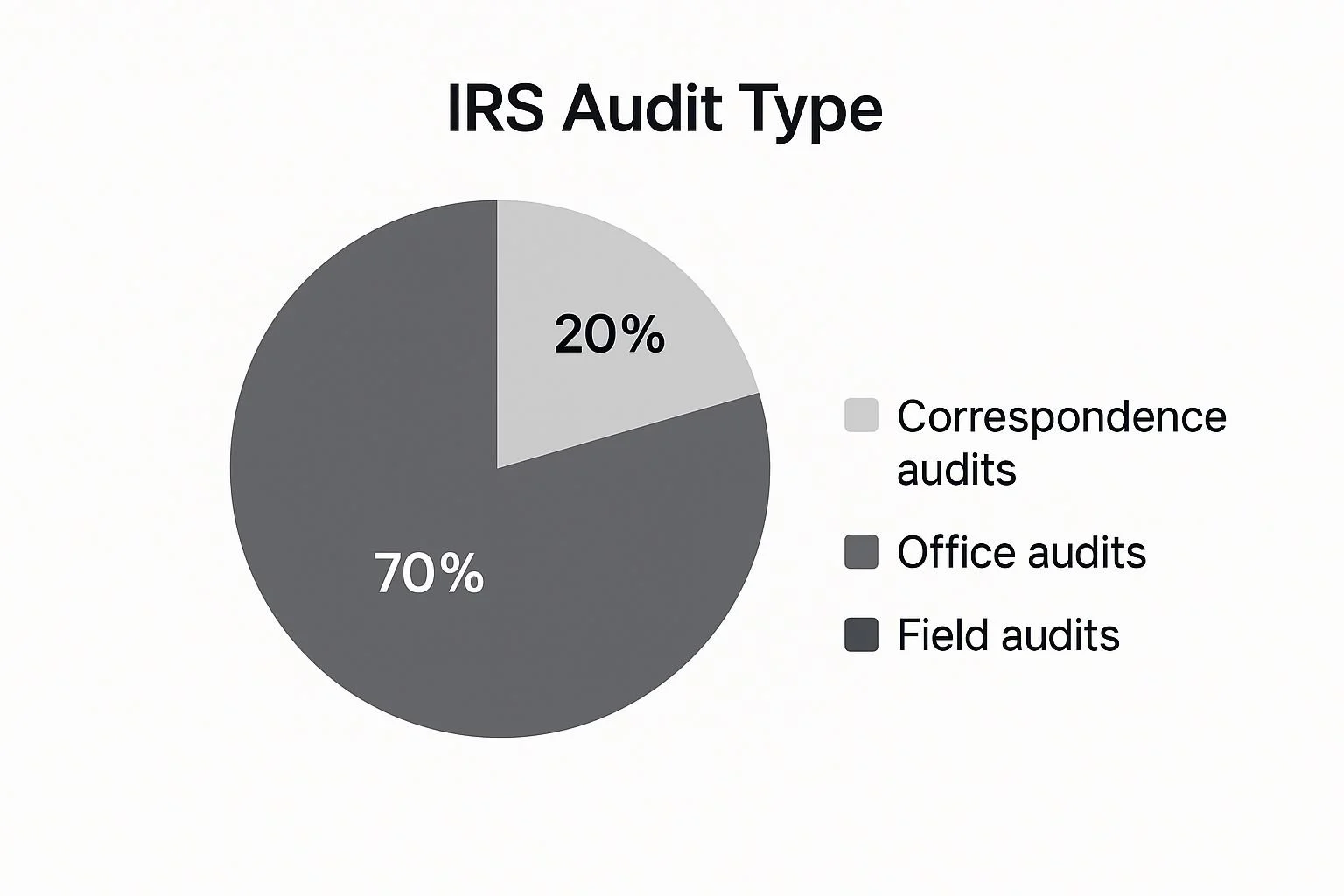
As you can see, in-person audits are pretty rare. The vast majority of examinations kick off with that letter in the mail, which makes your very first response absolutely critical.
Why Self-Representation Is a Major Risk
Imagine a small business owner gets a correspondence audit questioning their vehicle expense deductions. Thinking it’s a simple paperwork issue, they mail the IRS their entire mileage log along with a shoebox full of receipts. What they don't realize is they just showed the auditor that their record-keeping is a mess.
The auditor's curiosity is piqued. Now, they decide to expand the audit to look at meals and entertainment expenses, too. Suddenly, a minor inquiry has spiraled into a major headache.
An IRS tax audit representative would have stopped this from ever happening. They would have carefully reviewed the initial request, provided only the specific documents needed, and managed all communication to keep the audit laser-focused and contained.
The financial stakes here are incredibly high. In the last fiscal year alone, the IRS closed over half a million audits and recommended a staggering $29.0 billion in additional taxes. Since correspondence audits make up the bulk of these cases, even a seemingly simple letter can lead to a huge tax bill. You can dig into the specifics in the IRS Data Book. Bringing in a pro from day one isn't a cost; it's an investment in minimizing your financial risk.
Who Can Represent You Before the IRS

When the IRS comes knocking, you can't just send anyone to handle things. The agency is incredibly strict about who can officially speak for you. Only a handful of credentialed professionals have what’s known as unlimited representation rights. This means they can represent you on any tax matter, for any tax year, and before any IRS office.
Choosing the right kind of IRS tax audit representative is one of the most important decisions you'll make. It’s not a one-size-fits-all situation; the right choice really depends on the nitty-gritty details of your case. Let’s break down the main players.
The Federally-Licensed Tax Specialist: Enrolled Agents
An Enrolled Agent (EA) is a tax pro who is federally licensed by the U.S. Department of the Treasury itself. Think of it as the highest credential the IRS can award. Unlike CPAs or attorneys, whose expertise can be quite broad, an EA's entire world revolves around taxation.
To become an EA, you have to pass a grueling three-part IRS exam covering every corner of individual and business tax law. This intense focus makes them fantastic for complex audits that get deep into the technical weeds of the tax code, collections, and appeals.
Key Takeaway: Because they're licensed at the federal level, an Enrolled Agent can represent you no matter what state you live in. This makes them a uniquely flexible and powerful ally, especially if your tax issues cross state lines.
The Financial Expert: Certified Public Accountants
A Certified Public Accountant (CPA) is licensed by their state and brings a profound understanding of accounting, bookkeeping, and the story your financial statements tell. While many CPAs are also tax experts, their real superpower is often their deep familiarity with a client's financial DNA.
This background is priceless during an audit, particularly for a business. A CPA can brilliantly defend the very financial records and accounting methods that form the foundation of your tax return. If the IRS is questioning your business expenses, how you recognize revenue, or your inventory numbers, the CPA who prepared your returns is already armed with the knowledge to defend you.
The Legal Advocate: Tax Attorneys
A Tax Attorney is a lawyer who lives and breathes tax law. While they can step in on any audit, you absolutely need one on your team the moment an audit hints at becoming a criminal investigation. If the IRS even whispers about tax evasion or fraud, you need the legal protection of attorney-client privilege.
This legal shield keeps your conversations with your representative completely confidential—a protection that EAs and CPAs simply can't provide. Tax attorneys are also the only professionals who can fight for you in U.S. Tax Court if your dispute can't be settled with the IRS. They are your last line of defense when the stakes are highest.
Comparing Your IRS Representation Options
To make it easier, here's a quick rundown of your primary choices for unlimited representation. Each has a unique strength, so think about which one aligns best with the core issues of your audit.
| Professional | Primary Expertise | Licensing Body | Best For |
|---|---|---|---|
| Enrolled Agent (EA) | Deep federal tax law, complex returns, appeals, and collections. | U.S. Department of the Treasury (Federal) | Highly technical tax code disputes and representation across any state. |
| Certified Public Accountant (CPA) | Accounting, bookkeeping, financial statements, and business finances. | State Board of Accountancy (State) | Audits focused on business financials, expenses, and record-keeping. |
| Tax Attorney | Tax law, legal defense, and litigation. Protected by attorney-client privilege. | State Bar Association (State) | Serious audits with potential criminal charges, tax fraud, or Tax Court cases. |
Ultimately, the best representative is the one whose skills directly counter the IRS's questions. A technical tax issue calls for an EA, a business financials audit is perfect for a CPA, and any hint of legal trouble means you call a tax attorney immediately.
How the IRS Selects Returns for an Audit

Most people think getting audited is just a stroke of bad luck, but that’s rarely the whole story. The IRS isn't pulling returns out of a hat. Instead, they use a methodical, data-heavy approach to flag returns that need a second look.
This is where a good IRS tax audit representative earns their keep. Knowing why you were likely selected gives them a huge advantage. It allows them to anticipate the auditor’s questions and build a proactive defense, rather than just playing catch-up with IRS inquiries.
The Power of Computer Scoring
The IRS’s primary weapon is a powerful computer program called the Discriminant Inventory Function (DIF) system. Think of it like a credit score for your tax return. It analyzes your filing and assigns it a numeric score based on how it compares to statistical norms.
A high DIF score signals that your return has a strong chance of containing errors that, if corrected, would result in more tax owed. The system works by comparing your return against a massive database of similar returns that have already been audited.
If your deductions, credits, or reported income stray too far from the established norms for your income level and profession, your DIF score goes up—and so does your audit risk.
Let's say the average taxpayer in your income bracket claims about 2% of their income in charitable donations. If you claim 20%, the DIF system will almost certainly flag it. This doesn't automatically mean your deduction is fraudulent; it just means the IRS wants proof.
Uncovering Discrepancies with Third-Party Data
Another huge audit trigger is a simple mismatch between what you reported and what others reported about you. The IRS gets a flood of information from third parties and their computers are constantly cross-referencing this data with your tax return.
This data-matching process looks at documents like:
W-2s from Employers: Does the income you reported match what your company told the IRS they paid you?
1099 Forms: The system checks income from clients (1099-NEC), interest from banks (1099-INT), and dividends from brokers (1099-DIV).
Form 1099-K: Payment processors like PayPal and Stripe report your gross transactions, making it critical for small businesses to report every dollar.
Imagine you reported $50,000 in freelance income, but the 1099s the IRS received from your clients add up to $75,000. Their automated system will catch that discrepancy instantly. This is probably the single most common reason people receive those initial audit letters in the mail.
A seasoned representative knows this. The first thing they'll do is pull all those third-party documents to find and address any mismatches before the auditor even brings them up.
How to Vet and Hire Your Representative

Choosing the right IRS tax audit representative is probably the single most important decision you'll make in this entire process. Think of them as more than just an advisor; they're your advocate, your strategist, and your shield when dealing with the IRS. To find the right person, you need to go beyond a quick web search and really dig into their qualifications and, more importantly, their actual experience.
Where do you even start looking? I always tell people to begin with trusted professional directories, not just random online listings. These are curated databases of credentialed experts. It can also be helpful to understand how legal professionals attract clients, as it gives you a better sense of where the real talent congregates.
Here are the best places to find qualified pros:
National Association of Enrolled Agents (NAEA): This is a fantastic resource for finding federally-licensed tax specialists who focus specifically on tax matters.
State CPA Societies: If your audit involves state or local tax laws on top of federal issues, finding a CPA here is a smart move.
State Bar Associations: For cases with serious legal complexities or potential criminal exposure, a tax attorney is non-negotiable. This is where you find them.
Crucial Questions for Your Initial Consultation
Most reputable pros offer an initial consultation, and this is your chance to interview them. Don't be shy. You’re hiring an expert for a high-stakes situation, so you need to feel completely confident in their ability to handle it.
Come prepared with a list of questions that go far beyond "what do you charge?" You want to get a feel for their direct experience with cases that look like yours.
Ask pointed questions like these:
How many audits similar to my situation have you handled in the last year?
Will I be working directly with you, or will my case be handed off to a junior associate? Who is my main point of contact?
What's your process for keeping clients in the loop? How often will I hear from you?
Based on what I've told you so far, what’s your gut reaction? What are the potential weak spots you see?
A Quick Tip from Experience: Pay very close attention to how they answer. A confident, experienced representative will give you straight, clear answers. If you get vague responses or they seem hesitant to talk about past cases, that’s a major red flag.
Verifying Credentials and Understanding the Fees
Before you sign on the dotted line, do your homework. You can—and should—verify the credentials of any Enrolled Agent, CPA, or attorney with their respective state licensing boards. The IRS also has a directory of federal tax preparers you can check.
Next, you absolutely must get a crystal-clear understanding of their fee structure. There’s no single way it’s done, but you’ll typically run into one of these three models:
Hourly Rate: You pay for the actual time they spend on your case. This is common, but the final cost can be unpredictable.
Flat Fee: You agree on a single, all-inclusive price to handle the entire audit from start to finish. This gives you cost certainty, though it might seem higher upfront.
Retainer: You pay an upfront fee, and they deduct their hourly charges from that balance as they work on your case.
Always, always get a written engagement letter that spells out the scope of their services and the exact fee structure. For anyone facing a hefty tax bill, exploring all your options is critical.
Finally, be wary of anyone who promises a specific outcome or pressures you to sign immediately. A true professional—the kind of IRS tax audit representative you want in your corner—will manage your expectations and give you a realistic outlook, not a guaranteed win.
Navigating the Audit with Your Representative
Once you bring an IRS tax audit representative on board, the entire dynamic of your situation shifts. It’s a huge relief. You’re no longer facing the IRS alone; you now have a seasoned strategist running the show.
The first official move is to sign an IRS Form 2848, Power of Attorney and Declaration of Representative. Think of this document as your shield. It legally notifies the IRS that your representative is now the official point of contact. From that moment on, the auditor must go through them for everything. This is critical because it insulates you from direct contact, preventing an off-the-cuff remark that could accidentally complicate your case.
Establishing the Game Plan
With the Power of Attorney filed, your representative’s real work begins. They’ll immediately take the reins, starting with a deep dive into your tax return, the audit notice, and any back-and-forth you’ve already had with the IRS.
Their main objective is to build a solid defense strategy. This isn't a passive role; it involves several key actions:
Wrangling Your Documents: They'll guide you in gathering and organizing every piece of necessary paperwork, from receipts and bank statements to contracts and mileage logs.
Thinking Like an Auditor: An experienced pro knows what the IRS is looking for. They can anticipate the auditor's line of questioning and prepare clear, proactive responses.
Controlling the Narrative: They will carefully manage every response to IRS inquiries, making sure to provide only the information that's required—and nothing more.
This methodical approach is absolutely essential. Your representative’s job is to keep the audit laser-focused on the original issues and prevent it from spiraling into other areas of your finances or previous tax years.
Your Rep's Role During the Audit
As the audit moves forward, your representative handles all the heavy lifting. When the IRS issues an Information Document Request (IDR), it doesn't land on your desk and cause a panic. It goes straight to your professional. They'll scrutinize it to ensure it’s relevant and not an overreach before even thinking about how to respond.
Your representative's core function is to protect your rights and frame your case in the most favorable light possible. They translate dense, complicated tax law into a compelling argument, all backed by meticulously organized evidence.
Throughout the audit, your representative will be reviewing your financial records and other relevant documents. Specialized tools like legal document review software can often help them sift through everything with greater accuracy and efficiency.
Ultimately, they manage all the negotiations with the auditor. They’re the ones presenting arguments, citing specific tax code, and pushing for a fair resolution. This frees you up to focus on your life and your business, giving you invaluable peace of mind without the constant weight of an IRS audit on your shoulders.
Common Questions About Tax Audit Representation
Getting that letter from the IRS can trigger a flood of questions and a whole lot of anxiety. Getting clear, straight answers is the first real step toward taking back control of the situation. Let's walk through some of the most common things people ask when they find themselves needing an IRS tax audit representative.
What Is the Difference Between an Enrolled Agent and a CPA for an IRS Audit?
This is a great question, and the answer really depends on the specifics of your audit. While both EAs and CPAs are highly qualified to represent you before the IRS, they come from slightly different backgrounds.
An Enrolled Agent (EA) is a tax specialist through and through. They are licensed directly by the IRS, which means their entire professional world revolves around tax law, a deep understanding of the tax code, and navigating IRS procedures like appeals and collections.
A Certified Public Accountant (CPA), on the other hand, is licensed at the state level. Their training is broader, covering everything from financial reporting and business accounting to, of course, taxes.
So, who should you choose? Think of it this way:
Lean towards an EA for: Situations involving complex or obscure parts of the tax code, handling appeals, or if your case is purely a tax law dispute.
Lean towards a CPA for: Audits that are digging deep into your business's financial statements, bookkeeping practices, or the justification of specific expenses.
Can I Hire a Representative After My Audit Has Already Started?
Yes, and you absolutely should if you feel you're in over your head. It's never too late to bring in a professional. Many people try to handle the initial stages themselves, only to realize the complexity and the stakes are much higher than they anticipated.
Hiring a representative mid-stream can completely change the tone of the audit. Their first move will be to file a Power of Attorney, which immediately puts them between you and the IRS. They'll review everything that's happened so far, figure out the best path forward, and start correcting any missteps that might have been made. This happens all the time.
Key Insight: A seasoned representative's first job is often damage control. They'll stop you from talking directly to the auditor, preventing you from accidentally making things worse while they get up to speed and build a real strategy.
How Much Does an IRS Tax Audit Representative Typically Cost?
There’s no single price tag, unfortunately. The cost for an IRS tax audit representative can vary quite a bit depending on who you hire (a tax attorney will cost more than an EA, for example), where they're located, and just how messy your audit is.
Generally, you'll see a few common fee structures:
Hourly Fees: This is the most common model, with rates often falling between $150 to over $500 per hour. It's typical for audits where the time commitment is hard to predict.
Flat Fee: Some pros will quote a single, all-in price to handle the entire audit from start to finish. This might run several thousand dollars, but it gives you certainty about the total cost.
Initial Retainer: You pay an amount upfront, and the representative bills their hourly fees against that balance.
No matter the structure, always insist on a signed engagement letter that spells out the fees in plain English before any work starts. This is your best protection against surprise bills later on.
Do I Have to Talk to the IRS if I Hire a Representative?
For the most part, no. And frankly, that’s one of the biggest reasons to hire someone.
Once your representative has you sign IRS Form 2848 (the Power of Attorney), they officially become your advocate. The IRS is then legally obligated to direct all communication—every phone call, every letter, every request for documents—to them, not you.
This shields you from the pressure of speaking with an auditor and accidentally saying something that could be misinterpreted or hurt your case. In rare situations, an auditor might request your presence, but even then, your representative will be right by your side, having prepped you on exactly what to expect.
Facing an IRS audit is a serious matter, but you don't have to navigate it alone. Attorney Stephen A Weisberg offers a FREE Tax Debt Analysis to determine exactly how we can help resolve your IRS issues. Instead of demanding a large upfront fee, we start by providing clarity and a strategic plan. Take the first step toward peace of mind and get the expert representation you deserve.
Want to understand your options before you call anyone?
Download my free book — Freedom From Tax Debt — a plain-language guide to how the IRS collections process actually works and what resolution really looks like.
➥ Contact Attorney Stephen A. Weisberg for a free Tax Debt Analysis.
Contact Me Here: https://www.weisberg.tax/contact-1
Email: s.weisberg@weisberg.tax
Phone/Text: (248) 971-0885
Address: 300 Galleria Officentre, Suite 402, Southfield, MI 48034
