What If I Miss the Tax Deadline A Clear Action Plan
So, you missed the tax deadline. First thing's first: take a deep breath. The single most important thing you can do right now is file your return immediately. Yes, even if you can't pay a dime of what you owe. This one move is your best defense against the biggest penalties and the first step to getting this sorted out.
Your Immediate Reality After a Missed Deadline

It’s easy to feel a pit in your stomach when you realize the deadline has passed. The moment that date comes and goes, the IRS system essentially flags your account for two separate problems: not filing on time and not paying on time.
Think of it like getting two different late fees for the same overdue utility bill. One fee is for not sending in the meter reading, and the other is interest on your unpaid balance. Both start ticking up the day after taxes are due, and they have their own rules and costs.
Immediate Consequences of a Missed Tax Deadline
If you owe the IRS, missing the filing deadline triggers two distinct penalties that can quickly inflate your tax bill. Here's a quick breakdown of what you're up against.
| Penalty Type | How It's Calculated | Maximum Penalty |
|---|---|---|
| Failure-to-File | 5% of your unpaid tax bill for each month (or part of a month) your return is late. | 25% of your total unpaid tax. |
| Failure-to-Pay | 0.5% of your unpaid tax bill for each month (or part of a month) the tax remains unpaid. | 25% of your total unpaid tax. |
As you can see, the Failure-to-File penalty is by far the more costly of the two, which is why filing as soon as possible is so critical to minimizing the financial damage.
The Two Core Penalties Explained
The IRS doesn’t just hit you with a single "late fee." Its approach is designed to make you act fast, and the two main penalties are:
Failure-to-File Penalty: This one is the heavy hitter. It's ten times more expensive than the failure-to-pay penalty, and it's designed to make sure you submit your return, even if you can't pay.
Failure-to-Pay Penalty: This penalty is charged on whatever tax you haven't paid by the deadline. It's a much smaller percentage, but it will keep growing every month until your balance is zero.
These penalties are calculated based on what you owe. The Failure-to-File penalty is a steep 5% of your unpaid tax for every month you're late, maxing out at 25%. The Failure-to-Pay penalty adds another 0.5% each month. Together, they can turn a manageable bill into something much more intimidating. You can dig deeper into these specific tax penalties and fines to see the full picture.
The most important takeaway is this: Just filing your return—even with a $0 payment—stops that massive Failure-to-File penalty from growing. It's the most powerful move you can make to control the situation.
Understanding this difference is the key to shifting from panic to a clear plan. Now, let's break down exactly how these penalties work and what you can do to get back on track.
Understanding Failure-to-File vs. Failure-to-Pay Penalties

When you blow past the tax deadline, the IRS doesn't see it as one simple mistake. They actually split it into two separate offenses: failing to file your return and failing to pay your tax bill. Understanding this difference is absolutely critical, because one penalty is far, far more damaging than the other.
The one you really need to worry about is the Failure-to-File penalty. It’s a beast. The IRS hits you with a charge of 5% of your unpaid tax for every single month your return is late. This penalty keeps growing until it hits a cap of 25% of what you owe. The IRS makes this penalty so harsh for one reason: they want your paperwork, even if they can't get your money right away.
Then there’s the Failure-to-Pay penalty. This one is much more manageable, accruing at 0.5% of your unpaid taxes each month. It also maxes out at 25%, but it accumulates much more slowly. While it's not something you want, its immediate financial sting is nowhere near as severe as the penalty for not filing.
A Real-World Penalty Breakdown
Let's put this into perspective with a quick example. Say you owe the IRS $5,000, and you're three months late on both filing and paying.
Here’s how quickly things would get out of hand:
Failure-to-File Penalty: At 5% a month, you're looking at $250 in penalties for each month you don't file. After three months, that's a painful $750.
Failure-to-Pay Penalty: The 0.5% monthly penalty adds another $25 to your bill. For three months, that’s an additional $75.
So, in just 90 days, your original $5,000 debt has ballooned by $825. Your new total is $5,825, and that doesn't even include the interest that's been quietly adding up the whole time.
The most powerful lesson here is that simply submitting your tax return—even if you pay nothing—stops the 5% Failure-to-File penalty in its tracks. You'd still face the smaller 0.5% Failure-to-Pay penalty, but you would avoid the much larger financial hit.
Why Filing First Is Your Best Move
This scenario makes it crystal clear: your absolute first priority is to get that return filed. Period. Just by submitting the paperwork, you shut down the most aggressive penalty the IRS has. This single action can save you a fortune and keep a manageable tax bill from spiraling into a five-figure nightmare.
So many people put off filing because they know they can't afford to pay, but they don't realize they're digging themselves into a much deeper hole.
Even if you’re years behind, the strategy doesn't change. Filing is always the first, most important step toward getting right with the IRS and minimizing the financial damage.
A Global Perspective on Late Tax Filing

If you're staring down a missed tax deadline, that sinking feeling isn't unique to the United States. It's a universal language. Tax authorities all over the world use financial penalties to make sure people file on time, even if their methods look a little different.
This global view hammers home a simple truth: governments everywhere take tax compliance seriously. For U.S. expats or anyone with financial ties abroad, this isn't just trivia—it's essential knowledge.
The IRS might have a strict penalty system, but seeing how other major economies handle late filings puts it all in context. Being prompt isn't a suggestion; it’s a globally enforced rule with a hefty price tag for procrastinators.
How Different Countries Handle Late Taxes
Thinking you might catch a break in another country is a common misconception. In reality, penalties for blowing a tax deadline are standard practice across the globe, each with its own flavor of enforcement.
The United Kingdom: The UK has a points-based system for late VAT returns. It works a bit like getting points on your driver's license—each miss adds a point, and once you hit a certain threshold, a financial penalty kicks in.
Germany: The Germans are a bit more direct. They often slap on a significant late filing surcharge right away, plus monthly penalty interest on whatever tax you owe.
The United States: As we've covered, the U.S. model is a one-two punch: a big Failure-to-File penalty combined with a smaller Failure-to-Pay penalty. It’s a powerful motivator to at least get the paperwork in.
The consequences for filing late vary, but they almost always involve a painful mix of penalties and interest. For instance, since January 1, 2023, the UK has been using that penalty points system for late VAT.
Germany charges 1% monthly penalty interest on late VAT payments. And back in the U.S., state-level penalties for failing to file or pay sales tax can run anywhere from 5% to 25% of what you owe. You can actually see a full global tax penalties breakdown to compare how different nations tackle the issue.
No matter the country or the exact penalty math, the message from tax agencies is loud and clear: file on time. Delays will always cost you.
This international view is especially critical for the estimated 9 million Americans living abroad. They're often juggling U.S. tax laws and the rules of their host country, which makes hitting every deadline an even bigger challenge.
Your Step-by-Step Action Plan After Missing the Deadline
Knowing the penalties is one thing, but what really matters is what you do next. If you've missed the tax deadline, the worst thing you can do is freeze. Panic gets you nowhere. What you need is a clear, methodical plan to minimize the damage and get back on track.
First things first: file your tax return immediately. I can't stress this enough. This single action stops the Failure-to-File penalty in its tracks. That penalty is the big one, climbing at an aggressive 5% per month, so shutting it down is your most powerful first move. It doesn't matter if you can't pay a dime of what you owe—just get that return submitted.
Once the return is filed, your next priority is to pay as much of the tax bill as you possibly can. Every dollar you send to the IRS reduces the principal balance, which in turn shrinks the amount that both the Failure-to-Pay penalty and interest are calculated on.
Choosing the Right Payment Path
Okay, so you've filed and maybe paid a portion of the bill. What about the rest? The good news is the IRS isn't expecting you to conjure up a huge sum of money out of thin air if you simply don't have it. They have structured options to help you manage the debt.
The process is fairly straightforward, as you can see below.
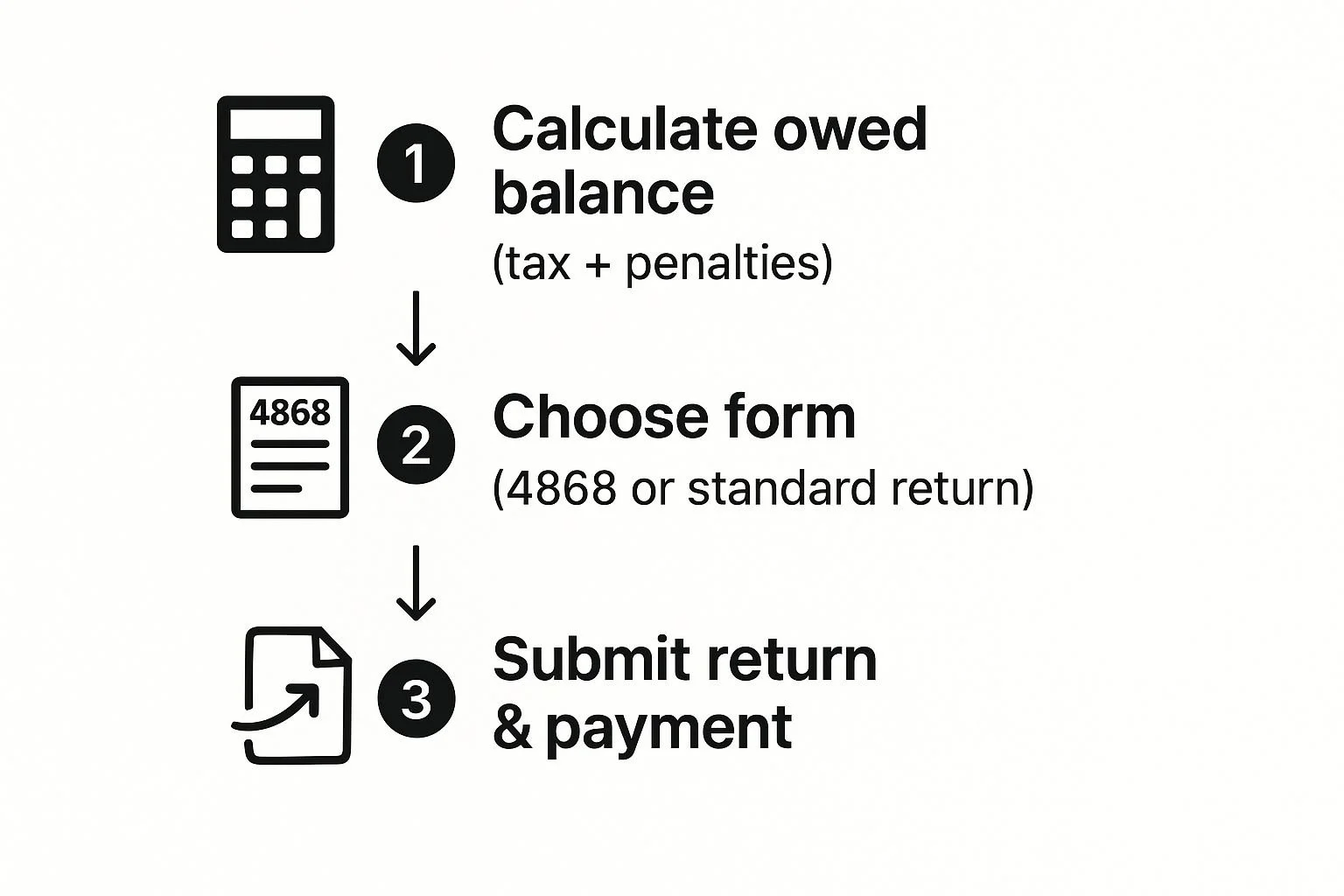
As this shows, it all starts with figuring out what you owe, which leads directly to filing and paying. Those are the two critical steps that stop the penalties from spiraling.
If paying it all off at once just isn't in the cards, you'll need to explore a more formal arrangement with the IRS. Before you do anything else, get your documents in order. Using a comprehensive tax checklist can be a lifesaver here, ensuring you have all your ducks in a row before making contact.
Believe it or not, the IRS would much rather work with you to find a manageable solution than spend resources chasing a debt they might never collect. When you proactively reach out and engage with their payment options, you're showing good faith, and that goes a long way.
IRS Payment Options at a Glance
For anyone who can't wipe out their tax balance right away, the IRS has a few main pathways. Each one is built for a different financial reality, so it's vital to figure out which one fits your specific situation. If you've ever found yourself thinking you forgot to file taxes and have no idea what to do, these options are your roadmap.
Short-Term Payment Plan: This gives you up to 180 extra days to pay your full tax liability. It's the perfect solution if you just need a few more months to pull the funds together.
Offer in Compromise (OIC): An OIC is an agreement that lets you settle your tax debt for less than the full amount you owe. This isn't for everyone; it's generally reserved for people facing true financial hardship.
Installment Agreement: Think of this as a long-term monthly payment plan. It lets you pay off your tax debt over time, sometimes up to 72 months.
Let's break down these options a bit more clearly.
Comparing IRS Payment Relief Options
The table below gives a quick overview of the main relief options, helping you see at a glance which one might be the best fit for your circumstances.
| Option | Best For | Key Requirement |
|---|---|---|
| Short-Term Payment Plan | People who can pay in full soon, but need a few extra months (up to 180 days). | Ability to pay the entire balance, including penalties and interest, within the extension period. |
| Installment Agreement | Those who need more than six months to pay off their debt through regular monthly payments. | Having a tax debt under a certain threshold and committing to a consistent payment schedule. |
| Offer in Compromise (OIC) | Taxpayers with significant, demonstrable financial hardship who cannot pay their full tax debt. | Proving to the IRS that you lack the income and/or assets to pay the full amount owed. |
Each path serves a different purpose. The Installment Agreement is by far the most common route for people needing more time, while the OIC is a more intensive solution for those in a serious financial bind. Choosing the right one is the key to resolving your tax issue effectively.
How to Potentially Waive IRS Penalties
Staring at a pile of IRS penalties can feel overwhelming, especially after you’ve already missed a tax deadline. But here’s something most people don’t know: the IRS might be willing to give you a break.
The process is called penalty abatement, and it’s a formal way of asking the IRS to remove or reduce the penalties they’ve tacked onto your bill. It’s not a magic wand, but if you have a legitimate reason for your mistake, it’s a very real option for lowering what you owe. The trick is to understand what the IRS considers a valid reason and how to present your case.
Two Main Paths to Penalty Relief
When it comes to penalty relief, the IRS generally offers two distinct paths. Figuring out which one fits your situation is the first—and most important—step.
First-Time Penalty Abatement: This one is for taxpayers with an otherwise spotless record. If you’ve filed and paid on time for the last three years and this year was just a slip-up, the IRS might forgive the penalty as a one-time courtesy.
Reasonable Cause: This path is for when life genuinely throws you a curveball. If circumstances beyond your control prevented you from filing or paying on time, you can ask for a waiver based on "reasonable cause."
Think of First-Time Abatement like a "free pass" for being a good taxpayer. Reasonable Cause, on the other hand, is for those times when an unavoidable event—like a serious illness or a natural disaster—made it impossible to meet your tax obligations.
The IRS Fresh Start Program is an umbrella initiative that includes penalty relief options. Understanding this program can provide a broader context for how the IRS helps struggling taxpayers.
What Qualifies as Reasonable Cause
While the term "reasonable cause" might sound a bit vague, the IRS is pretty specific about what it covers. Simply forgetting the deadline or not having the money to pay your tax bill, unfortunately, won't cut it.
You have to show that you tried your best to comply—what the IRS calls "ordinary business care and prudence"—but were still unable to do so.
Here are some examples of what often qualifies:
A serious illness or death, either yours or an immediate family member's.
Your home or business records were destroyed in a fire, flood, or another disaster.
You were unavoidably out of the country or otherwise absent, making it impossible to file.
You received incorrect information from a competent tax advisor.
To make your case, you can't just tell the IRS what happened. You'll need to write a detailed explanation and provide supporting documents to back up your claim. This proves you're not just making excuses but have a solid reason for the delay.
The High Stakes of Missing International Filings
Missing the domestic tax deadline is one thing, but if you're a U.S. taxpayer with financial ties abroad, the consequences jump to a whole new level. When you have foreign assets, bank accounts, or business interests, a missed deadline isn't just about paying a little extra in interest—it can unleash some of the most aggressive penalties the IRS has in its arsenal.
These aren't your typical late fees. They are designed to be punitive, forcing absolute transparency on offshore financial dealings. The standard Failure-to-File penalty looks like a parking ticket compared to the fines for unfiled international information returns, like a Form 5471 for a foreign corporation or a Form 8865 for a foreign partnership.
The Staggering Cost of Non-Compliance
For anyone managing the maze of international tax rules, building a solid financial future requires comprehensive financial planning for expats. Dropping the ball on these very specific filing requirements can lead to truly shocking penalties.
The U.S. government slaps an immediate $10,000 penalty on you for failing to file key foreign information returns on time. If you ignore an IRS notice about it for more than 90 days, the meter starts running—an additional $10,000 continuation penalty gets tacked on for every 30-day period you're late.
That means the total penalty can balloon to a mind-boggling $60,000 per form, per year. It's essential to understand the full financial risk by learning more about these specific international tax penalties.
Here’s the crucial difference: domestic penalties are usually tied to how much tax you owe. These international penalties, however, are assessed per form, per year. You could literally owe $0 in U.S. tax but still get hit with tens of thousands in penalties just for not submitting the right paperwork.
For U.S. expats or anyone with foreign accounts, this is a massive financial landmine. Simply overlooking a single international form can hurt you far more than being years behind on your regular domestic tax return. The IRS is dead serious about offshore transparency, and its penalty structure proves it. Ignoring these rules is a gamble you just can't afford to take.
Frequently Asked Questions About a Missed Tax Deadline
Once the initial shock of missing the tax deadline wears off, a lot of questions start to bubble up. Getting straight answers is the first step to getting back on track and tackling the problem head-on.
What If I Am Owed a Refund?
This is one of the few silver linings. If the IRS actually owes you money, there is no penalty for filing your return late.
But don’t take that as a green light to forget about it. The clock is ticking. You only have a three-year window from the original due date to file that return and claim your refund. Miss that deadline, and your money is gone for good—forfeited to the U.S. Treasury. So, it's always best to file as soon as you realize you've missed the date.
Does an Extension Give Me More Time to Pay?
Absolutely not. This is a huge and costly misunderstanding that trips up countless taxpayers every year. Filing for an extension with Form 4868 gives you more time to get your paperwork in order, pushing your filing deadline to October 15th. That's it.
Your estimated tax payment is still due by the original April deadline. If you don't pay what you owe by then, the Failure-to-Pay penalty starts racking up, even if you have an approved extension.
Will a Missed Deadline Affect My Credit Score?
Not at first. The IRS doesn't report your tax troubles to the big consumer credit bureaus like Experian or Equifax. Your tax debt is between you and them.
However, if that debt sits unpaid for too long, things can get serious. The IRS can file a Notice of Federal Tax Lien, which is a public claim against your property. Since it’s a public record, it can show up on your credit report and do some real damage to your score.
At Attorney Stephen A Weisberg, we know just how stressful IRS problems can be. We don’t ask for a huge retainer to get started. Instead, we begin with a FREE Tax Debt Analysis to figure out the smartest way forward for your specific situation. If you're tangled up in tax issues, visit us at weisberg.tax to see how we can help.
So, you missed the tax deadline. First thing's first: take a deep breath. The single most important thing you can do right now is file your return immediately. Yes, even if you can't pay a dime of what you owe. This one move is your best defense against the biggest penalties and the first step to getting this sorted out.
Want to understand your options before you call anyone?
Download my free book — Freedom From Tax Debt — a plain-language guide to how the IRS collections process actually works and what resolution really looks like.
➥ Contact Attorney Stephen A. Weisberg for a free Tax Debt Analysis.
Contact Me Here: https://www.weisberg.tax/contact-1
Email: s.weisberg@weisberg.tax
Phone/Text: (248) 971-0885
Address: 300 Galleria Officentre, Suite 402, Southfield, MI 48034
