IRS Offers in Compromise Calculator | Maximize Your Savings
For many, the first move is to use an IRS offers in compromise calculator to get a quick reality check on where they stand.
Should You Consider an Offer in Compromise?
An Offer in Compromise is reserved for very specific, and often difficult, financial situations. This isn't a casual negotiation over the phone—it’s an exhaustive, deep dive into your entire financial life. The number one reason the IRS accepts an offer is what they call “Doubt as to Collectibility.” In plain English, this means your income and assets just aren't enough to pay off your tax bill.
Imagine a self-employed graphic designer who had a great year, but then their biggest client went under. Suddenly, they’re stuck with a huge tax liability they have no way of paying. That’s a textbook example of someone who might be a good candidate for an OIC. The program is truly for people whose financial reality has taken a significant, and often permanent, nosedive.
Setting Realistic Expectations
Before you even think about plugging numbers into a calculator, it’s critical to wrap your head around what the OIC program actually demands.
The process requires total transparency and a boatload of paperwork. You’ll need to submit Form 656, provide incredibly detailed financial statements, and pay a $205 application fee plus an initial payment (though low-income taxpayers can sometimes get these waived).
The IRS website itself is your primary source for all the official forms and guidance.

You can see the page points you directly to their Pre-Qualifier tool. This is the official IRS offers in compromise calculator, and it’s designed to stop you from wasting time on a full application if you don’t meet the basic financial thresholds.
Who Is a Good Candidate?
Figuring out if you’re even eligible is the absolute first hurdle. The IRS has a set of non-negotiable criteria you have to meet before they’ll even look at your offer.
Filing Compliance: You must have filed all your tax returns. No exceptions.
Payment Compliance: You need to be up-to-date on your current year's estimated tax payments or have proper withholding from your job.
No Active Bankruptcy: You can't be in the middle of an open bankruptcy case.
If you don’t tick these boxes, you’re not getting an OIC. Period. The calculator is there to help with the financial analysis, but these basic compliance rules come first.
How to Prepare Your Financials for the Calculator

Jumping straight into the IRS Offer in Compromise calculator without your financial details is like trying to build a puzzle with half the pieces missing. Sure, you'll get an answer, but it won't be the right one. A little prep work now ensures the number the calculator spits out is a true reflection of your situation, not just a frustrating wild guess.
Think of it as putting together a complete financial snapshot of your life. The calculator needs precise, accurate numbers to do its job, which is why gathering everything before you start is the most crucial step in this whole process.
Assembling Your Income and Asset Dossier
First things first, you need a crystal-clear picture of every dollar coming in and every asset you own. And I don't just mean your primary paycheck—the IRS is looking for the whole story.
Start gathering these key documents:
Proof of Income: This means your last few pay stubs, any 1099s from freelance or contract gigs, and statements for things like Social Security or disability payments.
Bank Statements: You'll want to collect at least the last three months of statements for all your checking and savings accounts. Be ready to explain any large or out-of-the-ordinary deposits.
Retirement Accounts: Dig up the most recent statements for your 401(k), IRA, or any other retirement funds. The calculator requires the current market value.
Other Assets: Do you own stocks, bonds, or crypto? You'll need the current value for these, too.
Accuracy here is absolutely paramount. Applying sound data analysis best practices can make a huge difference in the reliability of your eventual OIC submission. It really just boils down to double-checking every number and making sure all your documents tell a consistent story.
Valuing Your Major Possessions
Next up, you need to assign a realistic value to your big-ticket physical assets, which usually means your home and your vehicles. What the IRS really cares about is the equity you hold in them—what would be left over after you paid off any loans.
For your home, a quick "Zestimate" from a site like Zillow can be a decent starting point, but don't stop there. The IRS will be looking for a more formal valuation, often based on what similar homes in your area have recently sold for or even a professional appraisal.
When it comes to your cars, a tool like Kelley Blue Book (KBB) or Edmunds can give you a solid private party sale value. A word of caution: don't use the trade-in value, as it's almost always lower. The goal is to figure out the fair market value if you were to sell it yourself today.
Pro Tip: Don't forget to subtract your outstanding loan balances from these asset values. For example, if your car is worth $15,000 but you still owe $12,000 on the loan, your equity is just $3,000. That's the number the calculator is looking for.
Documenting Your Necessary Living Expenses
Finally, the calculator needs a detailed breakdown of your monthly living expenses. And you can't just pull numbers out of thin air. The IRS has its own set of national and local standards to determine what they consider a "reasonable" expense.
Start tracking and documenting your actual costs for:
Housing and utilities
Food and clothing
Transportation (gas, insurance, maintenance)
Out-of-pocket healthcare expenses
Any court-ordered payments like child support
Getting these documents organized and ready to go will make the whole calculator process smooth and, most importantly, accurate. It's your best shot at getting a reliable first look at whether an OIC is a real possibility for you.
Using the IRS Offer in Compromise Pre-Qualifier Tool
Once you have all your financial paperwork in order, it's time to face the official IRS Offer in Compromise calculator, which they call the Pre-Qualifier Tool. Think of this less as a simple calculator and more as a dry run of the IRS's initial review. It’s built to give you a realistic preview of your chances, helping you avoid the time, effort, and application fee if your situation doesn't fit their strict mold.
Let’s put this into practice with a real-world scenario. Meet Sarah and Tom. Sarah’s a nurse with a steady W-2 income, but Tom is a freelance writer, so his earnings are all over the place. A few years back, an unexpected tax bill threw them for a loop, and they've been playing catch-up ever since. They've done the hard work of gathering their financial details and are ready to see if an OIC could actually work for them.
Translating Your Life into IRS Language
As you start plugging your numbers into the tool, you'll see it asks for very specific figures—household size, asset values, monthly income. Every single field is there for a reason. The IRS uses this information to calculate what they call your Reasonable Collection Potential (RCP), which is the number that really matters.
For Sarah and Tom, this process looks like this:
Household Size: They enter "2". This figure is crucial because it helps the IRS determine their allowable living expenses based on national and local standards—not necessarily what they actually spend.
Total Income: They need to combine Sarah's net pay with Tom's average monthly earnings. Because Tom's income fluctuates, they should average his earnings over the last six months to present a more stable, realistic picture.
Asset Equity: They have $15,000 in home equity and $4,000 in their car. It's important to remember this is equity, not the total value. It's what's left after you subtract the mortgage and car loan from the fair market value of the assets.
This process—from your raw financial data to a potential offer amount—is exactly what the IRS agent reviewing your case will do. The calculator just gives you a head start.
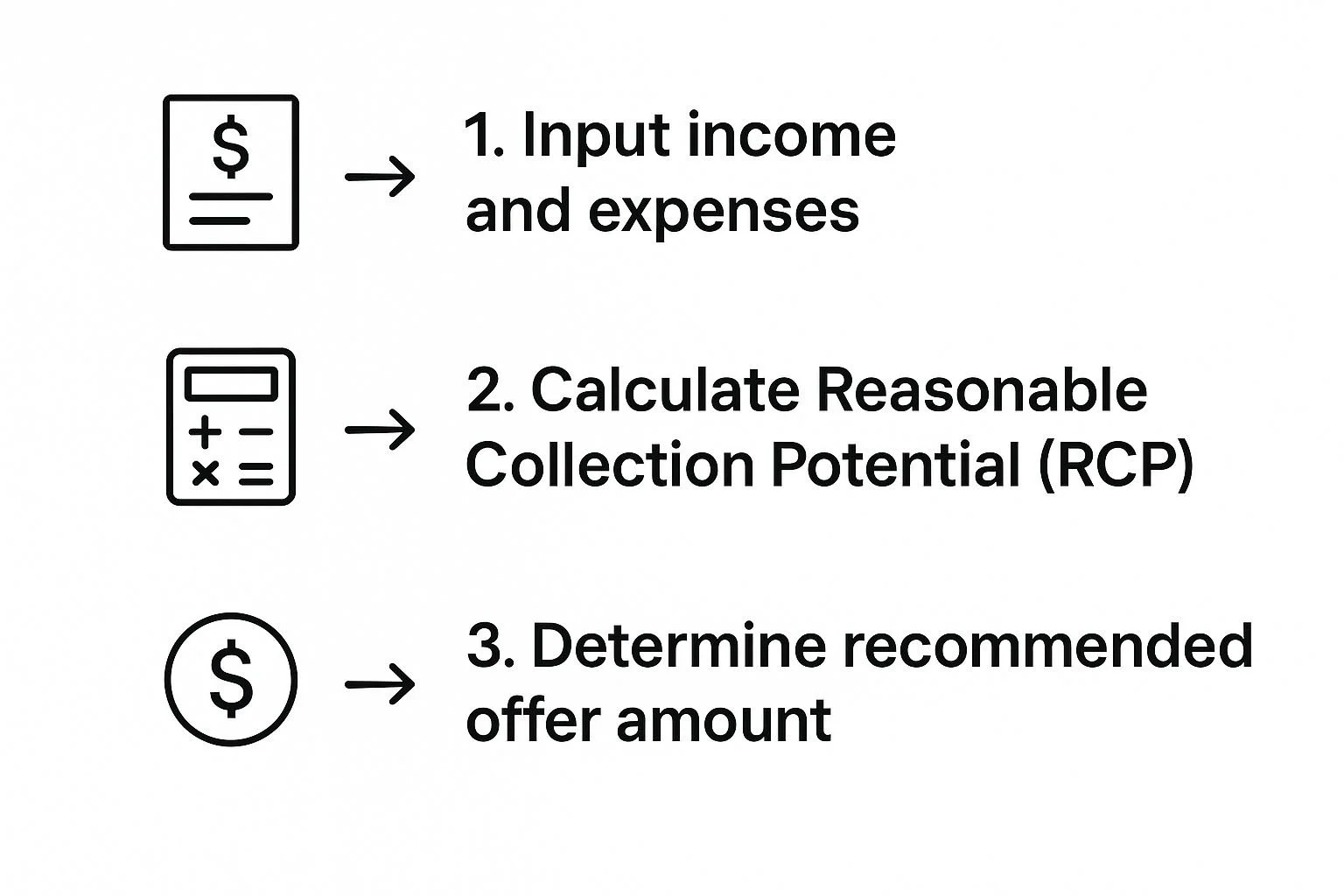
This chart helps visualize the logic. It shows how the Pre-Qualifier tool systematically takes your financial inputs and runs them through the IRS formula to see what they believe you can afford to pay.
To give you a clearer picture of the kind of information you'll need, here's a sample of what a family might input.
Sample Data for the OIC Calculator
| Financial Item | Example Value | Where to Find This Information |
|---|---|---|
| Gross Monthly Income | $5,500 | Recent pay stubs, bank statements, freelance invoices |
| Household Size | 3 | Your own family records |
| Cash on Hand | $1,200 | Current bank account balances |
| Home Equity | $20,000 | Property appraisal minus outstanding mortgage balance |
| Vehicle Equity | $3,500 | Kelley Blue Book value minus outstanding car loan |
| Allowable Monthly Expenses | $4,800 | IRS national and local standards (the tool helps here) |
Having these numbers ready beforehand makes the process much smoother and the results far more accurate.
Navigating Common Sticking Points
One of the trickiest parts for most people is figuring out their monthly disposable income the IRS way. The calculator subtracts your allowable expenses from your total income, but this is where people get tripped up. The IRS doesn't care what you actually spend; they care about what they allow you to spend based on their own rigid standards.
The online tool is your essential first step. It runs the numbers on your income, expenses, and asset equity to project a potential settlement amount. For someone who owes $75,000, the calculator might find their RCP is closer to $25,000, making that a realistic offer.
A frequent mistake is overstating expenses or forgetting to include all sources of income, both of which will give you a false sense of hope. The result you get is only as good as the data you put in.
While it's a completely different tool, even looking at something like an automation ROI calculator can help you get in the mindset of how financial formulas work.
By taking your time and carefully inputting the data you’ve prepared, you'll walk away with a result that truly reflects whether an Offer in Compromise is a viable path forward for you.
What Your Calculator Results Actually Mean

So you've punched in all the numbers, triple-checked your figures, and hit "calculate." The number staring back at you from the IRS offers in compromise calculator is the single most important piece of this puzzle. It’s the IRS's first look at your Reasonable Collection Potential (RCP).
Everything in the Offer in Compromise program hinges on this number. It's the bottom line.
The RCP represents what the IRS thinks it could squeeze out of you through other means, like hitting your bank account with a levy or garnishing your wages. Think of it less as a negotiation starting point and more as the absolute minimum bid the IRS will entertain. Getting a handle on this figure is crucial for figuring out what to do next.
Cracking the Code on the RCP Formula
This isn't some arbitrary number the calculator pulls out of thin air. It’s based on a very specific, rigid formula that the IRS uses to get a snapshot of your financial reality.
The calculation boils down to two key components:
Net Asset Equity: The IRS looks at what your assets are worth (your house, car, bank accounts, etc.) and subtracts what you owe on them. The leftover amount is your equity.
Future Disposable Income: This is your gross monthly income minus what the IRS considers allowable living expenses. That final number is then multiplied by either 12 (for a lump sum payment) or 24 (for a short-term payment plan).
The calculator simply adds these two parts together. The result is your minimum offer amount. A high RCP tells the IRS you have enough resources to pay a good chunk of your debt, making an OIC a long shot. A low RCP is a green light, signaling you're likely a solid candidate for the program.
Your calculator result is the RCP, plain and simple. The IRS is basically saying, "Based on these numbers, this is the most we believe we could ever realistically get from you." It’s a reality check, not an invitation to haggle.
So, What's the Verdict? Interpreting Your Outcome
The number you get will push you down one of three very different paths. It’s vital to know which scenario you’re in before you spend another minute on this process.
Scenario 1: It Looks Like You're a Strong Candidate
If the calculator spits out a number that's way lower than what you owe, you're probably in a great position. Let’s say you owe $80,000 in back taxes, but the calculator suggests an offer of $15,000. That’s a huge difference, and it’s a strong indicator that you should move forward.
Your next move? Time to start gathering your documents and tackling the official Form 656 and the highly detailed Form 433-A (OIC).
Scenario 2: An OIC Might Not Be the Answer
What if the numbers are too close for comfort? You owe $50,000, and the calculator determines your RCP is $45,000. An OIC won't do you much good here. You’d go through the entire lengthy process just to save a few thousand dollars.
In this case, your energy is better spent looking at other relief options, like an Installment Agreement or seeing if you qualify for Currently Not Collectible status.
Scenario 3: The Calculator Says "No"
Sometimes the tool will just tell you that you're ineligible. This usually means your disposable income is too high or you've got too much equity tied up in assets.
Don't panic. This is your chance to go back and scrub your numbers. Did you make a typo? Did you overvalue an asset? Are you claiming all the expenses the IRS allows? This isn't necessarily a dead end—it's an opportunity to refine your figures and see if you can legitimately lower that RCP.
Common Mistakes That Get Offers Rejected
Running the numbers through an IRS offers in compromise calculator is a great first step, but it's just a preview. The real test is the formal application, which gets put under a microscope by the IRS. From my experience, knowing what gets an offer thrown out is just as critical as knowing how to fill out the forms.
It’s important to be realistic. The Offer in Compromise program is notoriously tough to get into, and the acceptance rates reflect that. The IRS's own data shows that only about 35% to 40% of offers are accepted. That number tells you just how seriously they take the financial deep dive on every single application. For a closer look at the official rules, you can always check the IRS's official guidance on their website.
Inaccurate Financial Disclosures
Submitting incomplete or inconsistent financial information is probably the fastest way to get a rejection letter. I’m not just talking about forgetting to list a savings account; it’s the little discrepancies that a trained investigator will catch every time.
For example, that weekend side hustle you have? If you under-report that income but your bank statements show consistent deposits, an IRS agent will immediately flag it. Another classic mistake is miscalculating your car's value. Using the low-ball trade-in value instead of its actual fair market value can sink your offer, as the IRS will believe you have more equity—and therefore more ability to pay—than you claimed.
Key Takeaway: The IRS investigator’s job is to verify, not to trust. They will cross-reference every number you provide. Your application must present a cohesive and completely transparent financial picture, leaving no room for doubt or suspicion.
Failing Basic Compliance Rules
Even if your financial picture is perfect, there are some hard-and-fast rules that will get your offer disqualified automatically. These are complete non-starters.
You absolutely must be in full compliance before you submit the offer and while it's being reviewed. This means:
Filing All Required Returns: You can't have any outstanding tax returns. If you're behind, get them filed before you even think about submitting an OIC.
Staying Current on Payments: You have to be current on this year's estimated tax payments or have proper withholding set up with your employer.
Avoiding Bankruptcy: You cannot be in an active bankruptcy case.
If you submit an offer while you're out of compliance, it's dead on arrival. If you realize an OIC just isn't in the cards for you, don't lose hope. It’s smart to explore other tax debt solutions to find a better fit. The end goal is to resolve the problem, and sometimes that means taking a different path.
Your Questions About the OIC Process Answered
So, you’ve run the numbers through an IRS offers in compromise calculator. That initial calculation gives you a starting point, but it's completely normal for the road ahead to still feel a bit foggy. Let's tackle some of the most common questions that pop up once you start seriously thinking about an OIC.
One of the first things people wonder is, "What happens the moment I mail my application?" After the IRS gets your Form 656, they'll do an initial check to make sure it’s all there. Assuming it is, they assign your case to an investigator, and a crucial thing happens: most collection activities against you get put on hold.
This investigator has one job: to dig into every financial detail you provided and verify it's accurate. They might circle back asking for more documents or wanting to clear something up. Don’t expect a quick turnaround here; this deep dive can easily take several months before you get a recommendation to either accept or reject your offer.
Navigating State vs. Federal Debt
I get this question all the time: "Will this IRS deal take care of my state taxes too?" It's a critical point of confusion. An IRS Offer in Compromise only settles your federal tax liabilities. That's it. State tax agencies are entirely separate animals, with their own playbooks for resolving tax debt.
If you're in the hole with both the feds and the state, you have to fight on two different fronts. You'll need to get in touch with your state's department of revenue to see what programs they offer. Expect a completely different set of forms, rules, and eligibility standards.
Important Takeaway: The OIC is a fantastic tool for dealing with the IRS, but it has zero impact on what you owe your state. Never assume a federal deal automatically resolves state tax problems.
The Five-Year Compliance Period
"What if I hit the lottery after my offer is accepted?" It's a valid concern, but the IRS has a clear rule for this. Once they accept your OIC, you're on the hook for a five-year compliance period.
During these five years, your job is simple: file every tax return and pay every new tax bill on time. That's the deal. As long as you keep up your end of the bargain, a sudden windfall or a big promotion won't blow up your original agreement.
But make no mistake, slipping up has major consequences. If you miss a filing deadline or can't pay a new tax bill, the IRS can default your OIC. When that happens, your original tax debt—minus whatever you've paid—comes roaring back to life, along with all the penalties and interest they'd previously wiped away. Staying on the right side of these complex rules is non-negotiable, and it highlights the value of understanding comprehensive compliance management solutions.
Facing a complex IRS situation can be overwhelming. Instead of guessing, get a clear picture of your options. At Attorney Stephen A Weisberg, I start with a FREE Tax Debt Analysis to determine exactly how I can help before you commit to anything. Find out if you qualify for tax relief today.
When you’re staring down a mountain of tax debt, it can feel like you’re completely stuck. But there’s a formal path forward for taxpayers in real financial trouble called the IRS Offer in Compromise (OIC). This isn't some secret handshake or tax loophole; it's a structured program for people who genuinely cannot afford to pay what they owe.
Want to understand your options before you call anyone?
Download my free book — Freedom From Tax Debt — a plain-language guide to how the IRS collections process actually works and what resolution really looks like.
➥ Contact Attorney Stephen A. Weisberg for a free Tax Debt Analysis.
Contact Me Here: https://www.weisberg.tax/contact-1
Email: s.weisberg@weisberg.tax
Phone/Text: (248) 971-0885
Address: 300 Galleria Officentre, Suite 402, Southfield, MI 48034
