What is a 4506-T Form? Your Complete Guide
Let's break down exactly what this form is all about, without the confusing government jargon. At its heart, Form 4506-T is basically a permission slip. You're giving the IRS the green light to send a summary of your tax records to someone else, like a lender.
Think of it as your official financial report card. When you need to prove your income for a big financial step, this is how you do it.
Understanding the 4506-T Form and Its Purpose
So, why does this form even exist? It’s all about trust. When you apply for a mortgage, a small business loan, or even some government benefits, the institution on the other side needs to know that the income you've stated is the real deal.
The 4506-T is the bridge that connects the income you claim with what you've actually reported to the IRS.
By signing it, you're authorizing a third party—like your bank—to get a tax transcript directly from the source. It’s important to know this isn't your entire, detailed tax return. It's a much more streamlined summary of the key figures.
To give you a clearer picture, here’s a quick overview of what the Form 4506-T entails.
Form 4506-T at a Glance
| Attribute | Description |
|---|---|
| Official Title | Request for Transcript of Tax Return |
| Primary Use | To authorize the IRS to release a taxpayer's transcript to a third party. |
| Common Scenarios | Mortgage applications, loan underwriting, business financing, and some government aid programs. |
| What It Provides | A summary (transcript) of your tax return, not a full copy. |
| Key Function | Serves as a reliable tool for third-party income verification. |
Essentially, this form creates a standardized, trustworthy way for lenders and other organizations to confirm your financial information.
What Exactly Is a Tax Transcript?
A tax transcript is the key piece of information you're requesting with a 4506-T. It's a line-by-line summary of your tax return data, showing things like your adjusted gross income (AGI) and other figures that a lender needs to see.
It doesn't include every single schedule or worksheet you attached to your return, just the highlights. If you want a deeper dive, you can find more helpful insights about the 4506-T form on how it's used.
The core job of Form 4506-T is to provide a secure and reliable way to verify income, which is absolutely critical for preventing fraud in major financial deals.
This simple document builds a solid foundation of trust. For a lender, seeing an official IRS transcript is undeniable proof that the numbers on your loan application match your reported income. It’s often a non-negotiable step in the approval process for a few huge reasons:
Preventing Fraud: It’s the easiest way to confirm an applicant hasn't fudged their income numbers to get a bigger loan than they can actually afford.
Assessing Risk: It gives lenders an accurate snapshot of your financial health, helping them make a much more informed lending decision.
Standardizing the Process: It creates a consistent method for all lenders to check income, which keeps the playing field level and fair for everyone.
When You Might Need a Form 4506-T

So, when does this unassuming form actually show up in your life? It usually pops up during major financial moments when someone needs to be absolutely sure about your income history.
Think of it as the ultimate source of truth, giving undeniable proof of your financial standing straight from the IRS itself.
The most common place you'll see it is when you’re applying for a mortgage. Lenders aren't just taking your word for it; they need to confirm that the income you've stated is the real deal.
It’s their way of managing risk and preventing fraud, which is why a signed Form 4506-T is a standard part of any mortgage document checklist.
Signing this form is like giving your lender a key. It unlocks a direct line to the IRS, allowing them to confirm your income and build the trust needed to hand over the funds for your new home.
This simple piece of paper can be the ticket to huge financial milestones. But its usefulness doesn't stop with just buying a house.
Common Scenarios Requiring a 4506-T
While getting a home loan is probably the most frequent reason, you might run into a request for a Form 4506-T in a few other key situations. In every case, it boils down to one thing: someone needs official, third-party verification of your tax records.
You’ll likely need to sign off on one when:
Applying for a Business Loan: If you're a small business owner or run a sole proprietorship, banks will often dig into your personal tax transcripts. This helps them gauge your business's health and your ability to pay back the loan.
Securing Federal Student Aid (FAFSA): The Department of Education might ask for a tax transcript to verify the income of students or parents applying for financial aid. It's all about making sure the assistance goes to the right people.
Resolving Tax Issues: When you work with a tax professional to sort out past problems with the IRS, pulling your old tax data is often step one.
It’s not just about personal finance, either. The IRS uses this process to verify income during audits, and legal teams rely on it to get official records for court cases. It’s a quiet but powerful tool that helps keep trillions of dollars in financial transactions honest.
Transcript vs. Full Tax Return Copy: Which One Do You Need?
It's a common point of confusion: Form 4506-T versus its close relative, Form 4506. While they sound similar, they serve very different purposes.
Think of it like this: a tax transcript (which you get with Form 4506-T) is the highlight reel of your tax return. It gives a third party, like a mortgage lender, the key numbers they need—like your adjusted gross income—without all the extra detail. It's the "just the facts" version.
A full copy of your tax return (requested with Form 4506) is the whole movie, including every schedule and attachment you originally filed. It's the complete picture, but it's rarely necessary for standard verification purposes.
As you can see below, the 4506-T even lets you pick what kind of summary you need, whether it's just the return data, a record of payments, or a combination of both.
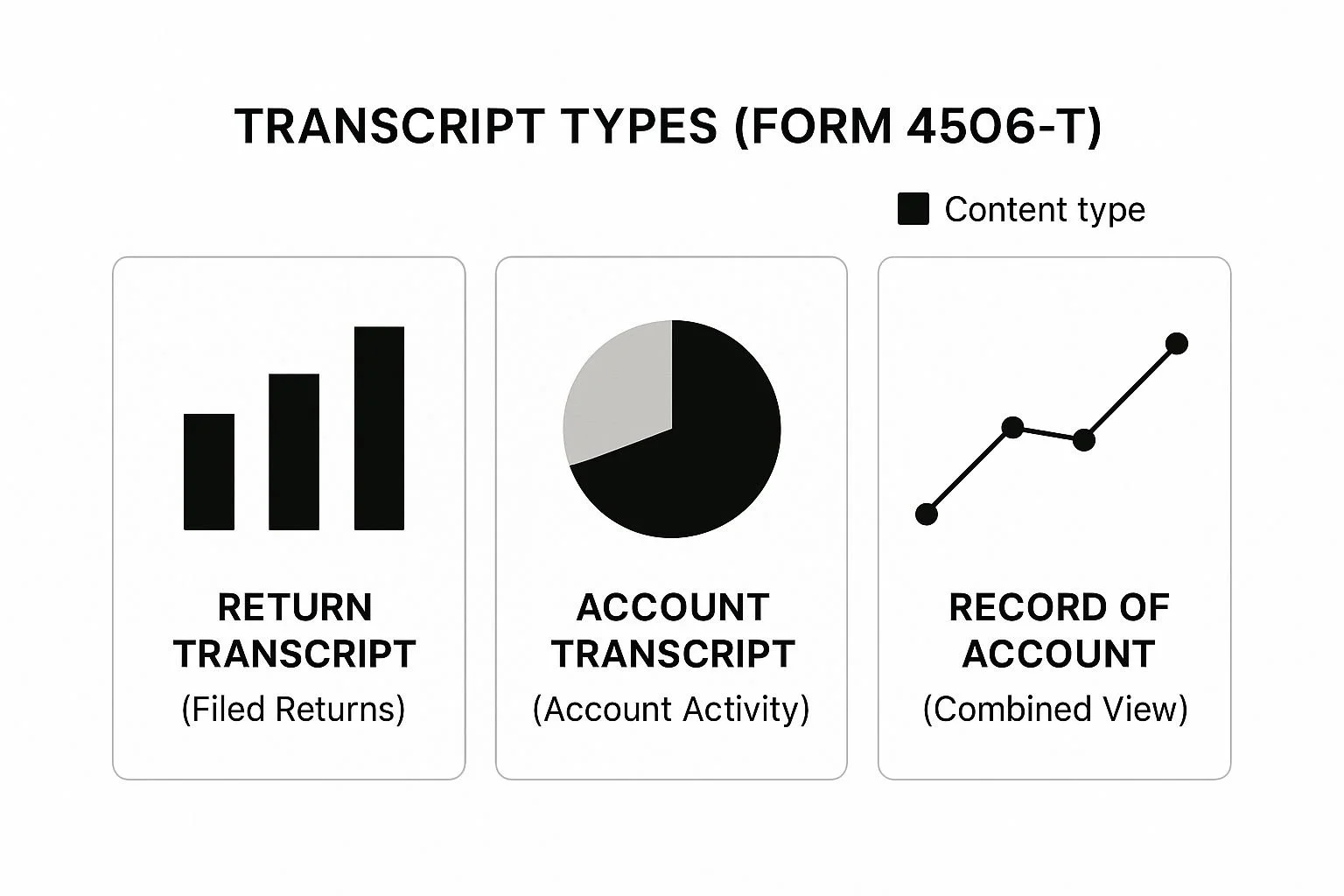
This flexibility is why the transcript is the go-to for most situations.
To make the choice even clearer, let's break down the main differences between requesting a transcript and getting a full copy of your return.
Transcript (Form 4506-T) vs Full Copy (Form 4506)
| Feature | Form 4506-T (Transcript) | Form 4506 (Copy) |
|---|---|---|
| What You Get | Computer-generated summary of key tax data | An exact photocopy of your original return |
| Cost | Free | $43 fee per return |
| Processing Time | Usually 1–3 weeks | Can take up to 75 days |
| Common Use | Mortgage applications, student loans, business loans | Amending a return, IRS audits, court proceedings |
As the table shows, unless you have a very specific legal or tax reason to need a complete duplicate of your filing, the transcript is almost always the better option.
Why Speed and Cost Matter
When you're trying to close on a house or secure a business loan, time is everything. Waiting 75 days for a document is simply not an option.
The transcript from Form 4506-T is not only free, but it also arrives much faster, keeping your application moving forward without a hitch.
This is exactly why lenders and other institutions overwhelmingly ask for a transcript. It provides the proof they need without the high cost and frustrating delays of getting a full copy.
Of course, every financial situation is unique. If you're dealing with more complex IRS issues, understanding all your options is the first step toward finding a resolution.
How to Complete and Submit Form 4506-T
I know government forms can look intimidating, but filling out Form 4506-T is actually pretty straightforward. The trick is to be meticulous. Think of it less like a complex puzzle and more like a simple, but very precise, checklist.
The first four lines are where most mistakes happen. This is where you put your name, Social Security Number (or EIN), and address.
Here’s the catch: this information must perfectly match what you put on the original tax return you're requesting.
Even a slight difference—like using "St." instead of "Street"—can get your request kicked back by the IRS, causing frustrating delays.
Take a look at the top of the form where this crucial information goes.

Getting these fields right from the start is the single most important thing you can do to ensure the process goes smoothly.
Finalizing and Sending Your Request
Once you've triple-checked your personal details, you'll move on to specifying exactly what you need. On Line 6, you'll check the box for the type of transcript required, and on Line 9, you'll enter the tax years.
It’s easy to rush through this part, but forgetting to check a box or putting down the wrong year-end date will stop your application in its tracks.
I always recommend confirming these details with your mortgage lender or whoever requested the transcript in the first place.
Your signature on Form 4506-T is your official green light to the IRS. Without it, they can't legally release your private financial records. Keep in mind this authorization is only valid for 120 days, so don't let the signed form sit on your desk for too long.
After you've filled it out and signed it, you have two ways to get it to the IRS:
Mail: The correct mailing address depends on where you live. You'll need to check the official IRS instructions for Form 4506-T to find the right processing center for your state.
Fax: Sending it by fax is often much faster. If you go this route, make sure you keep the fax confirmation sheet as your proof of submission.
Accuracy here is more than just a box-ticking exercise. Simple errors can create major roadblocks, delaying loan approvals or other important financial matters.
Avoiding Common Mistakes That Cause Delays
It’s a frustratingly common story: a simple mistake on your Form 4506-T brings a mortgage or loan application to a screeching halt, sometimes for weeks.
To keep your financial plans moving forward, you have to nail this form on the first try. It’s all about avoiding the simple, easy-to-miss errors that trip so many people up.
Believe it or not, the most frequent blunders are usually the most basic ones. Sloppy handwriting, forgetting to sign and date the form, or asking for the wrong tax year are all surefire ways to get your request kicked back by the IRS.
But the single biggest error? Mismatched information. The name, address, and Social Security Number you put on Form 4506-T must perfectly match what’s on the tax return you're requesting a transcript for.
How to Prevent Common Errors
The best way to sidestep these issues is to treat it like a meticulous copy-and-paste job. Grab the tax return for the specific year you need and transcribe your personal details exactly as they appear on that document. If you spelled out "Street," don't abbreviate it to "St." now.
Here are a few other critical checkpoints to double-check before you send it off:
Illegible Handwriting: If you’re filling out a paper copy, print everything clearly in block letters. If the IRS can't read a letter or number, they'll reject the form without a second thought.
Missing Signature: An unsigned form is a dead form. And if you filed a joint return, remember that both spouses must sign for the request to be valid.
Incorrect Tax Year: Always confirm with your lender which tax years they require. Entering the wrong year-end date on Line 9 is an incredibly common—and entirely avoidable—mistake.
Taking a few extra minutes to be meticulous here can save you a world of frustration and delay. But if you do find yourself dealing with penalties from other filing issues, it's always smart to see if you have grounds for a penalty abatement for reasonable cause.
Frequently Asked Questions About Form 4506-T
It's completely normal to still have a few questions, even after getting the rundown on Form 4506-T. Let’s tackle some of the most common ones we hear so you can feel confident when it comes time to sign.
A major concern for almost everyone is data security. When you sign a Form 4506-T, you’re not just handing over your information blindly.
You are giving the IRS specific, limited permission to release your tax transcript directly to the third party you've named, like a mortgage lender. The whole process follows secure government protocols.
Key Questions Answered
So, how long is your signature on this form actually good for? It's not indefinite. Your authorization on a Form 4506-T is only valid for 120 days from the date you sign. This built-in expiration date is a safeguard, ensuring your consent is recent and preventing old forms from being used down the road.
But what if the IRS searches its records and comes up empty for a year you requested?
If the IRS can't find a tax return for a certain year, they won't just leave you hanging. They will issue what's called a Verification of Non-filing Letter. This is an official confirmation that, according to their records, no return was filed for that period—a piece of information that can be just as crucial for a lender.
Another frequent question revolves around submitting the form yourself. Here’s the deal:
Can you submit it directly? Absolutely. You can mail or fax the form to the IRS yourself to get a transcript sent either to you or to a designated third party.
Is there an online portal? This is a tricky one. You can't submit the 4506-T form itself through a portal. However, the IRS does offer a "Get Transcript" online tool. After verifying your identity, you can use it to view and download most of your own transcripts instantly.
That online tool is usually the quickest route if you just need the records for yourself. But when a lender or other institution is the one requesting it, they’ll almost always handle the submission process for you.
Navigating IRS forms can be stressful, especially when a lot is riding on it. At Attorney Stephen A Weisberg, we specialize in cutting through the confusion and resolving tax problems. If you're dealing with tax debt or other complex IRS issues, a great first step is our FREE Tax Debt Analysis to see what your options are.
➥ Contact Attorney Stephen A. Weisberg for a free Tax Debt Analysis.
Contact Me Here: https://www.weisberg.tax/contact-1
Email: s.weisberg@weisberg.tax
Phone/Text: (248) 971-0885
Address: 300 Galleria Officentre, Suite 402, Southfield, MI 48034
