What Is a CP2000 Notice? A Step-by-Step Guide
Opening that envelope from the IRS can make anyone’s heart skip a beat. But if the letter inside is a CP2000 notice, take a deep breath. It’s not a formal audit, and it’s not an accusation.
Think of it as the IRS raising its hand and saying, "Hey, the numbers you reported don't quite match what we received from your employer or bank. Can you help us figure out why?" It's a proposed change to your tax return, giving you the chance to review their findings and respond.
Demystifying The IRS CP2000 Notice
While any IRS letter can feel intimidating, the CP2000 is actually one of the most common and manageable notices you can receive. It simply means a computer found a discrepancy.
The IRS runs a powerful program called the Automated Underreporter (AUR) system. Its main job is to play a giant game of "match." It takes the income and payment information on your tax return and compares it against all the W-2s and 1099s filed under your Social Security number.
When the system flags a mismatch—maybe you forgot about some freelance income, missed a stock sale, or a financial institution reported something incorrectly—it automatically generates a CP2000. You're not alone if you get one. In 2019, for instance, the IRS sent out over 4.7 million of these notices. That’s roughly one for every 34 tax returns filed!
To help you quickly grasp what this notice is all about, here's a simple breakdown.
CP2000 Notice at a Glance
| Key Aspect | What It Means for You |
|---|---|
| It is NOT an audit. | This is an automated, computer-generated notice about a specific data mismatch. It is not a full-blown examination of your entire return. |
| It IS a proposal. | The IRS is proposing changes and calculating what you might owe. This is their opening position, not a final bill. |
| You MUST respond. | Ignoring the notice is the worst thing you can do. You have a set timeframe (usually 30 days) to agree, disagree, or provide more info. |
| It is often correctable. | Many CP2000 notices are due to simple oversights or errors that can be explained with proper documentation. |
The key takeaway is that a CP2000 is the start of a conversation, not the final word.
This Is A Proposal, Not A Bill
This is the most critical point to remember: a CP2000 is a proposed adjustment, not a final tax bill you have to pay immediately. The notice will clearly show the changes the IRS wants to make and what that means for your tax bill, including any potential interest and penalties.
You have a few ways to handle it:
Agree: If you look it over and realize the IRS is right, you can simply sign the response form and pay what's due.
Disagree: If you believe their information is wrong, you can dispute the proposed changes. This involves sending a written explanation along with documents that back up your side of the story.
Partially Agree: It's also possible to agree with some of the proposed changes but not others. You'd explain which parts you accept and which you dispute.
Strong financial habits can often prevent these issues from happening in the first place. For businesses and individuals managing complex finances, understanding a Governance, Risk, and Compliance (GRC) framework can provide a solid foundation for accurate reporting. Ultimately, your response dictates what happens next.
Why the IRS Automated System Flagged Your Return

It’s easy to feel singled out when a CP2000 notice shows up in your mailbox, but the process that created it is anything but personal. It's completely automated.
Think of it this way: the IRS keeps a running tab for your Social Security number. Every time an employer, bank, brokerage firm, or client pays you, they send a form—like a W-2 or a 1099—to both you and the IRS.
These documents all get filed away in the IRS's massive database. This is where a program called the Automated Underreporter (AUR) gets to work. Its only job is to play a game of "match." It compares the income you reported on your tax return against all the data that third parties sent in about you.
When the AUR system spots a difference between those two sets of numbers, a digital flag goes up. It’s not making a judgment call or assuming you did anything wrong. It’s simply noting a discrepancy, and that's what triggers a CP2000 notice to be mailed out.
The Power of Information Matching
This powerful information-matching system is the engine behind your notice. The AUR program is ruthlessly efficient at spotting gaps between the income on your return and the numbers reported by payers. With more financial reporting going digital, the IRS’s ability to match this information has only gotten stronger, leading to more CP2000 notices over the years. You can find more details about how the IRS generates these notices on roberthalltaxes.
The system is particularly good at catching common, often unintentional, reporting mistakes.
A CP2000 notice is basically the IRS computer saying, "Hey, we have a 1099 form showing you earned $5,000 from this client, but we can't find that income on your return. Can you explain?" It’s a query, not an accusation.
Common Triggers for a CP2000 Notice
While any mismatch can set off the system, a few usual suspects are responsible for the vast majority of these notices. Knowing what they are can help you quickly figure out what might be wrong.
Here are some of the most frequent culprits:
Forgotten 1099-NEC or 1099-K Income: This is probably the number one reason for freelancers and gig workers. A company pays you, reports it on a 1099, and you simply forgot to include that specific income stream when you filed.
Unreported Investment Activity: Did you sell some stock or crypto? Your brokerage sends the IRS a Form 1099-B detailing your sales. If you don't report those transactions—even if you had a loss—it creates a mismatch that the system will catch.
Missed Retirement Distributions: If you took money out of an IRA or 401(k), you'll get a Form 1099-R. Even if you just rolled the money into another retirement account, it has to be reported on your return correctly, or the system will flag it as unreported taxable income.
As the IRS leans more heavily on algorithms, these automated checks are becoming even more sophisticated. The role of AI in tax audits is growing, making it more critical than ever for taxpayers to ensure their reporting is spot-on.
How to Read and Understand Your CP2000 Notice
Getting a letter from the IRS can be intimidating, and the CP2000 is no exception. At first glance, it looks like a jumble of tax jargon, columns, and codes. It’s easy to feel overwhelmed.
But don’t let it get to you. Think of the notice as a roadmap from the IRS, pointing directly to what they believe is a mistake on your tax return. Once you learn how to read that map, you can figure out exactly where their numbers and your numbers part ways.
The Key Sections of Your Notice
Every CP2000 notice is laid out in a similar way. The first page gives you the big picture, but the real meat is usually on the pages that follow. When you’re looking it over, you’re searching for a few critical details that explain the IRS’s proposed changes.
Here’s where to look first:
Tax Year in Question: This should be right at the top. Make sure it’s the year you think it is.
Response Deadline: This is a big one. The IRS usually gives you 30 days to reply before they take the next step. Mark this date on your calendar immediately.
Summary of Proposed Changes: This is the bottom line—it shows the proposed new tax amount, plus any penalties and interest they've tacked on so far.
Contact Information: You'll find a phone number for the specific IRS unit that sent the notice. This is who you'll call if you need to ask for more time to respond.
This first pass gives you the essentials—what year they’re looking at, how much they think you owe, and when you need to act. Now you’re ready to dig into the details.
The table below breaks down the key parts of a CP2000 notice, telling you what to look for in each section and why it matters for your response.
| Section of Notice | What to Look For | Why It's Important |
|---|---|---|
| Header | Tax Year, Notice Date, Response Deadline | Confirms which return is under review and sets your action timeline. |
| Summary of Proposed Changes | The total proposed tax, penalties, and interest. | This is the "bottom line" amount the IRS believes you owe. |
| Explanation of Changes | A side-by-side comparison of amounts you reported vs. amounts reported to the IRS. | This is the core of the notice—it pinpoints the exact income or deduction causing the issue. |
| Response Form | The tear-off portion where you indicate if you agree, disagree, or partially disagree. | This is the official document you'll send back to communicate your position to the IRS. |
| Payment Voucher | A slip for sending a payment if you agree with the changes. | Only use this if you accept the IRS's calculations and are ready to pay the amount due. |
Understanding these components turns the notice from a confusing document into a clear list of items you need to verify and address.
Finding the Source of the Discrepancy
After the summary page, you’ll find the most important part of the notice. It’s a detailed breakdown that compares what you reported on your tax return with the information the IRS got from employers, banks, or other payers. This is the heart of the matter.
Think of this section as the evidence page. It’s where the IRS lays out its case, showing a side-by-side comparison of “what you reported” versus “what was reported to us.”
This section gets very specific. It will name the payer (like "ABC Freelance Co." or "Main Street Brokerage") and the exact form, like a 1099-NEC for freelance work or a 1099-B for stock sales.
This is what tells you precisely which piece of income was missed or reported differently. For example, it might show you reported $5,000 from a client, but their 1099-NEC shows they paid you $8,000. This is the clue you need to build your response, because it pinpoints the exact item you need to prove or dispute.
Your Step-by-Step Plan for Responding to the IRS
So, you’ve read through the CP2000 notice and figured out what the IRS is saying. Now it’s time to act. The single most important rule here is to never ignore it. The IRS gives you a deadline—usually 30 days—and meeting it is the key to getting this sorted out without bigger headaches down the road.
You really have three ways to play this, and it all depends on your situation: you can agree, partially agree, or completely disagree with the IRS's proposed changes. Each path requires a slightly different game plan, but they all start with a prompt, well-organized reply.
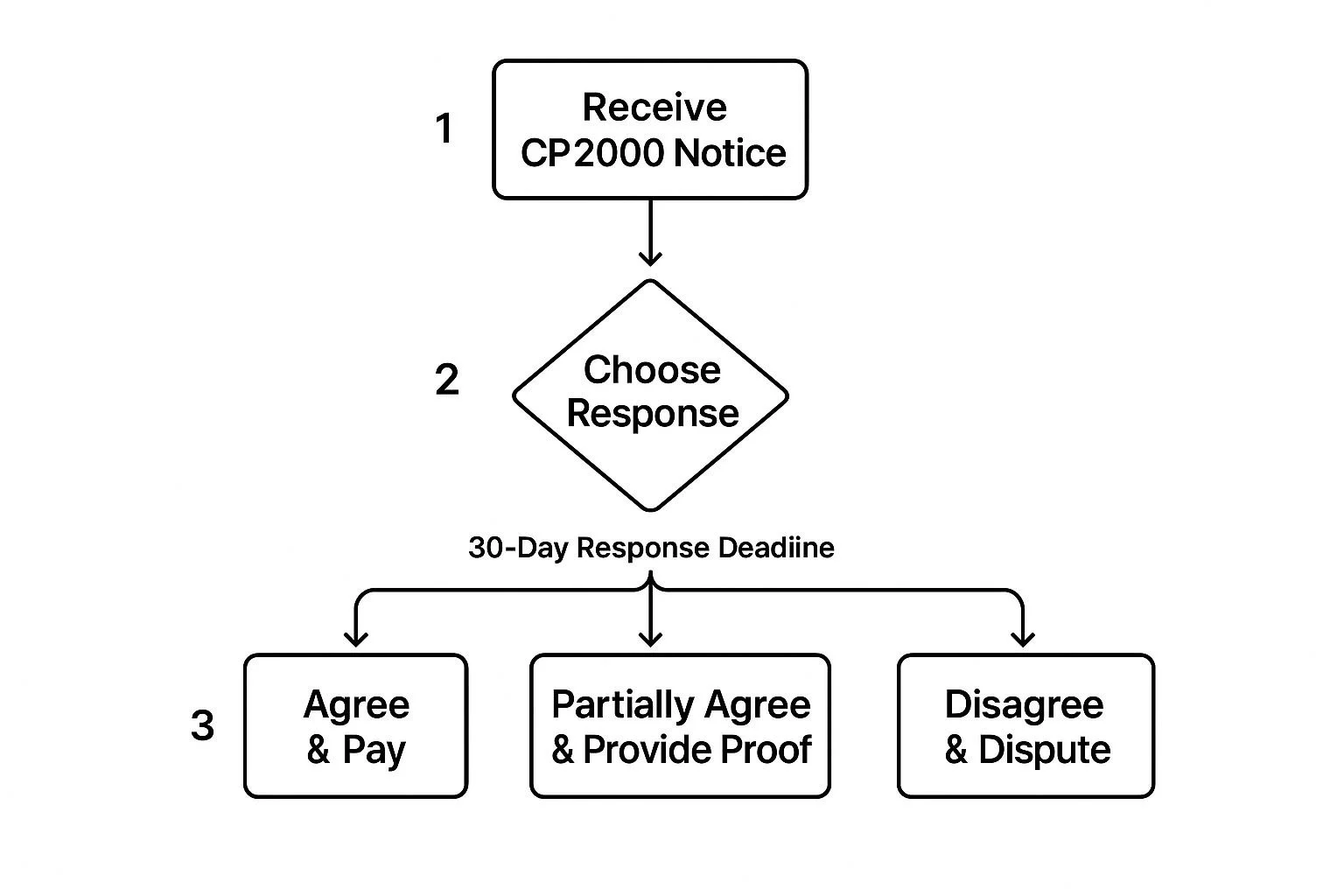
This simple workflow shows the main decision points after receiving a CP2000 notice. As you can see, no matter which option fits your situation, a formal response is the required next step.
Path 1: You Agree with the IRS Changes
This is the most direct route. If you've gone over the notice, checked your own records, and realized, "Yep, they're right," your job is pretty simple.
Fill out the Response Form: Grab the response form that came with your CP2000 notice.
Sign on the Dotted Line: Sign the form to confirm you accept their adjustments.
Settle the Bill: You can pay the total amount online, mail a check with the payment voucher, or look into payment plans if you can't cover it all at once.
Once you agree and pay, you’re accepting the extra tax, interest, and any penalties. For most people, this closes the case.
Path 2: You Partially Agree with the Changes
Sometimes, the truth is somewhere in the middle. Maybe you did forget to report some income, but you also see that the IRS's math is off. A classic example is when they have the proceeds from a stock sale but none of your cost basis information, making your taxable gain look way bigger than it actually was.
In this scenario, you need to be very clear about what you agree with and what you don't. Your response should include:
A Signed Response Form: Make sure to check the box indicating you don't fully agree.
A Detailed Letter: Write a clear explanation that breaks down which parts of the notice are correct and which parts are wrong.
Proof to Back It Up: Include copies of any documents that support your side of the story, like corrected 1099s or brokerage statements that clearly show your cost basis.
This approach takes a bit more work, but it’s crucial for making sure you only pay what you actually owe.
Path 3: You Disagree with the Entire Notice
If you’re convinced the IRS is completely wrong—maybe they've mixed up your information with someone else's or overlooked a major deduction you took—then it's time to build your case. This is where being organized and having your evidence ready is absolutely essential.
When you disagree, your goal is to provide the IRS with irrefutable proof that your original tax return was accurate. You are essentially correcting their records with your own.
To make your case effectively, you'll need to mail back a complete response package. This includes your signed response form (with the "disagree" box checked), a thorough letter explaining exactly why their notice is incorrect, and copies of every single supporting document.
Even though much of the IRS process is automated, a human will eventually review your dispute. So make it easy for them. If the amount of money involved is significant or the details get complicated, bringing in a tax professional is often the smartest move you can make.
What's at Stake? The Financial Consequences
When you get a CP2000 notice, it’s crucial to understand what's really on the line. The numbers on that page aren't just suggestions; they represent real financial consequences that can snowball if you don't handle them correctly. The most obvious hit is the proposed additional tax, which is the starting point of the whole issue.
But that's where the financial pain only begins. The IRS charges interest on any unpaid tax, and here's the kicker: the clock didn't start ticking when you got the notice. Interest starts accruing all the way back from the original tax filing deadline for that year. That means you could already be on the hook for months, or even years, of interest before you've even opened the envelope.
More Than Just Tax: Interest and Penalties
On top of the back-dated interest, the IRS might also tack on an accuracy-related penalty. This is usually a hefty 20% of the underpaid tax. It comes into play if the IRS believes the mistake wasn't just an accident but was due to negligence or a significant understatement of your income tax.
Think of a CP2000 notice like a small leak in a pipe. At first, it's just a manageable drip—the proposed tax. But if you ignore it, that drip turns into a flood of compounded interest, steep penalties, and eventually, more serious collection actions. A quick response is your best bet for damage control.
The High Cost of Doing Nothing
Ignoring a CP2000 notice is, by far, the worst move you can make. If you miss the response deadline, the IRS simply assumes you agree with everything they've proposed. They'll follow up with a Statutory Notice of Deficiency, often called a 90-day letter. This isn't a proposal anymore; it's a formal tax bill, and your options for fighting it become much more limited.
From there, things can escalate to liens on your property, levies on your bank accounts, and other aggressive collection efforts. The CP2000 itself gives you a chance to clear things up before it gets to that point. It lays out exactly what income, deduction, or credit is in question and what the IRS thinks you owe. By responding quickly and accurately, you can often resolve the matter before it spirals out of control. For a deeper dive, you can discover more insights about IRS CP2000 notices on roberthalltaxes.
Understanding the full range of outcomes—from paying the full amount plus penalties to potentially having the entire proposal reversed—is key. It empowers you to make a strategic choice that protects your finances and gets the issue sorted out efficiently.
Common Triggers from Crypto and Gig Economy Income

The way we make money has changed dramatically, and the IRS is playing catch-up. Two of the biggest modern-day minefields for taxpayers are the gig economy and cryptocurrency trading, both of which have become major sources of CP2000 notices.
If you're a freelancer, an independent contractor, or just earning extra cash on the side, you’ll be getting forms like the 1099-NEC and 1099-K. It's surprisingly easy to misplace one from a small job or forget about income you received through a payment app. The problem is, a copy of every one of those forms goes straight to the IRS, creating a digital breadcrumb trail its automated system can easily follow.
If the numbers on their end don't match what you reported, you can bet a notice is on its way.
The Headaches of Crypto Tax Reporting
Cryptocurrency introduces a whole other level of complexity that trips up even savvy investors. A lot of people don't realize that nearly every move you make can be a taxable event.
Did you sell crypto for cash? That's a transaction. Trade Bitcoin for Ethereum? That's one, too. Used some crypto to buy a pizza? You guessed it—another taxable event.
Crypto exchanges are now required to issue Form 1099-B, which reports the gross proceeds from your sales. When you don't report these transactions and the capital gains on your return, the IRS computer sees the income from the 1099-B but nothing from you. That mismatch is an instant trigger for a CP2000.
In 2021, we saw a huge spike in CP2000 notices hitting cryptocurrency traders, right as exchanges got serious about reporting to the IRS. That trend isn’t slowing down. Some experts believe that soon, up to 10% of all these notices could be tied to unreported crypto gains.
The 1099-K Confusion
The Form 1099-K is another big one, and it's causing more confusion every year. These forms come from payment processors like PayPal, Venmo, and Stripe, and they report the gross amount of payments you received.
That’s the key problem. The gross amount doesn't tell the whole story. It doesn't factor in your business expenses, any refunds you issued, or personal payments from friends that got mixed in with your business income.
Failing to properly reconcile the big number on the 1099-K with your actual, taxable net income is practically a guaranteed way to get flagged. The rules around this form have been changing constantly, so staying on top of it is critical.
Common Questions About CP2000 Notices
Even with all the details laid out, seeing an IRS envelope on your doormat can bring up a lot of specific questions. Let's tackle some of the most common things people ask when they're holding a CP2000 notice.
Is a CP2000 Notice the Same as an Audit?
No, and that's a really important distinction. A CP2000 notice isn't a full-blown tax audit.
Think of it more like an automated flag. The IRS computer systems found a mismatch between the income reported under your Social Security number and what you put on your tax return. It's handled entirely by mail and focuses on that one specific discrepancy. A formal audit, on the other hand, is a much deeper, more thorough examination of your entire financial picture.
What if the Information on the CP2000 Is Wrong?
It happens. The information the IRS has might be incorrect, or they might have misinterpreted something. If that's the case, you need to respond and set the record straight.
On the response form, you'll check the box that says, "I do not agree." Then, you need to attach a clear, simple letter explaining exactly why the IRS is wrong. The key is to back up your explanation with proof. Include copies—never send your originals—of any documents that support your claim, like a corrected Form 1099, bank statements, or other financial records.
Can I Request More Time to Respond?
Absolutely. The critical part is to ask for an extension before your original deadline passes.
Find the phone number on the notice and give the IRS a call. Calmly explain your situation and why you need more time to gather your documents and prepare a proper response. It is always, always better to officially request an extension than to simply ignore the deadline. If you don't respond, the IRS will just assume you agree with their proposed changes.
Should I Hire a Tax Professional to Help?
For a simple, clear-cut issue, you might be able to handle it yourself. But if the notice involves a significant amount of money, a complex transaction, or you just feel out of your depth, bringing in a professional is a wise investment.
A qualified CPA, tax attorney, or Enrolled Agent speaks the IRS's language. They know how to structure the response, what documents to include, and can communicate directly with the agency on your behalf. Their expertise can make all the difference in getting the best possible outcome.
Navigating IRS issues can be stressful, but you don't have to do it alone. Attorney Stephen A Weisberg starts with a FREE Tax Debt Analysis to determine exactly how we can help before you ever pay a fee. Visit us at weisberg.tax to get the expert help you need.
Want to understand your options before you call anyone?
Download my free book — Freedom From Tax Debt — a plain-language guide to how the IRS collections process actually works and what resolution really looks like.
➥ Contact Attorney Stephen A. Weisberg for a free Tax Debt Analysis.
Contact Me Here: https://www.weisberg.tax/contact-1
Email: s.weisberg@weisberg.tax
Phone/Text: (248) 971-0885
Address: 300 Galleria Officentre, Suite 402, Southfield, MI 48034
