How to Stop Garnished Wages Today – Expert Tips
If you want to stop your wages from being garnished, you have to act fast. Your best move—whether it's filing an exemption, negotiating with the creditor, or even considering bankruptcy—depends entirely on why your paycheck is being docked in the first place. Figuring that out is the crucial first step.
Why Is Your Paycheck Being Garnished?
A garnishment notice doesn't just materialize out of thin air. It’s usually the final move a creditor makes to collect a debt after a legal process has already played out. To effectively fight back and reclaim your full paycheck, you first have to trace the garnishment back to its source.

For most consumer debts—think credit cards, personal loans, or medical bills—the creditor can't just start taking your money. They have to sue you and win a judgment in court first. Only after a judge issues a court order can they legally force your employer to withhold part of your wages. This means there was a lawsuit leading up to this, even if you weren't fully aware of it at the time.
But that's not the only way it can happen.
Court-Ordered vs. Administrative Garnishments
The path to a garnished paycheck isn't always the same. The big difference comes down to whether a court was involved or if a government agency acted on its own.
Court-Ordered Garnishments are the standard for private debts. A creditor, like a bank or hospital, must take you to court and get a judge’s approval.
Administrative Garnishments are a different beast entirely. Federal and state agencies, like the IRS for back taxes or the Department of Education for defaulted student loans, can often skip the courthouse. They have the authority to garnish your wages directly.
This is a critical distinction. Government agencies can move much faster, which is why a tax levy or student loan garnishment can feel like it came out of nowhere. There's no lawsuit to serve as a warning. Child support orders also follow their own streamlined process, typically managed through state agencies.
Key Takeaway: The first thing you need to do is identify who is garnishing your wages and for what type of debt. The strategy for fighting a credit card company is completely different from how you'd handle the IRS.
To help you figure out what you're up against, here's a quick breakdown of the common types of wage garnishment. This table compares the triggers and legal requirements for each, which can point you toward the right solution.
Common Types of Wage Garnishment
| Type of Debt | Requires Court Order? | Typical Garnishment Limit | Key Action to Stop It |
|---|---|---|---|
| Credit Cards & Medical Bills | Yes | Up to 25% of disposable income | File a Claim of Exemption, negotiate a payment plan, or bankruptcy. |
| Federal Student Loans | No | Up to 15% of disposable income | Request a hearing, enter a loan rehabilitation program, or apply for forbearance. |
| Back Taxes (IRS Levy) | No | Varies based on filing status and dependents | Set up an IRS payment plan, file for Offer in Compromise, or prove financial hardship. |
| Child & Spousal Support | Yes (Part of the support order) | Up to 50-60% of disposable income | Petition the court to modify the support order due to a change in circumstances. |
Understanding these differences is essential because each path requires a unique response. You can't treat an IRS levy like a credit card judgment.
The Bigger Picture of Wage Garnishment
It's also helpful to know that wage garnishment trends often follow the economy. Just before the pandemic hit in March 2020, the U.S. wage garnishment rate peaked at 3.9%. But thanks to federal relief programs, like the pause on student loan collections, that number fell to 2.8% by January 2024.
This data, highlighted in ADP's research on garnishment trends, shows just how much government policy can affect our paychecks. It’s also a reminder of how vulnerable income sources can be, raising important questions about whether pensions can be garnished in certain situations.
Your First Moves to Protect Your Income
Getting a wage garnishment notice can feel like a punch to the gut. It's a critical moment, and I've seen firsthand how people react—often with panic. But the key is to move quickly and strategically, because your first few actions can make all the difference.
Your most powerful immediate defense is almost always found within the court system. This isn’t about fighting a losing battle; it's about asserting your legal rights.
Filing a Claim of Exemption
The first tool in your toolbox is a legal document called a Claim of Exemption. Think of this as your formal objection to the court. You're not just saying you can't afford it; you're officially arguing that some, or even all, of your income is legally protected from being taken.
You’re essentially telling the judge that garnishing your wages would cause an unreasonable hardship or that the money itself is shielded by state or federal laws. Don't just assume the garnishment is a done deal. I've worked with many clients who successfully stopped it cold by proving their income was exempt.
Some of the most common grounds for an exemption include:
Head of Household Status: If you’re the primary financial support for a child or another dependent (providing more than half their support), your income often gets extra protection.
Receiving Protected Benefits: Money from sources like Social Security, disability payments, veteran's benefits, or unemployment is typically untouchable for most creditors.
Low Income: Your earnings might simply be below the legal threshold that can be garnished. Both federal and state laws set a minimum amount you must be left with.
If you believe the garnishment is based on a mistake or is just plain unlawful, writing an effective appeal letter is a great way to formally state your case and build a paper trail.
A successful Claim of Exemption doesn't just chip away at the garnishment amount—it can stop it completely. The court has to review your claim before the creditor can touch your paycheck, buying you precious time to defend your income.
This visual guide breaks down the core process of protecting your wages, from figuring out your legal protections to getting the right paperwork filed.
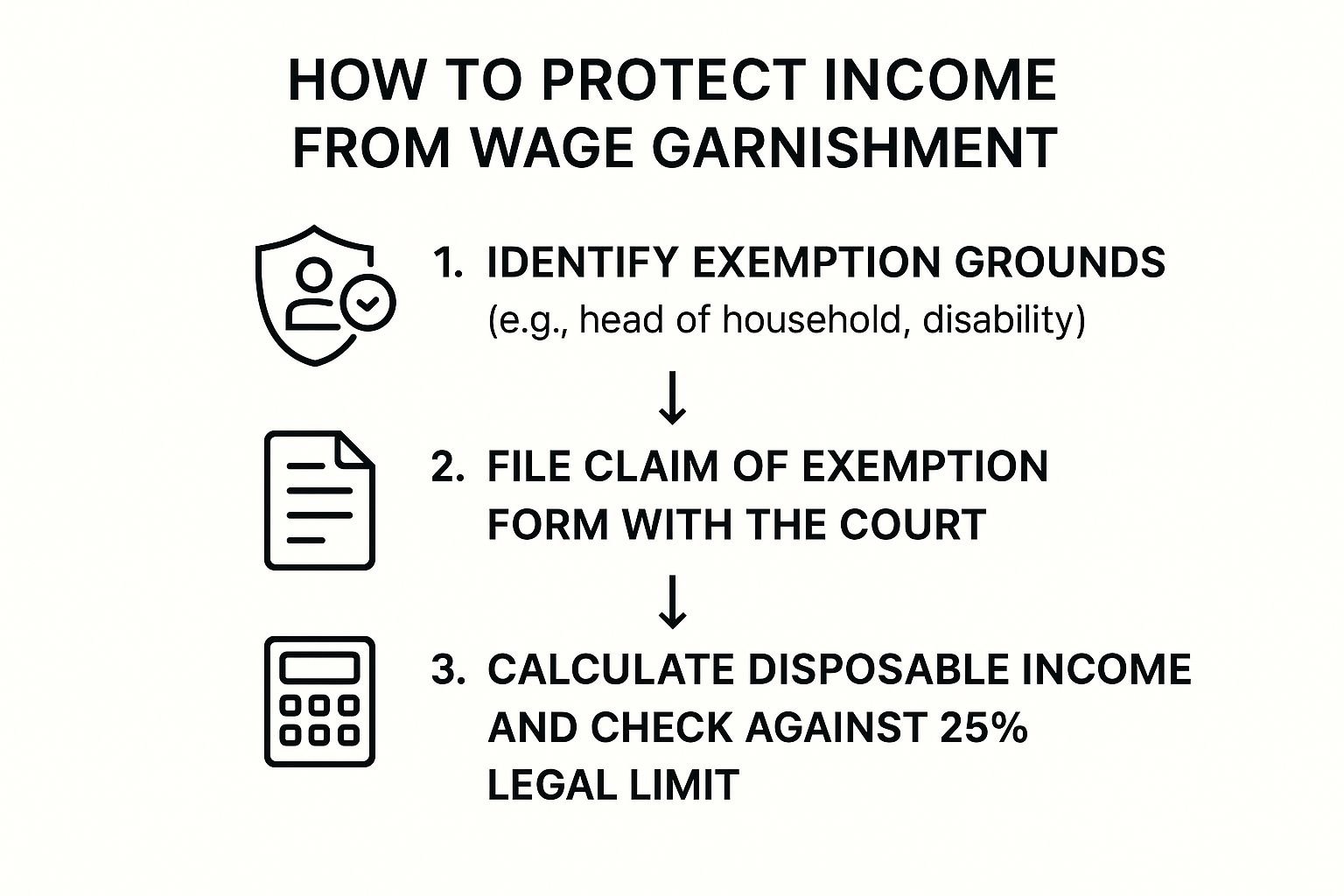
As the infographic shows, this is a methodical process. It starts with understanding what the law says they can and can't do.
Understanding the Legal Limits
Another crucial piece of the puzzle is doing the math yourself. You need to calculate your disposable income and see if the amount they're trying to take is even legal. Disposable income isn't your total paycheck; it's the amount left after legally required deductions like federal, state, and local taxes are taken out.
For most consumer debts, like credit cards or personal loans, federal law caps the garnishment at 25% of your disposable income.
Let's say your weekly disposable income is $600. The absolute most a creditor could legally take for that old credit card debt is $150 per week (25% of $600). If they try to take a penny more, you have a solid legal basis to object. Knowing this number is your shield against illegal or excessive deductions.
Be aware, though, that federal debts are a different beast. If you're dealing with the IRS or defaulted student loans, the rules are more aggressive. For tax debt, you might need to explore specialized solutions, like getting your account declared, which can pause collections while you get back on your feet.
Handling Federal Debt Garnishments
When a federal agency like the IRS or the Department of Education comes after your wages, the rules of the game change entirely. Private creditors have to take you to court and get a judgment before they can touch your paycheck. The federal government? They can often skip that step and go directly to your employer.
It’s no wonder these garnishments often feel like they come out of nowhere.

This powerful process is called an administrative wage garnishment, and it gives the government a massive advantage. But don't mistake that power for a lack of options—you still have rights and clear paths to stop the deductions and get back on your feet.
Defaulted Federal Student Loans
If you've defaulted on a federal student loan, the government doesn't need a judge's permission to start garnishing your wages. They can simply order your employer to start withholding money.
Federal student loan collections are a different beast from consumer debt. The government can legally take up to 15% of your disposable income without a court order. This administrative power puts millions of Americans in a tough spot, especially since the pandemic-era student loan protections have ended.
If you’re facing this, you’re not powerless. Here are a few solid strategies to stop a student loan garnishment:
Request a Hearing: You have a legal right to challenge the garnishment. In a hearing, you can argue that the debt isn't valid or, more commonly, that the garnishment would cause you and your family extreme financial hardship.
Loan Rehabilitation: This is often the best route out of default. You’ll agree to make nine affordable monthly payments over a ten-month period. Once you complete the program, the garnishment stops, and the default is even removed from your credit report.
Loan Consolidation: Another strong option is to bundle your defaulted loans into a new Direct Consolidation Loan. This immediately gets you out of default, halts the garnishment, and can make you eligible for more manageable income-driven repayment plans.
Dealing with IRS Tax Levies
When it comes to creditors, the IRS is in a league of its own. An IRS wage levy doesn't follow the usual percentage limits that other garnishments do. Instead, they calculate a specific amount you need for basic living expenses—based on your filing status and dependents—and they can take pretty much everything else.
Key Insight: From my experience, the IRS would much rather work with you to resolve a tax debt than force a levy. A levy is usually their last move after they haven't heard from you. Being proactive is your single best defense.
The good news is that the IRS has several well-established programs designed to help taxpayers get back in good standing and stop a wage levy.
Offer in Compromise (OIC): This is an agreement that lets you settle your tax debt for less than the total amount you owe. If the IRS accepts your OIC, the levy is released.
Installment Agreement: Think of this as a formal payment plan. You agree on a monthly payment amount, and as long as you stick to it, the IRS won't touch your wages.
Currently Not Collectible (CNC) Status: If you can prove that you truly cannot afford to pay for basic living expenses like housing and food, the IRS may place your account in CNC status. This temporarily pauses all collection activity, including wage levies.
Understanding the employment law and compliance landscape is crucial when you're dealing with federal actions.
Go Straight to the Source: Negotiate With Your Creditors

While filing court papers has its place, sometimes the most direct path to stopping a wage garnishment is simply picking up the phone. It sounds odd, I know—calling the very people you owe money to. But opening a direct line of communication with your creditor or their attorney can be a surprisingly powerful move.
Here’s something most people don't realize: creditors often see garnishment as a last resort. For them, it’s an expensive and drawn-out legal headache. If you can come to the table with a reasonable alternative, you’ll find they are often more than willing to listen.
Putting a Realistic Offer on the Table
Your mission is to find a solution that works for everyone. This usually means proposing either a lump-sum settlement or a new, voluntary payment plan. Each path requires a slightly different approach.
The Lump-Sum Settlement: This is your big move—offering to pay a single, reduced amount to wipe the slate clean. Creditors love this option because it’s guaranteed money in their pocket right now. For a debt of $8,000, for instance, you might offer $4,500 to settle it once and for all.
The Voluntary Payment Plan: Don't have a chunk of cash on hand? Propose a new payment schedule you can actually stick to. This demonstrates good faith and provides the creditor with a steady income stream, saving them the trouble of managing a garnishment.
When you make that call, be ready to talk specifics about your finances. Have your income and expenses laid out clearly. This isn't about making excuses; it's about showing them, with hard numbers, what you can genuinely afford. This tactic can even work with government agencies.
Key Takeaway: From a creditor's perspective, a guaranteed settlement today is often better than a long, uncertain garnishment process. Your willingness to negotiate is your biggest asset in getting them to halt the garnishment.
Know Your Leverage
In negotiations, timing is key. Creditors are dealing with a massive administrative load, especially with so many people facing financial hardship. This became incredibly clear when TransUnion estimated that up to two million student loan borrowers could face garnishment when the payment pause ended. You can read more about these startling wage garnishment predictions at Fortune.
This huge wave of cases actually gives you some leverage. You can position your offer as a quick and easy way for an overworked collections department to close a file. Frame it as a true win-win: they get their money without the hassle, and you get to stop the garnishment before it wreaks havoc on your finances.
When Bankruptcy Becomes the Best Way to Stop a Garnishment
So, you’ve tried negotiating with your creditors, you've filed every exemption claim you can think of, and still, that garnishment is eating away at your paycheck. It’s easy to feel like you’ve hit a wall.
But for many people who are truly overwhelmed by debt from multiple places, bankruptcy isn't just a last resort—it’s a powerful and immediate legal solution. It's not about giving up; it's about using the strongest tool available to get your financial life back.
The moment you file for bankruptcy, a legal protection called the automatic stay kicks in. Think of it as a legal stop sign. This powerful court order immediately freezes most collection efforts against you. Creditors, collection agencies, and even the IRS have to back off. The phone calls, the lawsuits, and most importantly, the wage garnishment must stop.
The Immediate Relief of the Automatic Stay
The automatic stay is designed to give you instant breathing room. It’s not a polite request; it’s a federal mandate that creditors must obey. This gives you time to get your finances in order without the constant stress of money being taken from your check.
Let's say a creditor has a judgment against you and has been taking 25% of your disposable income every single pay period. The very day your bankruptcy petition is filed with the court, your attorney can notify your employer to halt the deductions. The protection is sweeping and shields you while your case moves forward.
Pro Tip: It's sometimes possible to claw back money that was garnished within the 90 days before you filed for bankruptcy. An experienced attorney can argue that these payments were "preferential transfers," meaning one creditor was unfairly paid ahead of others. You could potentially get that money back.
Chapter 7 vs. Chapter 13: Which Path Is Right?
Bankruptcy isn't a one-size-fits-all solution. Both major types of personal bankruptcy will stop a garnishment cold, but they work in fundamentally different ways. Knowing the difference is crucial.
Chapter 7 Bankruptcy
This is often what people think of when they hear "bankruptcy." It’s known as a "liquidation" or "fresh start" because its main goal is to wipe the slate clean of most unsecured debts.
What it achieves: It completely eliminates debts like credit card balances, medical bills, and old personal loans.
Best for: People with lower income and fewer assets. You’ll have to pass a "means test" to show that you genuinely can't afford to pay back what you owe.
The result: After a few months, your debts are discharged, and the garnishment is gone for good.
Chapter 13 Bankruptcy
Instead of wiping out debt, Chapter 13 is a "reorganization." You work with the court to create a structured repayment plan you can actually afford.
What it achieves: It bundles all your debts into one manageable monthly payment that you make over three to five years.
Best for: Individuals with a steady income who have assets to protect, like a house they don't want to lose to foreclosure, or those who earn too much to qualify for Chapter 7.
The result: The garnishment stops right away. You then follow the court-approved plan to repay a portion of your debt over time.
Filing for bankruptcy is a major decision, and it’s not something to jump into lightly. The process is complex, and getting advice from a qualified bankruptcy attorney is essential. But when you’re drowning in debt, it provides a clear, legal, and definitive way to stop a wage garnishment and start fresh.
Answering Your Top Questions About Wage Garnishment
If you’re facing a wage garnishment, you probably have a million questions running through your head. It’s a stressful, often confusing situation, but I promise you, you're not the first person to go through this. Getting clear answers is the first real step toward taking back control.
Let’s tackle some of the most common—and urgent—questions people ask when they're trying to figure out how to stop garnished wages.
Can They Fire Me for This?
This is usually the first question I hear, and it’s a completely valid fear. The short answer is no, not for a single garnishment.
Thanks to the federal Consumer Credit Protection Act (CCPA), your employer can't legally fire you because of one garnishment order. Your job is protected in that scenario.
But—and this is a big but—that protection has its limits. The federal law doesn't necessarily shield you if you have two, three, or more garnishments from different creditors piling up. Some states do offer more robust protections for employees, so it’s always smart to look into your specific state's labor laws to know exactly where you stand.
How Much of My Paycheck Can They Actually Take?
Creditors can't just drain your bank account. Federal law is very clear about the maximum amount they can take for most types of consumer debt, like credit cards or personal loans.
The law sets a cap. They can only take the lesser of two amounts:
25% of your weekly disposable earnings.
The amount your disposable earnings exceed 30 times the federal minimum wage.
The key phrase here is "disposable earnings." That’s the money left in your paycheck after mandatory deductions like federal, state, and local taxes have been taken out. It doesn't include things like health insurance or retirement contributions.
Be aware, though, that these limits change for other types of debt. Garnishments for student loans (up to 15%), back taxes, or child support can take a much bigger bite out of your income.
What If I Just Ignore the Garnishment Notice?
Ignoring a garnishment notice is, without a doubt, the worst move you can make. It won't make the problem disappear; it will only make it worse.
By the time you get that notice, the creditor has already won in court. They have a legal judgment, and your employer is now legally obligated to follow that court order and start withholding your pay.
If you do nothing, the garnishment starts automatically. You forfeit your right to claim exemptions, challenge the debt amount, or even try to negotiate a better deal with the creditor. Time is of the essence, and acting fast is your best defense.
Do I Really Need to Hire a Lawyer?
Not always, but it can make a huge difference. You can absolutely try to handle it yourself first. Many people successfully file exemption claims or negotiate directly with their creditors without ever speaking to an attorney.
However, if your situation gets complicated, it’s time to call in a professional. I strongly recommend getting legal help if you have to go to a court hearing, if you think the debt itself is wrong or fraudulent, or if you're exploring bankruptcy as a way out. An experienced attorney knows the system, protects your rights, and can find solutions you might not see on your own.
Facing a wage garnishment can be overwhelming, but you have more options than you think. At Attorney Stephen A Weisberg, I start with a FREE Tax Debt Analysis to see if and how I can help before you ever pay a fee. Find out your best path forward by visiting weisberg.tax today.
Want to understand your options before you call anyone?
Download my free book — Freedom From Tax Debt — a plain-language guide to how the IRS collections process actually works and what resolution really looks like.
➥ Contact Attorney Stephen A. Weisberg for a free Tax Debt Analysis.
Contact Me Here: https://www.weisberg.tax/contact-1
Email: s.weisberg@weisberg.tax
Phone/Text: (248) 971-0885
Address: 300 Galleria Officentre, Suite 402, Southfield, MI 48034
