Your Guide to IRS Not Collectible Status
When the IRS says you owe them money, the pressure can feel immense. But what happens when you genuinely can't afford to pay? This is where a lesser-known but vital IRS provision called Currently Not Collectible (CNC) status comes into play.
Think of it as a financial pause button. It’s not a get-out-of-jail-free card, but it is an official acknowledgment from the IRS that, right now, you don't have the means to pay your tax debt and cover your basic living expenses. It’s designed to give you breathing room when you need it most.
What Does “Currently Not Collectible” Really Mean?

Let’s be honest, getting a notice from the IRS is stressful. The fear of bank levies or having your wages garnished can be paralyzing. CNC status is the government’s way of saying, "We see you're in a tough spot, and we'll stand down for now."
Imagine your income is water flowing into a bucket. Every month, you have essential costs like rent, groceries, and medical bills that act as holes in that bucket. If your income just barely covers those holes, the bucket stays empty. When the IRS grants CNC status, they’re recognizing that trying to take any more water would leave you completely dry.
Hitting Pause On Aggressive Collections
Once you're officially placed in Currently Not Collectible status, the IRS agrees to temporarily stop its collection efforts. This isn’t a random decision; it’s based on a detailed financial analysis that proves you can't afford to pay.
Here's what that pause looks like in real life:
No More Levies or Garnishments: They'll stop seizing money from your bank accounts or taking a chunk of your paycheck.
The Threatening Letters Stop: You get a break from the relentless, scary collection notices.
Time to Regroup: It provides a crucial window to stabilize your finances without the immediate threat of enforcement.
The standard for this is genuine financial hardship. As outlined in IRS Policy Statement 5-71, taking your money would prevent you from meeting necessary living expenses—it's not for a mere inconvenience. You can find a deeper dive into what qualifies as hardship on the Choice Tax Relief website.
To put it all in one place, here's a quick summary of what CNC status involves.
CNC Status at a Glance
This table breaks down the key aspects of Currently Not Collectible status, from what happens when it's granted to what you can expect down the road.
| Feature | What It Means for You |
|---|---|
| Collection Activity | All active collection efforts, like levies and garnishments, are stopped. |
| Tax Debt | The debt itself is not forgiven. It remains on your account. |
| Interest & Penalties | They continue to add up, so the total amount you owe will grow over time. |
| Tax Refunds | The IRS will still seize any future tax refunds and apply them to your outstanding debt. |
| Federal Tax Lien | A Notice of Federal Tax Lien may still be filed or remain in place, affecting your credit. |
| Financial Review | The IRS will periodically review your financial situation to see if your ability to pay has improved. |
As you can see, CNC is a powerful tool for immediate relief, but it comes with important caveats.
Crucial Point: This is a temporary solution, not a permanent one. Your tax debt doesn't just vanish. Interest and penalties keep piling up, and the IRS will check in on your finances periodically to see if you can start paying again.
Think of it as a truce. The war on your tax debt isn't over, but the active fighting is on hold. This gives you an invaluable chance to get your financial life back on track and figure out a long-term plan.
How the IRS Decides If You Qualify

Getting the IRS to place your account into Currently Not Collectible status isn't a matter of just telling them you can't pay. The agency doesn't make decisions based on emotion; it's all about the numbers. They essentially run a financial stress test on your budget to see if paying your tax debt would genuinely push you over the edge and prevent you from covering basic living costs.
This whole process boils down to one simple question: what is your real ability to pay? The IRS isn't just looking at the top-line number on your paycheck. They're digging into what’s actually left after you’ve paid for necessities. It's a very detailed analysis designed to separate true financial hardship from a tight budget.
To get this complete financial picture, the IRS requires you to lay all your cards on the table. This is done through official forms like the Collection Information Statement (either Form 433-F or 433-A). Think of this form as your financial autobiography, detailing everything from your income and assets to your monthly expenses.
The Role of Allowable Living Expenses
The absolute core of the IRS’s decision-making process is a concept called allowable living expenses. The IRS won't just accept your personal budget at face value. Instead, they measure your claimed expenses against a set of national and local standards for what it costs to live.
It’s like they have a standardized budget template. The IRS has already figured out what it should reasonably cost a person or family to get by in your specific county or metropolitan area. This creates a level playing field and prevents people from claiming wildly inflated expenses to get out of their tax debt.
These standards cover the absolute basics needed for day-to-day life:
Housing and Utilities: This includes your rent or mortgage, property taxes, insurance, and basic utilities like gas and electricity, all based on the average costs for your family size in your area.
Food and Clothing: The IRS uses a national standard to determine a reasonable budget for groceries, cleaning supplies, and basic clothing.
Transportation: This covers the cost of getting to and from work, whether it’s a bus pass or the ownership and operating costs for a vehicle, again based on regional data.
Healthcare: You can include your out-of-pocket medical costs, like insurance premiums, co-pays, and prescriptions.
The IRS agent will add up these standardized expenses and subtract that total from your gross monthly income. The number that's left is what they consider your disposable income—the amount they believe you could, in theory, send them each month.
The Key Takeaway: If your monthly income is less than or equal to the total of your IRS-approved allowable living expenses, you have a very strong argument for financial hardship. That’s the hard data the IRS needs to approve your request for Currently Not Collectible status.
A Real-World Example of CNC Qualification
Let’s walk through a quick scenario to see how this works in the real world. Meet the Smith family—two parents, two kids. Mr. Smith’s hours at his construction job were just cut, dropping their monthly income from $5,500 down to $4,200. To make matters worse, they just had an unexpected medical issue and now have a new $400 monthly payment plan.
Here’s a simplified look at how the IRS would break down their finances:
| Financial Factor | Smith Family's Reality | IRS Allowable Standard |
|---|---|---|
| Monthly Income | $4,200 | N/A |
| Housing & Utilities | $1,850 | $1,900 (Local Standard) |
| Food & Clothing | $1,100 | $1,050 (National Standard) |
| Transportation | $650 | $600 (Local Standard) |
| Healthcare Costs | $500 | $500 (Actual Expense) |
| Total Expenses | $4,100 | $4,050 |
In this example, the IRS calculates the family's total allowable living expenses at $4,050. After subtracting that from their $4,200 income, the Smiths are left with a net disposable income of just $150 per month.
Since that $150 is barely enough to make a dent in a significant tax debt, the IRS would almost certainly agree that forcing them to pay would cause an economic hardship. The Smiths are prime candidates for Currently Not Collectible status.
Ultimately, the IRS is focused on your ability to pay, which is determined by your disposable income. Knowing how to properly calculate disposable income gives you a massive advantage because you can see your own financial situation through the same lens the IRS will use.
Your Step-By-Step Guide to Requesting CNC Status
Dealing with the IRS can feel intimidating, but asking for Currently Not Collectible (CNC) status is a much more straightforward process than you might think. It really comes down to open communication and providing a clear, honest picture of your financial situation. Think of it less as a confrontation and more as a presentation of facts.
Your goal is to show the IRS, with proof, that you simply don't have the money to pay your tax debt after covering your basic living expenses. Let's walk through exactly how to do that.
This graphic breaks down the entire process into three core stages, from your initial homework to getting a final decision.
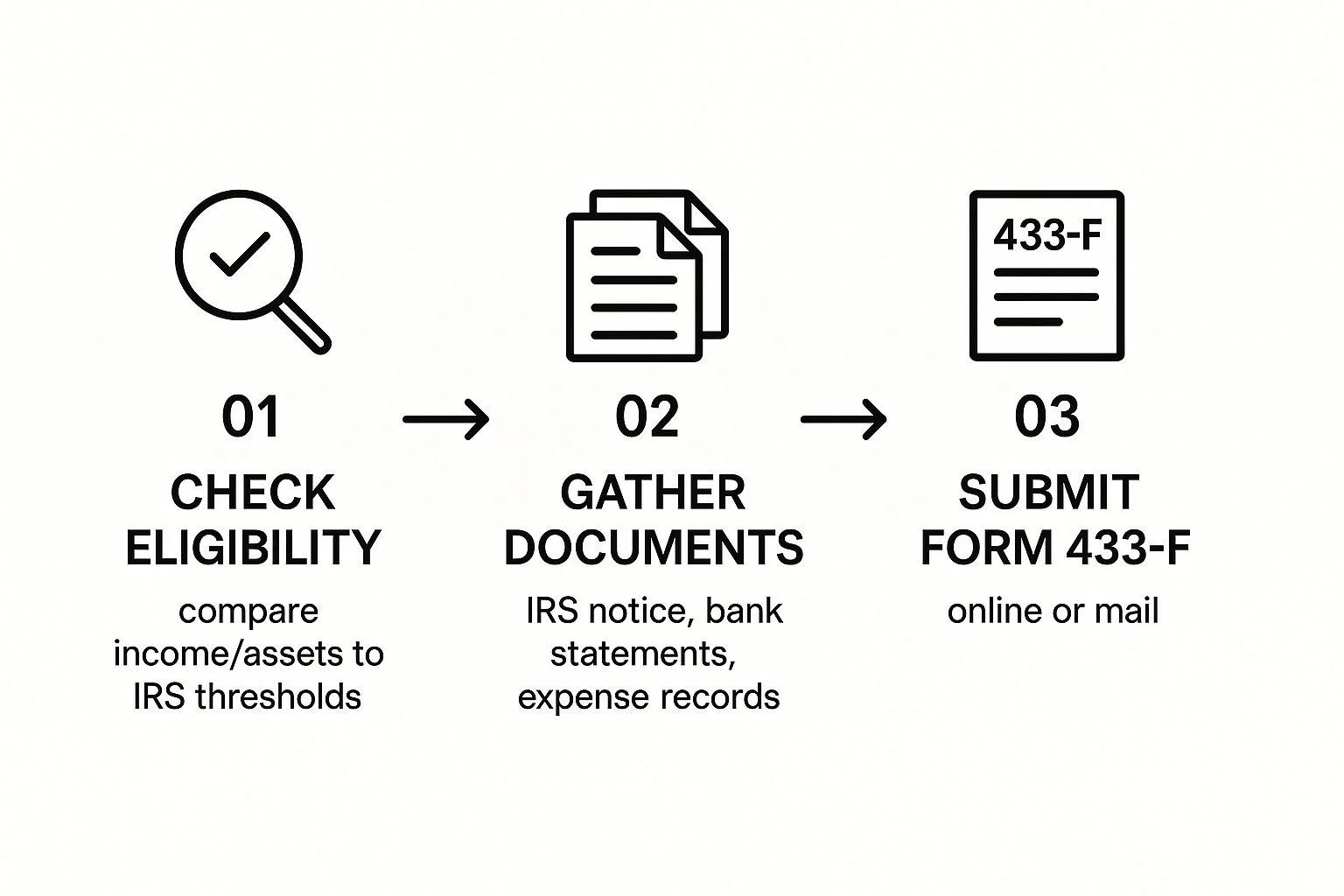
Seeing it laid out like this helps simplify what's ahead and shows you the key milestones you'll need to hit.
Step 1: Contact the IRS and State Your Intent
The first real step is to get on the phone with the IRS. Find the number on your most recent collection notice and give them a call.
When you get an agent on the line, just tell them you need to be considered for Currently Not Collectible status because of a financial hardship. This call gets the ball rolling. The agent will probably ask a few basic questions about your job and finances to see if you're in the right ballpark before telling you what comes next.
Step 2: Gather Your Financial Documents
This part is the most labor-intensive, but it’s also the most important. The IRS won't just take your word for it; they need to see the numbers. You’re essentially building a case file that proves you can’t afford to pay.
Here’s a quick checklist of what you'll need to pull together:
Proof of Income: Your last 3 to 6 months of pay stubs are perfect. If you’re self-employed, a profit and loss statement for the year will work.
Bank Statements: Grab the last few months of statements for every checking and savings account you have.
Proof of Expenses: This means copies of your mortgage or rent statements, utility bills, car payments, insurance bills, and any major medical expenses.
Asset Information: You'll need to list any major assets like property or vehicles, including what they're worth and how much you still owe on them.
Getting all this organized ahead of time will make the next step a thousand times easier and shows the IRS you're taking this seriously.
Step 3: Complete the Collection Information Statement
The main event of your request is filling out a Collection Information Statement. For most people, this will be Form 433-F. This is the official form where you lay out all the financial details you just gathered.
The form asks for a complete breakdown of your income, assets, and all of your monthly living expenses. Be brutally honest and triple-check your numbers. The IRS will be comparing this information against the documents you provide and the data they already have on file.
Expert Tip: The IRS isn't making an emotional decision. They run your numbers through a strict formula to see if your allowable expenses leave any money for tax payments. Their decision to grant CNC status is based entirely on this data.
After you fill out Form 433-F, you’ll send it in with all your supporting documents. An IRS agent will review everything, and they might call you to ask some follow-up questions. If they agree that your finances are as tight as you’ve shown, they’ll approve your request and officially place your account into CNC status.
What Life Is Like with CNC Status

Getting the IRS to grant you Currently Not Collectible status can feel like the sun breaking through the clouds after a long, dark storm. That initial wave of relief is immense, and for good reason. Once your request is approved, the most aggressive and frightening collection tactics stop cold.
Think of it as the IRS hitting the pause button on its collection machine. That constant, heavy threat hanging over your head is finally lifted, giving you the breathing room you desperately need to get back on your feet.
The biggest, most immediate change is the end of enforced collections. This means you no longer have to live in fear of waking up to a frozen bank account or seeing a huge chunk of your paycheck disappear. For most people, this is the most critical benefit, as it lets them use their money for what it's meant for—rent, food, and other basic necessities.
The Good: The Pause Button Effect
The day-to-day pressure just evaporates. You're no longer constantly looking over your shoulder, worrying about the IRS seizing your assets. This alone can do wonders for your mental and emotional health. That sense of stability is exactly what the CNC program is designed to provide.
Here's what you can expect right away:
No More Levies or Garnishments: The IRS will stop taking money directly from your bank accounts and paychecks.
The Calls and Letters Stop: That relentless stream of intimidating notices and calls from collectors will go silent.
Time to Rebuild: You get a crucial window of time to work on the financial issues that got you here in the first place, without the IRS making things worse.
This pause isn't just a break; it's a lifeline. It lets you shift your focus from simply surviving IRS enforcement to actually improving your financial situation.
The Not-So-Good: The Debt Doesn't Disappear
It is absolutely critical to understand that CNC status is a temporary timeout, not a get-out-of-jail-free card. Your tax debt is not forgiven or canceled. While the collection activity stops, the debt itself is still there, and it's actually growing.
The CNC designation effectively removes these accounts from the IRS’s active inventory but does not eliminate the debt. Interest and penalties continue to accumulate, and the IRS may apply any future tax refunds to outstanding balances.
This is the catch. The total amount you owe keeps ticking upward because interest and penalties don't stop accruing. The IRS doesn't just forget about the money you owe; the account is simply moved to a different status.
On top of that, the IRS will automatically intercept any future tax refunds you’re owed and apply them to your tax bill. This will happen every single year you remain in CNC status until the debt is paid in full.
Lingering Consequences and Future Reviews
Even with active collections on hold, the IRS can still take actions to protect its claim on your money. One of the most common is filing a Notice of Federal Tax Lien. This is a public legal claim against your property, and it comes with some serious baggage.
Credit Damage: A tax lien will hammer your credit score, making it much harder to qualify for a car loan, mortgage, or even a credit card.
Selling Property: If you try to sell a house or other major asset, the IRS gets its money from the sale proceeds before you see a dime.
Finally, CNC status is not a "set it and forget it" deal. The IRS will periodically check in on you, usually every one to two years. They'll likely send a notice asking for an updated financial statement to see if your income has gone up or your expenses have come down. If they decide you can now afford to pay, they'll pull you out of CNC status and expect you to start a payment plan. It’s also on you to stay current with all new tax filings and payments—one misstep, and your CNC status can be revoked immediately.
Comparing CNC to Other Tax Relief Options
When you're buried under a mountain of tax debt and can't see a way out, getting the IRS to declare your account Currently Not Collectible feels like a lifesaver. But it’s important to understand that CNC is just one tool in the IRS relief toolkit. Each program—CNC, an Installment Agreement, or an Offer in Compromise—is built for a very specific financial situation.
Let’s break it down with a simple analogy:
CNC Status is the emergency "pause button." You press it when your financial situation is so dire you can't afford any payments right now without falling behind on essentials like rent or food.
An Installment Agreement (IA) is your standard "payment plan." It's for people who can't pay the full amount today but can chip away at it with steady monthly payments over time.
An Offer in Compromise (OIC) is the "settlement deal." This is for taxpayers who can prove they'll likely never be able to pay the full debt, offering a lump sum to wipe the slate clean for good.
Choosing the right path isn't a guessing game; it's about taking an honest look at your finances—both today and what you realistically expect in the future.
CNC vs. an Installment Agreement (IA)
For many people, the first instinct is to set up a payment plan. An Installment Agreement seems straightforward: you agree to make monthly payments for up to 72 months until the debt is gone. Simple, right?
The problem is, people often commit to payments they can't actually afford. They look at the debt, panic, and agree to a number without truly stress-testing their budget. The Taxpayer Advocate Service found that a staggering 36% of taxpayers who signed up for "streamlined" payment plans were likely putting themselves in economic hardship. They were agreeing to pay the IRS money they needed for basic living expenses, which is a recipe for default.
This is precisely where CNC status is the smarter move. If your income minus your necessary living costs leaves nothing on the table, an IA is just setting you up to fail. CNC provides the breathing room that an Installment Agreement simply can't.
CNC vs. an Offer in Compromise (OIC)
The Offer in Compromise (OIC) is often considered the "holy grail" of tax relief—a chance to settle a massive tax bill for pennies on the dollar. An OIC offers what everyone wants: finality. Once it's accepted, the debt is resolved forever. But this incredible benefit comes with an incredibly high bar for approval.
To get an OIC, you have to convince the IRS that there’s almost no chance they could ever collect the full amount you owe before the time limit on collections runs out. This involves a deep, intrusive dive into every corner of your financial life. The process is tough, and the IRS rejects far more offers than it accepts.
CNC, on the other hand, is about pausing, not settling. It’s far easier to qualify for if you can show you’re in a tough spot right now. In many cases, CNC can be a strategic first step, giving you the time and space to get your finances in order before deciding if a more permanent solution like an OIC is the right long-term play.
To help you visualize how these options fit together, we’ve put together a quick comparison.
Tax Relief Showdown: CNC vs. OIC vs. Installment Agreement
Choosing between tax relief options can be confusing, as each serves a very different purpose. This table cuts through the noise and lays out the core differences to help you see which path might be right for your circumstances.
| Feature | Currently Not Collectible (CNC) | Offer in Compromise (OIC) | Installment Agreement (IA) |
|---|---|---|---|
| Primary Goal | Temporarily pause collections due to hardship. | Settle the tax debt for less than the full amount. | Pay the full tax debt over an extended period. |
| Impact on Debt | Debt remains and grows with interest/penalties. | The settled portion of the debt is forgiven. | The full debt, plus interest, is paid over time. |
| Eligibility | Inability to meet basic living expenses. | Doubt as to collectibility, liability, or effective tax administration. | Ability to make consistent monthly payments. |
| Duration | Temporary; reviewed periodically (1-2 years). | A one-time settlement. | Lasts until the debt is paid off (up to 72 months). |
Ultimately, there is no single "best" option—only the best option for you. Understanding these distinctions is the first step toward making a smart, strategic decision to resolve your tax issues for good.
Common Questions About IRS Not Collectible Status
Digging into the details of IRS Not Collectible status can bring up a lot of questions. Let's walk through some of the most common concerns people have, so you can get a clearer picture of what to expect.
Will the IRS File a Tax Lien?
Yes, it's very likely. Even if your account is placed in Currently Not Collectible status, the IRS can—and often will—file a Notice of Federal Tax Lien.
Think of it this way: CNC status stops the IRS from actively taking your money or property right now. The lien, however, is like the IRS putting a public claim on your assets. It’s their way of securing their spot in line ahead of other creditors. This lien will show up on your credit report and can make it difficult to sell property or get new loans until the tax debt is paid off.
How Long Can I Stay in CNC Status?
There’s no set-in-stone timeframe. The IRS sees CNC as a temporary pause, not a permanent solution, and it’s meant to last only as long as your financial hardship does.
Typically, the IRS will circle back to review your financial situation every one to two years. If they see your income has gone up or your essential living expenses have dropped, they'll likely remove the CNC status. That said, it's entirely possible to stay in CNC until the ten-year clock on collecting your tax debt runs out.
Key Insight: Staying on top of your current taxes is non-negotiable. If you don't file a new tax return or you end up owing more tax, the IRS will almost certainly pull you out of CNC and restart collections.
Do I Still Need to File My Taxes Every Year?
Absolutely, 100% yes. Having a past-due balance in CNC status doesn't give you a pass on filing and paying your taxes going forward.
Failing to stay current is the quickest way to lose your protected status. The IRS views it as a basic requirement for keeping the arrangement in place.
What Happens When Not Collectible Status Ends?
Your CNC status will usually end for one of two reasons.
First, your financial situation might improve. If an IRS review shows you can now afford to make payments, they’ll take you out of CNC and expect you to set up a payment arrangement.
Second, the debt itself could expire. The IRS generally has ten years to collect a tax debt, a deadline known as the Collection Statute Expiration Date (CSED). If that ten-year window closes while your account is in CNC status, the IRS legally loses its right to collect the money. Your debt is essentially wiped clean.
When tax professionals handle these complex scenarios for their clients, they often rely on powerful software platforms, using solutions like Drake Tax Hosting to manage their workflow.
At Attorney Stephen A Weisberg, we know that dealing with the IRS is stressful. We don’t use high-pressure sales pitches. Instead, we offer a FREE Tax Debt Analysis to find the right solution for you. If you need help with your tax problems, visit us at weisberg.tax to see how we can help.
Want to understand your options before you call anyone?
Download my free book — Freedom From Tax Debt — a plain-language guide to how the IRS collections process actually works and what resolution really looks like.
➥ Contact Attorney Stephen A. Weisberg for a free Tax Debt Analysis.
Contact Me Here: https://www.weisberg.tax/contact-1
Email: s.weisberg@weisberg.tax
Phone/Text: (248) 971-0885
Address: 300 Galleria Officentre, Suite 402, Southfield, MI 48034
