What to Do If You Owe Back Taxes
If you owe back taxes, the single most important thing you can do is face the problem head-on. Don't let those official-looking envelopes from the IRS pile up unopened.
It’s time to file any returns that are past due, figure out exactly what you owe, and start looking at the payment and relief options the IRS offers.
Getting proactive right now is your best defense against mounting penalties and the key to finding a solution that works for you.
Your First Moves When You Owe the IRS

Seeing that first letter from the IRS confirming you have a tax debt can send a jolt of anxiety through anyone. It’s a common feeling, but letting that fear paralyze you is the most expensive mistake you can make. The goal is to switch from panic mode to a calm, organized plan of action.
This initial stage is all about getting a clear, accurate picture of the situation. Ignoring the notices won’t make the debt vanish; it just closes doors on your best options and invites the IRS to get more aggressive with collections. Think of this as laying the groundwork—you have to get the facts straight before you can build a resolution.
Gather Every Piece of IRS Correspondence
Your first real task is to round up every single notice and letter the IRS has sent you. These documents aren't just payment demands; they're roadmaps that contain crucial information.
Keep an eye out for specifics like:
Notice Numbers (e.g., CP14, CP504): These little codes are important. They tell you exactly what the notice is for and how far along you are in the collections pipeline.
Tax Years in Question: The letters will clearly state which tax year or years the debt is for.
Assessed Amounts: You'll find a breakdown of the original tax, plus a running tally of the penalties and interest that have piled up.
Get all these notices into a folder and arrange them by date. This simple step creates a timeline of your debt, helping you understand how it has grown and what the IRS might do next.
Organize Your Financial Documents
Once you have the IRS notices sorted, it's time to pull together your own financial records for those same years. You're not trying to conduct a full-blown audit on yourself. You just need the right information to double-check the IRS's numbers.
You’ll want to locate:
Income Statements: W-2s from jobs, 1099s for any freelance or contract work, and records of any other income you received.
Expense and Deduction Records: This includes receipts, bank statements, or any other proof for business expenses, credits, or deductions you might be able to claim.
This is absolutely essential. If you didn't file and the IRS prepared a Substitute for Return (SFR) for you, they almost certainly didn't include any of your deductions or credits. That means the amount they claim you owe could be inflated. Your records are the proof you need to correct their assessment.
Key Takeaway: Trying to tackle a tax debt without your documents in order is like trying to navigate a new city without a map. Taking time to collect and organize your IRS notices and financial records puts the power back in your hands to verify the debt, spot errors, and build a solid case for a resolution.
When you're staring down a tax bill, it's easy to feel overwhelmed. The key is to take it one step at a time. This checklist breaks down the most critical first moves to get you on the right track.
Immediate Action Checklist for Back Taxes
| Action Item | Why It's Important | Quick Tip |
|---|---|---|
| Open All IRS Mail | Ignoring notices escalates the problem. The letters contain vital info on deadlines and your rights. | Designate one spot for all IRS mail. Open it the day it arrives so you never fall behind. |
| File Past-Due Returns | The Failure to File penalty is severe. Filing stops this penalty from growing and is required for most relief options. | Even if you can't pay, always file. It’s the first step to getting back into compliance. |
| Review Your Transcripts | Get an official record from the IRS of your account activity, payments, and assessments for the years in question. | You can request your tax transcripts for free directly from the IRS website. |
| Assess Your Ability to Pay | Honestly evaluate your current budget to understand what you can realistically afford to pay right now. | Don’t guess. Look at your bank statements for the last three months to see where your money is actually going. |
Completing these first steps will replace anxiety with clarity and give you the foundation you need to move forward confidently.
Understanding the True Cost of Delay
Putting off your back taxes only makes things worse. The IRS has a system of penalties that kicks in automatically, starting with a failure-to-pay penalty of 0.5% per month. That penalty can grow to as much as 25% of the unpaid tax, and that's before they add compounding interest on top of it all.
Beyond the financial hit, the IRS has powerful tools to collect what's owed, including liens and levies. In 2023 alone, the IRS filed roughly 280,000 tax liens and issued around 750,000 levies to seize property, bank accounts, or garnish wages. For more on public debt trends, you can find great information at weforum.org.
Why Filing Past-Due Returns Is a Critical First Step
Before you can even think about negotiating a payment plan or asking for relief, you have to get compliant with the IRS. It's a non-negotiable prerequisite, and it means filing every single one of your overdue tax returns. Skipping this puts a hard stop on any potential resolution.
A lot of people I talk to think the biggest problem is not paying their taxes. But in the eyes of the IRS, not filing is often a much more serious offense, and the penalties really reflect that. Taking the step to file shows you intend to cooperate, and it immediately re-opens the door to solutions that are completely off the table otherwise.

The Steep Cost of Not Filing
The IRS has two main penalties that hit taxpayers who fall behind: the Failure to Pay penalty and the Failure to File penalty. The difference between them is massive.
The Failure to Pay penalty is 0.5% of your unpaid taxes for each month they go unpaid. It’s a slow burn, eventually capping out at 25% of your total tax bill.
Now, compare that to the Failure to File penalty. This one is a monster. It’s calculated at 5% of your unpaid taxes for each month a return is late. While it also caps at 25%, it gets you there ten times faster. If both penalties happen to apply in the same month, the IRS reduces the Failure to File penalty by the Failure to Pay amount, but that combined hit still adds up at an alarming rate.
Here's the key takeaway: The single most effective thing you can do to stop that aggressive Failure to File penalty dead in its tracks is to file the overdue return. It doesn't matter if you can't pay a single dollar of what you owe right now. Just filing puts an immediate cap on that specific penalty.
Finding Your Old Tax Documents
To get these old returns filed, you'll need income documents like your W-2s and 1099s. If you’ve lost them over the years, don't panic—the IRS has copies. You can simply request a "Wage and Income Transcript" for free right from the IRS website.
This transcript is a lifesaver. It shows all the income information that was reported to the IRS under your Social Security number for any given tax year. It’s the perfect tool for reconstructing your financial picture and making sure your filing is accurate.
The Substitute for Return Problem
If you wait long enough, the IRS might just get tired of waiting and file a return for you. This is called a Substitute for Return (SFR). And while that might sound helpful on the surface, trust me, it’s the absolute worst-case scenario for your finances.
When the IRS creates an SFR, they only use the income data they have on hand. Here’s what that means for you:
No Deductions or Credits: The SFR is filed using the "single" or "married filing separately" status, which are usually the least favorable. More importantly, it won't include any of the deductions or credits you were entitled to—things like business expenses, dependents, or education credits are completely ignored.
Inflated Tax Bill: Because of this, the tax debt calculated by an SFR is almost always way higher than what you actually would have owed if you had filed yourself.
The good news? You can always override an SFR by filing your own, original tax return for that year. When you submit an accurate return with all your rightful deductions and credits, it replaces the IRS's high-ball estimate. This gives you a true, and almost certainly much lower, tax liability to work with.
Getting your past-due returns filed is the foundation for fixing your back tax issues. It stops the worst penalties from bleeding you dry, shows you exactly what you're up against, and makes you eligible for payment plans and other relief programs.
It’s the action that moves you from being a victim of the situation to being in control of the solution.
Finding the Right IRS Payment and Relief Option
First off, congratulations. If you've filed all your past-due tax returns, you've already cleared a huge hurdle. Getting compliant stops the nasty Failure to File penalties from piling up and sends a clear signal to the IRS that you’re ready to get this sorted out.
Now, the focus shifts from catching up to cleaning up. Let’s figure out what to do about that tax bill if you can't just write a check for the full amount.
The good news is the IRS knows people fall on hard times. They have several well-established programs to help taxpayers manage their debt. The key is to find the one that actually works for your financial situation.
Straightforward Payment Plans
For most people, the simplest way forward is a formal payment plan. The IRS has two main flavors, and the right one for you depends on how much you owe and how fast you can clear the debt.
A Short-Term Payment Plan gives you up to 180 days to pay everything off. This is a fantastic option if you know some cash is coming your way soon—maybe a year-end bonus, a commission check, or proceeds from selling an asset. The big perk here? No setup fees. Interest and penalties will still tick up, but you avoid that initial administrative cost.
Need more runway? An Installment Agreement is the go-to long-term solution. It's a formal deal where you make monthly payments for up to 72 months (that’s six years). You're not alone if you go this route.
About 10 million taxpayers are currently on an active installment plan, which shows just how common this path is. The OECD actually tracks how tax agencies globally handle these situations, and payment plans are a cornerstone of modern tax administration.
Deeper Relief Programs for Serious Hardship
But what if even a monthly payment feels impossible right now? This is when you need to look at the IRS's more serious relief programs. They aren’t easy to qualify for, but for those who are truly struggling, they can be an absolute lifeline.
An Offer in Compromise (OIC) is probably the most well-known—it’s an agreement to settle your tax debt for less than you owe. People often call this "tax forgiveness," but that's a bit of a misnomer. The IRS only accepts an OIC if they're convinced it’s the absolute most they could ever hope to get from you.
To get an OIC approved, you have to open up your books and prove that paying in full would cause you "economic hardship." The IRS agents dig deep into your finances, looking at:
Ability to pay: What's left over after your necessary living expenses are covered?
Income: How much are you earning now, and what’s your realistic future earning potential?
Asset equity: What's the value of everything you own (house, car, savings) after subtracting any loans against them?
The OIC application is a beast. It demands perfect documentation, and the truth is, the IRS rejects most applications. Usually, it's because the paperwork is a mess or because their analysis shows the person could pay the debt over time through an installment plan.
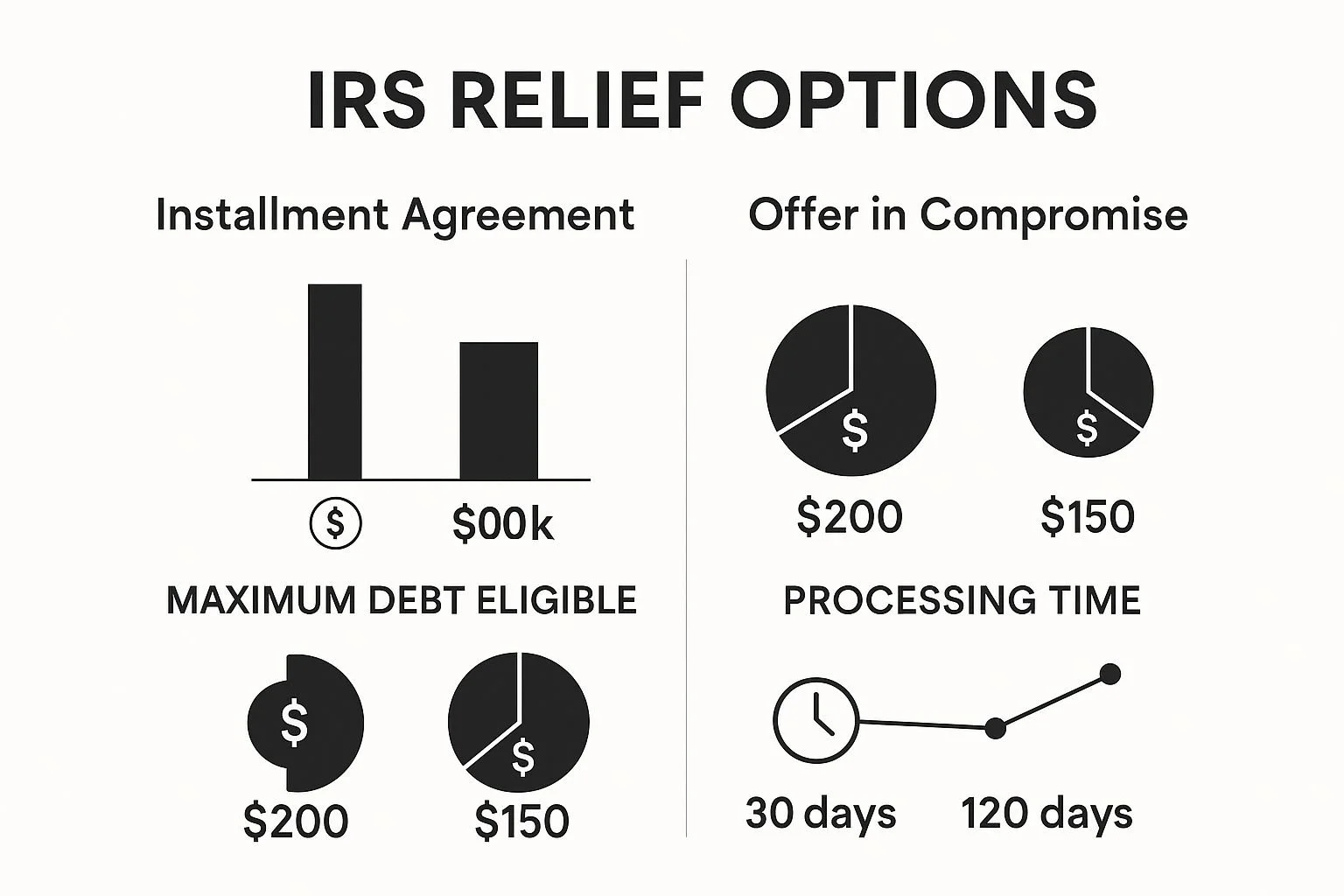
As you can see, the OIC promises a bigger potential reward, but it comes with a much tougher, longer, and more uncertain fight than a standard payment plan.
For people in the most dire situations—think unemployment, a serious illness, or even homelessness—there's another tool: Currently Not Collectible (CNC) status.
If the IRS puts you in CNC status, they’re hitting the pause button on collections. It means they’ve determined you can’t even afford your basic living expenses, let alone a tax payment. This isn’t a get-out-of-jail-free card; interest and penalties keep growing, and the IRS will check in on you periodically to see if your situation has improved.
CNC status is a temporary shield. It stops levies and wage garnishments, giving you critical breathing room. But be aware: the 10-year clock the IRS has to collect your debt also pauses while you're in CNC.
Comparison of IRS Tax Debt Solutions
Choosing between these options can be overwhelming. To make it a little clearer, I've put together a table that breaks down the most common solutions. Think of this as a quick-glance guide to help you see where you might fit.
| Solution | Best For... | Key Requirement | Potential Downside |
|---|---|---|---|
| Short-Term Payment Plan | Taxpayers who can pay in full within 180 days. | Full payment within 180 days. | Interest and penalties continue to accrue. |
| Installment Agreement | Taxpayers who need up to 6 years to pay off their debt. | A consistent monthly income to make payments. | Setup fees may apply; interest/penalties continue. |
| Offer in Compromise (OIC) | Taxpayers with very limited income and assets who can't pay in full. | Proving significant economic hardship. | High rejection rate; complex and lengthy application. |
| Currently Not Collectible (CNC) | Taxpayers facing severe financial distress (e.g., unemployment, illness). | Inability to cover basic living expenses. | Temporary solution; debt and penalties continue to grow. |
Each path has its own set of rules and consequences. The goal is to find the one that gives you a realistic way to resolve your debt without making your financial situation worse.
Ultimately, resolving back taxes comes down to making an honest assessment of your finances and choosing a path you can actually follow through on. It's that proactive choice that will finally put this problem behind you for good.
How to Ask the IRS to Waive Your Penalties
When you're already buried in tax debt, IRS penalties can feel like salt in the wound. The failure-to-file and failure-to-pay penalties, in particular, can quickly turn a manageable tax bill into a mountain of debt. But here's the good news: those penalties aren't always set in stone.
The IRS actually has a formal process for wiping out, or "abating," penalties. You just have to show you had a legitimate reason for not filing or paying on time.
This isn't some secret loophole; it's about building a solid, documented case for why you deserve a break. Getting those penalties removed can slash what you owe and make the entire situation much easier to handle.

Building a Case for Reasonable Cause
The most well-known route to penalty relief is showing the IRS you had reasonable cause. This is where you prove that you did your best and exercised normal business care, but circumstances beyond your control still prevented you from meeting your tax deadlines.
The IRS looks at these requests on a case-by-case basis, so the strength of your argument—and the paperwork to back it up—is everything.
Think of yourself as a storyteller with evidence. You need to convince the IRS that your mistake wasn't due to carelessness but to a serious, unavoidable event.
So, what counts as a good reason? Common situations that often qualify include:
Serious Illness or Death: A sudden, severe illness that affected you or someone in your immediate family.
Destruction of Records: Your financial records were lost in a fire, flood, or another disaster.
Bad Advice: You were given incorrect guidance from a tax professional or even an IRS employee.
Let's say a medical emergency landed you in the hospital for two weeks right before the tax deadline. To build your case, you'd need to provide hospital records and a timeline that clearly connects the event to your inability to file. Just saying "I was sick" won't cut it.
The First-Time Penalty Abatement Program
There's another, often overlooked, way to get penalties waived: the First-Time Penalty Abatement (FTA) program. This is an administrative waiver the IRS can grant to taxpayers with a clean compliance history. If this is your first run-in with tax trouble, it’s an incredible opportunity.
Key Takeaway: The FTA is basically a "get out of jail free" card for your first mistake. If you've been a model taxpayer for the last three years, the IRS might give you a one-time pass on failure-to-file, failure-to-pay, and failure-to-deposit penalties.
To get a First-Time Abatement, you have to check three boxes:
Filing Compliance: You've filed all your required tax returns (or filed a proper extension).
Clean Penalty History: You have no prior penalties for the three tax years before the year in question.
Payment Compliance: You've paid the tax due or have set up a plan to pay it. This means you need an active installment agreement if you can't pay everything at once.
You can request an FTA with a simple letter or even just by calling the IRS. It's often much easier to get than a reasonable cause abatement because it's based on your record, not on a subjective review of your life events. While this program is a powerful tool, it's just one piece of the puzzle. You can explore more strategies in our complete guide to the IRS tax forgiveness program.
When Should You Call a Tax Professional?
It’s tempting to try and fix a tax problem yourself. I get it. But there’s a point where going it alone stops being smart and starts being risky.
Knowing when to hand the ball to a pro isn't giving up; it’s a strategic move to bring in someone who lives and breathes the tax code.
This decision can save you an incredible amount of money, stress, and time in the long run.
Plenty of people can set up a basic IRS installment agreement on their own without much trouble. But when the numbers get bigger and the situation gets messy, the right expert is worth their weight in gold.
A true professional doesn't just shuffle papers—they build a strategy, go to bat for you with the IRS, and make sure your rights are protected every step of the way.
The Big Red Flags: Time to Get Help
Some situations are giant, flashing signs that you’re in over your head. If any of these sound familiar, it’s time to seriously think about calling for backup.
You should be looking for an expert if:
Your tax debt tops $50,000. Once you cross this line, the IRS collection process gets much more serious, and the available solutions require a lot more finesse.
You have multiple years of unfiled returns. Getting caught up isn't just about filling out old forms. It's a complex puzzle of piecing together records and dealing with a mountain of penalties and interest, something a pro can unravel methodically.
You’re facing an IRS audit. An audit is a formal, and often intimidating, examination of your financial life. Having an expert represent you prevents you from accidentally saying or handing over something that makes things worse.
You're trying for an Offer in Compromise (OIC). The OIC is the holy grail of tax relief, but the application is brutal, and most are rejected. A professional knows exactly how to package your financial story to give you the best shot at an approval.
The IRS is threatening to take your assets. Once you get a Final Notice of Intent to Levy, the clock is ticking. A tax pro can often step in immediately to halt collections and negotiate a better path forward.
Ignoring these signs is a recipe for disaster. You could end up with a much worse outcome than you needed to.
Understanding Your Professional Options
Not all tax pros are created equal. You've got three main types of practitioners who have the credentials to represent you before the IRS, and each brings a different set of skills to the table. The right choice really hinges on the specifics of your case.
An Enrolled Agent (EA) is a tax specialist licensed directly by the IRS. Think of them as tax gurus. They are an fantastic choice for handling complex tax debt, back filings, and representation issues.
A Certified Public Accountant (CPA) is licensed by their state. Many CPAs focus on bookkeeping and tax prep, but those who specialize in tax controversy are powerful allies in audits and collection cases.
A Tax Attorney is a lawyer specializing in tax law. You absolutely must hire an attorney if your case could turn criminal (like tax evasion) or if you need to fight the IRS in U.S. Tax Court. They also provide attorney-client privilege, which keeps your conversations completely confidential.
Crucial Tip: When you're trying to figure out what to do if you owe back taxes and your case is complicated, the type of expert matters. For most collection problems, an EA or a CPA with controversy experience is perfect. If there's any risk of legal trouble, a tax attorney is the only way to go.
Watch Out for Tax Relief Scams
The tax relief industry is, unfortunately, crawling with shady companies that prey on people's fear. You’ve seen their late-night commercials promising to settle your debt for "pennies on the dollar"—a misleading phrase that almost always refers to the hard-to-get Offer in Compromise.
Be very skeptical of any company that:
Guarantees they can slash your debt before they’ve even seen your financial details.
Asks for a huge upfront fee without giving you a clear, detailed plan of action.
Tells you to stop all communication with the IRS. That's terrible advice.
A legitimate, ethical professional will always start by digging into your situation to find the best realistic solution. They’ll explain your options in plain English and will never promise an outcome they can't be sure of. Choosing to hire a qualified expert is the single most powerful step you can take to finally put your tax problem behind you.
Common Questions About Owing Back Taxes
When you're staring down a tax debt, your mind can race with worst-case scenarios and nagging "what-ifs." It's completely normal.
Let's cut through the noise and tackle some of the most pressing questions we hear from clients every day. These are straight answers to give you clarity and a solid footing as you figure out your next steps.
Will I Go to Jail for Owing Back Taxes?
This is the number one fear, so let's put it to rest right now. Going to jail simply for owing the IRS money is incredibly rare.
The U.S. tax system draws a very clear line between civil and criminal matters. Jail time is reserved for criminal tax evasion—the deliberate, willful act of deceiving the government. Think hiding offshore accounts, creating fraudulent documents, or intentionally not reporting huge chunks of income. That's a different ballgame.
For the vast majority of people who fall behind due to a job loss, medical bills, business struggles, or honest mistakes, the IRS is focused on civil collection. Their goal is to work with you to pay what you owe. The real trouble starts when you ignore them, not when you're simply unable to pay.
Can the IRS Take My Social Security or Retirement Funds?
Yes, the IRS does have the authority to go after these funds, but it's never their opening move.
Through a system called the Federal Payment Levy Program (FPLP), the IRS can automatically take up to 15% of your monthly Social Security benefits. This isn't a surprise attack; it happens after you've received multiple notices demanding payment.
They can also levy retirement accounts like your 401(k) or IRA, though this is a much more aggressive step and usually happens further down the road.
Key Takeaway: An IRS levy is a last-resort collection tool. The agency is required to send a series of warning letters, like the CP504 and the final Letter 1058 (Final Notice of Intent to Levy), before seizing anything. This period is your window of opportunity to get a payment plan in place and protect your assets.
How Long Does the IRS Have to Collect Back Taxes?
There is a statute of limitations on how long the IRS can chase a tax debt. It’s officially known as the Collection Statute Expiration Date (CSED).
In most cases, the IRS has 10 years from the date your tax was assessed to collect the debt, plus penalties and interest. The "assessment date" is usually a few weeks after you file a return or when an audit is finalized.
But here’s a critical detail many people miss: certain actions can pause, or "toll," that 10-year clock. The countdown stops if you:
File for bankruptcy
Submit an Offer in Compromise
Request a Collection Due Process (CDP) hearing
Live outside the U.S. for an extended time
What Happens If I Can't Pay My Installment Agreement?
Life throws curveballs. If your financial situation takes a nosedive and you can no longer afford your agreed-upon monthly payment, don't just stop paying. That's the worst thing you can do.
Stopping payments will cause your agreement to default, and the IRS will jump right back into aggressive collections, bringing levies and liens back into play.
The right move is to be proactive and contact the IRS immediately.
You can often renegotiate your payment plan based on your current income and expenses. The IRS might agree to a lower monthly payment. If things are really tough, you could even qualify for Currently Not Collectible (CNC) status, which puts a temporary hold on all collections. When you're trying to figure out your income picture, especially if you're self-employed, a good Self-Employment Tax Calculator can be a useful tool for planning. In the end, honest communication is everything.
At Attorney Stephen A Weisberg, we know how stressful tax problems are, but you don’t have to face them on your own. We start with a free, in-depth analysis to map out a clear strategy for your unique situation.
➥ Contact Attorney Stephen A. Weisberg for a free Tax Debt Analysis.
Contact Me Here: https://www.weisberg.tax/contact-1
Email: s.weisberg@weisberg.tax
Phone/Text: (248) 971-0885
Address: 300 Galleria Officentre, Suite 402, Southfield, MI 48034
