Where to Send Form 9465 A Complete IRS Address Guide
Where you mail your Form 9465 really boils down to two things: your home state and whether you're sending a payment along with it. I can't tell you how many times I've seen simple mailing mistakes add weeks, or even months, to getting an IRS payment plan approved.
Let's cut right to the chase.
Finding the Correct IRS Mailing Address
The IRS doesn’t have just one mailbox for Form 9465. They use a handful of different processing centers, and where you send your form depends entirely on where you live. This system helps them manage the millions of forms they get, but it can be a headache for taxpayers.
Getting this right the first time is probably the most important thing you can do to get your installment agreement set up quickly. A wrong turn here means your form has to be rerouted internally, and that’s a delay you just don’t need.
The difference in wait time is no joke. A correctly addressed form gets processed much faster than one that has to be forwarded from the wrong service center.
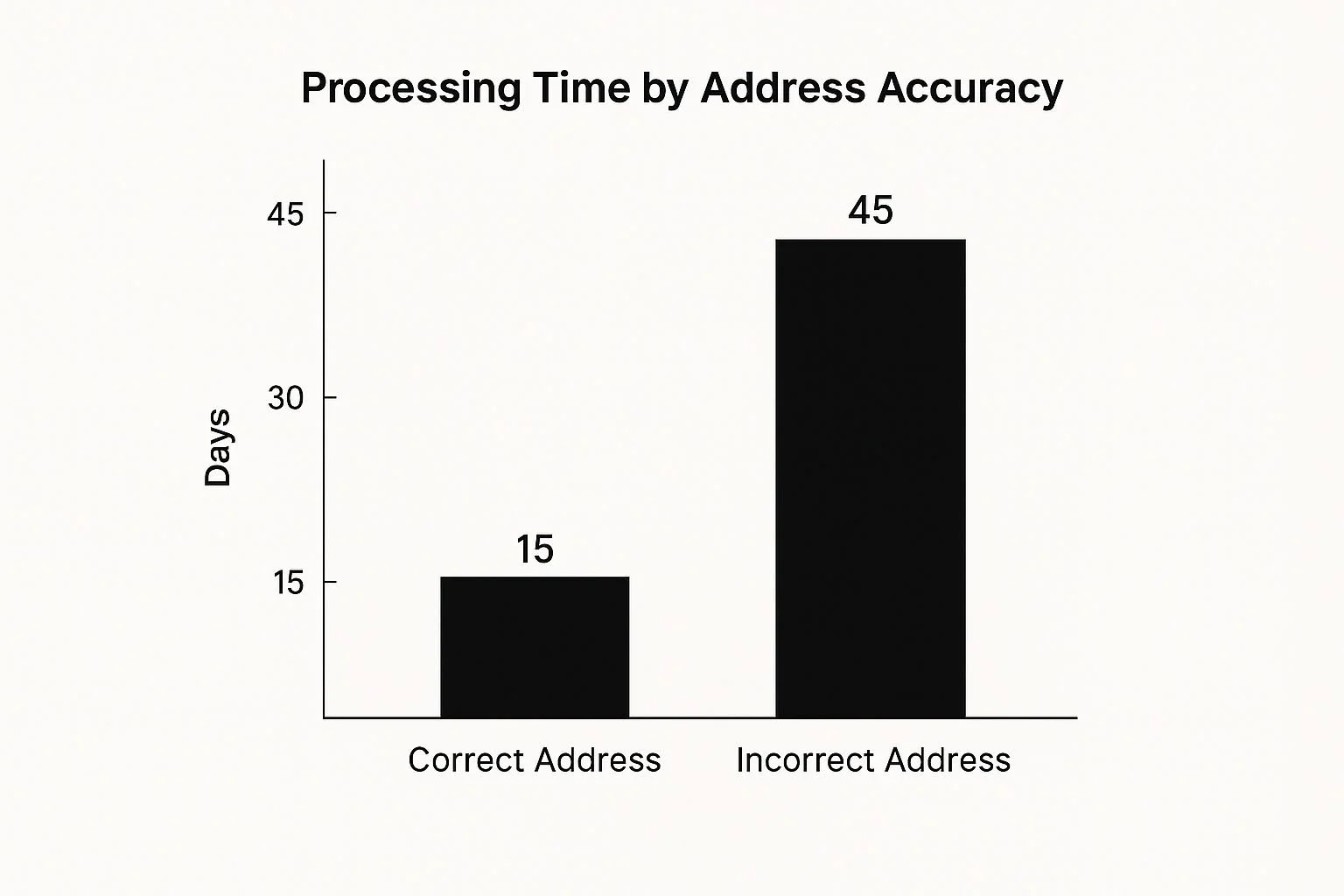
As you can see, getting the address right can literally shave months off your wait time.
Mailing Addresses for Form 9465
To make this simple, I've put together a table with the correct addresses based on your location. Just find your state in the first column and use the corresponding address. Remember, the address is different if you are enclosing a check.
IRS Mailing Addresses for Form 9465 by Location
Find the correct address based on your state. The address changes depending on whether you are including a payment with your form.
| If you live in... | Mailing Address (Without Payment) | Mailing Address (With Payment) |
|---|---|---|
| Alabama, Florida, Georgia, the Carolinas, Rhode Island, Virginia, West Virginia | Department of the Treasury Internal Revenue Service Kansas City, MO 64999-0025 |
Internal Revenue Service P.O. Box 931100 Louisville, KY 40293-1100 |
| District of Columbia, Maine, Maryland, Massachusetts, New Hampshire, New York, Vermont | Department of the Treasury Internal Revenue Service Kansas City, MO 64999-0025 |
Internal Revenue Service P.O. Box 37910 Hartford, CT 06176-7910 |
| Kentucky, Louisiana, Mississippi, Tennessee, Texas | Department of the Treasury Internal Revenue Service Austin, TX 73301-0025 |
Internal Revenue Service P.O. Box 7704 San Francisco, CA 94120-7704 |
| Arkansas, Illinois, Indiana, Iowa, Kansas, Michigan, Minnesota, North Dakota, Oklahoma, South Dakota, Wisconsin | Department of the Treasury Internal Revenue Service Kansas City, MO 64999-0025 |
Internal Revenue Service P.O. Box 802501 Cincinnati, OH 45280-2501 |
| Alaska, Arizona, California, Colorado, Hawaii, Idaho, Montana, Nevada, New Mexico, Oregon, Utah, Washington, Wyoming | Department of the Treasury Internal Revenue Service Ogden, UT 84201-0025 |
Internal Revenue Service P.O. Box 7704 San Francisco, CA 94120-7704 |
| Connecticut, Delaware, New Jersey, Pennsylvania | Department of the Treasury Internal Revenue Service Kansas City, MO 64999-0025 |
Internal Revenue Service P.O. Box 802502 Cincinnati, OH 45280-2502 |
| Ohio | Department of the Treasury Internal Revenue Service Fresno, CA 93888-0025 |
Internal Revenue Service P.O. Box 802502 Cincinnati, OH 45280-2502 |
| All APO and FPO addresses, non-U.S. addresses, or if you live in a U.S. territory or possession | Department of the Treasury Internal Revenue Service Austin, TX 73301-0025 |
Internal Revenue Service P.O. Box 1303 Charlotte, NC 28201-1303 |
These addresses are current, but it's always a good habit to double-check against the latest instructions on the IRS website before you seal the envelope.
Pro Tip: Never trust an old address. The IRS shuffles these locations around more often than you'd think. A quick check on the official IRS website or the instructions for the current year's Form 9465 can save you a world of hurt.
Why You Can't Always File Online
Mailing a paper form is often mandatory for larger tax debts. If you owe more than $50,000, for example, the IRS Online Payment Agreement tool typically won't work for you. In these cases, you have to go the old-school route: print the form, sign it with an original signature, and mail it in.
For a little extra security, I always recommend using a trackable shipping method. That delivery confirmation is your proof that the IRS received your form, which is invaluable if anything gets lost in the shuffle.
Is Form 9465 the Right Choice for You?

Before you start looking for mailing addresses, let's take a step back. Is filing a paper Form 9465 actually your best move? This form is the classic way to request a monthly payment plan from the IRS, but old habits aren't always the most efficient.
Sometimes, you have no choice but to go the paper route. If your total balance—including tax, penalties, and interest—is more than $50,000, you’ll most likely need to mail in a physical Form 9465. This usually means you'll also have to submit a detailed financial statement, like Form 433-F, to justify your proposed payment amount.
The same logic applies to businesses. If you're dealing with payroll tax debt that exceeds $25,000, the IRS will want the paper form. For these larger, more complex cases, a detailed paper trail is simply part of the deal.
You Might Be Able to Skip the Paperwork Entirely
If your tax situation isn't quite so complicated, there's a much easier path forward. The IRS has put a lot of effort into its online tools, and they can save you time, postage, and a ton of stress.
You should seriously consider using the IRS Online Payment Agreement (OPA) tool if you fit this profile:
Your total tax debt is under the threshold: Less than $50,000 for individuals or under $25,000 for businesses.
You can pay off the debt relatively quickly: The online system will calculate a payment term, and if you can meet it, you're golden.
You want an answer now: The OPA tool gives you an immediate decision. Mailing a form means waiting, sometimes for 30 to 60 days, just to hear back.
My Advice: Don't just mail Form 9465 because it's what you've heard about. The online tool is faster, the setup fees are often lower, and you get instant confirmation that your plan is approved. That peace of mind is priceless.
A huge part of this process is figuring out a realistic monthly payment. You don't want to propose an amount that's too low and gets rejected, or too high and becomes unsustainable. It’s a smart move whether you ultimately file online or by mail.
Getting Form 9465 Ready for a Smooth Submission
Knowing where to send your Form 9465 is a great start, but what you put inside the envelope is just as critical. I've seen simple mistakes delay a request for weeks or even cause an outright rejection, which means you have to start the entire process over. Let's run through a final checklist before you seal that envelope.
One of the most common errors I see is a missing or photocopied signature. The IRS is very particular about this: they require an original "wet ink" signature on all paper forms. If you send a copy or a printed form with a digital signature, they'll send it right back.
What Goes Into Your Submission Packet
Before mailing anything, lay it all out and make sure your packet is complete. A thorough package avoids frustrating back-and-forth communication with the IRS.
Here’s what should be in your envelope:
The signed Form 9465: Take a moment to review every field for accuracy and completeness.
A copy of your tax bill: It's best to include the actual IRS notice that shows the amount you owe.
Your first payment (if you're making one): If you're sending an initial payment, make the check payable to the "U.S. Treasury." Be sure to write your Social Security number and the tax year on the memo line.
Financial documentation (if necessary): If your tax debt is over $50,000, the IRS will want more information. You'll likely need to attach a Collection Information Statement.
A Quick Pro Tip: I always tell my clients to spend the extra few dollars for certified mail with a return receipt. It gives you a tracking number and, more importantly, legal proof that the IRS received your documents. That little green card you get back in the mail provides incredible peace of mind.
Skip the Mailbox: A Look at Faster E-Filing Alternatives

While it's good to know the right mailing address for Form 9465, why wait on the postal service if you don't have to? For many people, the IRS offers a much more direct and less stressful digital path.
The government’s preferred method is the Online Payment Agreement (OPA) tool. Think of it as a self-service portal that gives you an immediate answer on your payment plan request. That’s a huge difference from the 30-to-60-day waiting period you can expect when you send your form by mail. Getting that instant confirmation can offer some serious peace of mind.
Who Can Use the Online Tool?
The OPA isn't for everyone, but the rules are pretty broad and cover a lot of common tax situations. The main thing is that you've filed all your required returns and your total tax bill falls below a certain amount.
You’re likely a great fit for the online tool if:
You're an individual who owes less than $50,000 total (that’s tax, penalties, and interest combined).
You're a business that owes less than $25,000 total (again, including penalties and interest).
This online system was specifically designed to help taxpayers with more straightforward debt situations get things sorted out quickly. If you're curious about the bigger picture, you can always dig into the official IRS tax statistics to see how economic trends affect the number of people on payment plans each year.
Expert Tip: Using the OPA tool isn't just about speed; it's also about saving money. The setup fees for an online agreement are much lower than for paper-filed requests, especially if you opt for direct debit payments.
When you put the two options next to each other, the digital route is a clear winner for most. With the OPA, you get to skip the postage, avoid worrying about your form getting lost in transit, and cut out that long, anxious wait for a letter in the mail. If you qualify, it’s easily the most efficient way to get an approved payment plan locked in.
So, You've Mailed Your Request. What Happens Next?
You’ve mailed Form 9465, and now you wait. This part of the process can feel a bit like sending a message in a bottle, but understanding the next steps can take a lot of the anxiety out of the equation. You've taken the first big step, and now the ball is in the IRS's court.
You should hear something back from the IRS within 30 to 60 days. If you sent your form via certified mail, you'll have proof of delivery, which can provide some immediate peace of mind. While you wait, it’s a smart move to keep making voluntary payments if you're able. Every dollar you send helps chip away at the interest and penalties that are still adding up.
Decoding the IRS Response Letter
When that official-looking envelope finally arrives, it will contain one of three responses. Knowing what each means will help you figure out your next move.
You're Approved! This is the news you've been waiting for. The letter will confirm that your installment plan has been accepted, clearly state your monthly payment amount, and give you all the details on how to get started.
More Information Needed: This isn't a "no," it's a "not yet." The IRS might need you to clarify something about your income or ask for a complete financial statement using Form 433-F. It's crucial to respond to this request as quickly and thoroughly as possible.
Your Request Was Denied: A denial can be disheartening, but it's not the final word. The notice will spell out exactly why your request was turned down. Often, it's due to things like a previously broken payment plan or an unfiled tax return from a past year.
Once you get that approval, don't delay. Start making your payments on time, every time. The IRS is serious about these agreements, and even one missed payment can put you in default, landing you right back where you started and facing potential collection actions like liens or levies.
If you do receive a denial notice, pay close attention to the section on your appeal rights. You typically have 30 days to appeal the decision. Acting fast is key to keeping your options open and preventing the IRS from moving forward with more aggressive collection methods.
Finishing Up: Your Form 9465 Questions Answered
Let's tackle some of the most common questions I hear from clients about mailing Form 9465. Getting these final details right is crucial for a smooth process and can save you a lot of time and frustration down the road.
Can I Just Email or Fax It?
This is probably the number one question people ask, hoping to speed things up. The short answer is a hard no. The IRS is incredibly strict about protecting your private financial information, so they will not accept Form 9465 via email or fax.
Your only two routes are traditional mail or, if you're eligible, using their Online Payment Agreement (OPA) system. Sticking to these official channels is non-negotiable.
What If I'm Facing a Special Situation?
Life and taxes are rarely straightforward. Here’s how to handle a couple of common scenarios:
Living Abroad: If you're an expatriate, have an APO/FPO address, or live in a U.S. territory, you can't just send your form to any old processing center. There's a designated address, which is usually Austin, TX. But here's a pro tip: never assume. Always, always check the latest version of the Form 9465 instructions on the IRS website for the current, correct address before you mail anything.
The Cost to Set Up: Yes, there's a fee for this. The IRS charges a one-time user fee to set up the installment agreement. The exact amount depends on your income, how you apply, and how you plan to pay. Applying online is your cheapest bet, and you'll get a further discount if you agree to make payments via direct debit. If you qualify as a low-income taxpayer, you might get the fee reduced or even waived entirely.
A Word of Caution: Don't ever miss a payment. If you do, the IRS will likely default your agreement and send out a notice, often a CP523, threatening to terminate the plan. That's a serious problem, as it can put you right back in the path of aggressive collections like levies and liens. If you think you're going to miss a payment, be proactive and call the IRS immediately to see what can be done.
Finally, what if the proposed monthly payment is still more than you can handle? You're not necessarily out of luck. The IRS has other arrangements for people in tough financial spots.
At Attorney Stephen A Weisberg, we know how stressful tax debt can be. We don't believe in sales pressure; we believe in solutions. That’s why we start with a free, no-strings-attached analysis of your situation to find the best way forward. Find out how we can help you resolve your IRS issues today.
Want to understand your options before you call anyone?
Download my free book — Freedom From Tax Debt — a plain-language guide to how the IRS collections process actually works and what resolution really looks like.
➥ Contact Attorney Stephen A. Weisberg for a free Tax Debt Analysis.
Contact Me Here: https://www.weisberg.tax/contact-1
Email: s.weisberg@weisberg.tax
Phone/Text: (248) 971-0885
Address: 300 Galleria Officentre, Suite 402, Southfield, MI 48034
