Understanding IRS Trust Fund Penalties
When you withhold payroll taxes from an employee's paycheck, that money isn't yours to use. You're simply holding it 'in trust' for the government. A Trust Fund Recovery Penalty (TFRP) is what happens when that trust is broken, and the consequences are severe. It makes you personally liable for 100% of the unpaid taxes.
What Are Trust Fund Penalties and Why They Matter

Think of it like this: your business is a temporary holding area for employee taxes. When you deduct federal income, Social Security, and Medicare taxes from a paycheck, you're acting as a trustee for those funds. Your one and only job is to hand that money over to the U.S. Treasury.
When a business fails to make that handoff, the IRS can bring out one of its most powerful collection tools: the Trust Fund Recovery Penalty. This isn't just another business fine. The TFRP is designed to pierce the "corporate veil," bypassing the business entity and going straight after the personal assets of the people responsible.
Understanding the Personal Liability Component
The TFRP specifically targets individuals who were responsible for collecting and paying these taxes and who willfully failed to do so. The penalty is equal to 100% of the unpaid trust fund tax amount. This means you could be on the hook, personally, for the entire tax debt the business owes.
This is what makes trust fund taxes so different from other business debts. If your company can't pay a vendor, that's typically the company's problem. But with trust fund taxes, the IRS can and will pursue the personal assets of:
Business owners and partners
Corporate officers like the CEO, CFO, or COO
Members of the board of directors
Even bookkeepers or controllers with check-signing authority
In the eyes of the government, this isn't just an unpaid bill. It's the misuse of funds that legally belonged to the U.S. Treasury the second they were withheld from an employee's pay.
Why This Penalty Is So Serious
The TFRP is no accident; it’s designed to ensure the government collects the revenue that funds massive programs like Social Security and Medicare. Because this money is so vital, the IRS pursues it relentlessly.
A business struggling with cash flow is not an excuse. For business leaders, this means a corporate financial problem can spiral into a devastating personal crisis. We're talking about potential liens on your home, levies on your personal bank accounts, and catastrophic damage to your financial life.
Grasping the seriousness of trust fund penalties starts with a commitment to tax compliance. Being proactive is key, which is why preparing for tax season is about more than just filing—it's about protecting yourself. You can also stay informed on the latest developments by subscribing to our newsletter for updates on trust fund tax matters.
Who the IRS Considers a Responsible Person

When the IRS starts looking for someone to hold accountable for unpaid payroll taxes, they don't just pull up the company's org chart. The idea of a "responsible person" is all about substance, not titles. It’s a real-world test that ignores what's on your business card and focuses entirely on who really had significant control over the company's money.
Think of it like this: the IRS isn't just looking for the registered captain of the ship. They're looking for anyone who had a hand on the wheel, steering the company's finances and deciding where the money went—even if they were a deckhand with temporary control.
This means that liability for trust fund penalties can reach far beyond the CEO or the person who owns the most stock. Anyone with the authority to decide which bills get paid—and which ones don't—could find themselves squarely in the IRS's sights.
Beyond the C-Suite Authority and Control
At its core, the IRS investigation is all about authority and control. The main question is: did you have the effective power to make sure the taxes were paid? If the answer is yes, you could be on the hook, no matter your official title. The IRS cares about practical power, not theoretical roles.
The IRS uses several key indicators to pinpoint a responsible person. It’s critical to understand that having just one of these duties could be enough to land you in hot water.
Signature Authority: Could you sign checks for the company, even if you rarely did?
Financial Decision-Making: Were you part of the conversation about which creditors or vendors to pay?
Hiring and Firing Power: Did you have the authority to hire or fire people, especially in financial positions?
Director or Officer Status: Being a corporate officer or on the board of directors often implies a duty to watch over the company's financial health.
The IRS test is a matter of status, duty, and authority. They want to know who had the power to prevent the default from happening. You can be held responsible even if you weren't the most responsible person; multiple people can be held liable.
Consider a bookkeeper who signs checks for office supplies. They might not seem like a key decision-maker. But if that same bookkeeper also had the authority to write a check to the IRS for payroll taxes—and instead paid other vendors on a supervisor's orders—they could be deemed a responsible person. Gaining a full understanding of TFRP personal liability is non-negotiable for anyone handling company money.
Real-World Scenarios of Responsibility
To really bring this home, let's walk through a couple of common business situations. The IRS will dig into the day-to-day realities of the business, not just what’s written down in the corporate bylaws.
Scenario 1: The "Silent" Partner
An individual owns 50% of a small construction company but isn't involved in daily operations. However, their name is on the business bank account as a signatory, and they occasionally move money to cover payroll. The IRS could easily argue that their access to and control over the funds gave them the power to ensure tax payments were made, making them a responsible person.
Scenario 2: The Office Manager
An office manager, who holds no executive title, is handed the company checkbook and a stack of bills. The owner tells them, "Pay our suppliers first. We'll deal with the IRS later." Because that office manager had the physical ability and the authority to write and sign the check to the IRS, they could be held personally liable for the unpaid taxes. An order from a superior doesn't wipe away your responsibility.
These examples make it clear: the IRS casts a wide net. It's the practical ability to direct where the money goes that matters most, which is why anyone with financial duties must be incredibly vigilant about payroll tax compliance.
Understanding Willful Failure to Pay Taxes
The second piece of the puzzle for a Trust Fund Recovery Penalty is “willfulness.” This is where many people get tripped up. The word sounds like it implies some kind of criminal mastermind, a deliberate plot to defraud the government.
But in the world of IRS enforcement, the reality is much simpler—and much broader.
It's a Matter of Priorities, Not Malice
Willfulness isn't about having a bad motive. It’s simply the conscious, voluntary, and intentional decision to pay other creditors before you pay the U.S. Treasury. If you knew the payroll taxes were due and you used that money for any other business expense, that's a willful act.
Imagine a business hitting a rough patch. Cash flow is tight. The landlord is calling about rent, a critical supplier is threatening to cut you off, and you still have to make next week's payroll. That money withheld from your employees' paychecks—the trust fund taxes—is sitting right there in the company bank account.
Using those funds to pay the landlord, settle up with the supplier, or even just to make the next payroll run is considered a willful act. The moment you chose to prioritize any other bill over the government's trust fund taxes, you met the willfulness requirement.
This simple flowchart shows just how direct the path is from withholding the funds to a willfulness determination.
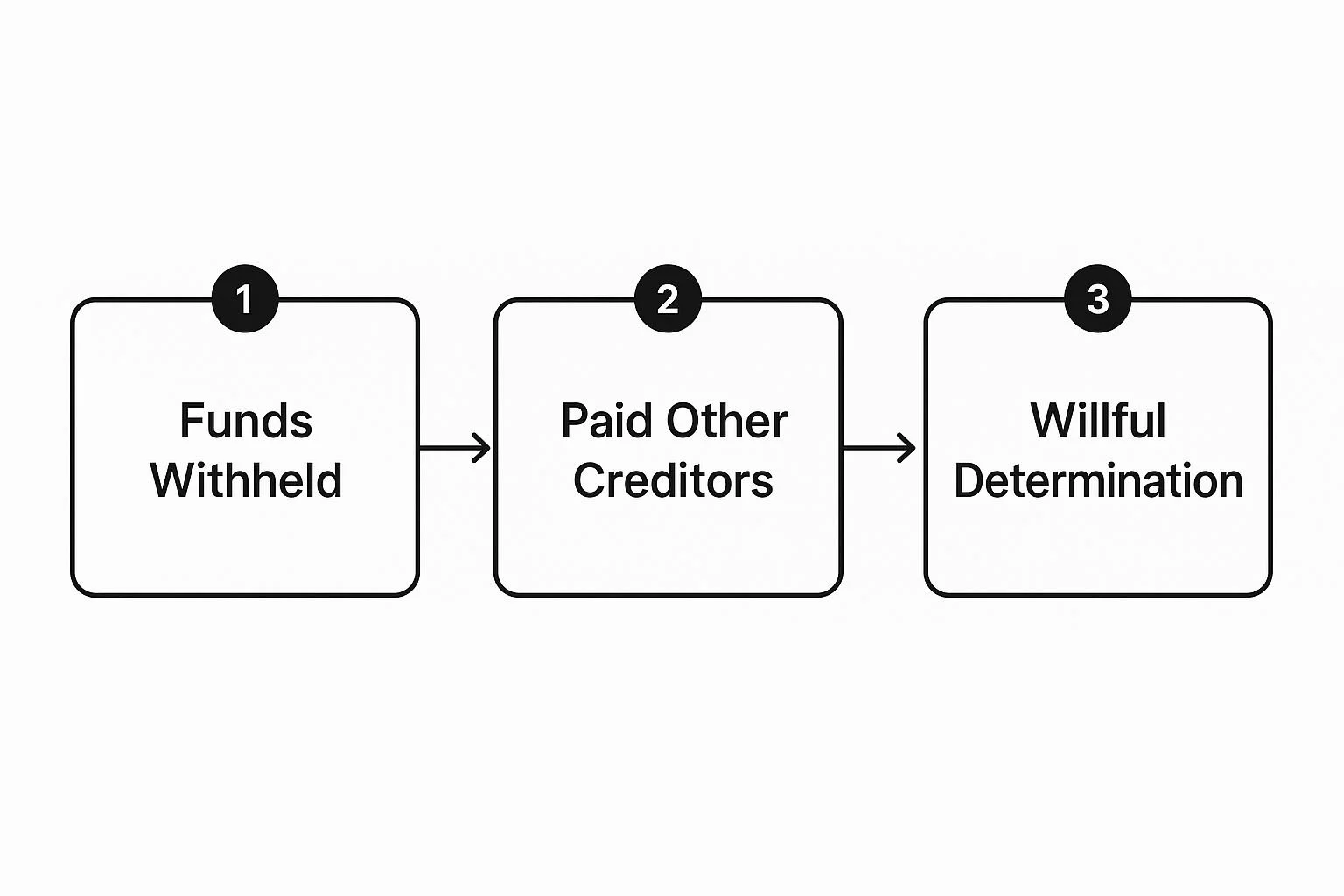
It boils down to a critical concept: once those taxes are withheld, they legally belong to the government. Using them for anything else is a willful failure to pay.
Reckless Disregard Also Counts as Willful
You can still be found to have acted willfully even if you didn't personally write the check to another creditor. The IRS standard includes a powerful concept called reckless disregard. This means you failed to investigate a known risk that the taxes weren't being paid.
This often comes into play in situations like these:
You were aware of serious financial problems or mismanagement within the company.
You heard rumors or got warnings from your bookkeeper that payroll taxes were behind.
You intentionally kept yourself out of the financial loop to create "plausible deniability."
Sticking your head in the sand is not a defense strategy. If a responsible person should have known about the unpaid taxes and did nothing to correct the problem, the IRS will see that inaction as a willful failure.
“Willfulness can be shown by evidence that the responsible person had knowledge of payments to other creditors, including employees, after being aware of the failure to pay over withholding taxes. Bad intent is not required; ‘reckless disregard of an obvious and known risk’ that taxes might not be remitted is sufficient.”
This sets a very high bar for anyone with a hand in company finances. A CEO who glances at monthly financial statements showing a growing tax liability can't later claim they didn't know. Just seeing that information and continuing to sign off on other payments is enough to establish willfulness for trust fund penalties.
The ultimate takeaway is that the IRS focuses on two things: knowledge and action. Once a responsible person knows about the tax delinquency, every single payment made to another creditor—including paying net wages to employees in the future—cements the element of willfulness and opens that person up to crushing personal liability.
How the IRS Assesses Trust Fund Penalties
When a business falls behind on payroll taxes, the IRS doesn't just send a bill and hope for the best. It kicks off a very specific, methodical investigation to recover what it's owed. Knowing how this process works is your first line of defense, as there are critical moments where you can—and must—act.
The journey from a missed payment to a personal penalty assessment follows a clear roadmap. It's not random; it's a series of deliberate steps designed to identify who was in control of the company's finances and hold them accountable.
What Actually Goes into the Penalty?
First, let's clear up a common—and costly—misunderstanding. The Trust Fund Recovery Penalty (TFRP) is not a penalty for the entire unpaid payroll tax bill. That would be brutal.
Instead, the IRS hones in on the money that was supposed to be held in trust for the government. The TFRP is calculated as 100% of the unpaid trust fund portion only.
This "trust fund" portion includes two key things:
Federal income tax you withheld from your employees' paychecks.
The employees' share of Social Security and Medicare taxes (FICA).
Think of it this way: this is money that never belonged to the business in the first place. The business was just a temporary custodian. The IRS takes the failure to hand over this money very seriously.
To break down exactly what the IRS targets, here’s a look at the components of payroll tax and whether they are included in the penalty calculation.
Anatomy of a TFRP Assessment
| Payroll Tax Component | Included in TFRP Calculation? | Explanation |
|---|---|---|
| Employee Income Tax Withheld | Yes | This is the primary component of the trust fund. It's money taken directly from an employee's pay for their federal tax obligations. |
| Employee's FICA Share | Yes | The employee's half of Social Security and Medicare contributions is also considered part of the trust fund. |
| Employer's FICA Share | No | The business's matching contribution for FICA is a direct business expense. While still owed, it is not included in the personal TFRP. |
This distinction is crucial. It means that while the company is on the hook for its own share of FICA taxes, the personal liability assessed under the TFRP is strictly limited to the funds that were held in trust for employees.
The Assessment Process Step by Step
The road to a TFRP assessment is formal and well-documented. It usually starts when a company's missed payroll tax deposits raise a red flag, prompting a Revenue Officer to launch an investigation.
Here’s how it typically unfolds:
The Form 4180 Interview: The Revenue Officer will interview everyone who might have had financial control. They use Form 4180, "Report of Interview with Individual Relative to Trust Fund Recovery Penalty," to ask pointed questions about your job duties, signature authority, and awareness of the unpaid taxes. This is a fact-finding mission to build their case.
The Proposed Assessment (Letter 1153): If the officer concludes you were both responsible and willful, the IRS sends Letter 1153. This is the official "Proposed Assessment of Trust Fund Recovery Penalty," and it's the document that formally puts you on notice that the IRS intends to hold you personally liable.
The 60-Day Appeal Window: This is it—the most critical deadline you will face. From the date on Letter 1153, you have 60 days to file a formal protest and appeal the decision. If the letter was sent to an address outside the U.S., you get 75 days.
Missing this 60-day window is catastrophic. If you fail to file a timely appeal, the proposed penalty becomes final. At that point, the IRS can begin aggressive collection actions against your personal assets, including levying bank accounts and placing liens on your property.
This tight deadline highlights the need to act immediately. A $1 million corporate payroll tax debt can quickly morph into a $1 million personal liability for the responsible person, which is why enforcement is so aggressive.
Common Mistakes That Put You in the IRS Crosshairs
A Trust Fund Recovery Penalty investigation doesn't just happen out of the blue. The IRS doesn't pick names out of a hat. Instead, these investigations are almost always triggered by specific business missteps that send up giant red flags.
Think of these mistakes less as simple accounting errors and more as symptoms of a much bigger problem, usually related to deep financial or operational distress. If you can spot these warning signs in your own business, you have a chance to fix things before a Revenue Officer shows up at your door.
Using Payroll Tax Money as a Slush Fund
This is, without a doubt, the number one reason business owners get hit with a TFRP. It happens when a company gets into a tight spot with cash flow. Suddenly, that pool of money withheld from employee paychecks looks like a tempting, interest-free loan to cover rent, pay a critical supplier, or even just make the next payroll.
It's a disastrous move. From the IRS's perspective, the moment you use that money for anything other than sending it to the U.S. Treasury, you've acted willfully. It doesn't matter if you fully intended to pay it back next week; the act itself is the violation.
Imagine a restaurant owner who uses the withheld taxes to buy a new oven, figuring they'll pay the IRS back after a busy weekend. If that weekend is a bust, the tax hole gets deeper, and they've already checked both boxes—responsibility and willfulness—for a TFRP assessment.
Messy and Inconsistent Bookkeeping
Disorganized books are a fertile ground for tax nightmares. When financial records are treated as an afterthought, it's incredibly easy to lose track of what you owe, blow past deposit deadlines, or forget to file your quarterly Form 941.
This kind of sloppiness creates a vicious cycle. Without a clear picture of your finances, you might not even realize how far behind you are on your tax obligations until the debt has ballooned into something truly terrifying.
A few classic bookkeeping red flags include:
Never reconciling payroll liabilities to see if what you think you owe matches reality.
Lumping withheld tax funds into your main operating bank account.
Having no system in place to double-check that your tax deposits were actually made.
A business flying blind with its finances is demonstrating a "reckless disregard" for its obligations. To the IRS, this isn't just bad management—it's a form of willfulness that strengthens their case for holding you personally liable for the unpaid taxes.
Putting Blind Faith in a Payroll Company
Handing off your payroll to a third-party service is often a great decision, but it doesn't hand off your legal responsibility. A common, and costly, misconception is that if you hire a payroll provider, the tax obligation is now their problem. It isn't.
You are still the one on the hook. If the payroll company pulls the tax funds from your account but never actually sends them to the IRS, you are still the responsible person in the government's eyes. It is ultimately your job to make sure the money got where it was supposed to go.
A surprising number of TFRP cases stem from a payroll service that either goes under or, in the worst cases, steals client funds. The business owner is often the last to find out, leaving them blindsided by a massive personal tax bill. The only way to protect yourself is to periodically verify through your own IRS account that the payments have been received and credited.
How to Defend Against a Proposed TFRP Assessment
Getting that proposed Trust Fund Recovery Penalty notice from the IRS can make your stomach drop. But before you panic, take a breath and remember one crucial word: proposal. This isn't a final judgment, and you absolutely have the right to fight back.
A solid defense is built on taking immediate action and having a smart strategy. The IRS has to prove two things to hold you personally liable: that you were a “responsible person” and that you acted “willfully.” Your job is to show them they can’t. This isn’t about burying your head in the sand; it’s about methodically building a case with hard evidence showing you don't fit the legal bill.
Challenging the Responsible Person Status
Your first move is often to argue that you simply weren't a "responsible person." This isn't about your work ethic; it's about your actual power within the company. A fancy title on a business card means nothing if you didn't have the real authority to make financial decisions.
The IRS has to prove you had significant, independent control over the company’s money. To counter this, you need to pull together proof that your hands were tied. Your goal is to paint an accurate picture of what you really did day-to-day.
Evidence that can make a real difference includes:
Corporate Bylaws or Operating Agreements: These official documents might explicitly state that someone else—not you—held the purse strings.
Bank Signature Cards: If you couldn't sign company checks, that’s powerful proof you weren't in control of the finances.
Testimony from Colleagues: Signed statements from other officers or employees who can confirm you had a limited role in financial matters are incredibly persuasive.
Correspondence: Got an email or memo from your boss telling you exactly which bills to pay (and which to ignore)? That’s gold. It shows you lacked the final say.
The bottom line is this: you can't be held responsible for a decision you didn't have the authority to make. If a superior’s orders actively prevented you from paying the IRS, you have a very strong defense.
Disputing the Finding of Willfulness
Okay, let's say the IRS does manage to pin you as a responsible person. They still have to clear a second hurdle: proving your failure to pay was willful. This is where many of these cases are won or lost.
"Willfulness" doesn't just mean you deliberately stiffed the government; it also includes "reckless disregard." To win here, you have to show you either didn't know about the unpaid taxes or, once you found out, you did everything a reasonable person would do to fix it.
Claiming you just didn't know is a tough argument to win. A stronger approach is often to show you acted responsibly once the problem came to light. For example, if you discovered the delinquency and immediately tried to get the IRS paid but were shot down by a senior partner or the board, that action can dismantle the "willfulness" claim.
Another angle is to show you didn't recklessly ignore your duties. Maybe you relied on a bookkeeper with a great track record or a major payroll service that dropped the ball without your knowledge. This can be part of a solid defense, but be warned: the IRS expects business owners to have some system in place to verify that tax payments are actually being made.
The Formal Appeals Process and Other Options
When you get that Letter 1153 proposing the TFRP, the clock starts ticking. You have a strict 60-day window to file a formal protest. Missing this deadline is a critical, often irreversible, mistake—the proposed penalty automatically becomes a final assessment. If you're in this position, you need to understand how to appeal an IRS tax decision right away.
Beyond a direct appeal, you may have other cards to play. It’s sometimes possible to show you had "reasonable cause" for not paying, which can be a complex but effective way to get penalties waived. Digging into the specifics of IRS reasonable cause for penalty abatement can open up new possibilities. And if the liability is legitimate, an Offer in Compromise could be a route to settling the debt for a fraction of what you owe.
Let’s be clear: a TFRP defense is not a DIY project. The stakes are incredibly high, the deadlines are brutal, and the rules are a maze. The single most important step you can take to protect your personal assets is to get a qualified tax professional in your corner—immediately.
Common Questions About Trust Fund Penalties
When you're staring down a potential Trust Fund Recovery Penalty (TFRP), the legal jargon can feel like a different language. It’s a stressful situation, but getting clear, practical answers is the first step. Let's break down some of the most common questions business owners and financial officers ask.
Can the IRS Come After More Than One Person?
Yes, and they often do. The IRS isn't looking for the single most responsible person; it's looking for every person who meets the legal standard for being responsible and willful.
Think of it this way: the IRS casts a wide net. A company's CEO, a controller, a high-level bookkeeper, and even a board member could all be deemed responsible. Every single one of them can be held 100% personally liable for the entire unpaid tax amount. While the IRS can only collect the total tax debt once, it has the authority to pursue every responsible party until that debt is fully paid.
Will My Business Bankruptcy Protect Me Personally?
This is a critical point that trips up many people: no, it won't. Filing for business bankruptcy does nothing to shield you from personal TFRP liability.
The penalty is legally separate from the company's own tax debt. It's an assessment made directly against you as an individual.
Imagine the "corporate veil" that normally protects you from business debts. The TFRP pierces right through it. So, even if the business dissolves through bankruptcy, your personal assets—your home, your savings, your car—are still on the line.
What if I Was Just Following Orders?
Claiming you were simply following a superior's instructions is known as the "Nuremberg Defense," and it almost never succeeds in TFRP cases. The courts have been very clear on this.
If you had the authority to sign checks or direct payments, an order from your boss to pay rent or suppliers instead of the IRS doesn't get you off the hook. The law sees it as your duty to pay the government first. The only way this defense might work is if you can prove you had zero independent authority and were physically or legally prevented from making the tax payment, which is an incredibly high bar to meet.
How Long Does the IRS Have to Act?
The IRS doesn't have forever to assess this penalty. There's a specific window called the statute of limitations.
Generally, the IRS has three years from the date the company’s payroll tax return (Form 941) was filed to assess the TFRP against you. So, if a return for the second quarter of 2024 was filed on July 31, 2024, the IRS typically has until July 31, 2027, to make its move.
Be careful, though—filing a late or fraudulent return can give the IRS more time. Once the penalty is officially assessed, the IRS then has 10 years to collect it from you.
Trying to handle a TFRP investigation on your own is a high-stakes gamble. Attorney Stephen A Weisberg has spent years defending business owners, executives, and bookkeepers from personal liability for payroll taxes. If you’ve received a notice about a proposed assessment, the time to act is now. Start with a FREE Tax Debt Analysis to map out your options and build a solid defense. Visit us at weisberg.tax to get started.
Want to understand your options before you call anyone?
Download my free book — Freedom From Tax Debt — a plain-language guide to how the IRS collections process actually works and what resolution really looks like.
➥ Contact Attorney Stephen A. Weisberg for a free Tax Debt Analysis.
Contact Me Here: https://www.weisberg.tax/contact-1
Email: s.weisberg@weisberg.tax
Phone/Text: (248) 971-0885
Address: 300 Galleria Officentre, Suite 402, Southfield, MI 48034
