1040 Schedule D Instructions: Your Complete Tax Guide
Understanding Schedule D: What Every Taxpayer Needs To Know
Navigating Schedule D can seem confusing. This form deals with capital gains and losses, and understanding it is essential for accurate tax filing. This guide will break down the key aspects of Schedule D in a clear and concise manner.
Why The IRS Requires Schedule D
The IRS uses Schedule D to track the sale and purchase of capital assets. These include investments like stocks, bonds, and real estate. By requiring this reporting, the IRS can properly tax profits (gains) and allow deductions for losses.
This provides a comprehensive overview of your yearly financial activity.
When To File Schedule D
You don't always have to file Schedule D. If you held investments without selling, you likely don't need to file. However, if you sold any capital assets during the tax year, resulting in a gain or loss, you'll usually need to complete it.
Other situations, such as worthless securities or nonbusiness bad debts, might also require Schedule D. Since its creation, it has been a vital part of reporting capital gains and losses, updated to reflect current tax laws.
As of 2024, the IRS emphasizes completing Form 8949 before certain lines on Schedule D. This ensures accurate reporting of capital transactions. Learn more here.
Decoding The Structure Of 1040 Schedule D Instructions
The 1040 Schedule D instructions can seem intimidating, but they're manageable when broken down. The form has Parts I and II. Part I focuses on short-term gains and losses (assets held for one year or less). Part II covers long-term gains and losses (assets held for over a year).
This distinction is crucial because short-term and long-term gains have different tax rates. You'll report details for each transaction in each part: date acquired, date sold, proceeds, cost basis, and the resulting gain or loss.
This detailed breakdown helps the IRS calculate your total capital gain or loss. This final figure from Schedule D then goes onto your Form 1040, affecting your overall tax liability.
The following table summarizes the filing requirements for Schedule D based on different transaction types:
Schedule D Filing Requirements by Transaction Type
| Transaction Type | Schedule D Required | Additional Forms Needed | Common Examples |
|---|---|---|---|
| Sale of stocks held for less than one year | Yes | Form 8949 | Selling shares of a company after owning them for 10 months |
| Sale of bonds held for more than one year | Yes | Form 8949 | Selling government bonds after owning them for 2 years |
| Sale of real estate held for more than one year | Yes | Form 8949 | Selling a rental property owned for 5 years |
| Worthless securities | Yes | A company you invested in goes bankrupt | |
| Nonbusiness bad debts | Yes | A loan you made to a friend becomes uncollectible | |
| Inherited assets sold within one year | Yes | Form 8949 | Selling inherited stock within one year |
| Gifted assets sold within one year | Yes | Form 8949 | Selling gifted stock within one year |
| No sale of assets | No | N/A | Holding stocks, bonds, or real estate without selling during tax year |
This table highlights when Schedule D is required and what other forms you might need. Understanding these scenarios can help you prepare for tax season and ensure accurate filing.
Your Line-By-Line Schedule D Completion Roadmap
Ready to tackle Schedule D? This section offers a clear roadmap for completing the form, making a potentially daunting task much more manageable. We'll break down the steps, explain where the information comes from, and clarify the connection between Form 8949 and Schedule D.
Organizing Your Paperwork: The First Step To Success
Before even looking at Schedule D, gather your 1099-B forms, brokerage statements, and any other transaction records. These documents provide the details you need for accurate reporting.
For instance, your 1099-B forms list sales of stocks, bonds, and other securities, including dates, proceeds, and potentially, cost basis information. Having everything organized ensures you have all the necessary data at your fingertips.
Understanding the Form 8949 and Schedule D Relationship
Many taxpayers find the relationship between Form 8949 and Schedule D confusing. Form 8949, "Sales and Other Dispositions of Capital Assets," supports Schedule D. Think of it this way: Form 8949 itemizes each individual transaction, while Schedule D summarizes the totals.
This two-step process gives the IRS a detailed yet organized view of your capital gains and losses. You'll need both forms if your broker didn't report cost basis or if you need to adjust the basis reported on your 1099-B.
However, if your 1099-B includes all the correct information, you might be able to skip Form 8949 and report directly on Schedule D. The 1040 Schedule D instructions clarify these scenarios in detail.
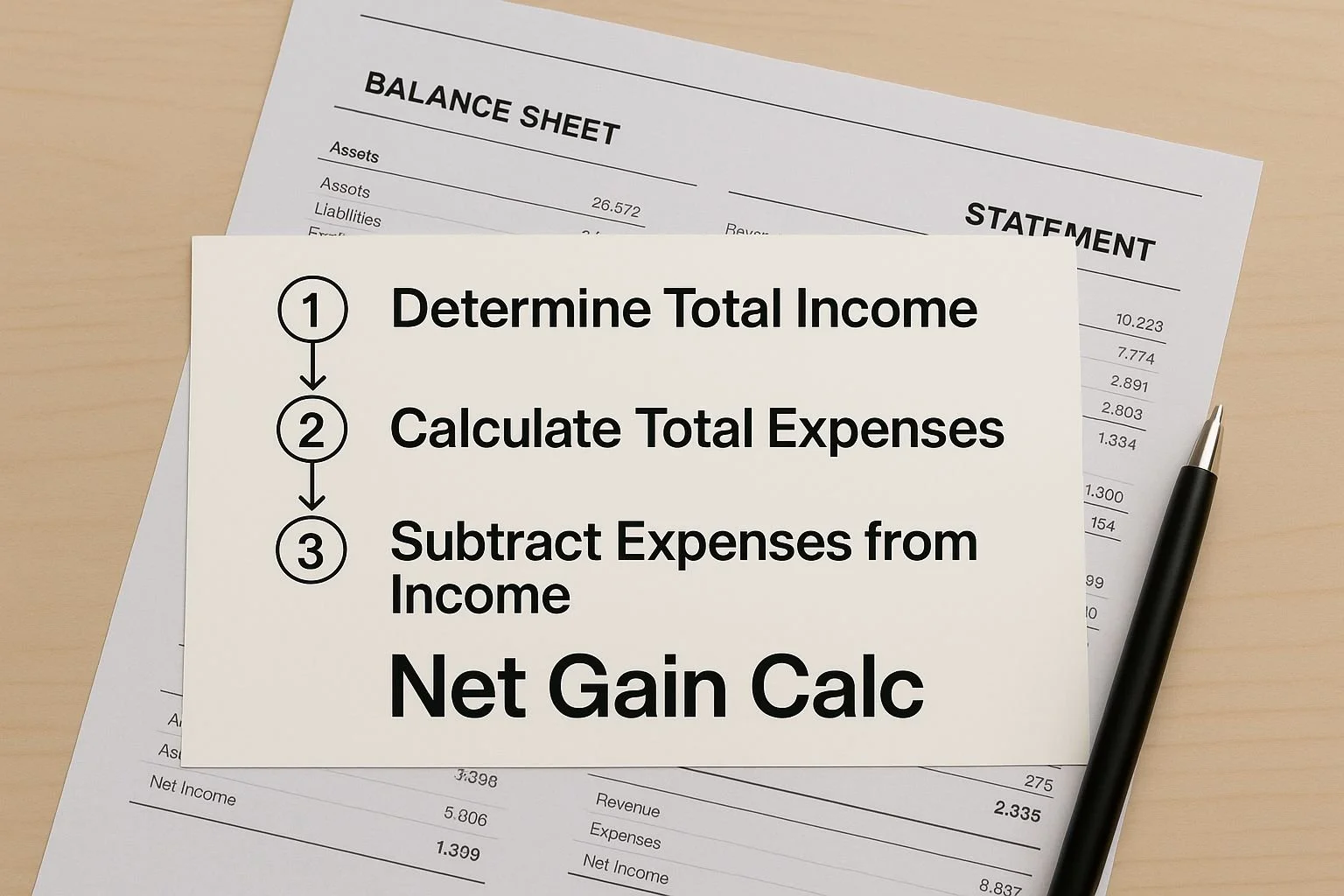
The infographic above illustrates the process of calculating net gains, using financial statements as a backdrop. It highlights the importance of accurate record-keeping in determining your final tax liability. Accurate data entry on Form 8949 is crucial, as any errors will carry over to Schedule D and affect your overall tax calculation.
Completing Schedule D: A Step-by-Step Guide
Let's break down the Schedule D completion process:
Part I: Short-Term Capital Gains and Losses: This section covers assets held for one year or less. Enter information from your Form 8949 (if applicable) or directly from your brokerage statements. Be sure to include the date acquired, date sold, proceeds, cost basis, and the calculated gain or loss for each transaction.
Part II: Long-Term Capital Gains and Losses: This section covers assets held for more than one year. Follow the same process as Part I, transferring data for your long-term holdings.
Totals and Summary: After entering all your transactions, calculate the totals for both short-term and long-term gains and losses. These totals then transfer to your Form 1040.
Key Considerations and Tips
Cost Basis: Accurately determining your cost basis is critical. This is the original purchase price of the asset, adjusted for factors like stock splits and commissions. An inaccurate cost basis can lead to incorrect calculations of your gains or losses.
Wash Sale Rule: Be mindful of the wash sale rule, which disallows losses from the sale of securities if you repurchase substantially identical securities within 30 days before or after the sale.
Double-Checking Your Work: Before submitting your return, review your entries on both Form 8949 and Schedule D to catch any potential errors. This careful review can help you avoid costly mistakes and potential issues with the IRS.
By following these steps and paying close attention to detail, you can confidently complete Schedule D and accurately report your capital gains and losses. This methodical approach simplifies the process and ensures you meet all IRS requirements.
Avoiding The Costly Mistakes That Trigger Audits

Even seasoned tax filers can make errors on Schedule D. This section explores some of the most frequent missteps that can attract unwanted attention from the IRS, potentially leading to audits and penalties.
These mistakes can range from simple data entry errors to more complex miscalculations involving cost basis and wash sale rules. Understanding these potential pitfalls is the first step toward accurate compliance with 1040 Schedule D instructions.
Common Errors and Their Consequences
Data entry errors, while seemingly insignificant, can raise red flags with the IRS. Transposing digits in a sale date or purchase price, for example, can create discrepancies that draw scrutiny.
Miscalculating your cost basis, especially after stock splits or reinvested dividends, can significantly impact your reported gains or losses. This can result in penalties and interest charges. For more information on avoiding IRS audits, see this helpful resource: How to avoid an IRS audit.
Another frequent error is overlooking the wash sale rule. This rule prohibits claiming losses if you repurchase substantially identical securities within 30 days before or after the sale.
Failing to properly account for wash sales can lead to disallowed losses and an inaccurate calculation of your tax liability. Applying the wash sale rule can be complex, particularly in intricate trading scenarios.
Discrepancies Between Your Records and IRS Information
The IRS receives transaction information directly from brokers. Any discrepancies between your reported figures and the information received by the IRS can trigger automatic notices or even audits.
Therefore, meticulously checking your 1040 Schedule D instructions against your brokerage statements is essential. Forgetting to report a sale or entering incorrect proceeds, for instance, will likely result in an IRS notice.
Correcting Mistakes After Filing
Discovering errors after filing your return can be stressful. However, there are ways to correct these mistakes. If the error resulted in an underpayment of taxes, you must file an amended return using Form 1040-X.
This process is more complex than filing an original return. Seeking professional advice is often recommended. Filing an amended return is crucial to rectifying the situation and avoiding further penalties.
Organizing Your Records For Prevention
Preventing mistakes is always easier than correcting them. A well-organized record-keeping system is essential for accurate Schedule D completion.
Maintaining a spreadsheet or using tax software like TurboTax can help you track your transactions, cost basis, and holding periods.
This proactive approach simplifies tax preparation and minimizes the risk of errors that can lead to audits. Consistent and accurate record-keeping is the key to successfully navigating Schedule D and avoiding potential complications.
Mastering Capital Gains And Losses Like A Pro
Understanding capital gains and losses is essential for managing your taxes. It directly affects your tax liability, making accurate calculations crucial for completing Schedule D correctly. Let's explore how these gains and losses are determined and how they influence your Form 1040.
Calculating Gains And Losses: More Than Simple Subtraction
Calculating gains and losses is more nuanced than simply subtracting the purchase price from the selling price. Your cost basis is the original purchase price plus adjustments for things like commissions and stock splits.
This cost basis is subtracted from the proceeds (the selling price minus selling expenses) to determine the gain or loss. This is a key step in understanding your 1040 Schedule D instructions.
For instance, imagine you bought stock for $100, paid a $5 commission, and later sold it for $150 with a $5 selling commission. Your cost basis would be $105, and your proceeds would be $145, resulting in a $40 capital gain.
Factors like reinvested dividends or inherited assets can make these calculations more complex.
Short-Term Vs. Long-Term: Why The Timeframe Matters
How long you hold an asset determines if a gain or loss is short-term (one year or less) or long-term (more than one year). This distinction is important because different tax rates apply. Typically, long-term gains are taxed at lower rates than short-term gains. This makes the holding period a key consideration in tax planning.
The Impact Of Timing On Your Tax Bill
When you buy and sell assets can significantly affect your taxes. Selling a profitable asset at the year's end instead of the beginning, for example, can shift the gain to the next tax year. This could be beneficial depending on your income and tax bracket for each year.
Strategic timing can optimize your tax burden over time. You might be interested in: IRS Innocent Spouse Relief.
Tax-Loss Harvesting: Turning Losses Into Tax Savings
Tax-loss harvesting involves selling losing investments to offset gains in others, reducing your overall tax liability. While it doesn't recover the initial investment loss, it minimizes the tax impact. This strategy allows you to manage your portfolio strategically, considering tax implications.
Complexities: Inherited Property, Gifts, And More
Inherited property, gifted assets, stock splits, and reinvested dividends introduce complexities to capital gains calculations. Inherited assets have a stepped-up basis, meaning the cost basis is adjusted to the fair market value at the date of the decedent's death.
Gifted assets usually retain the donor's cost basis. Stock splits and reinvested dividends affect your cost basis per share, requiring careful record-keeping. Understanding these nuances is crucial for accurate reporting.
Documentation: Keeping It Organized For Schedule D
Meticulous record-keeping is crucial for supporting the figures you report on Schedule D. Detailed records of purchases, sales, cost basis adjustments, and holding periods are essential.
This not only ensures accurate reporting but also prepares you for potential IRS inquiries. Good organization can save you time and stress during tax season.
To understand the difference between short-term and long-term capital gains tax rates, let's take a look at the table below:
Short-Term vs. Long-Term Capital Gains Tax Rates Comparison of tax rates and holding period requirements for different types of capital gains
| Holding Period | Tax Rate | Income Bracket | Filing Status Impact |
|---|---|---|---|
| One year or less (Short-term) | Your ordinary income tax rate | All income brackets | Same for all filing statuses |
| More than one year (Long-term) | 0%, 15%, or 20% | Varies depending on income | Rates apply to each filing status individually |
As you can see, the holding period significantly impacts the applicable tax rate. Short-term gains are taxed as ordinary income, while long-term gains benefit from potentially lower rates. Understanding these differences is essential for effective tax planning.
Navigating Form 8949 And Schedule D Together
Many taxpayers find the relationship between Form 8949 and Schedule D confusing. This section clarifies how these two forms work together when reporting capital gains and losses, which are important parts of your 1040 Schedule D instructions.
How Form 8949 Supports Schedule D
Form 8949, "Sales and Other Dispositions of Capital Assets," provides detailed information to the IRS about each capital asset transaction. Think of it as an itemized receipt. Schedule D then summarizes these individual transactions from Form 8949 to calculate your total capital gain or loss for the year. Schedule D acts like a summary of all your purchases.
When To Use Both Forms vs. Schedule D Alone
You'll need both Form 8949 and Schedule D if your broker didn't report the cost basis on your 1099-B or if you need to adjust the reported basis. For example, if you had selling expenses not listed on the 1099-B, use Form 8949 to make those adjustments.
However, if your 1099-B includes all the necessary information and you don’t need to make any adjustments, you might be able to report directly on Schedule D.
The 1040 Schedule D instructions provide specific guidance on these situations. This simplifies reporting when your broker fully documents your straightforward transactions.
Handling Complex Transactions Across Multiple Accounts
If you have multiple brokerage accounts, you’ll need a separate Form 8949 for each account. Be sure to categorize transactions by short-term and long-term gains and losses.
Then, transfer the totals from each Form 8949 to the corresponding sections of Schedule D (Part I for short-term, Part II for long-term). This keeps your investment activity organized, even across different accounts.
What If Information Is Missing?
Missing information can be problematic, but there are ways to address it. If you’re missing cost basis information, contact your broker. If that doesn't work, the IRS provides guidelines for reasonably estimating the basis. It’s important to document your attempts to get the correct information.
While estimating is sometimes allowed, showing that you made a good faith effort to follow the 1040 Schedule D instructions is essential for complying with IRS requirements.
Finding Historical Forms When You Need Them
Accessing prior-year tax forms and instructions is sometimes necessary. Whether you're amending a past return, dealing with multi-year transactions, or researching tax law changes, having the correct 1040 Schedule D instructions is essential.
This section explores how to navigate the IRS website efficiently and find the resources you need.
Why You Might Need Older Forms
Several scenarios require older Schedule D forms and instructions. Amending a prior return due to an error or newly discovered information is a common reason. Multi-year transactions, such as installment sales or carryforward losses, might also require referencing forms from multiple years.
Additionally, understanding how tax laws have changed over time can be valuable when planning your current investment strategies.
For example, if you incurred a capital loss in 2015, you might need the 2015 Schedule D instructions to understand how to apply that loss to your current return.
Or, if you are amending a 2018 tax return, you'll need the 1040 Schedule D instructions specific to that year. These situations highlight the importance of accessing historical tax information.
Navigating the IRS Website for Past Forms
The IRS website offers a repository of prior-year forms and instructions. While it can seem overwhelming, using the search function and filtering by year can significantly narrow down your results.
The IRS offers access to forms and instructions dating back to 1980. This comprehensive archive gives taxpayers and tax professionals valuable historical perspective on reporting requirements.
For instance, amending a 1999 return requires the specific Schedule D from that year, which is readily available on the IRS website. You can find prior year forms and instructions here.
Dealing With Carryforward Losses and Multi-Year Transactions
Carryforward losses from previous years can complicate your current filing. You'll need the forms and instructions from the year the loss occurred to correctly determine the amount you can carry forward. Similarly, multi-year transactions necessitate having the correct forms for each year involved.
Keeping organized records of these transactions simplifies the process. For additional help with unfiled returns, read this guide to avoid penalties.
Maintaining Consistent Record-Keeping
Consistent record-keeping across tax years is crucial. Keeping accurate records of your investment activity, including purchase dates, sale dates, cost basis, and related expenses, simplifies future filings.
This also allows easy access to information if you need to amend a return or deal with multi-year transactions. This proactive approach can significantly reduce stress during tax season.
Professional Strategies For Schedule D Success
Completing Schedule D accurately and efficiently can be challenging. This section explores professional strategies used by CPAs and Enrolled Agents to simplify the process and reduce errors.
These insights can boost your confidence with Schedule D, whether you're preparing it yourself or working with a tax professional.
Organizational Systems for a Smooth Tax Season
Tax professionals understand the importance of organization. They frequently use specialized software like Intuit Lacerte and cloud-based systems to manage client documents and track important deadlines. Even for individual taxpayers, a similar, smaller-scale approach can make a big difference.
Consider creating a designated folder for investment records, using spreadsheets to track transactions, or utilizing personal finance apps like Mint to monitor portfolio activity year-round. A well-organized system prevents last-minute scrambles for documents during tax season.
Leveraging Digital Tools and Apps
Several digital tools can automate record-keeping and simplify Schedule D preparation. Portfolio trackers such as Personal Capital can automatically import transactions, calculate cost basis, and even flag potential wash sales.
Tax software like TurboTax often integrates with these apps, streamlining data entry and reducing manual errors. These tools not only save time but also improve accuracy.
Effective Collaboration With Financial Advisors and Tax Preparers
Communication between taxpayers, financial advisors, and tax preparers is essential for Schedule D success. Financial advisors offer valuable insights into investment strategies and their tax implications.
Sharing transaction records and discussing tax planning with your preparer well before the filing deadline allows ample time to address complex issues. This proactive approach ensures everyone is informed and minimizes surprises.
Handling Complex Scenarios
Certain situations, like cryptocurrency transactions, foreign investments, and business property sales, add complexity to Schedule D. Cryptocurrency transactions require careful tracking of cost basis and transaction dates, often involving thousands of individual trades.
Foreign investments may require converting gains and losses into U.S. dollars and navigating international tax treaties.
Business property sales often involve depreciation recapture and complex calculations.
For help with settling tax debt, you might be interested in: IRS Offer in Compromise. These complexities may require additional research or consulting a specialized tax professional.
When to Seek Professional Help
While many can complete Schedule D independently, some situations benefit from professional assistance. Complex investment portfolios, significant capital gains or losses, or unusual transactions like cryptocurrency trading or foreign investments often warrant expert help.
A qualified tax professional can navigate the tax code, identify potential tax savings, and ensure accurate reporting. This guidance offers peace of mind and potential long-term savings.
Ready to simplify your taxes and ensure accurate Schedule D completion? Visit Attorney Stephen A. Weisberg for expert guidance and personalized support. With years of experience handling complex tax situations, Attorney Weisberg can help you minimize your tax liability and achieve financial peace of mind.
➥ Contact Attorney Stephen A. Weisberg for a free Tax Debt Analysis.
Contact Me Here: https://www.weisberg.tax/contact-1
Email: sweisberg@wtaxattorney.com
Phone/Text: (248) 971-0885
Address: 300 Galleria Officentre, Suite 402, Southfield, MI 48034
