Can the IRS Garnish My Wages? Know Your Rights Today
Yes, the IRS can garnish your wages for unpaid taxes. The scary part? They can do it without a court order—a power that most other creditors simply don't have.
But let's be clear: this isn't something that happens out of the blue. An IRS wage garnishment is the final move in a long, legally defined collection process. You will always receive multiple warnings before they ever touch your paycheck.
Understanding IRS Garnishment Authority

The idea of the IRS reaching directly into your paycheck is enough to keep anyone up at night. But knowing the rules of the game is the first step toward taking back control. The most important thing to understand is that an IRS wage garnishment, which is technically called a "wage levy," follows a completely different set of federal laws than a typical garnishment.
This isn't just a minor legal detail; it's a critical distinction.
If a credit card company or hospital wants to garnish your wages, they have to jump through hoops. They must first sue you, win a judgment in court, and then get a separate court order to start the garnishment. The IRS, on the other hand, can skip that entire judicial process. Their power comes straight from federal tax law, giving them an incredibly potent tool for collecting tax debt.
This special power doesn't mean they can act without warning. In fact, the law requires them to follow strict procedures designed to protect you. The IRS must send a specific sequence of notices, giving you plenty of time and opportunity to sort out your debt before a levy ever starts.
The IRS is legally required to send a "Final Notice of Intent to Levy and Notice of Your Right to a Hearing" at least 30 days before they can garnish your wages. This letter is your last official warning and a crucial moment to take action.
IRS Wage Levy vs Regular Creditor Garnishment
To really see how different the IRS's power is, it helps to compare it side-by-side with a regular creditor garnishment. The table below breaks down the key differences, highlighting why an IRS notice demands your immediate attention.
| Feature | IRS Wage Levy | Regular Creditor Garnishment |
|---|---|---|
| Court Order Required? | No, the IRS has direct statutory authority to issue a levy. | Yes, a creditor must win a court judgment first. |
| Process Speed | Can be much faster since there are no court proceedings. | Slower, because it's tied to the court system's schedule. |
| Amount Taken | Based on a specific formula (filing status & dependents from Publication 1494). | Limited by federal law (usually up to 25% of disposable income). |
| Notice Period | A mandatory 30-day "Final Notice of Intent to Levy" is required. | Varies by state law and only comes after a court judgment. |
As you can see, the IRS operates on a completely different level. They have more power and can move much faster, but they are also bound by very specific rules—rules you can use to your advantage if you act promptly.
Don’t Get Blindsided: Understanding the IRS Warning Notices
Let’s be honest, the thought of the IRS garnishing your wages is terrifying. But here’s the good news: it never, ever comes out of the blue. An IRS wage levy is the last resort in a long, predictable communication chain. They don't just kick down the door; they send a series of official letters designed to grab your attention and give you plenty of chances to sort things out.
Think of these notices as a countdown timer. Each one you receive cranks up the urgency, signaling you’re one step closer to forced collection. Knowing what to look for is your first and best defense against a levy.
The First Wave: The Tax Bills
The whole process usually kicks off with a letter like the CP14, Notice of Tax Due and Demand for Payment. This is the first official bill you’ll get, and it lays everything out: how much you owe, the reason for the debt, and a deadline for payment.
If that letter goes unanswered, you can expect a few more reminders to land in your mailbox. Notices like the CP501, CP503, and CP504 will follow. The tone of each one gets a little more serious, reminding you that penalties and interest are piling up and warning that they’ll have to take action if the debt isn't paid.
The infographic below picks up the timeline right at the critical 30-day warning period—the final stretch before things get real.
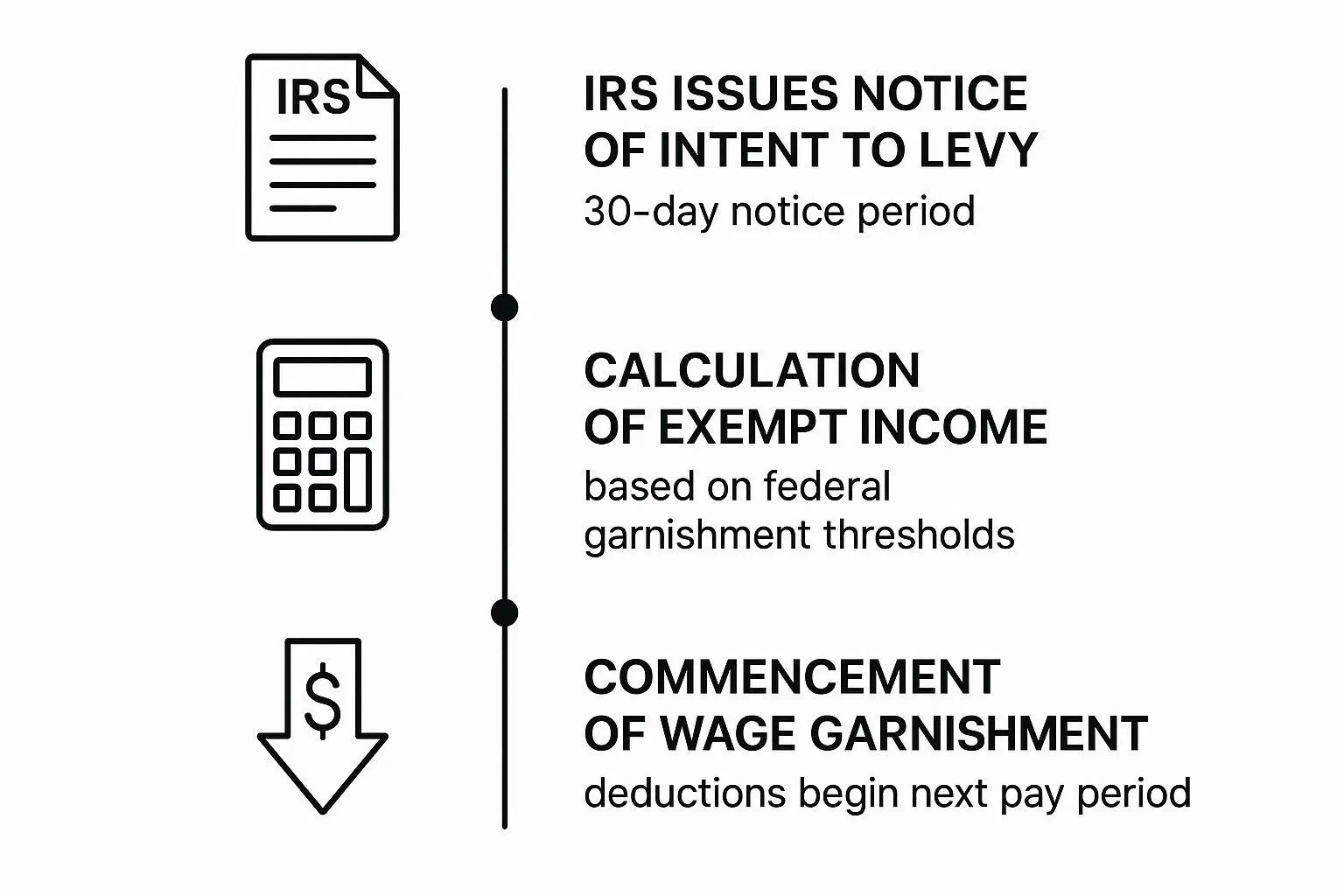
As you can see, once that final notice goes out, the clock is officially ticking. Ignore it, and those deductions from your paycheck are right around the corner.
The Final Warning You Cannot Ignore
This is the one. The most critical piece of mail you can get from the IRS is the Final Notice of Intent to Levy and Notice of Your Right to a Hearing (often labeled as Letter 1058 or LT11). This isn't just another bill. It's a legally required warning shot that gives you 30 days to respond before the IRS can lawfully contact your employer and start the garnishment process.
This final notice is your last clear chance to formally appeal or set up an alternative payment solution. Ignoring this letter is the single action that directly greenlights a wage garnishment.
When this notice arrives, you still have powerful options to stop the levy before it even begins:
Request a Collection Due Process (CDP) Hearing: You have the right to formally appeal the levy. To do this, you must file Form 12153 within that 30-day window.
Set Up a Payment Plan: You can contact the IRS to arrange an Installment Agreement, allowing you to pay back your tax debt in manageable monthly payments.
Negotiate a Settlement: Depending on your financial situation, you might be able to settle your tax debt for less than you owe.
Getting any of these letters is stressful, no doubt. But they are also opportunities. If you understand what each notice means and act quickly, you have the power to stop the collection process cold and keep your paycheck whole.
How Much of Your Paycheck the IRS Can Take
When that garnishment notice hits your desk, one question jumps to the front of the line: just how much of my paycheck can the IRS actually take?
The answer isn't a simple, flat percentage. While most creditors are stuck with a cap, usually around 25% of your disposable income, the IRS operates under a completely different rulebook. Their authority is much broader.
Instead of a fixed rate, the IRS uses a specific formula to figure out what you need for basic living expenses. The goal is to leave you with something, but the amount they can seize is often substantial and can put you in a tough spot financially, fast.
Calculating Your “Exempt Amount”
The IRS figures out how much of your pay is protected by using a set of tables found in IRS Publication 1494. This calculation hinges on two key details: your tax filing status (like single or married filing jointly) and how many dependents you claim.
The number they land on is your "exempt amount." Think of it as a financial safety net—it’s the portion of your paycheck the IRS agrees you need to cover the essentials. Anything you earn above that protected line during a pay period is fair game for the levy.
This is why a wage levy's impact feels so different from person to person. A single taxpayer with no kids will have a much smaller exempt amount, meaning a bigger chunk of their pay goes to the IRS. On the other hand, someone who is the sole breadwinner for a family of four will see more of their check protected.
To put some real numbers on it, the amount the IRS can take can range anywhere from 25% to 50% of your disposable income. For example, back in 2023, a single person with no dependents had $1,154.17 per month protected. A married couple filing a joint return with two dependents got to keep $3,091.67 a month. You can discover more insights about these specific IRS rules and how they are applied in practice.
It’s critical to remember that the IRS isn’t bound by the same laws that restrict other creditors, like the Consumer Credit Protection Act. Their unique power lets them take a much bigger piece of your income.
What This Means for Your Take-Home Pay
Let's walk through a real-world scenario. Picture two employees at the same company, earning the exact same salary but with very different home lives:
Employee A: A Single Filer
This person has a lower exempt amount. As a result, a much larger slice of their paycheck is considered non-exempt and gets sent directly to the IRS.
Employee B: Married with Two Dependents
Thanks to their filing status and dependents, this employee has a significantly higher exempt amount. A smaller portion of their pay is subject to the levy, leaving them with more take-home pay.
Your employer gets the garnishment order straight from the IRS, complete with the exemption tables. They don't have a choice in the matter—they are legally required to use those tables to do the math, withhold the correct amount, and send it to the government.
Your Employer’s Role in an IRS Garnishment

When the IRS decides to garnish your wages, your employer is suddenly pulled into the situation. They aren't a bystander anymore; they become a legally obligated participant.
It all starts when a specific document arrives at their office: Form 668-W, Notice of Levy on Wages, Salary, and Other Income. This isn't a request—it's an order. Your employer is required by federal law to comply, and they have to act fast.
Think of your company as a middleman with no choice in the matter. Their sole responsibility is to calculate the portion of your paycheck the IRS can take, withhold it, and send the money directly to the government. They have to keep doing this with every single paycheck until the IRS officially tells them to stop.
What Your Employer Must Do
Once that garnishment order lands on your employer's desk, they have a very specific to-do list. There’s no room for negotiation or making exceptions for you.
Their duties are crystal clear:
Calculate the Exempt Amount: First, they have to figure out how much of your pay is legally protected from the levy, using the tables the IRS provides.
Withhold the Correct Funds: Starting with your very next paycheck, they will deduct the non-exempt portion of your income.
Remit Payment to the IRS: Your employer is then responsible for sending every dollar they withhold straight to the government.
For any company on the receiving end of this, following the rules is non-negotiable. It’s a serious legal matter, which is why having solid employment law and compliance guidance for employers is so critical to avoid missteps and potential penalties.
Can I Be Fired for an IRS Wage Garnishment?
It’s a terrifying thought, but you can breathe a little easier. Federal law specifically protects you from being fired because of a single wage garnishment. This crucial safeguard is there to ensure you don't lose your job while you're trying to get your tax situation sorted out.
This whole process drives home a critical point: your employer’s hands are tied. They are simply following a direct order from the IRS. The only way to fix this is to work directly with the IRS—your payroll department has no power to change anything.
This system isn't unique to the IRS. A similar process called Administrative Wage Garnishment allows other federal agencies to collect non-tax debts. They can order an employer to withhold up to 15% of your disposable earnings, all without a court order, demonstrating just how standard this practice is for federal collections. You can read more about this process on the Treasury's website.
How to Stop or Prevent an IRS Wage Garnishment
Getting that final notice from the IRS can make your stomach drop. It feels like the end of the line, but I promise you, it's not. This is your cue to act. You have real, powerful options to stop a wage garnishment before it even touches your paycheck, or to get one released if it's already started.
This isn't about secret tricks. It’s about knowing how to work with the IRS using their own established programs. Think of it as a negotiation. The IRS absolutely wants to collect the tax you owe, but they have official, structured ways to help you do it. Stepping up and engaging them puts you back in the driver's seat. The key is to move quickly and pick the right play for your financial situation.
Set Up an IRS Installment Agreement
The most straightforward way to stop a levy in its tracks is to formally agree to pay what you owe over time. An Installment Agreement is exactly what it sounds like: a payment plan you set up directly with the IRS. It allows you to make manageable monthly payments until the debt is gone.
As soon as that agreement is locked in, the IRS is required to stop all collection actions. No more wage garnishments. This is the perfect route for anyone who can afford to pay off their debt but just needs more time to do it without the shock of a huge chunk disappearing from their paycheck. For many people, you can even apply for one online if your total debt is under a certain amount.
Negotiate an Offer in Compromise
But what happens when you genuinely can't pay the full amount, no matter how much time they give you? That's where the Offer in Compromise (OIC) comes into play. An OIC is a formal program that lets you settle your tax liability with the IRS for less than the full amount you owe. It’s a powerful tool, but it's not a gimme.
To get an OIC approved, you have to open up your books and prove to the IRS that paying the full amount would cause you a serious financial hardship. They're going to take a hard look at everything:
Your ability to pay
Your monthly income
Your necessary living expenses
The equity in any assets you own
If the IRS accepts your offer, they agree to wipe the slate clean on the rest of the debt once you pay the lower, settled amount. It’s a true fresh start, but the application is incredibly detailed. Getting a handle on all your financial documents is critical; an AI finance tax document analyzer can sometimes help organize the information needed for the application.
Request Currently Not Collectible Status
For those in a truly tough spot financially, there's another path: Currently Not Collectible (CNC) status. If you can show the IRS that you can't even cover your basic living expenses, let alone make a tax payment, they may agree to temporarily pause all collection activity.
CNC status is an immediate halt to collections. The IRS essentially says, "We see you can't pay right now, so we're backing off." This stops a wage garnishment cold.
Just know that this is a temporary fix, not a permanent solution. The IRS will check in on your finances periodically to see if your situation has improved. And while you're in CNC status, interest and penalties keep adding up on your original debt. Still, it provides critical breathing room when you need it most.
Each of these options gives you a way to reclaim your finances and keep your hard-earned money. The most important thing you can do right now is choose a path and take that first step.
Who Is Most at Risk for Wage Garnishment?

You might think an IRS wage levy is something that only happens to a select few, but the reality is quite different. The threat doesn't fall evenly across the board. While anyone with an unpaid tax bill could face garnishment, the data shows that some groups get hit much harder and more often than others.
It’s rarely just about owing money. More often than not, falling behind with the IRS is a symptom of bigger financial problems. This is especially true for people who have years of unfiled returns piling up, creating a snowball of debt and penalties.
Key Demographics and Industries
Looking at the numbers reveals some clear, and frankly, surprising patterns. Wage garnishment is a widespread issue, affecting about 7.6% of all employees in any given year.
Certain groups, however, carry a much heavier burden:
Middle-Aged Workers: The highest rate of garnishment (10.5%) hits people between 35 and 44. This is typically a time when financial pressures like mortgages, childcare, and other debts are at their absolute peak.
Manufacturing and Transportation Sectors: Workers in these fields are disproportionately affected. A staggering 48% of manufacturing companies report having at least one employee with a garnishment.
Middle-Income Earners: Here’s a twist—garnishment rates actually tend to go down as income goes up. This suggests that middle-income families often have fewer resources to settle a tax debt before the IRS escalates things to a levy.
These aren't just abstract statistics; they tell a story about the real financial squeeze that millions of working families are feeling. If you're interested in the details, you can learn more about these garnishment trends from ADP's research on the subject.
The data underscores a critical reality: wage garnishment is not just an abstract legal issue. It's a widespread financial challenge that disproportionately impacts the backbone of the American workforce—middle-income families and essential industry workers.
Knowing this context makes it all the more important to tackle tax problems head-on. The sooner you take action, the more options you'll have to avoid becoming another statistic and protect your hard-earned paycheck.
Common Questions About IRS Wage Garnishment
Even after learning the basics, you're probably still wondering how this all plays out in the real world. Let's tackle some of the most frequent questions I hear from clients to clear up any confusion and help you know what to expect.
Can the IRS Garnish My Social Security Benefits?
Yes, they absolutely can. The IRS has the authority to levy federal payments, and that includes your Social Security retirement and disability benefits.
This happens through a system called the Federal Payment Levy Program (FPLP). Under this program, the IRS can take 15% of your monthly benefit payment until your tax debt is paid off. There are a few protections, however. Supplemental Security Income (SSI) benefits, for instance, are completely exempt and cannot be garnished by the IRS.
What if I Am Self-Employed?
This is a big one. If you're a freelancer, independent contractor, or business owner, the IRS can't garnish your "wages" in the traditional sense. But don't get too comfortable—they have other ways to collect that are just as effective.
Instead of going after a paycheck, the IRS can:
Levy Your Bank Account: They can seize funds directly from your business or personal accounts without warning.
Levy Your Accounts Receivable: This is a powerful move. The IRS can legally order your clients to stop paying you and send that money directly to them instead. Imagine the disruption that would cause your business.
While the mechanism is different for the self-employed, the outcome is the same: the IRS will intercept income at its source to satisfy the tax debt. The core question "can the IRS garnish my wages" extends to all forms of income.
How Long Does an IRS Wage Garnishment Last?
An IRS wage garnishment is what's known as a "continuous levy." This isn't a one-time event; it doesn't just stop after a few paychecks or a certain number of months. It stays in place indefinitely until one of three things happens:
The tax debt is paid in full.
You work out another solution with the IRS, like an Installment Agreement.
The IRS officially releases the levy, which usually happens only if you can prove extreme financial hardship.
For people in truly tough spots, looking into options like the IRS tax forgiveness program can be a lifeline, potentially leading to a permanent resolution and a release of the levy.
If you're facing a potential wage garnishment, don't wait for the IRS to act. Attorney Stephen A Weisberg offers a FREE Tax Debt Analysis to determine the best strategy for your specific situation. Find out how to protect your income by visiting weisberg.tax.
Yes, the IRS can garnish your wages for unpaid taxes. The scary part? They can do it without a court order—a power that most other creditors simply don't have.
Want to understand your options before you call anyone?
Download my free book — Freedom From Tax Debt — a plain-language guide to how the IRS collections process actually works and what resolution really looks like.
➥ Contact Attorney Stephen A. Weisberg for a free Tax Debt Analysis.
Contact Me Here: https://www.weisberg.tax/contact-1
Email: s.weisberg@weisberg.tax
Phone/Text: (248) 971-0885
Address: 300 Galleria Officentre, Suite 402, Southfield, MI 48034
