Ultimate Guide to Tax Debt Settlements
The IRS understands that life happens. A job loss, a medical emergency, or a struggling business can make it impossible to pay your tax bill in full. That's where tax debt settlements come in—they are formal agreements that let you clear your tax liability for less than what you originally owed.
What Are Tax Debt Settlements

Think of a tax settlement not as a handout, but as a practical solution. It's a structured program designed for taxpayers who genuinely cannot afford to cover their entire tax bill. The government essentially agrees that collecting a smaller, realistic amount now is better than chasing a debt that you may never be able to fully repay.
This isn't about letting people off the hook. It’s a pragmatic approach based on your current financial reality—your income, expenses, and assets. The IRS will take a deep dive into your finances to determine what you can actually afford to pay.
The Purpose of Settlement Programs
Why would the IRS ever agree to take less than what they're owed? It's simple: their primary goal is to keep the tax system running. Forcing a taxpayer into bankruptcy doesn't help anyone.
Settlement programs serve a few important functions:
They offer a real path forward for people dealing with serious financial hardship.
They bring taxpayers back into the system, encouraging them to stay compliant in the future.
They ensure the collection process is fair by basing the outcome on a taxpayer's proven ability to pay.
At its core, a tax debt settlement is a fresh start. It acknowledges a taxpayer's financial hardship while allowing the government to collect what is reasonably possible, and then everyone moves on.
The two most common routes for settling your tax debt are the Offer in Compromise (OIC) and the Partial Pay Installment Agreement (PPIA). They sound similar, but they're built for very different situations. Grasping what makes each unique is the first step toward figuring out if one might work for you.
Quick Overview of Key Tax Settlement Options
To help clarify, here’s a straightforward comparison of the main settlement programs the IRS offers. Think of this as a starting point for understanding which path might align with your financial circumstances.
| Settlement Option | Primary Goal | Best For |
|---|---|---|
| Offer in Compromise (OIC) | Resolve the entire tax debt with a one-time payment or short-term plan that is less than the total amount owed. | Taxpayers with low income and few assets who can prove they will likely never be able to pay the full debt. |
| Partial Pay Installment Agreement (PPIA) | Make affordable monthly payments over a set period, after which the rest of the tax debt is forgiven. | Taxpayers who can't pay in full but have a consistent monthly income to put toward their tax liability. |
Each program has its own strict set of rules and qualification criteria, but knowing the basic difference between a lump-sum settlement (OIC) and a long-term payment plan (PPIA) is crucial.
Exploring Tax Settlement Options
When you’re staring down a mountain of tax debt, it’s easy to feel like you have no way out. The good news is, the IRS has a whole toolbox of solutions, not just a single hammer. Each tax debt settlement program is built for a different financial reality, and figuring out which one fits your life is the crucial first step.
Think of it like going to the doctor. You wouldn't get the same prescription for a headache as you would for a broken arm, right? In the same way, the IRS tailors its relief programs to the specific kind of financial hardship a taxpayer is facing.
The real goal here is to find a resolution that actually works. And the need for these solutions is growing. The global debt settlement market, which includes tax debt settlements, is expected to jump from USD 10.46 billion in 2025 to USD 18.28 billion by 2034. This isn't just a number; it shows how many people are looking for manageable ways to handle their debt.
The Offer In Compromise Program
The Offer in Compromise (OIC) is the big one—it's what most people picture when they hear "tax settlement." An OIC lets certain taxpayers completely resolve their tax liability for less, sometimes much less, than what they originally owed. It’s an incredibly powerful tool, but it's reserved for those who can prove they're in serious financial trouble.
An OIC isn't a backdoor negotiation for people who just don't feel like paying. It’s a formal application where you have to open up your books and prove that paying the full amount would create a genuine economic hardship. The IRS only approves an OIC under one of three specific conditions:
Doubt as to Collectibility: This is the most common path to an OIC. It applies when your income and assets simply aren't enough to cover what you owe. The IRS essentially agrees that they're unlikely to ever get the full amount from you, so settling for a smaller, realistic sum is the better option.
Doubt as to Liability: This is a less-traveled road where you can prove the IRS got the numbers wrong in the first place. If you have evidence showing they made a mistake when calculating your tax bill, you can challenge the debt itself.
Effective Tax Administration (ETA): This is for rare cases. It applies when paying the full debt wouldn't technically cause economic hardship, but it would be unfair or unjust due to exceptional circumstances, like a severe long-term illness that has wiped out your savings.
"An Offer in Compromise is fundamentally an agreement that collecting a portion of the debt is a better outcome for the government than collecting nothing at all. It's a pragmatic solution rooted in the taxpayer's verifiable ability to pay."
Getting an OIC approved requires a deep-dive into the IRS's financial analysis formulas.
Partial Pay Installment Agreements
So, what if you have a steady income but still can't possibly pay off your entire tax debt before the clock runs out on the collection statute? This is where a Partial Pay Installment Agreement (PPIA) can be a lifesaver. A PPIA lets you make monthly payments you can actually afford, based on your real budget.
Unlike a standard payment plan where you have to pay every penny back, a PPIA is set up so you only pay back a portion of the debt. Once the collection statute expires—usually ten years after the tax was assessed—the rest of your debt is wiped clean. It's a great option for people who have some disposable income but not enough to ever clear the whole balance.
This infographic breaks down what the IRS is looking at when they consider you for programs like the OIC and PPIA.
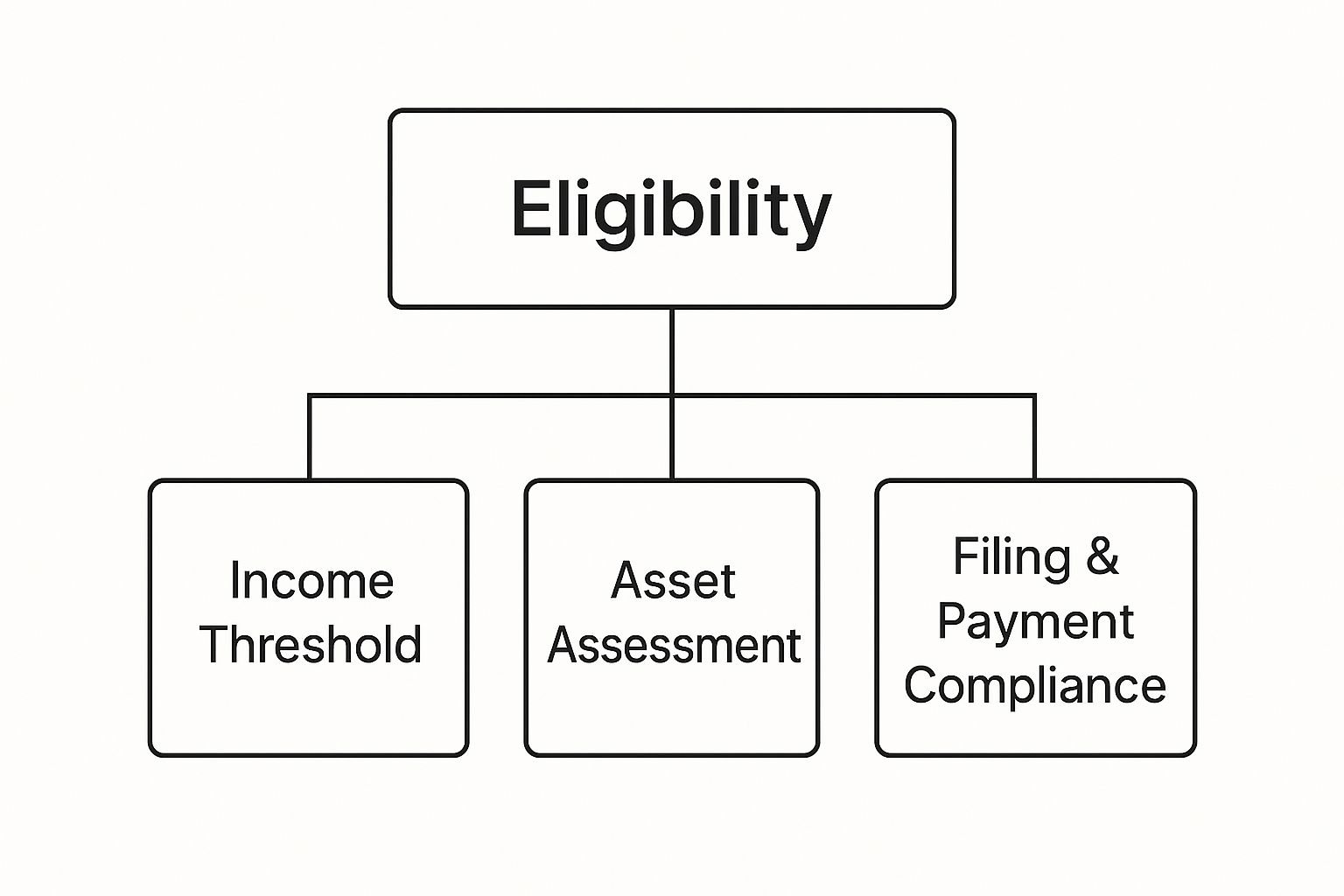
As you can see, it all comes down to a careful review of your income, your assets, and whether you've been compliant with tax laws in the past.
Other Tax Relief Options
Beyond the two main settlement programs, the IRS has other tools that can be part of your strategy.
Currently Not Collectible (CNC) Status
If you're facing a severe financial storm and can't even afford a small monthly payment, you might qualify for Currently Not Collectible (CNC) status. Think of this as a temporary timeout on collections. The IRS acknowledges you can't pay right now and will stop garnishing your wages or levying your bank accounts.
CNC isn't a permanent fix, though. Your debt will keep growing with interest and penalties, and the IRS will check in periodically to see if your financial situation has improved.
Penalty Abatement
Sometimes, the penalties are what make a tax bill truly unbearable. Penalty Abatement is a process where the IRS can remove certain penalties if you can show you had a good reason for failing to file or pay on time.
What counts as a "good reason"?
Reasonable Cause: Things outside of your control, like a death in the family, a serious illness, a natural disaster, or records you couldn't get.
Statutory Exceptions: Specific situations written into the tax code that excuse penalties.
First-Time Abatement: If you have a clean record, the IRS might give you a one-time pass and forgive penalties for a single tax year.
Each of these programs has a different job. By understanding all the options on the table, you can start building a strategy that fits your financial reality and gives you a clear path forward.
Checking Eligibility for Tax Settlements

So, you want to settle your tax debt. Before you even get to fill out a form, the IRS needs to be absolutely convinced of one thing: you truly cannot pay what you owe. This isn't just about showing them an empty bank account. It's a deep dive into your entire financial life.
They boil it all down to a single, critical number called your Reasonable Collection Potential (RCP).
Think of the RCP as the amount the IRS believes it could realistically squeeze out of you over the next few years. If that number is less than your total tax bill, you’ve got a real shot at a settlement. If it's higher, well, they'll expect you to pay in full, and your application will likely be dead on arrival.
The RCP isn't just a ballpark figure; it’s a specific calculation based on your assets, income, and what the IRS considers allowable living expenses. And that last part is where many people get tripped up—the IRS has its own strict rulebook on what you actually need to live on.
The Two Pillars of Eligibility
Before the IRS even glances at your RCP, you have to clear two non-negotiable hurdles. Fail either of these, and your application stops right there. Consider them the gatekeepers to the entire settlement process.
All Tax Returns Filed: You must be completely caught up on filing. The IRS won't even talk about settling old debt if you haven't filed all your required tax returns from previous years.
Current on This Year's Taxes: You also have to be making your current estimated tax payments. This proves you’re serious about staying on the right side of the law from here on out.
Getting these two things in order is your ticket to the game. It shows good faith, and without it, you're just wasting your time.
The foundation of any tax settlement is compliance. The IRS needs to see that you are making a sincere effort to follow the rules now before they consider forgiving past debts.
How the IRS Calculates Your Ability to Pay
Once you've passed the compliance check, the IRS gets down to business with your finances to figure out that all-important RCP. This calculation is the make-or-break moment for your settlement application.
At its core, the RCP formula looks something like this:
(Net Value of Your Assets) + (Future Monthly Disposable Income) = Reasonable Collection Potential
Let's break that down into plain English:
Assets: This is the equity in everything you own—cash, cars, real estate, retirement accounts, you name it. They'll look at what it's worth minus any loans against it.
Future Income: The IRS takes your monthly income and subtracts your allowable monthly living expenses. That leftover amount is your "disposable income." They then multiply that figure by a certain number of months to estimate what you could pay them over time.
This is where having an expert in your corner can make a huge difference. If you want to get into the nitty-gritty of what the IRS is looking for, you can learn more about how to qualify for an Offer in Compromise in our detailed guide.
A Case Study in Eligibility
Let's put this into practice with a hypothetical family, the Jacksons. They're staring down a $75,000 tax bill.
First, the IRS looks at their assets. They have $5,000 in savings and a car with $10,000 in equity. That means the asset portion of their RCP is $15,000.
Next up is their income and expenses:
Monthly Income: $6,000
Allowable Monthly Expenses: $5,700 (This is based on strict IRS national and local standards, not just what the Jacksons actually spend).
This leaves them with $300 in monthly disposable income ($6,000 - $5,700). For a lump-sum offer, the IRS typically multiplies this by 12 months, giving them a future income value of $3,600.
Now, we just add it all up:
$15,000 (Assets) + $3,600 (Future Income) = $18,600 (RCP)
Because their RCP of $18,600 is a fraction of their $75,000 tax debt, the Jacksons look like prime candidates for a settlement. The IRS would probably accept an offer somewhere right around that $18,600 mark.
Navigating the Settlement Application Process
Applying for a tax settlement can feel like gearing up to climb a mountain, but when you break it down into clear, manageable steps, the whole journey becomes a lot less intimidating. The secret to success isn't some magic formula; it's meticulous preparation and a deep understanding of what the IRS needs to see.
Think of it this way: you're building a solid case for why settling your tax debt is the best possible outcome—not just for you, but for the government, too.
Assembling Your Financial Dossier
The real work begins long before you even touch an official form. It all starts with putting together a completely transparent financial snapshot of your life. This is no time for guesstimates. Every single number you provide has to be backed up by solid documentation because you can be sure the IRS will be checking. Accuracy is your best friend here.
Before you can fill out any paperwork, you need to gather a comprehensive set of documents. This "financial dossier" is the hard evidence that proves your financial situation. Miss one little piece of the puzzle, and you could face major delays or even an outright rejection.
Here's what you need to start collecting:
Proof of Income: Grab your last three to six months of pay stubs. If you’re self-employed, you'll need your profit and loss statements for that same timeframe.
Bank Statements: The IRS will want to see three to six months of statements for all your bank accounts. They're looking at your average balance and keeping an eye out for any large or unusual transactions.
Asset Valuations: You have to document the value of everything you own. This means recent statements for retirement accounts, investment portfolios, and up-to-date appraisals or market analyses for your home and vehicles.
Monthly Expense Records: Pull together all your bills and receipts for necessary living costs—think rent or mortgage payments, utilities, groceries, healthcare, and transportation.
A huge blind spot for many people is forgetting to account for every single asset. The IRS has powerful tools to access financial information and will find undisclosed accounts or property. If they do, your application is likely dead in the water.
This level of detailed documentation is the foundation of your entire settlement application. It ensures every claim you make is verifiable. It’s also worth noting that this push for transparency isn’t just an IRS thing. Global initiatives like the OECD's Common Reporting Standard, which led to the sharing of details on 47 million financial accounts, have created a world where financial transparency is the new norm.
This program alone cut deposits in tax havens by 20-25% and helped recover €95 billion in tax revenue. It just goes to show how seriously governments everywhere are taking financial accountability. You can find more on these global tax trends on the IMF's website.
Completing the Official IRS Forms
Once you have your financial dossier organized, you're ready to tackle the official paperwork. The two most important forms for an Offer in Compromise (OIC) are Form 656 and Form 433-A (OIC).
Form 656 is your actual offer. It's where you formally state how much you propose to pay and the terms for that payment. Form 433-A (OIC), the Collection Information Statement, is where all your hard work gathering documents pays off. It’s a detailed financial disclosure where you lay out all your income, expenses, assets, and liabilities.
One of the biggest tripwires here is miscalculating your "allowable" expenses. The IRS doesn't just take your word for it; they use strict national and local standards for things like housing and transportation costs.
These official amounts might be quite a bit lower than what you actually spend, so applying these standards correctly is critical for presenting a realistic financial picture.
After You Submit Your Application
With your application in the mail, the waiting game begins. The IRS will assign an examiner to your case, and their job is to go through every detail of your submission with a fine-tooth comb. This isn’t a quick skim—it’s a full-blown financial audit.
Here’s a rough timeline of what to expect:
Initial Review: The examiner first checks if your package is complete. If anything is missing, they'll reach out to request the missing forms or documents.
Financial Verification: Next, they’ll independently verify everything—the value of your assets, your sources of income, and whether your listed expenses line up with their allowable standards.
Negotiation: If the examiner's calculations suggest you can pay more than you offered, they might come back with a counteroffer. This is a crucial point in the process, and it’s where having an experienced professional in your corner can make all the difference.
While you're waiting, you absolutely must stay current on all your tax obligations. That means filing every return on time and paying any new taxes that come due. Falling out of compliance while your offer is being reviewed is one of the fastest ways to get it thrown out.
An OIC can be a life-changing solution, but it isn't for everyone. For those who might not qualify, looking into the IRS's back taxes payment plan strategies can be another excellent way to get back on solid ground. Just be prepared for a bit of a wait—the OIC process can take anywhere from six months to over a year. Patience and ongoing compliance are non-negotiable.
Comparing DIY and Professional Services

When you're staring down a mountain of tax debt, one of the first big questions you'll face is: "Should I handle this myself or hire a professional?" It's a classic cost-versus-benefit dilemma. You can try to save money on fees by going it alone, or you can invest in an expert who might get you a much better result.
Let's be honest, the DIY route is tempting. No attorney fees sounds great, right? If your situation is incredibly simple—maybe a small debt and a straightforward financial picture—you might be able to pull it off. But don't underestimate what you're taking on. This path demands a huge investment of your time, an almost obsessive level of detail, and a solid grasp of complex IRS rules.
Make one small mistake—miscalculate your Reasonable Collection Potential (RCP), miss a deadline, or fill out a form incorrectly—and your offer can be flat-out rejected. After months of work, you’re right back where you started.
When to Call in a Pro
As soon as your tax situation gets even a little complicated, the scales tip heavily in favor of hiring a tax attorney or an Enrolled Agent. These professionals live and breathe the tax code. They speak the IRS's language fluently and know exactly what revenue officers are looking for.
Here’s where their expertise really shines:
Pinpoint Financial Analysis: They know the IRS playbook for calculating your ability to pay. They can maximize your allowable expenses to present the strongest, most convincing case for a lower settlement.
Smarter Negotiation: An experienced pro sees angles you’d never spot. They know the pressure points and can build a rapport with the IRS agent, which is something you just can't do on your own.
A Faster Resolution: Because they know the system inside and out, they sidestep the common mistakes that bog down applications, often getting you to the finish line much faster.
The real value of a good tax professional isn't just filling out paperwork. It's building a compelling, legally-sound argument that convinces the IRS that accepting your offer is their best financial move.
Think of them as a shield. They handle all the stressful calls and communications, insulating you from the anxiety of dealing directly with the IRS. That alone is often worth the fee, letting you get on with your life while they fight the battle.
To help you visualize the trade-offs, here’s a quick comparison of what you’re up against.
DIY vs Professional Tax Help Comparison
| Factor | DIY Approach | Hiring a Professional |
|---|---|---|
| Cost | No professional fees, but you risk costly mistakes. | Upfront investment in fees, but can lead to larger savings. |
| Time & Effort | Extremely time-consuming; requires extensive research. | Minimal time from you; the professional handles everything. |
| Expertise | You're responsible for learning complex tax laws and procedures. | You get immediate access to years of specialized knowledge. |
| Success Rate | Lower. Prone to errors that cause delays or rejection. | Higher. Professionals know how to build a winning case. |
| Stress Level | High. You deal directly with the IRS and all the pressure. | Low. The professional acts as a buffer between you and the IRS. |
Ultimately, the right choice depends on your specific situation, but for anything beyond the most basic cases, professional help often pays for itself.
How to Spot a Good Tax Resolution Service (and Avoid the Scams)
Deciding to get help is a big step, but choosing the right help is even more critical. The tax resolution industry is notorious for "too good to be true" offers. You have to be a savvy consumer.
Be very skeptical of any company that:
Guarantees an outcome: This is the biggest red flag. No ethical professional can guarantee the IRS will accept an offer. They can only promise their best effort.
Uses high-pressure sales tactics: If they’re pushing a "limited-time deal" or rushing you to sign, run. Legitimate help is based on careful analysis, not a sales pitch.
Demands a massive fee upfront: Reputable firms usually start with a paid consultation or initial investigation to see if you even qualify for relief. They won't ask for thousands before they know if they can help you.
The best tax pros are transparent. They'll start with a deep dive into your finances, lay out all your options, and give you a realistic assessment of what you can expect from your tax debt settlements. By weighing the pros and cons carefully, you can make the smart choice that gets you on the fastest path back to financial freedom.
Avoiding Common Settlement Mistakes
Trying to get a tax settlement approved can feel like walking on a tightrope. One wrong move, and months of hard work can go down the drain, leading to an outright rejection that sends you right back to where you started. Knowing the common pitfalls ahead of time is your best defense.
The single biggest mistake? A lack of complete transparency. It's tempting to think you can underreport your income or conveniently "forget" to list a small investment account, hoping the IRS won't dig that deep. Trust me, that's a gamble you will lose. The IRS has powerful tools to cross-reference your financial life, and they will find discrepancies.
Hiding Assets or Income
I've seen it happen. Someone applies for a settlement but doesn't disclose a brokerage account with $8,000 in it. When the IRS inevitably finds it, the offer isn't just rejected—it's dead on arrival. Worse, the applicant's credibility is shot, making any future attempts to negotiate infinitely harder. When dealing with the IRS, honesty isn't just the best policy; it's the only one that works.
Another classic error is dropping the ball on your current tax obligations while the IRS is reviewing your offer.
The IRS looks at your current compliance as a test of good faith. If you can't keep up with your tax duties now, why would they believe you'll stick to a settlement agreement for past debts?
This means you absolutely must keep filing all your returns on time. You also need to make any required estimated tax payments while your offer is under consideration. Missing even one deadline can get your entire case thrown out.
Missing Critical Deadlines and Requirements
The settlement process runs on a strict clock. When the IRS asks for more documents, you'll have a firm deadline to get them in. It's surprisingly easy to miss a 30-day window for providing updated bank statements, but that simple mistake is enough for the IRS to close your file.
Here are the top three blunders that will sabotage your settlement efforts:
Inaccurate Financials: Submitting financial forms with outdated or just plain wrong information about your income, assets, and expenses is the fastest way to get a rejection letter.
Ignoring New Tax Liabilities: If you owe new taxes after you've submitted your offer, it sends a clear signal to the IRS that you aren't serious about staying compliant.
Misunderstanding Payroll Taxes: Business owners often mistakenly believe an Offer in Compromise can wipe out their personal liability for unpaid payroll taxes. Things like the Trust Fund Recovery Penalty operate under a whole different set of unforgiving rules.
Getting a tax settlement approved is all about meticulous attention to detail and unwavering honesty. If you can steer clear of these common mistakes, you'll show the IRS you're a serious candidate ready to put your tax problems behind you for good.
Got Questions About Tax Settlements? We Have Answers.
Walking through the world of tax debt settlements can feel like navigating a maze. It’s only natural to have a lot of questions. Here are some straightforward answers to the things taxpayers most often ask when they’re thinking about settling their debt with the IRS.
How Long Does The IRS Offer In Compromise Process Usually Take?
You’ll want to be patient with this one. While the IRS tries to wrap things up in a few months, the reality is that a typical Offer in Compromise (OIC) process takes anywhere from 6 to 12 months from start to finish. If your case is particularly complex and requires some back-and-forth, it can stretch out even longer.
Will A Tax Debt Settlement Hurt My Credit Score?
This is a big concern for many, and the answer is a bit nuanced. The settlement itself—your OIC agreement—isn't reported to the credit bureaus. So, no, the settlement doesn't directly ding your score.
What does show up, however, are the collection actions the IRS took before you settled. If the IRS filed a Notice of Federal Tax Lien, that will absolutely appear on your credit report and can drag down your score. The good news? Once you’ve paid your settlement in full, you can ask the IRS to release the lien, which is a major step toward rebuilding your credit.
What Happens If My Offer In Compromise Gets Rejected?
Don't panic—a rejection isn't the final word. The IRS gives you 30 days from the date on the rejection letter to file an appeal. This is your chance to go before the IRS Office of Appeals and make your case, maybe with new information or a clearer argument for why your offer should have been accepted.
If an appeal isn't the best route, there are still other avenues to explore, like a Partial Pay Installment Agreement.
The most important thing to remember is that an initial "no" from the IRS doesn't mean the game is over. Knowing your appeal rights is a crucial part of any good settlement strategy.
Can I Change My Settlement Plan After It's Been Approved?
Once a settlement is locked in, it’s very difficult to change. The IRS operates on the assumption that you'll honor the deal you made. You can try to request a review if you have a dramatic, unforeseen change in your financial situation, but there's no guarantee they'll approve any modifications.
That’s why it’s so critical to make sure the offer you submit is both accurate and realistic from the very beginning.
Feeling buried under tax debt? Don't hand over thousands to a big, faceless firm just to become another case number. Start with a clear, honest assessment. Attorney Stephen A Weisberg provides a FREE Tax Debt Analysis to show you exactly what he can do to help. Discover your best path forward by visiting weisberg.tax today.
When you owe the IRS money, it can feel like you're staring down an insurmountable mountain of debt. Many people think their only options are paying every last penny or facing a storm of penalties and aggressive collection actions. But that's not the whole story.
Want to understand your options before you call anyone?
Download my free book — Freedom From Tax Debt — a plain-language guide to how the IRS collections process actually works and what resolution really looks like.
➥ Contact Attorney Stephen A. Weisberg for a free Tax Debt Analysis.
Contact Me Here: https://www.weisberg.tax/contact-1
Email: s.weisberg@weisberg.tax
Phone/Text: (248) 971-0885
Address: 300 Galleria Officentre, Suite 402, Southfield, MI 48034
