Can the IRS Garnish Your Wages? Find Out Now
Yes, the IRS can garnish your wages. But let's be crystal clear about one thing: it never, ever happens out of the blue. This process, officially called a wage levy, is one of the most serious collection tools the government has for unpaid taxes.
However, the IRS doesn't just decide to do this one morning. They are legally required to follow a very specific, multi-step process that involves sending you several warning notices long before they ever touch your paycheck.
Understanding the Power of an IRS Wage Levy
The thought of the IRS reaching directly into your hard-earned paycheck is, frankly, terrifying. It’s this power that makes a wage levy such a feared and effective collection method.
Unlike a regular creditor who needs to sue you and get a court judgment first, the IRS has the unique authority to garnish wages on its own once it has followed the proper notification procedures.
Think of it less like a sudden ambush and more like a storm you can see building on the horizon. It all starts with the IRS officially assessing a tax debt against you.
This is followed by a series of letters demanding payment. You have multiple chances to respond, dispute the debt, or work out a payment arrangement.
It's only when those letters are ignored that the storm clouds gather and the levy eventually hits your finances.
The Purpose of a Wage Garnishment
From the government's standpoint, a wage levy has a very straightforward purpose: to forcibly collect a tax debt from someone who hasn't responded to any other collection attempt. It is truly a last-resort measure. This guide is here to pull back the curtain on the entire process, so you know exactly what to expect and how to act.
Here’s what you need to know right from the start:
No Surprises: The IRS must send you a final, formal notice of their intent to levy, giving you a critical 30-day window to respond.
You Have Options: Even after receiving that final notice, you can still stop the garnishment if you take the right steps.
Knowledge is Power: Understanding the timeline and your rights transforms a scary, overwhelming situation into a manageable problem with a clear solution.
To give you a clearer picture, let's break down the typical sequence of events.
The IRS Wage Garnishment Process at a Glance
This table shows the standard path the IRS follows before a levy is placed on your wages. Notice how many opportunities you have to intervene along the way.
| Stage | What Happens | Taxpayer's Opportunity |
|---|---|---|
| 1. Tax Bill (Notice CP14) | The IRS sends the first bill stating you owe taxes. | Review the bill for accuracy. Pay in full or explore payment options. |
| 2. Reminder Notices | If you don't respond, the IRS sends a series of reminder notices (e.g., CP501, CP503). | Contact the IRS to make arrangements before the situation escalates. |
| 3. Final Notice (Letter 1058/LT11) | You receive a "Final Notice of Intent to Levy and Notice of Your Right to a Hearing." This is the last warning. | You have 30 days to pay, set up a plan, or appeal the levy. This is your most critical window. |
| 4. Levy on Wages (Form 668-W) | The IRS sends Form 668-W to your employer, instructing them to start the garnishment. | By this point, options are more limited, but you can still work with the IRS to get the levy released. |
The most important takeaway? Ignoring those letters is what leads to the final, painful step.
The rest of this guide will walk you through everything in more detail—from the first warning letter to the exact strategies you can use to protect your income. We’ll break down the official timeline, explain how much the IRS can legally take, and outline your rights as a taxpayer.
By the end, you'll have a clear roadmap to resolve your tax problems long before a wage garnishment becomes your reality.
The Official IRS Collection Timeline Explained
The IRS can't just decide to start taking money from your paycheck out of the blue. Far from it. The journey from a simple tax bill to an active wage levy is a very structured, predictable process that’s spelled out by law.
Getting a handle on this timeline is your best defense because it gives you several clear opportunities to step in and fix the problem.
Think of it like a series of warning signs on a road. Each notice the IRS sends is a signpost letting you know you're getting closer to the "danger ahead" of a wage garnishment. If you ignore the first one, the road doesn't get any safer—it just means you’re less prepared for what’s coming next.
It almost always starts with a single piece of mail.
Stage 1: The First Bill (Notice CP14)
The very first letter you’ll get is usually a Notice CP14. This is the official bill for what the IRS calculates you owe in tax, penalties, and interest. Seeing that notice can definitely send a jolt of panic through you, but it's important to know this is not a threat of garnishment. Not yet.
This first notice simply establishes the debt and asks you to pay up. You’ll typically have 21 days to pay the balance before more failure-to-pay penalties start piling on. This is your earliest and easiest chance to resolve the issue before things escalate.
Stage 2: Reminder Notices and Growing Urgency
If you don't respond to that initial CP14, the IRS collection machine kicks into the next gear. You'll start getting a series of reminder notices that get progressively more firm in their tone. These often show up as a Notice CP501 and then a Notice CP503.
Each letter is another nudge about your outstanding balance, warning you about potential collection actions if the debt isn't handled. While these still aren't levy notices, they are a clear signal that the IRS is running out of patience and more serious actions are on the horizon.
Key Takeaway: The IRS collection process is automated and progressive. Every unanswered notice triggers the next one, pushing you closer to forced collection like a wage levy. Staying silent is basically telling them you're not willing to cooperate.
The infographic below maps out this sequence of events and shows you the critical windows you have for taking action.
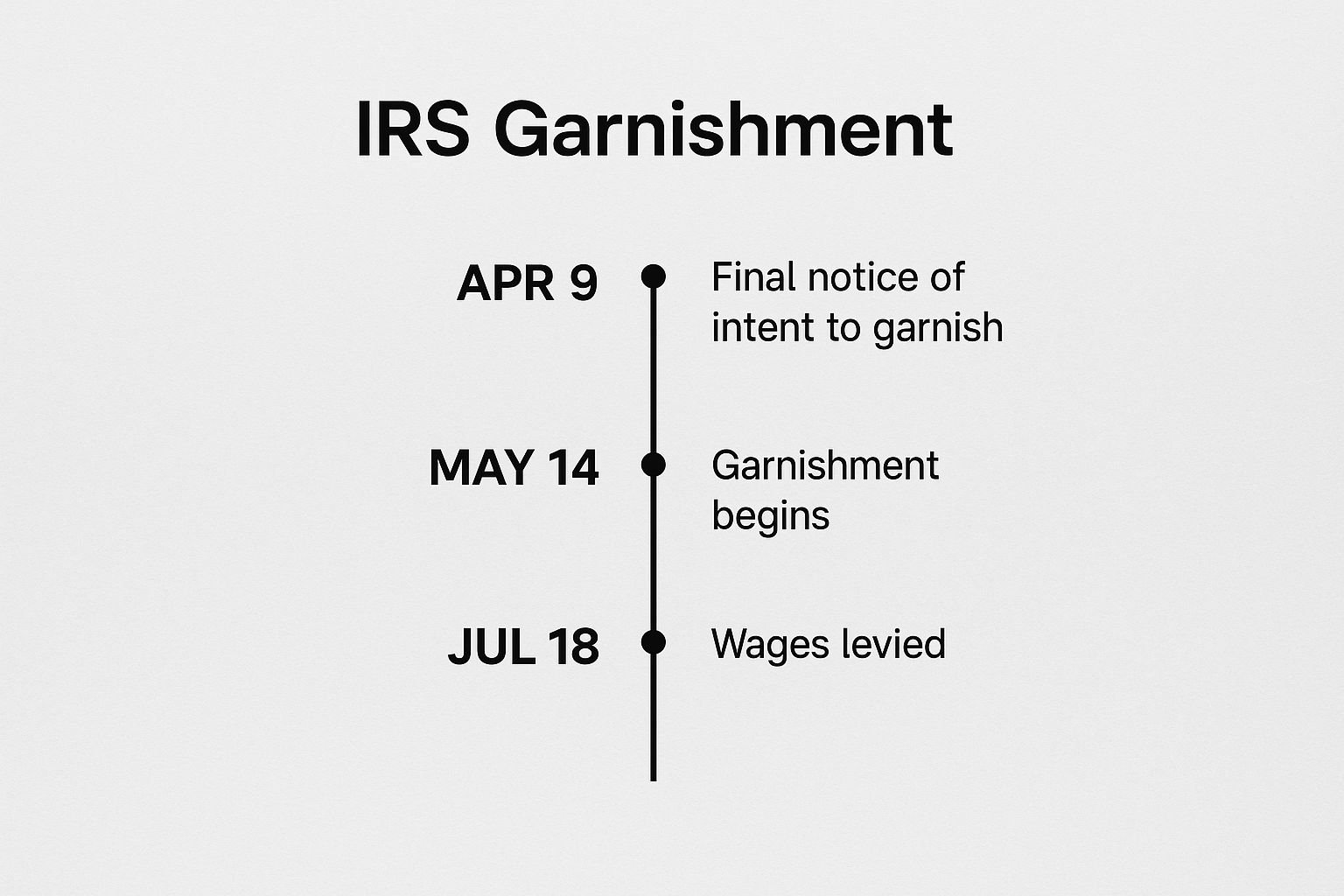
This visual timeline really drives home how each step gives you a clear shot at engaging with the IRS and finding a solution before that final, dreaded notice arrives.
Stage 3: The Final Notice of Intent to Levy
This is it. This is the most critical stage of the whole process. Once the reminder notices have gone unanswered, the IRS will send a Final Notice of Intent to Levy and Notice of Your Right to a Hearing. This is your last stop on the line before a garnishment actually starts.
This notice will come in the form of one of two letters:
Letter 1058
Letter LT11
Both letters do the same thing: they officially tell you that the IRS is planning to seize your property—including your wages. Most importantly, this notice gives you a 30-day window to act. During these 30 days, you can pay the debt, get on a payment plan, or formally appeal the levy by requesting a Collection Due Process (CDP) hearing.
Stage 4: The Levy Begins with Form 668-W
If you don't respond within that 30-day window from the Final Notice, the IRS will move forward with the levy. The agency sends Form 668-W, Notice of Levy on Wages, Salary, and Other Income, straight to your employer. This is a legally binding order that forces your employer to start taking a significant chunk of your pay and sending it directly to the IRS.
The IRS has to follow this strict process before it can touch your wages. It's only after a taxpayer has failed to resolve their debt after multiple notices and a final 30-day warning that the IRS will bring an employer into the mix to start withholding funds.
Knowing these stages is power. When a notice arrives, you can immediately figure out where you stand in the timeline and how much time you have left to act.
How Much of Your Paycheck the IRS Can Legally Take

When the threat of a wage levy becomes real, one question immediately takes over: “How much will I have left to live on?” This is the moment the true weight of an IRS garnishment hits home. To brace yourself for what’s coming, you have to understand how they calculate the damage.
There's a dangerous myth that the IRS plays by the same rules as your other creditors. They don't. While most creditors are limited by the Consumer Credit Protection Act to taking about 25% of your disposable income, the IRS operates under its own, far more aggressive authority.
Federal law gives them the power to take a much larger slice of your paycheck, which is what makes a tax levy so severe.
Instead of a flat percentage, the IRS uses a specific formula. It’s designed to leave you with just enough to cover basic living costs. Everything else goes straight to your tax debt.
Understanding Your Exempt Income
The entire calculation hinges on your exempt income. This is the part of your wages the government agrees you need for essentials, so it’s shielded from the levy. The IRS figures out this amount based on just two things: your tax filing status and the number of dependents you claim.
Your employer will get a notice from the IRS that includes a form called Form 668-W. Part 3 of that form is for you to fill out—it's where you state your filing status and list your dependents.
Crucial Action Step: You absolutely must complete and return Part 3 of Form 668-W to your employer right away. If you don't, your employer is legally forced to calculate the garnishment as if you're married filing separately with zero dependents. This is the worst-case scenario, resulting in the maximum possible garnishment and leaving you with the absolute minimum to live on.
Once your employer has your information, they turn to IRS Publication 1494, Tables for Figuring Amount Exempt from Levy on Wages, Salary, and Other Income.
This document, updated every year, has simple tables that match up your pay period (weekly, bi-weekly, etc.), filing status, and number of exemptions to find your exact protected amount.
How the Calculation Actually Works
Let's do the math. Your employer starts with your gross pay and subtracts any pre-tax deductions like health insurance or 401(k) contributions. What’s left is your "take-home pay."
From that number, they subtract your legally exempt amount from the Publication 1494 tables. The entire remaining balance is what they have to send to the IRS. Every single paycheck. Until the levy is released.
To see just how hard this can hit, let's run through a couple of real-world scenarios using the 2024 exemption tables for someone paid bi-weekly.
Example 1: The Single Filer
Taxpayer: Alex, who is single with no kids.
Paycheck: Alex takes home $2,000 every two weeks.
Exempt Amount: Based on the 2024 tables, the bi-weekly exempt amount for a single person with one exemption (for themself) is $583.33.
Garnishment Calculation: $2,000 (Take-Home Pay) - $583.33 (Exempt Amount) = $1,416.67
Result: The IRS takes $1,416.67 from Alex's paycheck every two weeks. Alex is left with just $583.33 to cover all living expenses.
Example 2: The Head of Household
Taxpayer: Maria, a head of household with two children.
Paycheck: Maria also takes home $2,000 every two weeks.
Exempt Amount: For a head of household with three exemptions (herself plus two kids), the bi-weekly exempt amount is $1,320.83.
Garnishment Calculation: $2,000 (Take-Home Pay) - $1,320.83 (Exempt Amount) = $679.17
Result: The IRS takes $679.17 from Maria's check, leaving her with $1,320.83.
These examples make it crystal clear: your family situation makes a huge difference. But even in the better scenario, the amount taken is substantial and can trigger an immediate financial crisis.
The harshness of this math highlights why you must act fast when you get a Final Notice of Intent to Levy. You can learn more about what this notice means by checking out our ultimate guide for taxpayers and the IRS Notice of Levy. Being proactive is your only real defense against having this brutal formula applied to your hard-earned money.
Know Your Rights and Protect Your Income
Getting a notice from the IRS can make you feel completely backed into a corner, as if you have no say in what happens next. But that’s simply not the case.
The tax system actually gives you a specific set of rights, and knowing them is the first real step toward protecting your paycheck. These aren't just flimsy suggestions; they are legally protected rights you can—and should—use.
When it comes to a wage garnishment, your most powerful tool is the right to appeal. Think of this as your official chance to hit the pause button and challenge the levy before a single dollar is taken from your wages. It’s your legal "time out" to open a negotiation with the IRS.
The catch? You have to act fast. This right is only triggered by the "Final Notice of Intent to Levy," and you have just 30 days from the date printed on that letter to respond.
Your Right to a CDP Hearing
Once you receive that final notice, you have the ability to formally request a Collection Due Process (CDP) hearing. Don't let the word "hearing" intimidate you.
This isn't some dramatic courtroom battle. It’s a formal meeting with the IRS Independent Office of Appeals—a neutral division that is completely separate from the collection agents pursuing you.
During a CDP hearing, you can accomplish a few critical things:
Challenge the Levy: You can lay out your case for why a wage garnishment would be a crushing financial blow.
Propose Alternatives: This is your best opportunity to formally suggest a more manageable payment plan, like an Installment Agreement.
Raise Defenses: If you have new information, you can even dispute the amount of tax the IRS claims you owe.
Requesting a CDP hearing brings one immediate, game-changing benefit: it legally stops all garnishment activity dead in its tracks while your appeal is reviewed. The IRS is barred from contacting your employer or starting the levy until the hearing process is over and the Appeals office has issued a decision. This buys you precious time to get your financial documents in order and build a solid case.
A Collection Due Process (CDP) hearing isn't about finding you "guilty" or "innocent." It's a negotiation designed to find a realistic collection alternative that works for both you and the government. Ignoring this is like waiving your right to self-defense.
To get this process started, you must file Form 12153, Request for a Collection Due Process or Equivalent Hearing, within that very tight 30-day window.
Other Fundamental Taxpayer Rights
Beyond the urgent need to appeal, remember that you are also protected by the Taxpayer Bill of Rights. These ten rights ensure you're treated fairly and with dignity throughout the entire process.
The Right to Be Informed: You have the right to know exactly what you need to do to comply with the tax laws.
The Right to Professional and Courteous Service: IRS employees are required to treat you with respect.
The Right to Privacy: The IRS cannot broadcast your tax problems to the public and must respect your privacy.
The Right to Representation: You can always hire an authorized representative, like a tax attorney, to step in and handle the IRS for you.
These rights are your shield, but they only work if you pick them up and use them. You have to assert them. For many people, trying to navigate these rights while proposing a viable payment alternative feels overwhelming.
At the end of the day, burying your head in the sand and ignoring the notices is the absolute worst thing you can do. It’s like telling the IRS, "Go ahead, I don't want my rights," leaving them free to garnish your wages without any further input from you.
How to Stop or Reduce an IRS Wage Levy
Getting that final notice from the IRS can make your stomach drop, but it doesn't mean your fate is sealed. Far from it. Think of it as the final whistle before the game ends—it’s your cue to get in there and make a play.
Whether a wage garnishment has already hit your paycheck or it's just a terrifying threat on the horizon, you have real, powerful options to stop it.
This is your practical playbook for taking back control. The absolute key is to stop ignoring the letters and start talking to the IRS. You need to show them there's a better, more realistic way for them to get paid than by ripping a chunk out of your check.
Burying your head in the sand guarantees the worst-case scenario. Engaging with them opens the door to relief.
Let's walk through the three main paths you can take.
Option 1: Set Up an Installment Agreement
The most common and direct way to stop a wage garnishment dead in its tracks is to get on an official IRS payment plan, what they call an Installment Agreement. It’s a formal contract where you agree to pay off your tax debt over time with a fixed monthly payment. As soon as the IRS approves it, they have to release the levy on your wages.
It's a lot like refinancing a high-interest loan. Instead of the lender forcibly taking a huge, unsustainable payment, you negotiate a predictable monthly amount that actually fits your budget. This gives you stability and, most importantly, a clear finish line for your tax problems.
Best For: Taxpayers who owe less than $50,000 (that’s the combined total of tax, penalties, and interest) and can realistically afford to pay the whole thing off over a few years.
Pros: It’s a pretty straightforward process, and you can often set it up yourself online. It stops the levy immediately and gives you a predictable payment.
Cons: The downside is that interest and penalties keep piling up on your unpaid balance until it’s gone. You will end up paying more than your original tax debt.
Option 2: Submit an Offer in Compromise
For some people, paying the full tax debt—even spread out over years—is just not in the cards. It's an impossible mountain to climb. In these tough situations, an Offer in Compromise (OIC) can be a genuine life-changer. An OIC allows certain taxpayers to settle their tax liability with the IRS for a lot less than the full amount they owe.
But let's be clear: this isn't a casual negotiation. The IRS will only say yes if they're convinced it's the absolute most they could ever hope to collect from you. To effectively argue your case against a levy, you need a crystal-clear picture of your finances.
You might even consider using a finance tax document analyzer to double-check your tax forms for any overlooked details or errors. You'll have to lay all your financial cards on the table, proving you simply don't have the income or assets to ever pay the full amount.
Key Insight: An Offer in Compromise all boils down to your "reasonable collection potential." The IRS will go through your income, expenses, and any assets you have with a fine-tooth comb to figure out what you can realistically pay. If their math shows they can get more from you by garnishing your wages over time, they will reject your offer.
Best For: Taxpayers facing true financial hardship with very limited income and few assets, making full payment impossible.
Pros: It can wipe out a massive tax bill for pennies on the dollar, giving you a real fresh start.
Cons: The application is incredibly detailed, invasive, and has very strict qualification rules. Not everyone is eligible, and the truth is, the IRS rejects most OIC applications.
Option 3: Prove Financial Hardship for CNC Status
So what happens if you can't even afford a small monthly payment on an installment plan? If an IRS wage levy would make it impossible for you to cover basic living expenses—we’re talking rent, food, and utilities—you might qualify for Currently Not Collectible (CNC) status.
This isn’t debt forgiveness. Think of it more like the IRS hitting the pause button on your account. They agree to temporarily stop all collection actions because they recognize that taking money from you right now would cause an "economic hardship."
The catch is that they'll usually check back in on your finances every year or so to see if your ability to pay has improved.
To get CNC status, you have to prove your case by submitting a detailed financial statement (Form 433-F). This form needs to clearly show that your monthly income is less than or equal to your basic, allowable living expenses. It’s a formal acknowledgment that you just don’t have the money to spare.
Best For: People with very low income who are genuinely struggling to cover their most essential needs.
Pros: It immediately stops all collection activity, including wage levies. This gives you critical breathing room when you need it most.
Cons: It's temporary, not permanent. Interest and penalties keep growing the whole time, so your tax debt actually gets bigger while collections are on hold.
No matter which option you pursue, there's one non-negotiable rule: you must be current on filing all your tax returns. The IRS won't even talk to you about a solution if you have unfiled returns. If you're facing a levy and aren't sure which path is right for you, explore our comprehensive stop IRS wage garnishment guide to protect your income for more in-depth strategies.
Common Questions About IRS Wage Garnishment
Even after you get the basics down, a few specific questions always seem to pop up when you're staring down a potential IRS levy. These are the practical, "what-if" scenarios that keep you up at night and cause a ton of stress.
Let's cut through the noise and get you some straight answers to the most common concerns I hear from people who are trying to figure out what an IRS wage garnishment really means for their life.
Can the IRS Garnish My Social Security Benefits?
Yes, they absolutely can. The IRS has the legal power to take a slice of your Social Security benefits, though it works a bit differently than a standard wage garnishment. They use a system called the Federal Payment Levy Program (FPLP).
Through the FPLP, the IRS can automatically and continuously take up to 15% of your monthly Social Security retirement or disability payments. The scary part? They don't need a court order to do it.
However, not all federal payments are on the table. The most important exception is Supplemental Security Income (SSI), which the IRS is forbidden from touching. This is why it’s so critical to get ahead of tax debt long before it escalates to the point where your federal benefits are in jeopardy.
What Is the Difference Between a Levy and a Lien?
People throw the words "levy" and "lien" around like they’re the same thing, but they are two completely different collection tools. Knowing the difference is crucial to understanding exactly where you stand with the IRS.
A tax lien is a legal claim the government files against your property—think your house, your car, or other major assets. It’s a public notice that basically says, "We have a right to this property if you sell it." It secures the government's interest and puts them first in line to get paid before most other creditors.
A tax levy, on the other hand, is the actual seizure of that property to pay off the debt.
To put it simply: a lien is the claim on your property, while a levy is the act of taking it. An IRS wage garnishment is a specific kind of levy—it's the active seizure of your future income.
So, while a lien is a serious black mark on your public record that wrecks your credit, a levy is the immediate action that directly drains your bank account and impacts your ability to pay your bills.
How Long Does an IRS Wage Garnishment Last?
An IRS wage garnishment isn’t a one-and-done deal. Once it starts, it’s a continuous process that latches onto your income and doesn't let go until your employer gets a formal "Release of Levy" notice from the IRS.
This means they will take money from every single paycheck you get. The garnishment will only stop when one of four things happens:
The tax debt is paid off in full, including every last penny of penalties and interest.
You negotiate an alternative payment solution with the IRS, like an Installment Agreement.
The levy is officially released after you successfully prove it’s causing you an extreme economic hardship.
The Collection Statute Expiration Date (CSED) arrives. This is the deadline for the IRS to collect, typically 10 years from the date the tax was first assessed.
Until one of those conditions is met, that levy will stay put, relentlessly siphoning money from your pay.
Will My Employer Know About My Tax Debt?
Yes, without a doubt. For the IRS to garnish your wages, they have to send a legal order—Form 668-W (Notice of Levy on Wages, Salary, and Other Income)—directly to your employer’s payroll department.
There is no way to hide this. The form legally compels your employer to calculate the garnishment and send that portion of your pay straight to the IRS.
While it’s definitely embarrassing, employers are required to comply and must treat it as a standard administrative task. The only real way to avoid this awkward and financially damaging situation is to be proactive. Getting in touch with the IRS to find a solution is the only way to keep them from dragging your employer into the middle of your tax problems.
If you're facing a potential wage garnishment, you don't have to navigate this complex and stressful process alone. At Attorney Stephen A Weisberg, I start with a FREE Tax Debt Analysis to determine the best way to help you resolve your issues with the IRS before you ever pay a fee.
➥ Contact Attorney Stephen A. Weisberg for a free Tax Debt Analysis.
Contact Me Here: https://www.weisberg.tax/contact-1
Email: s.weisberg@weisberg.tax
Phone/Text: (248) 971-0885
Address: 300 Galleria Officentre, Suite 402, Southfield, MI 48034
