What Is Penalty Abatement and How Can You Get It?
That brown envelope from the IRS sitting in your mailbox is enough to make anyone’s stomach drop. Seeing a penalty notice can feel like a final judgment, but it’s often just the start of a conversation. I like to think of penalty abatement as the tax equivalent of getting a parking ticket dismissed because you had a flat tire—it’s the official process the IRS uses to forgive penalties when you have a good reason.
Understanding IRS Penalties and Your Relief Options

The IRS issues penalties for a few common slip-ups: filing late, paying late, or failing to deposit certain payroll taxes. While these are meant to encourage everyone to stay on top of their obligations, the tax code isn't heartless. It recognizes that life happens. For a deeper look into how businesses can proactively avoid these kinds of issues, a comprehensive compliance audit checklist can offer some great insights.
At its core, penalty abatement is about fairness. It’s the channel the IRS provides to either reduce or completely eliminate penalties after they’ve been charged. If you can show that your mistake wasn't due to deliberate carelessness or "willful neglect," you likely have a solid case for relief.
The Two Main Paths To Relief
The IRS generally offers two main avenues for penalty relief, and knowing which one applies to your situation is the critical first step.
First-Time Abatement (FTA): This is the closest thing you'll get to a "get out of jail free" card from the IRS. It's an administrative courtesy for taxpayers who have a good track record. If you’ve been a model taxpayer for the past three years but made one mistake, the IRS will often waive the penalty without a big fuss.
Reasonable Cause: This is for those times when life truly got in the way. We're talking about circumstances completely beyond your control, like a sudden serious illness, a death in your immediate family, a fire or natural disaster, or another unavoidable event that prevented you from meeting your tax duties. You'll need good records to back it up, but it's a powerful tool for relief.
To make things a little clearer, I've put together a quick table that breaks down the two main types of abatement.
Quick Guide to IRS Penalty Abatement Types
| Abatement Type | Best For | Core Requirement |
|---|---|---|
| First-Time Abatement (FTA) | Taxpayers with a clean compliance history who just made a single mistake. | A three-year history of filing and paying all taxes on time. |
| Reasonable Cause | Taxpayers who faced extenuating circumstances that were out of their control. | Documented proof that you acted with ordinary business care and prudence despite your situation. |
At the end of the day, both of these options prove that an IRS penalty doesn't have to be the final word. When you understand the relief that's available, you can face that notice head-on and potentially save yourself a significant amount of money and stress.
Qualifying for First-Time Penalty Abatement
If you’re someone who typically stays on top of your tax obligations, the First-Time Penalty Abatement (FTA) is your most direct route to getting a penalty waived. Think of it as a one-time “get out of jail free” card from the IRS. It’s an administrative courtesy, a pass for an honest mistake from an otherwise good taxpayer.
This isn't a loophole for habitual late filers. The FTA program is a powerful tool, but the IRS has drawn some very clear lines in the sand. To even have a shot, you need to prove a history of responsible tax behavior.
The Three-Year Clean Slate Rule
The absolute bedrock of First-Time Abatement is your compliance history over the last three years. Before the IRS will forgive your current penalty, they’re going to look back at your track record.
The rule of thumb is simple: You need a clean slate for the three tax years right before the year you got the penalty. This means you can't have had any other penalties assessed during that time.
Let's say you got hit with a penalty on your 2023 tax return (which you filed in 2024). The IRS will pull your records for 2022, 2021, and 2020. If those years are penalty-free, you've cleared the first major hurdle.
Filing and Payment Requirements
A clean history is a great start, but it’s not enough. You also have to be completely up-to-date with your current tax duties. Before the IRS will even listen to your request, you must have:
Filed All Required Returns: Every single tax return you're obligated to file must be in. The only exception is if you have a valid, filed extension. The IRS simply won't forgive a past mistake if you're currently out of compliance.
Paid or Arranged to Pay: You must have paid off any tax you owe. If you can't pay it all at once, you need to have a formal payment plan, like an Installment Agreement, already in place.
This "get current, stay current" mindset is at the heart of nearly all IRS relief programs. The agency needs to see you're making a genuine effort to fix your tax problems before it will cut you a break. While FTA handles the penalty, if you're drowning in a tax debt you can’t afford, you might need a more powerful solution.
Which Penalties Qualify for FTA?
First-Time Abatement doesn't wipe away every type of penalty. It’s laser-focused on the most common slip-ups related to basic compliance. The main penalties it covers are:
Failure-to-File: The penalty you get when you don't file your tax return by the deadline (including extensions).
Failure-to-Pay: This kicks in when you file on time but don't pay the tax you owe by the original due date. It can swell to a painful 25% of your unpaid tax, so getting this one abated is a huge relief.
Failure-to-Deposit: This is for employers who mess up their payroll tax deposits—by paying late, in the wrong amount, or incorrectly.
It’s important to know that penalties for things like accuracy issues, tax fraud, or other serious violations are not eligible for this program.
How to Request First-Time Abatement
Getting FTA is often much more straightforward than building a case for reasonable cause. You've got two main ways to ask for it, each with its own benefits and drawbacks.
| Request Method | Best For | Pros | Cons |
|---|---|---|---|
| Phone Call | Simple, clear-cut cases where you know you qualify. | Fast. You can get an answer right on the call. | No paper trail unless you take detailed notes; get ready for potentially long hold times. |
| Written Request | More complex situations or if you want a formal record of your request. | Creates a clear paper trail; lets you lay out your case in detail. | It's slow. Expect to wait 60-120 days or even longer for a response. |
If you’re going the phone route, just call the number on your IRS notice. Have your tax info handy and politely tell the agent you're requesting First-Time Penalty Abatement. If you tick all the boxes, they can often approve it right there. If you prefer to write, send a letter or Form 843, Claim for Refund and Request for Abatement. Clearly state your request and confirm that you meet the three-year clean history and current compliance rules.
Building Your Case for Reasonable Cause

So, you don't have a perfect three-year compliance history to qualify for First-Time Abatement. Don't panic. Your next, and often most powerful, line of defense is arguing for Reasonable Cause.
This is where the IRS acknowledges that life happens. Sometimes, a situation is so disruptive that meeting your tax deadlines becomes genuinely impossible, no matter how responsible you are. This isn’t a get-out-of-jail-free card for being disorganized; it's a legitimate argument for when circumstances beyond your control completely derail your plans.
The heart of any successful Reasonable Cause claim boils down to proving two things: first, that you acted with ordinary business care and prudence, and second, that you were still unable to file or pay on time. Essentially, you have to show that any other responsible person in your exact shoes would have faced the same struggle.
The IRS looks at every Reasonable Cause request individually. There's no secret formula. Your best tool is a well-documented, compelling story that clearly explains what happened, when it happened, and precisely how it stopped you from taking care of your tax obligations.
Your success depends entirely on connecting the dots for the IRS agent reviewing your file. A vague excuse like "I was sick" is dead on arrival. You need to show how that sickness physically or mentally prevented you from filing, and you need credible proof to back it up.
What the IRS Considers a Valid Reason
The IRS intentionally avoids publishing a complete list of acceptable excuses because every taxpayer's situation is different. However, over the years, some circumstances have become commonly accepted as valid grounds for a Reasonable Cause defense. Knowing these can help you frame your own story in a language the IRS understands.
These reasons often include:
Death, Serious Illness, or Unavoidable Absence: This applies to you or a member of your immediate family. The key is proving the event was so debilitating or all-consuming that managing financial affairs was simply not an option.
Fire, Casualty, or Natural Disaster: This is a strong argument if your home, office, or critical records were destroyed in an event like a flood, hurricane, or fire.
Inability to Obtain Records: Sometimes, the documents you need are out of your hands. A classic example is waiting on a delayed K-1 from a partnership that you need to complete your own return.
Erroneous Advice: If you received incorrect guidance from a competent tax advisor (like a CPA or tax attorney) or even from the IRS itself, this can be a valid excuse. You'll need to prove you relied on that specific advice in good faith.
The more detail you provide and the stronger your supporting evidence, the better your odds.
The Power of Documentation and Storytelling
Your story is only as good as the evidence you have to prove it. Simply telling the IRS that something happened isn't enough—you must show them with impartial, third-party documentation. Your goal is to create a narrative that walks the agent through a clear timeline, using your documents to validate every step.
Think of it as building a case file. Depending on your situation, here's the kind of evidence you'll need:
For Serious Illness or Death:
Hospital or physician records that detail the dates, severity, and nature of the illness.
A copy of the death certificate for an immediate family member.
Any documents showing you were the primary caregiver, if that's relevant to your case.
For a Natural Disaster:
Copies of insurance claims, police reports, or statements from FEMA.
Dated photos showing the extent of the damage to your property or records.
News articles that confirm the disaster occurred in your specific location.
For Erroneous Professional Advice:
A copy of the specific written advice you received.
Proof of the tax advisor's credentials and that you provided them with all the correct information to begin with.
When you combine a clear, chronological story with undeniable proof, you're no longer just asking for a break. You're demonstrating that you're a responsible taxpayer who was simply caught in an impossible situation.
Navigating Complex International and Business Penalties
If you think a standard IRS penalty is stressful, wait until you run into one from the international or business tax world. These are in a completely different league. We're talking about penalties that are often shockingly large, incredibly complex, and slapped on automatically by an IRS computer without a human ever looking at your file.
This is especially common with filings that most people have never even heard of. For example, failing to file Form 3520 to report a gift from a foreign relative or Form 5471 for an interest in a foreign company can trigger life-altering penalties. The same goes for businesses that fall behind on payroll tax deposits—the IRS treats that with the utmost seriousness.
The tough part? Simply saying, "I didn't know about that form," won't get you very far. The key is to show the IRS that you acted with reasonable cause in spite of not knowing about some obscure rule.
The Problem with "Guilty Until Proven Innocent" Assessments
A huge hurdle here is how these penalties get triggered in the first place. The IRS system is programmed to act first and ask questions later. When a form like the 3520 comes in late, a computer automatically spits out a penalty notice. This penalty can be as high as 25% of the value of the gift or inheritance you received.
The system doesn't care why it was late. It just sees a missed deadline and assesses the fine.
This automated process results in a staggering number of penalties that shouldn't have been issued. The IRS's own Taxpayer Advocate Service found that for penalties tied to these international forms, the abatement rates are sky-high—between 55% and 72% of them get thrown out once a human gets involved. You can read the full analysis from the Taxpayer Advocate Service to see the data for yourself.
This tells us something incredibly important: a huge number of these terrifying penalty notices are ultimately waived. Your job is to give the IRS a clear, compelling story that forces a human review.
How to Build Your Case for Abatement
When a First-Time Abate isn't on the table, your entire argument rests on Reasonable Cause. For these high-stakes business and international penalties, that argument needs to be sharp and specific. You have to paint a picture showing that you genuinely tried to do the right thing but got tripped up by an unusually complex or little-known part of the tax code.
Here are a few arguments that often work:
Bad Advice from a Pro: Did you hire a CPA who dropped the ball and never mentioned a specific form you needed to file? If you can prove you gave them all the right information and their bad advice (or lack of advice) caused the mistake, you have a solid case.
An Obscure, Niche Rule: While ignorance of the law is a weak defense, you can successfully argue that your filing obligation was so obscure and your situation so unique that any normal, careful person would have missed it. This works best when you can also point to an otherwise perfect track record of filing and paying on time.
IRS System Errors: Sometimes the fault lies with the IRS itself. Maybe they sent a confusing notice, their agent gave you bad information over the phone, or a system glitch caused the problem.
Let's walk through an example to see how this plays out in the real world.
Example: The Unexpected Inheritance from Abroad
Meet Maria, a U.S. citizen whose aunt in Italy passes away, leaving her $150,000. Because inheritances are generally not taxable income in the U.S., Maria doesn't think to report it on her tax return. A year later, a friend mentions something about a Form 3520 for foreign gifts. Panicked, Maria realizes her mistake, immediately files the late form, and is promptly hit with an automatic penalty letter for $37,500 (25% of the inheritance).
Maria's argument for penalty abatement isn't just "I didn't know." That’s a losing strategy. Instead, she builds a detailed case showing she had reasonable cause:
First, she explains that she has zero experience with international finance and has never had to deal with foreign assets before.
Next, she shows that since the inheritance itself wasn't taxable income, she had no logical reason to suspect a separate, informational form was required. It's a non-intuitive requirement.
She then highlights her spotless tax history for all previous years, proving this was an honest mistake, not a pattern of negligence.
Finally, and most importantly, she emphasizes that the moment she learned of the rule, she acted immediately to get into compliance.
By framing it this way, Maria shifts the narrative. She's no longer a negligent taxpayer making excuses. She's a responsible person who acted with "ordinary business care and prudence" but was blindsided by a complex rule that few people ever encounter. This is how you build a compelling case for penalty abatement and dramatically increase your chances of success.
Your Step-by-Step Guide to Requesting Abatement
Knowing you have a solid case for penalty abatement is one thing. Actually convincing the IRS is a whole different ballgame. Let's walk through exactly how to turn your request from a source of stress into a clear, actionable plan.
Your first step happens the moment you get that dreaded envelope from the IRS. Don't just stare at the penalty amount and let panic set in. Read the notice carefully. You're looking for two key pieces of information: the notice number (like a CP14 or CP22A) and the specific tax year it applies to. This tells you exactly what penalty the IRS hit you with and why.
Once you know what you're up against, it's time to gather your proof. This is where most requests either succeed or fail. A request without solid documentation is just an empty claim in the eyes of the IRS.
You need to think like you're building a legal case file, whether you're going for a simple First-Time Abatement or arguing a more complex Reasonable Cause. Your proof is everything.
This flowchart gives you a simple visual of how these first crucial steps come together.
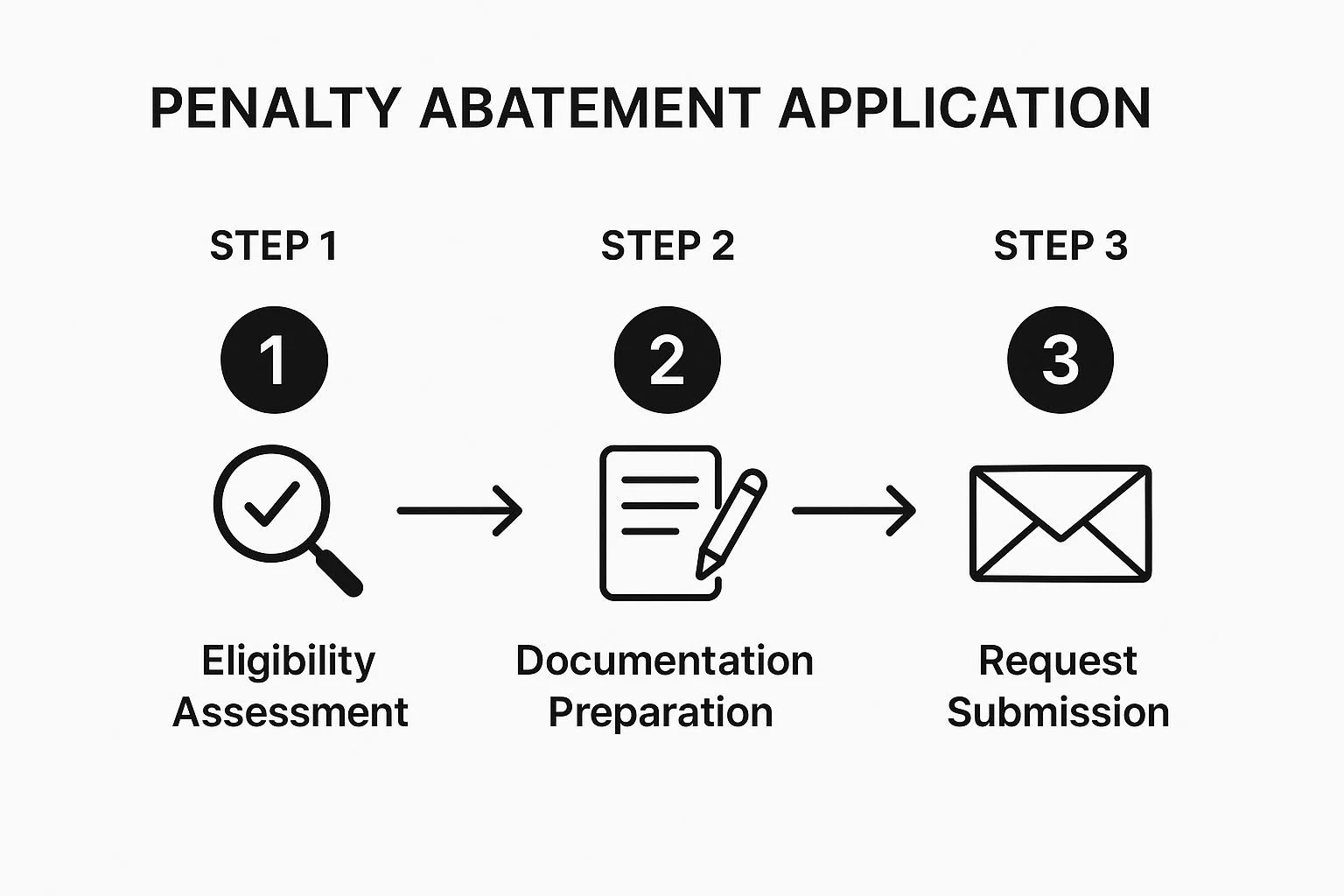
As you can see, figuring out your eligibility and getting your documents in order has to happen before you even think about contacting the IRS.
Choosing Your Method of Contact
With your evidence organized and ready to go, you need to decide how to make your request. There’s no single right answer here—the best approach really depends on your specific situation.
I've put together a quick comparison to help you decide which path makes the most sense for you.
Abatement Request Method Comparison
| Method | Best For | Pros | Cons |
|---|---|---|---|
| Phone Call | Simple, clear-cut First-Time Abatement requests. | Fast and direct; you can often get an answer on the spot. | Not suitable for complex cases; no paper trail unless you take detailed notes. |
| Written Request (Letter) | Any Reasonable Cause argument or complex situation. | Allows you to tell your full story and attach all necessary proof. | Takes longer to prepare and for the IRS to process; requires careful wording. |
| Form 843 | Formal Reasonable Cause claims, especially when requesting a refund of paid penalties. | Official IRS form; provides a clear structure for your claim. | Can feel rigid; might not offer enough space for a detailed narrative. |
For a simple FTA, a phone call is usually the quickest way to get it done. But for anything involving Reasonable Cause, you absolutely must put it in writing to build your strongest case.
Crafting a Compelling Written Request
If you're writing to the IRS, your tone should be clear, respectful, and persuasive. Every letter must include your name, address, Social Security Number (or TIN), the notice number, and the tax year in question.
The most effective requests I've seen all follow a simple formula: explain what happened, show why it meets the "reasonable cause" standard, and back it all up with undeniable proof. A chronological story supported by evidence is always your best bet.
Your letter should flow logically and include these key parts:
A direct opening statement saying you are requesting penalty abatement for specific penalties and the tax period.
A detailed, step-by-step story of the events that kept you from filing or paying on time.
A clear connection explaining how those events directly caused the tax issue.
A closing statement that reinforces you did your best to be responsible given the circumstances.
Remember, you're trying to convince an IRS agent who knows nothing about you that your situation is worthy of relief. Details matter.
What Happens After You Submit
And now, we wait. Patience is non-negotiable when dealing with the IRS. After you send your request (always use certified mail to get a receipt), the processing clock starts. For written requests arguing reasonable cause, you can expect to wait 60 to 120 days, and sometimes even longer for particularly complicated cases.
If your request is approved, you'll get a notice in the mail confirming the penalty has been removed. If it’s denied, you’ll get a letter explaining the IRS’s reasoning. But a denial isn't necessarily the end of the road. You have appeal rights, and you typically have 30 days to formally challenge the decision.
This process is purely for penalties. If the underlying tax debt itself is the bigger monster, you'll need to explore other solutions. For those facing a large tax bill, it's worth learning how to settle IRS debt through various tax relief programs.
Real Stories of Successful Penalty Abatement

It’s one thing to talk about rules and criteria, but it’s another to see how penalty abatement actually plays out for real people. These stories aren't just hypotheticals; they show how everyday taxpayers and business owners made their case to the IRS and got significant penalties wiped away. Think of them as both inspiration and a practical playbook.
The most straightforward win often comes from First-Time Abatement. I’ve seen cases where a taxpayer, after years of perfect tax compliance, simply forgot to file an extension and sent their return in a month late. They got hit with a failure-to-file penalty, but a single phone call to the IRS was all it took. By pointing to their clean three-year history, they had the penalty removed right then and there.
This just goes to show how powerful a clean record can be. It's your best piece of evidence that a mistake was an honest slip-up, not a pattern of behavior, which often makes for an easy administrative fix.
From Disaster to Relief: A Business Owner's Story
Reasonable cause is a different beast entirely. It requires a detailed story backed up with solid proof. Take, for example, a small business owner whose office was hit by a flash flood just weeks before their quarterly payroll taxes were due. The flood didn't just damage the building; it completely destroyed their local server, taking all their financial records with it.
Predictably, they were slapped with a hefty failure-to-deposit penalty. To get it abated, they couldn't just say "there was a flood." They had to prove it, and they did.
They gathered dated photos showing the extent of the office damage.
They provided copies of their insurance claim alongside the official disaster declaration for their county.
They even got a sworn statement from their IT consultant that detailed every failed attempt to recover the lost data.
This pile of evidence painted a clear, undeniable picture. It connected the dots between the disaster and their inability to pay on time. The IRS agreed they acted with ordinary business sense under truly extraordinary circumstances and erased the entire penalty.
Beating Complex International Penalties
Sometimes, the tax code itself is the biggest obstacle. I've seen taxpayers successfully abate penalties tied to notoriously confusing international forms. In one case, a client was facing a massive 25% penalty for a late Form 3520 after receiving a foreign gift. They won by demonstrating that it was their first time ever having this filing requirement and that their tax history was otherwise spotless.
Another taxpayer got a penalty for a late Form 5471 abated by explaining that their foreign company was minuscule and generated no personal financial benefit. This helped prove their mistake was an understandable one, not an attempt to hide anything. You can find more examples of how taxpayers argue these points in detailed reports on IRS foreign income reporting.
All these stories have one thing in common: the taxpayer didn't just offer up an excuse. They built a logical, evidence-based case that showed exactly why their specific situation deserved relief under the IRS’s own rules for penalty abatement.
Common Questions About IRS Penalty Abatement
Even after you've put together what feels like a solid plan, the penalty abatement process can still throw a few curveballs your way. It's only natural to have questions pop up, especially around how long you'll be waiting, how interest gets handled, and what happens if the IRS says "no." Let's walk through some of the most frequent questions I hear from taxpayers.
How Long Does a Review Take?
The wait time for an IRS decision is all over the map. If you're eligible for a First-Time Abatement and you call them, you might get an approval on the spot. It happens. But if you're sending in a written request, especially one arguing for Reasonable Cause, you need to settle in for a wait.
You should generally plan on hearing something back within 60 to 120 days. Don't be shocked if a more complicated case stretches out for six months or even longer. Whatever you do, always keep a complete copy of your request and your proof of mailing—it’s your only record.
Will Abated Penalties Remove Interest Too?
Yes, but it's a critical "yes, but..." When the IRS agrees to abate a penalty, they will also wipe out the interest that was charged on that specific penalty.
The key thing to remember is that the interest on your original unpaid tax bill is a different story. That interest is mandated by law and won't be removed, even with a great Reasonable Cause argument. It will keep accruing until the tax itself is paid off.
So, you get relief from the penalty and the interest it generated, but the interest on the core tax debt will stick around.
What if the IRS Denies My Request?
First off, don't panic. A denial letter isn't the end of the road. The IRS will send you a formal notice explaining their decision, and you have the right to fight it.
You'll usually have 30 days from the date on that denial letter to file a written appeal. This kicks your case up to the IRS Independent Office of Appeals, giving you a fresh set of eyes to review your evidence and hear your side of the story. If the penalties are significant, this is the point where bringing in a tax professional is less of a suggestion and more of a necessity.
Navigating IRS penalties can be complex, but you don't have to do it alone. Attorney Stephen A Weisberg offers a free Tax Debt Analysis to determine the best path forward for your specific situation. Get your free analysis and expert help with your IRS issues today.
➥ Contact Attorney Stephen A. Weisberg for a free Tax Debt Analysis.
Contact Me Here: https://www.weisberg.tax/contact-1
Email: s.weisberg@weisberg.tax
Phone/Text: (248) 971-0885
Address: 300 Galleria Officentre, Suite 402, Southfield, MI 48034
