Can You Be Jailed for Not Paying Taxes?
Yes, you can go to jail for not paying your taxes, but it's important to understand this is an absolute last resort and incredibly rare. It's reserved for the most serious cases of willful tax evasion.
The entire U.S. tax system hinges on a single, crucial distinction: your intent. There's a world of difference between being unable to pay your tax bill and actively trying to defraud the government. One is a civil matter; the other is a crime.
Unpacking the Fear Behind Unpaid Taxes
Let's be honest, the thought of facing jail time over a tax bill is terrifying. But for the vast majority of people, this fear is completely overblown. It’s crucial to separate the Hollywood drama from the reality of IRS enforcement.
When most people fall behind on their taxes, they face civil penalties. Think of these as financial consequences—essentially, very steep late fees. The IRS will tack on interest and penalties to what you owe. The goal isn't to lock you up; it's to get you to pay up.
The whole game changes, however, when simple non-payment crosses the line into deliberate, intentional deceit. It's like the difference between forgetting to pay your power bill versus illegally tampering with the meter to steal electricity. The first is a financial headache. The second is a crime.
The Critical Role of Willful Intent
The IRS and the Department of Justice don't press criminal charges lightly. To even consider it, they have to prove "willfulness." This is a high legal bar. It means they need solid evidence that you intentionally and voluntarily violated a law you knew existed.
This isn't about making a genuine mistake on your tax return or hitting a rough financial patch that makes paying impossible. Criminal investigations are triggered by clear, blatant acts of fraud.
We're talking about things like:
Concealing assets: Actively hiding money in offshore accounts or funneling it through a relative's name.
Using shell corporations: Setting up fake, empty companies purely to disguise where your income is coming from.
Keeping two sets of books: Maintaining one legitimate set of records for yourself and a completely different, fraudulent one to show the IRS.
Destroying records: Purposely shredding, deleting, or "losing" documents to block an audit.
The government's burden of proof here is immense. To get a criminal conviction for tax evasion, a prosecutor has to prove beyond a reasonable doubt that you acted with specific fraudulent intent. Simple negligence or an honest mistake will never land you in prison.
What the Numbers Actually Say
While the idea is scary, criminal tax prosecutions are not an everyday occurrence. The IRS picks its battles carefully, focusing on the most egregious cases.
But when the IRS does decide to prosecute, its track record is staggering. According to the latest IRS Criminal Investigation annual reports, the agency boasts a conviction rate of around 90% for tax-related crimes.
The penalties are severe. Willful tax evasion can lead to a maximum prison sentence of 5 years per offense and fines up to $250,000. So, while the odds of being prosecuted are low for the average taxpayer, the consequences for those who willfully break the law are life-altering.
Civil Penalties vs Criminal Charges at a Glance
It helps to see the differences side-by-side. Most tax issues fall squarely into the civil category, which is managed financially. Criminal charges are an entirely different beast, involving the justice system and the potential loss of liberty.
| Factor | Civil Tax Penalties | Criminal Tax Charges |
|---|---|---|
| Primary Goal | Collect the tax owed, plus interest and penalties. | Punish the wrongdoing and deter future crime. |
| Intent Required | None. Can result from mistakes or negligence. | "Willfulness" - a voluntary, intentional violation of a known legal duty. |
| Who Handles It | The IRS (auditors and revenue officers). | The IRS Criminal Investigation (CI) division and the Department of Justice. |
| Consequences | Fines, interest, liens, and levies on property. | Prison time, massive fines, and a permanent criminal record. |
| Burden of Proof | "Preponderance of the evidence" (more likely than not). | "Beyond a reasonable doubt" (a much higher standard). |
| Typical Example | Under-reporting income due to a calculation error. | Creating a shell company to hide millions in business income. |
Ultimately, the IRS's main goal is to collect taxes, not to fill prisons. As long as you aren't actively trying to deceive them, you're almost certainly dealing with a civil matter that can be resolved.
Civil Penalties vs. Criminal Tax Fraud: What's the Real Difference?

Let’s get one thing straight right away: the vast majority of tax problems are civil matters, not criminal ones. This is the single most important concept to grasp. Every year, the IRS deals with millions of cases involving late filings, honest mistakes, and underpayments. Nearly every single one is resolved with financial penalties, not a jail cell.
The entire legal universe separating a civil penalty from a criminal charge boils down to one powerful word: willfulness.
Before the threat of prison even enters the conversation, the government has to prove you intentionally schemed to cheat them. That means an honest mistake, a misunderstanding of our ridiculously complex tax code, or even just being sloppy isn't enough to land you in criminal court.
The Bright Line Between an Error and a Crime
To make this crystal clear, let’s imagine two freelance graphic designers. Both of them underpaid their taxes, but how they did it puts them on completely different sides of the law.
Scenario 1: The Civil Issue
Our first designer, Alex, is buried in client work and simply messes up the quarterly estimated tax payments. Alex completely forgot to account for one huge project and, as a result, ends up owing an extra $8,000 at tax time.
This is a classic civil issue. Alex didn’t intend to defraud the government; they just made a mistake. The IRS will require Alex to pay the $8,000 owed plus interest and a failure-to-pay penalty, but that’s where the story ends.
Scenario 2: The Criminal Fraud
Now, let’s look at Taylor, another designer with a similar income. Instead of making a calculation error, Taylor deliberately takes steps to hide money. This includes depositing cash payments into a personal bank account that is never reported on the books and creating fake invoices for business expenses that never happened, all to artificially lower taxable income.
Taylor’s actions scream willful intent to evade taxes. This is criminal tax fraud, and it’s the kind of behavior that can lead to prosecution and potential jail time.
The core difference isn't the amount of money owed but the deliberate actions taken to deceive. The IRS is looking for a pattern of deception, not a simple error in arithmetic.
A Look at Common Civil Penalties
Think of civil penalties as the IRS’s primary tool for encouraging people to follow the rules. They are financial additions to your tax bill, designed to be a slap on the wrist without dragging you through the court system.
Here are a few of the most common ones you might encounter:
Failure to File Penalty: This hits when you don't file your tax return by the deadline (including extensions). It's typically calculated as 5% of your unpaid taxes for each month your return is late, maxing out at 25% of what you owe.
Failure to Pay Penalty: This is what you get when you file on time but don't pay the tax you reported. This penalty is usually 0.5% of your unpaid taxes per month, and it’s also capped at 25%.
Accuracy-Related Penalty: If you underpay because of negligence or a major understatement of your income, the IRS can tack on a penalty of 20% of the underpaid amount.
These penalties can definitely add up and sting the wallet, but they remain purely financial. They don't carry the threat of incarceration.
The High Bar for Criminal Charges
For a tax issue to jump from a civil problem to a criminal nightmare, federal prosecutors have to prove willful intent beyond a reasonable doubt. This is the highest standard of proof in our entire legal system.
To win their case, the government must show that you:
Knew you had a legal duty to pay taxes.
Were fully aware of that duty.
Voluntarily and intentionally decided to violate it anyway.
This is a tough thing to prove. It's why criminal tax cases usually involve smoking-gun evidence of deceit, like keeping two sets of books, creating shell companies to hide money, or destroying records.
Comparing this to other financial crimes, such as understanding and preventing various forms of financial fraud, highlights how intent is the central element.
For the average taxpayer who just made a mistake or is struggling to pay their bill, their case will almost certainly stay on the civil side of the line.
The Path from Unpaid Taxes to a Criminal Investigation
Let's get one thing straight: the IRS isn't looking to throw people in jail for honest mistakes. The journey from a simple unpaid tax bill to a criminal investigation is a long one, with plenty of off-ramps. But you have to know when and how to take them.
Think of it as a series of escalating warnings. A simple missed payment is like a friendly reminder. Ignoring it is like ignoring a stop sign—the consequences get more serious with each missed signal. Things start small, but if you let them snowball, what began as a civil issue can absolutely turn into a criminal one.
The key is understanding the stages. Knowing what the IRS is doing and why helps you regain control and steer the situation back into the civil lane, where penalties are financial, not criminal.
From Automated Notices to Human Intervention
It all starts with a letter. Shortly after a payment deadline passes, the IRS computer system will automatically send you a CP14 notice. This is a basic, non-threatening letter that simply states you have a balance due. It's the IRS's first official nudge.
If that goes unanswered, the nudges get firmer. You'll receive a CP501, then a CP503, each one a little more insistent. The real warning shot is the CP504, which officially warns you of the IRS's intent to levy your property.
Each notice gives you a clear deadline, usually 30 days, to respond.
They provide clear instructions on how to pay or dispute the amount.
Ignoring them is what triggers late payment penalties and mounting interest.
Failing to respond to these automated notices is what gets a human involved. Once a revenue officer is assigned to your case, the game changes.
When Audits and Collections Get Serious
If the letters don't work, the IRS may initiate an audit or assign a revenue officer to collect the debt directly. An audit isn't automatically a sign of trouble; it can be triggered by simple math errors or random selection. The focus is still on getting the numbers right and collecting what's owed.
However, during an audit, investigators look for what they call “badges of fraud.” These are red flags that suggest you weren't just careless—you were actively trying to deceive.
Common badges of fraud include:
Using excessive amounts of cash that don't line up with your reported income.
Keeping two sets of financial books—one for you, one for the IRS.
Intentionally destroying or hiding financial records.
Revenue officers also have significant power to collect the debt, even without a criminal referral. They can place a lien on your property, levy your bank accounts (seize the funds), or garnish your wages. These are aggressive civil actions, but they are still worlds away from criminal charges.
The table below shows how a simple tax issue can escalate when the IRS gets involved.
IRS Enforcement Escalation Path
| Stage | IRS Action | Taxpayer Experience |
|---|---|---|
| 1. Initial Notice | Automated letter (CP14) is sent. | A formal bill arrives in the mail detailing the amount owed and payment options. |
| 2. Follow-Up Notices | A series of increasingly urgent letters (CP501, CP503, CP504) are mailed. | The language becomes more direct, warning of potential liens and levies. |
| 3. Revenue Officer Assigned | The case is moved from an automated system to a human agent. | You receive phone calls and direct correspondence from an IRS employee. |
| 4. Civil Enforcement | The officer may file a lien, levy a bank account, or garnish wages. | Your assets are now at risk of seizure to satisfy the tax debt. |
| 5. Fraud Indicators Found | The revenue officer discovers "badges of fraud" suggesting willful deceit. | The investigation shifts from "how much is owed?" to "was there criminal intent?" |
| 6. Criminal Referral | The case is formally referred to the IRS Criminal Investigation (CI) division. | The matter is now a criminal law enforcement issue, not a tax collection issue. |
As you can see, there are many steps before your case lands on a criminal investigator's desk. The key is to act long before it gets there.
The Referral to IRS Criminal Investigation (CI)
This is the line in the sand. If a revenue officer or auditor finds enough evidence of willful intent to deceive, they refer the case to IRS Criminal Investigation (CI). CI agents are not accountants; they are sworn federal law enforcement officers.
Once CI takes over, their goal is no longer to collect the tax. It's to determine if they can prove, beyond a reasonable doubt, that you committed a crime.
CI special agents can:
Execute search warrants on your home or business.
Issue subpoenas for bank records, emails, and other documents.
Conduct surveillance and even go undercover.
They are building a case for a prosecutor. This is the point where the risk of fines, felony charges, and prison time becomes very real.
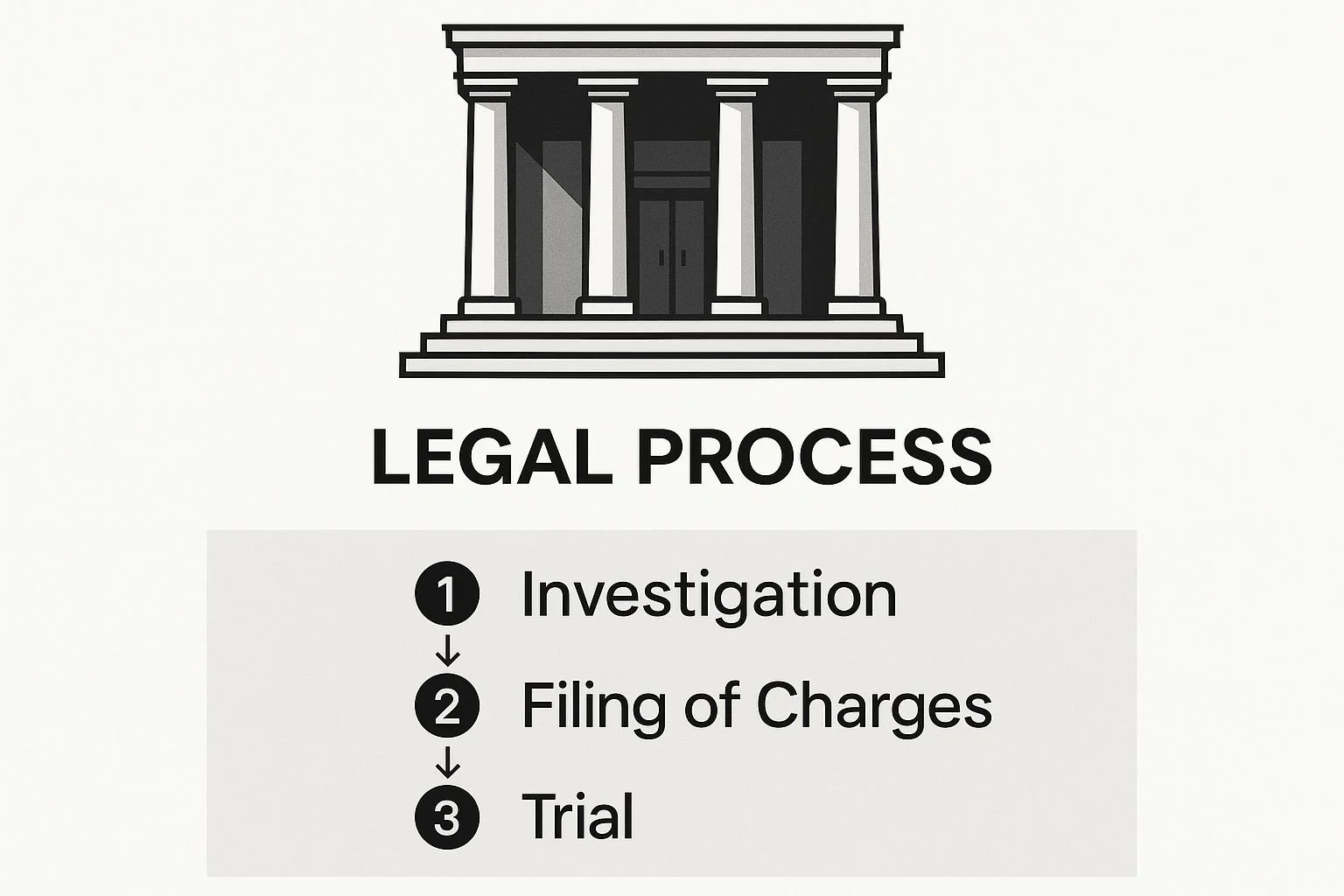
A CI referral means the government believes it has evidence of a crime. Your problem has transformed from a debt you owe to a charge you must defend against.
How to Protect Yourself
The best defense is a proactive offense. The earlier you address a tax problem, the more options you have and the less likely it is to escalate.
Open Your Mail. Don't ignore IRS notices. Read them immediately and aim to respond well before the 30-day deadline.
Get Professional Help. The moment you receive an audit notice or any communication that goes beyond a simple balance due, contact a qualified tax professional.
Communicate. If you can't pay in full, don't hide. The IRS is often willing to set up an installment agreement or consider other resolution options.
Explore Resolution Programs. Programs like the Offer in Compromise can help you settle your tax debt for less than the full amount owed if you qualify.
Fix Past Mistakes. If you have unfiled returns, don't wait for the IRS to find you.
Staying ahead of the IRS is the single most effective way to ensure a tax issue remains a civil matter.
What Happens During an IRS Criminal Investigation
When your case gets handed over to IRS Criminal Investigation (CI), the game completely changes. This is no longer about settling a debt with a tax collector; you are now the focus of a federal criminal inquiry.
The goal is no longer just collecting money—it's about building a case to prosecute you, which makes every single thing you do or say incredibly important.
The central players in this new reality are IRS Special Agents. Don't mistake them for auditors or revenue officers. These are highly trained federal law enforcement officers, and they have serious authority.
A Special Agent can:
Carry a firearm
Execute search warrants on your home or business
Conduct surveillance to watch your activities
Issue grand jury subpoenas to force banks, clients, and anyone you know to provide testimony and records
Their involvement means the IRS has reason to believe there’s strong evidence of willful tax fraud. From this moment on, their one and only objective is to gather enough proof to send you to prison.
Gathering Evidence and Building a Case
Once CI kicks off an investigation, agents start to meticulously reassemble your entire financial life. They operate with a power that far exceeds a standard civil audit. Expect them to subpoena years of your bank statements, credit card records, emails, and business communications.
They might also start interviewing your friends, family, employees, and business partners, trying to establish a pattern of behavior. They’re building a story—one that paints a clear picture of a deliberate intent to cheat the government.
This is where people make life-altering mistakes. Talking to a Special Agent without a lawyer is one of the riskiest things you could possibly do. Anything you say will be used to build their case against you. It's not optional; you need an experienced tax attorney to handle every interaction.
Should an IRS criminal investigation move forward, it helps to understand the wider world of claims and litigation, as the process edges closer to the courtroom. The IRS is methodical, and they are designed to leave no stone unturned before they make their final move.
The Recommendation for Prosecution
After they’ve gathered all the evidence they can find, the Special Agent and their supervisor review the entire file. If they believe they have enough to prove you’re guilty beyond a reasonable doubt, they will recommend prosecution. That recommendation then goes to the IRS division counsel for another look.
If the lawyers agree, your case is officially sent over to the Department of Justice (DOJ) Tax Division. This is the last stop before criminal charges are filed. DOJ attorneys perform their own independent review to make absolutely sure the case is a winner in court.
Putting people in prison for tax evasion has long been a cornerstone of tax enforcement in the U.S. The IRS Criminal Investigation division, which famously took down Al Capone, relentlessly pursues tax evasion as a crime. In recent years, IRS-CI conviction rates have consistently been above 90%.
Their enforcement actions recover billions and have even expanded into new frontiers like cryptocurrency tax fraud. This track record underscores the division's effectiveness and the very real risk of jail time if you're prosecuted. You can find more details in the IRS-CI annual reports on their official website.
This whole process can take months, sometimes years. Throughout this time, having expert legal representation guiding your every move is critical. If your issues haven't reached this stage, looking into different tax debt solutions might be the key to ensuring it never does.
Common Defenses and How to Lower Your Risk
Getting that notice about a criminal tax investigation is terrifying. It's easy to feel like you're already convicted. But here's the reality: an allegation is a long way from a conviction. The government has a massive hill to climb to prove willful intent beyond a reasonable doubt, and a good defense can make that hill a whole lot steeper.
The entire criminal case hinges on proving you knew what you were doing was wrong and did it anyway. It's not about making a mistake; it's about a deliberate choice to break the law. So, the best defense strategies focus on tearing down that idea of "willfulness" and showing the real story.
Attacking the Idea of Willfulness
To win, a prosecutor has to prove you voluntarily and intentionally dodged a legal duty you were well aware of. A sharp tax attorney’s job is to introduce reasonable doubt, showing that something else—not a criminal mindset—caused the tax error.
Here are a few ways that's done:
Honest Mistake of Law or Fact: Let's be real, the U.S. tax code is a beast. It's incredibly complex. You might genuinely misinterpret a rule about a specific deduction or how to source your income, which leads to a big underpayment. That’s a mistake, not a crime.
Reliance on a Professional: Most people aren't tax experts, so they hire one—a CPA or tax preparer. If that professional gave you bad advice or just messed up, and you trusted their work in good faith, that's a powerful defense. You did the responsible thing by hiring help; their mistake shouldn't land you in a courtroom.
Lack of Mental Capacity: Forming criminal intent requires a sound mind. A defense can be built if someone, due to a severe mental illness, dementia, or another condition, simply couldn't understand their legal duties or the consequences of their actions.
The bottom line is this: an error, even a huge one, isn't automatically fraud. The prosecution has to prove a "guilty mind." These defenses go right for the jugular of that argument.
How to Get Ahead of a Criminal Investigation
Of course, the best defense is making sure you never need one. If you’re aware of serious mistakes on your past tax returns, whether you made them on purpose or not, taking action now is your single most powerful move. The IRS is almost always more interested in getting the money it's owed than in putting people in jail.
By cooperating proactively, you can often turn a potential criminal case back into a civil one. It signals to the government that you want to comply, not evade. Waiting for the IRS to knock on your door is a terrible bet—coming forward on your own terms completely changes the game.
Here are the most effective steps you can take:
File Amended Returns: Found a major error on a return you already filed? Fix it with a Form 1040-X, Amended U.S. Individual Income Tax Return. Filing an amended return to correct the mistake and pay the tax you owe before the IRS contacts you is compelling evidence that you never had criminal intent.
Use a Voluntary Disclosure Program: If the problem is more serious, like failing to report offshore accounts, the IRS has formal voluntary disclosure programs. These are designed for people to come clean, pay what they owe (plus penalties), and in exchange, the IRS generally agrees not to pursue criminal charges.
Negotiate a Payment Plan: If you just can't afford to pay what you owe, don't just hide from the problem. Reaching out to the IRS to set up an installment agreement or an Offer in Compromise (OIC) shows you're acting in good faith. You're demonstrating a willingness to meet your obligations, which is the exact opposite of willful evasion.
At the end of the day, honesty and action are your best friends here. Tackling a tax issue head-on is always the smarter play. Filing back taxes, amending returns, and arranging to pay your debt can often stop a criminal investigation before it truly begins, keeping your problem in the civil arena where it can be solved with money, not jail time.
How Global Tax Enforcement Is Evolving
In our increasingly connected world, the old notion of stashing money offshore to sidestep taxes is becoming a ghost story. If you’re still thinking an international bank account is a foolproof shield from the IRS, it’s time for a serious reality check. The risk of getting caught has skyrocketed, turning what was once a common tax evasion tactic into a very dangerous game.

This massive shift is driven by international agreements, most notably the Foreign Account Tax Compliance Act (FATCA). You can think of FATCA as a global financial tell-all pact.
It forces foreign banks and other financial institutions to report information on accounts held by U.S. citizens directly to the IRS. Thanks to this automatic data exchange, the IRS often knows about your foreign assets before you even sit down to file your taxes.
A Worldwide Crackdown on Tax Evasion
This isn't just an American initiative; it's a full-blown global movement. All around the world, tax evasion is being met with severe legal consequences, and that often includes prison time. In Canada, for instance, willful tax evasion can lead to criminal charges and up to 5 years in jail.
European countries, having lost tens of billions to sophisticated tax fraud schemes, are also cracking down with real force. A series of high-profile data leaks have poured gasoline on the fire, proving that secret offshore accounts are anything but safe.
The bottom line is simple: there's really nowhere left to hide. The walls are closing in on anyone who thinks they can operate outside the tax system.
The New Frontier of Crypto Tax Enforcement
Tax agencies aren't just looking at traditional banks; they're quickly getting wise to new financial technologies like cryptocurrency. In the early days, digital assets felt anonymous, and some people saw them as the perfect way to hide income. That perception is now dangerously out of date.
The IRS has made its stance crystal clear: cryptocurrency is treated as property for tax purposes. The agency is now actively using powerful data analytics and legal subpoenas to unmask crypto investors who don't report their gains.
The IRS is aggressively pursuing enforcement actions against individuals using digital currencies to dodge their tax obligations. If you have any unresolved tax issues, no matter how small they seem, it's always better to get out in front of them.
For many people, the IRS Fresh Start Program provides a structured way to resolve old debts and get back on the right side of the law. Taking action now is the only surefire way to avoid much more serious trouble down the road.
Common Questions Answered
When you're dealing with the IRS, a lot of questions and "what ifs" can start swirling around. Let's tackle some of the most pressing concerns people have about unpaid taxes and where the lines are drawn.
How Long Does the IRS Have to Charge Me With Tax Evasion?
This is a big one, and the answer depends on whether we're talking about criminal charges or just civil collections.
For criminal tax evasion, the IRS generally has a six-year window to press charges. That clock starts ticking from the date you filed a fraudulent return. If the issue is a failure to file altogether, the six years begin from the return's original due date.
But for civil matters—meaning the IRS's ability to simply collect the money you owe—they have a much longer runway. The standard collection period is 10 years from the date the tax was officially assessed. Keep in mind, this isn't a hard-and-fast rule. Certain actions, like filing for bankruptcy or submitting an Offer in Compromise, can pause or even extend that 10-year deadline.
Can I Go to Jail for Not Paying State Taxes?
Absolutely. It's a common misconception that only the IRS has the power to bring serious charges. State governments have their own tax laws, their own enforcement bodies, and they are just as serious about tax fraud.
While the specifics will differ from state to state, the core idea is the same as it is at the federal level. Criminal charges aren't for people who simply can't afford their tax bill. They're reserved for cases of willful fraud and deliberate evasion.
If you're convicted of a state tax crime, the penalties can be harsh and may include:
Hefty fines that can easily surpass the original tax debt.
Probation and mandated community service.
Jail or even prison time, especially for large-scale or long-term fraud.
If I'm in Jail, Do I Still Owe Taxes?
Yes, being incarcerated doesn't wipe your tax slate clean. If you have income that meets the filing threshold—perhaps from a prison work program, investments, or other outside sources—you are still legally required to file a tax return.
Serving time does not pause your financial obligations to the government. If you fail to file or pay while incarcerated, penalties and interest will continue to pile up, leaving you with an even bigger financial hole to dig out of upon your release.
Think about it this way: many inmates were eligible for the COVID-era stimulus payments, but to get that money, they had to file a tax return to claim it as a Recovery Rebate Credit. This is a perfect example of how the tax system continues to operate, regardless of your personal circumstances. A tax problem will never just solve itself.
If you're facing tax problems, the first step is understanding your options. At Attorney Stephen A Weisberg, I provide a FREE Tax Debt Analysis to determine exactly how I can help before you ever pay a fee. Don't let fear and uncertainty dictate your next move. Contact my office today to get clear, honest guidance. Visit us at weisberg.tax to get started.
Yes, you can go to jail for not paying your taxes, but it's important to understand this is an absolute last resort and incredibly rare. It's reserved for the most serious cases of willful tax evasion.
Want to understand your options before you call anyone?
Download my free book — Freedom From Tax Debt — a plain-language guide to how the IRS collections process actually works and what resolution really looks like.
➥ Contact Attorney Stephen A. Weisberg for a free Tax Debt Analysis.
Contact Me Here: https://www.weisberg.tax/contact-1
Email: s.weisberg@weisberg.tax
Phone/Text: (248) 971-0885
Address: 300 Galleria Officentre, Suite 402, Southfield, MI 48034
