Where to Mail Form 9465 A Guide for Taxpayers
When you’re ready to mail in your Form 9465, the single most important detail is sending it to the right place. The IRS has different processing centers scattered across the country, and where you live determines which one handles your request.
Sending your form to the wrong address is a common mistake, but it's an easy one to avoid. It can cause serious delays, and when you're trying to sort out a tax bill, the last thing you need is more waiting and uncertainty.
Where to Mail IRS Form 9465
Let's get this right from the start. The address you use depends on two things: your location and whether you're filing Form 9465 by itself or with your tax return.
If you’re sending in Form 9465 on its own—maybe you already filed your return or got a tax bill in the mail—you'll use one of the addresses listed below. If you're including it with your tax return, you'll simply send it to the address listed in your tax form instructions (like the 1040).
The good news? The approval rate for these requests is incredibly high at 95%. So, once you get the form in the right hands, your chances are excellent. Just be prepared to wait—the average processing time is about six weeks.
Pro Tip: Before you seal that envelope, take one last look at the address. The IRS occasionally updates its mailing locations, and using an old address is a surefire way to delay your installment agreement. I always recommend checking the official IRS website for the most current addresses if you haven't filed in a while.
Official IRS Form 9465 Mailing Addresses by Location
Use this table to find the correct IRS mailing address for Form 9465 based on the state or U.S. territory where you reside.
| If You Live In... | Mail Your Form 9465 To This Address... |
|---|---|
| Alabama, Arkansas, Georgia, Illinois, Indiana, Iowa, Kansas, Kentucky, Louisiana, Michigan, Minnesota, Mississippi, Missouri, Nebraska, New Jersey, North Dakota, Ohio, Oklahoma, South Dakota, Tennessee, Texas, West Virginia, Wisconsin |
Department of the Treasury Internal Revenue Service Memphis, TN 37501-0250 |
| Alaska, Arizona, California, Colorado, Hawaii, Idaho, Montana, Nevada, New Mexico, Oregon, Utah, Washington, Wyoming |
Department of the Treasury Internal Revenue Service Ogden, UT 84201-0250 |
| Connecticut, Delaware, District of Columbia, Florida, Maine, Maryland, Massachusetts, New Hampshire, New York, North Carolina, Pennsylvania, Rhode Island, South Carolina, Vermont, Virginia |
Department of the Treasury Internal Revenue Service Kansas City, MO 64999-0250 |
| A foreign country, U.S. possession or territory*; or use an APO or FPO address; or file Form 2555 or 4563; or are a dual-status alien. |
Department of the Treasury Internal Revenue Service Austin, TX 73301-0250 |
*If you live in American Samoa, Puerto Rico, Guam, the U.S. Virgin Islands, or the Northern Mariana Islands.
Once you’ve found the correct address for your location, you’re ready to package your form and send it off. Getting this small detail right makes a huge difference in how smoothly the whole process goes.
Do You Really Need to Mail This Form?
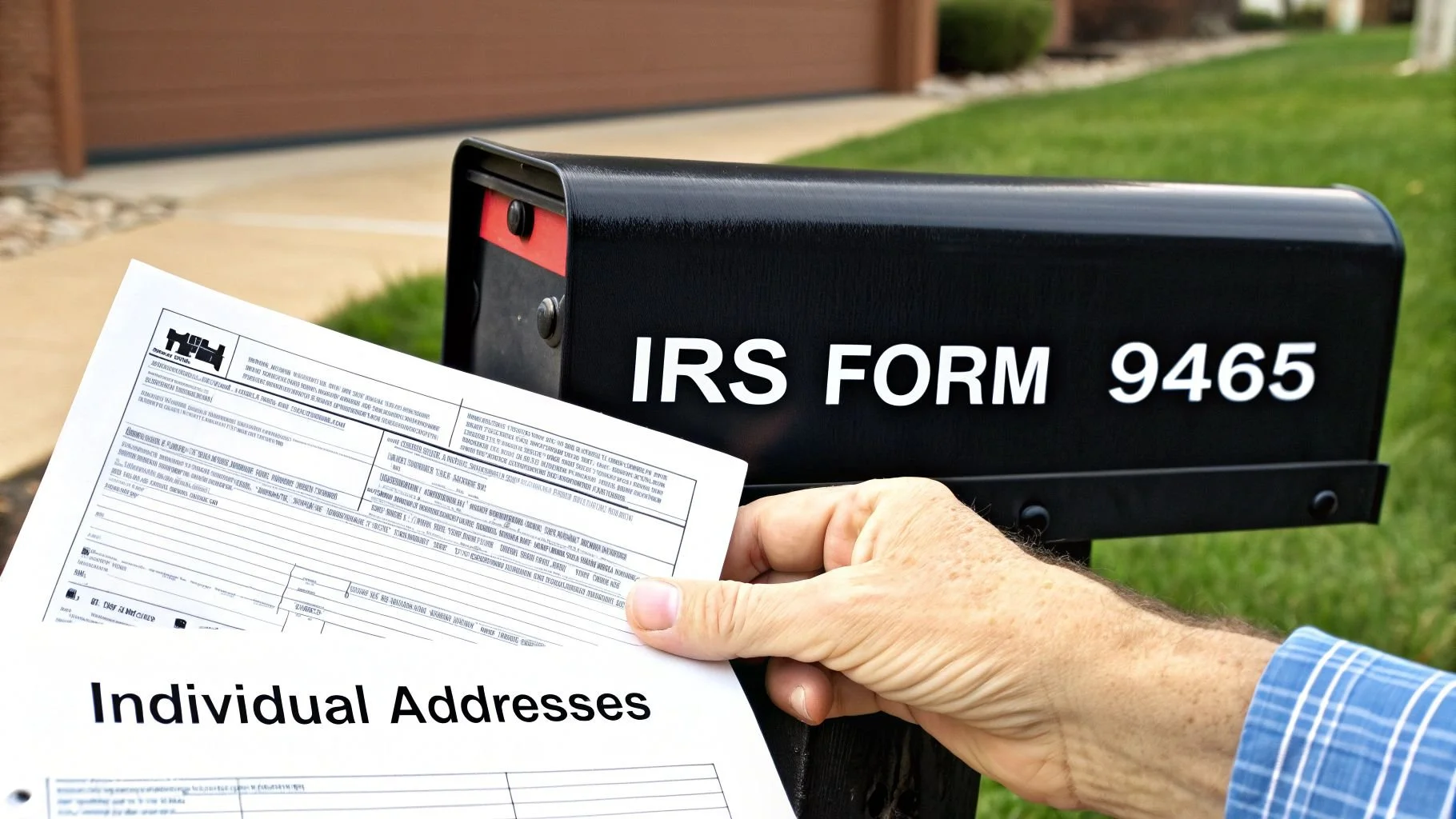
Before you start looking for a stamp, let's figure out if you even need to mail Form 9465 in the first place. While you can always send it the old-fashioned way, the IRS has much faster, streamlined options that might work for you. The big question it all boils down to is this: how much do you actually owe?
Your total tax bill—including all the taxes, penalties, and interest combined—is the key factor that determines your next move. Knowing where you stand helps you get the right documents together from the very beginning and avoid a ton of unnecessary paperwork.
When Mailing Is Your Only Option
There's one clear line in the sand. If you owe more than $50,000, the IRS requires you to mail in a paper copy of Form 9465. It's not just that form, either. You’ll also have to submit Form 433-F, which is a detailed Collection Information Statement that gives the IRS a full picture of your finances. You can dig into the specifics of these requirements by checking out the tax code for installment agreements.
This isn't a suggestion—it's a hard-and-fast rule. If your debt is over $50,000 and you forget to include Form 433-F with your Form 9465, your request for a payment plan will be rejected flat out.
Let's say you're a freelance designer who had a fantastic year but underestimated your quarterly payments, leaving you with a $62,000 tax bill. In this case, you can't just hop online and set up a payment plan. You absolutely have to mail both Form 9465 and Form 433-F to the correct IRS service center for them to even consider your application.
When You Can Skip the Post Office
On the flip side, if your tax debt is more manageable, you're in luck. The IRS has created much simpler paths for people with smaller balances, which means you can likely avoid mailing any forms at all.
If You Owe Under $10,000: You'll likely qualify for a guaranteed installment agreement. The main catch is that you need a good compliance history for the last five years, meaning you filed all your returns and paid on time.
If You Owe Under $50,000: For most people in this bracket, you can apply directly for a payment plan using the IRS Online Payment Agreement (OPA) tool. It's faster and you won't need to mail a thing.
This tiered system makes perfect sense. It lets the IRS quickly approve smaller, lower-risk cases online while dedicating more resources to thoroughly review the financials of taxpayers with larger debts. Knowing which category you fall into is the first critical step.
Getting Your Form 9465 Ready to Mail
How you put your documents together really matters. Taking a few minutes to get the details right before you even look for an address can save you weeks of headaches and delays down the road. A neat, properly assembled package shows the IRS you're on top of things and serious about getting your tax situation sorted out.
First things first, give the form one last look-over. Check that every line is filled out correctly, but laser-focus on the signature and date. An unsigned form is a classic, rookie mistake that gets your request kicked back to you instantly, forcing you to start all over.
Putting Your Packet Together
If you’re filing Form 9465 along with your main tax return (like the Form 1040), the order is key. Make sure you place the completed Form 9465 right on top of the first page of your tax return. Think of it as a cover sheet that tells the IRS exactly what you’re asking for from the moment they open the envelope.
On the other hand, if you're sending the form in by itself—maybe you got a bill or a notice from the IRS—you don’t need to send your whole tax return again. Just mail the completed Form 9465 on its own.
To make sure your paperwork sails through the IRS's automated scanners, stick to these simple but important tips:
Paper Clips, Not Staples: Staples are the enemy of IRS processing machines. They cause jams, which can tear up your forms or get them lost in the shuffle. A simple paper clip is the way to go.
Keep Your Check Separate: If you’re sending your first payment, don't attach it to any of the forms. Just make the check out to the "U.S. Treasury" and place it loose in the envelope. Don't forget to write your Social Security number and the tax year on the check's memo line—that's crucial for making sure it gets credited to the right account.
A well-organized packet is more than just good practice; it's a strategy. When an IRS agent gets a neat, correctly assembled submission, it makes their job easier and can subconsciously set a positive tone for your request.
Finally, pick a good envelope. Use something sturdy and big enough to hold everything without having to fold it into a tiny square. It's not just about looking professional; a quality envelope protects your sensitive financial information on its journey, making sure it arrives safe and sound.
Getting Your Form in the Mail and Confirming It Arrived

Alright, your Form 9465 is filled out and ready to go. But hold on—don't just slap a stamp on it and hope for the best. When you're dealing with the IRS, there's a cardinal rule I always tell my clients: if you can't prove you sent it, you didn't send it.
Choosing the right way to mail your form isn't just a small detail; it's a critical step that gives you a legal paper trail. This simple action can save you from major headaches down the road if the IRS ever claims they never received your request.
Choosing a Mailing Service You Can Trust
The U.S. Postal Service (USPS) is your best bet, but you need to use the right service to get the proof you need.
USPS Certified Mail: This is non-negotiable. I consider it the gold standard for any official IRS correspondence. It gives you a postmarked mailing receipt, which is your legal proof that you mailed the form on time.
Return Receipt: Want to be extra safe? Add a Return Receipt. For a small extra fee, you'll get a postcard or digital confirmation back showing the date your form was delivered and who signed for it.
IRS-Approved Private Carriers: If you'd rather use FedEx or UPS, you can. Just make sure you select one of the specific services that the IRS officially recognizes. These options will also provide the tracking and delivery confirmation you need.
Key Takeaway: The postmark date on your Certified Mail receipt is legally considered your filing date. This is a lifesaver if you're up against a deadline. Even if the IRS mailroom is backed up for weeks, you're covered.
How to Track Your Form and Verify It Got There
Once you’ve mailed your form, your job isn't over. Keep that tracking number handy and use it. You need to follow its journey online to make absolutely sure it reached the correct IRS facility.
For instance, when you plug your Certified Mail number into the USPS tracking website, you'll see a page just like this one.
This screen will show you exactly where your envelope is, all the way until it shows a final "Delivered" status. The moment you see that, take a screenshot or print the page. Keep that delivery confirmation with your original Certified Mail receipt.
This little packet of proof is invaluable. It’s your defense if you ever get an unexpected letter from the IRS, like a CP2000 notice.
Common Mistakes When Mailing Form 9465
You’ve done the hard part of filling out Form 9465, but a few simple slip-ups in the mailing process can cause major setbacks. I've seen it happen too many times—frustrating delays or even an outright rejection of a payment plan request, all because of a preventable error. Getting the mailing address right is just step one; avoiding these common pitfalls is how you get your request approved without a hitch.
One of the easiest traps to fall into is using an old mailing address. The IRS frequently updates its P.O. boxes and shuffles which processing centers handle certain forms.
Don't just rely on last year's address. Before you seal that envelope, always double-check the official IRS "Where to File" page for the most current information. It’s a good idea to bookmark that page for future use.
Another classic mistake? Forgetting to sign and date the form. It sounds so basic, but it happens all the time. An unsigned form is an incomplete form in the eyes of the IRS, and they will send it right back to you. That means you have to start the whole process over, losing valuable time you might not have.
Overlooking Key Details
Beyond the big two—address and signature—a few other small oversights can easily derail your submission. A surprisingly common issue is a miscalculation on the proposed monthly payment line. Make sure you're realistic about what you can afford, but also check that the amount is enough to clear your debt within the IRS's required timeframe.
Attaching documents correctly is also huge. If you're submitting Form 9465 with your annual tax return (Form 1040), it absolutely must be attached to the very front. On the other hand, if you're mailing it separately in response to an IRS notice, do not include another copy of your return.
Crucial Reminder: The IRS will almost certainly deny your installment agreement request if you have any unfiled tax returns from prior years. You must be fully caught up on all your past filing obligations before they'll even consider a payment plan.
Before you mail anything, it's worth taking a moment to review some common tax filing mistakes to avoid. A final once-over can save you weeks of headaches and delays.
Frequently Asked Questions About Form 9465

Even after you’ve got everything packaged up, a few last-minute questions can creep in. Dealing with the IRS often feels that way. Let’s tackle some of the most common things people ask about Form 9465 so you can mail your request without any lingering doubts.
What Happens if I Mail Form 9465 to the Wrong IRS Address?
This is a very common mistake, and thankfully, it’s not usually a catastrophe. If your form lands at the wrong IRS service center, they will typically forward it to the correct department internally.
The bad news? That internal rerouting is slow. Really slow. It can easily add weeks, sometimes even a month or more, to the processing time.
In a worst-case scenario, the envelope might just be returned to you, which could cause you to miss a critical deadline. This is exactly why I always recommend using a trackable service like USPS Certified Mail. It gives you a paper trail and proof of when you sent it.
The form will probably get where it needs to go, but the delays can create unnecessary stress and complications. Take an extra minute to double-check the address for your specific situation before you seal that envelope. It’s worth it.
Can I Mail Form 9465 if I Have Unfiled Tax Returns?
This is a non-starter for the IRS. They will not approve an installment agreement until you are completely caught up on all your required tax filings. If you have unfiled returns from prior years, your Form 9465 request will be denied or, at best, put on hold.
Your first order of business has to be getting those old returns filed. You can certainly mail Form 9465 along with your current year's return, but its approval is entirely contingent on you being compliant. The IRS won't even consider a payment plan until every single required return has been submitted and processed.
Should I Include My First Payment with My Mailed Form 9465?
While it’s not officially required, I strongly recommend it. Sending that first proposed payment along with your application is a powerful signal to the IRS. It shows you're acting in good faith and are serious about getting your tax debt sorted out. Think of it as a small gesture that can help grease the wheels for a smoother approval.
If you decide to include a check, make sure to do it right:
Make the check out to the "U.S. Treasury."
Never staple or paperclip the check to your forms. Just place it loosely in the envelope.
Write your Social Security Number, the tax year (like "2023"), and "Form 9465" on the memo line.
How Long Until the IRS Responds?
Now comes the hard part: waiting. After you mail your form, it typically takes the IRS 30 to 60 days to get back to you. Keep in mind, this can stretch out much longer during the chaos of tax season.
The IRS will send you an official letter in the mail letting you know if your plan was approved, denied, or if they need more information from you. If you’ve heard nothing after 90 days, it’s time to be proactive and call the IRS to check on the status of your request.
When you’re ready to mail in your Form 9465, the single most important detail is sending it to the right place. The IRS has different processing centers scattered across the country, and where you live determines which one handles your request.
Want to understand your options before you call anyone?
Download my free book — Freedom From Tax Debt — a plain-language guide to how the IRS collections process actually works and what resolution really looks like.
➥ Contact Attorney Stephen A. Weisberg for a free Tax Debt Analysis.
Contact Me Here: https://www.weisberg.tax/contact-1
Email: s.weisberg@weisberg.tax
Phone/Text: (248) 971-0885
Address: 300 Galleria Officentre, Suite 402, Southfield, MI 48034
