IRS Letter 4464C A Guide to Your Tax Refund Delay
Let’s be honest, getting a letter from the IRS can make your heart skip a beat. But before you panic, take a deep breath. IRS Letter 4464C is not an audit notice. It's a heads-up that your tax return has been pulled for a routine review before they cut you a refund check. The main reason? To double-check its accuracy and protect you from identity theft.
So, What Is an IRS Letter 4464C, Really?
Think of it like a standard security check. When your bank flags an unusually large transaction just to make sure it was really you, they’re doing it for your protection. That's exactly what the IRS is doing here.
This notice comes from the IRS's Integrity & Verification unit. It just means something on your tax return needs a closer look before your refund goes out the door. It’s all about preventing fraud and making sure the right person gets the right amount of money.
While it might feel like an annoying delay, this process is a critical defense against thieves filing fraudulent returns in your name. It's one of the safeguards that keeps the whole tax system running fairly.
Why Me? Understanding the Triggers
The IRS uses sophisticated automated systems to flag returns that look a little different from the norm. It doesn't mean you did anything wrong; it just means certain details on your return triggered a need for a second look.
Some of the most common reasons your return might get flagged include:
You're a First-Time Filer: Welcome to the world of taxes! If this is your first time filing, the IRS often takes an extra moment to verify your identity and income.
Big Swings in Your Income: Did you get a huge promotion or have a period of unemployment? A large jump or drop in your reported income compared to past years can catch the system's eye.
Claiming Certain Tax Credits: Some refundable credits, like the Earned Income Tax Credit (EITC) or the American Opportunity Tax Credit, are common targets for fraud, so they get extra scrutiny.
Mismatched Information: If the income you reported doesn't quite line up with the info your employer sent in on a W-2 or a client sent on a 1099, the IRS will pause to figure out why.
Getting this notice can be stressful, especially when you're counting on that refund. But knowing it’s a protective measure can ease some of the anxiety.
If you want to be more proactive in the future, understanding these triggers is half the battle. A little knowledge can go a long way in helping you file with confidence and reduce the chances of a review.
What to Expect During the 60-Day Review

Seeing the phrase "60-day review" on an official IRS letter can definitely make your heart skip a beat. But before you panic, it's important to understand what's actually happening on their end. This isn't an audit. Think of it more like a verification window.
The IRS is essentially pausing to put the puzzle pieces together, making sure the picture you painted on your tax return matches the information they have.
During this time, the IRS is busy cross-referencing everything. They’re comparing the income you reported with the data sent in by others, like your employer's W-2s or a client's 1099s. The whole point is to make sure all the numbers line up.
It’s basically a quality control check on your return.
What the IRS Is Really Looking For
This review zooms in on a few key areas of your return to confirm everything is above board before they send out your refund. Their main goal is to catch discrepancies that could point to an honest mistake or, in some cases, potential fraud.
Here’s a quick rundown of what they’re typically checking:
Income Verification: Does the income on your return match the W-2s and 1099s the IRS has on file from your job and other payers?
Withholding Confirmation: Is the amount of federal tax you said was withheld from your paychecks the same amount your employer reported?
Credit Eligibility: Do you actually qualify for the tax credits you claimed, like the Earned Income Tax Credit or the Child Tax Credit?
This methodical check is exactly why the process can take a while. The IRS is juggling millions of returns, and sometimes system backlogs or delays in getting data from employers can slow things down.
One of the most common reasons for a hold-up is simply the time it takes for third-party information to get processed and matched to your return. Your tax return might be perfect, but if your employer's W-2 submission is stuck in the IRS processing queue, your refund is on hold until that match is made.
A delay from an IRS Letter 4464C often takes the full 60 days because the agency is being extra careful with these details. This is especially common if you file early in the tax season.
Even though employers have to submit W-2s by January 31, it can take weeks for that wage data to become fully available in the IRS systems for cross-checking. You can get more insights about these IRS verification timelines and how they protect taxpayers.
In most situations, this 60-day period will come and go without you needing to lift a finger. The best thing you can do is be patient and let the IRS systems do their job. If the review finishes and they find no issues, your refund will be released.
What You Should (and Shouldn’t) Do Next
When an IRS Letter 4464C shows up in your mailbox, your first instinct is probably to panic and do something. Anything.
But the best advice is often the hardest to follow: stay calm and wait. The letter itself tells you that no action is needed on your part right now.
Resist that powerful urge to call the IRS over and over, or to start mailing them every financial document you can find. While it feels like you're being proactive, you might actually be creating more confusion and slowing down the review. Think of it like a line at the bank—if you get out to find a shortcut, you usually just end up losing your spot.
That doesn't mean you have to be completely passive, though. You can use this time strategically to get your financial house in order. Being prepared is the single best way to lower your stress and make sure things go smoothly if the IRS does come back with questions.
Be Productive While You Wait
Instead of sitting around worrying, channel that energy into gathering all the documents that support what you claimed on your tax return. This simple step immediately puts you back in a position of control. You'll have everything at your fingertips if the IRS sends a follow-up notice asking for proof.
Here’s a quick checklist of what to pull together:
Income Statements: Grab all your W-2s from employers and any 1099 forms (1099-NEC, 1099-K, etc.) from side gigs or other income sources.
Withholding Proof: Your W-2s already show your federal tax withholding. If you made estimated payments throughout the year, get the records for those, too.
Credit and Deduction Receipts: Find any paperwork that proves you were eligible for the credits and deductions you claimed. This could be anything from tuition statements for education credits to receipts for business expenses.
Having these files organized and ready to go will make responding to a future IRS request quick and painless. It’s a small amount of work for a huge amount of peace of mind.
When Taking Action Is the Right Move
While waiting is almost always the best strategy, there's one major exception. What if, while you’re reviewing all your documents, you find a big mistake on your return? Maybe you completely forgot to include the income from a freelance project shown on a 1099. In that case, taking action might be a good idea.
From a taxpayer’s perspective, an IRS Letter 4464C typically requires no immediate response. However, if you realize your reported income or withholding figures are incorrect, filing an amended return could potentially help accelerate the review and the release of your refund.
➲ Learn more about the strategic response to an IRS refund hold from tax experts at hallsirs.com.
Filing an amended return (Form 1040-X) to fix a significant error shows the IRS that you're committed to accuracy. This isn't for small typos, but for substantial mistakes, it can be a smart move.
Just remember that this situation is different from other IRS notices, like the CP2000, which has its own set of response requirements. For now, just assess your situation calmly and only act if it’s truly necessary.
Why Was My Return Flagged for Review?
Getting an IRS Letter 4464C in the mail can be nerve-wracking, and the first question is always, "Why me?" The answer almost always comes down to an automated system that spotted something on your return that didn't quite line up with their records.
It’s not an accusation. Think of it as the IRS tapping the brakes to double-check the details before sending out your refund. Understanding what triggers this pause can take a lot of the mystery—and stress—out of the process.
Mismatched Information
One of the most common red flags is a simple numbers game. If the income you reported doesn't match the information the IRS received from your employer, clients, or financial institutions, the system will flag it.
For example, your employer’s W-2 says they paid you $50,000, but your tax return claims $48,000. That discrepancy, no matter how small, is enough to trigger a manual review. The same goes for any income reported on 1099 forms from your bank, brokerage, or freelance gigs.
A Sudden Change in Your Financial Life
The IRS computers love consistency. When your financial picture changes dramatically from one year to the next, it can raise a flag and prompt a closer look.
This isn't necessarily a bad thing, but it does mean they want to verify the details. Common triggers include:
A big jump or drop in income: Did you land a huge promotion, start a successful side hustle, or experience a layoff? Any substantial swing in your earnings will get their attention.
Filing for the very first time: If you’re a new taxpayer, the IRS has no prior history to compare your return against. They often give first-time filers an extra look to verify everything.
Changing your filing status: Going from "Single" to "Married Filing Jointly" is a major shift in your tax profile, and the IRS may want to confirm all the new information is reported correctly.
Having unfiled returns from past years can also complicate things. If that’s your situation, getting caught up is the best move.
To give you a clearer picture, here's a breakdown of the most common reasons your return might have been pulled for a second look.
Common IRS Letter 4464C Triggers and What They Mean
| Trigger | What the IRS is Verifying | Example Scenario |
|---|---|---|
| Income Discrepancy | The income you reported on your return matches the W-2s and 1099s they received. | You reported $60,000 in income, but your W-2 from your employer shows $62,000. |
| Withholding Mismatch | The amount of federal tax you claimed was withheld matches what your employer reported paying on your behalf. | You claimed $8,000 in federal withholding, but your employer’s records show only $7,500. |
| New or Changed Dependents | You are eligible to claim the dependents listed on your return, especially if they are new or were claimed by someone else previously. | You claimed your niece who just moved in with you, but her parents also tried to claim her. |
| First-Time Filer | Verifying your identity and that your reported income and withholding are accurate without any prior tax history for comparison. | A recent college graduate files their first full-time employee tax return. |
| Claiming Specific Credits | You meet all the eligibility rules for high-fraud-risk credits like the EITC, AOTC, or ACTC. | Your income is on the edge of the EITC eligibility threshold, prompting a check of the details. |
| Sudden Income Fluctuation | A significant change in your reported income from the previous year is legitimate and correctly documented. | A freelance writer's income doubled from one year to the next, triggering an automatic review. |
Ultimately, each of these triggers boils down to the IRS wanting to confirm that the numbers are right before they issue a refund.
Claiming Certain Tax Credits
Let's be honest: some tax credits are more complicated than others. Refundable credits—the ones that can give you money back even if you don't owe any tax—are often a target for fraud and errors. Because of this, returns claiming them get a little extra attention.
The big three are the Earned Income Tax Credit (EITC), the American Opportunity Tax Credit (AOTC) for college expenses, and the Additional Child Tax Credit (ACTC). The IRS isn't saying you did anything wrong; they just need to be absolutely sure you meet all the specific, and often complex, requirements before cutting a check.
The whole process can feel a bit overwhelming, but understanding the timeline can help.
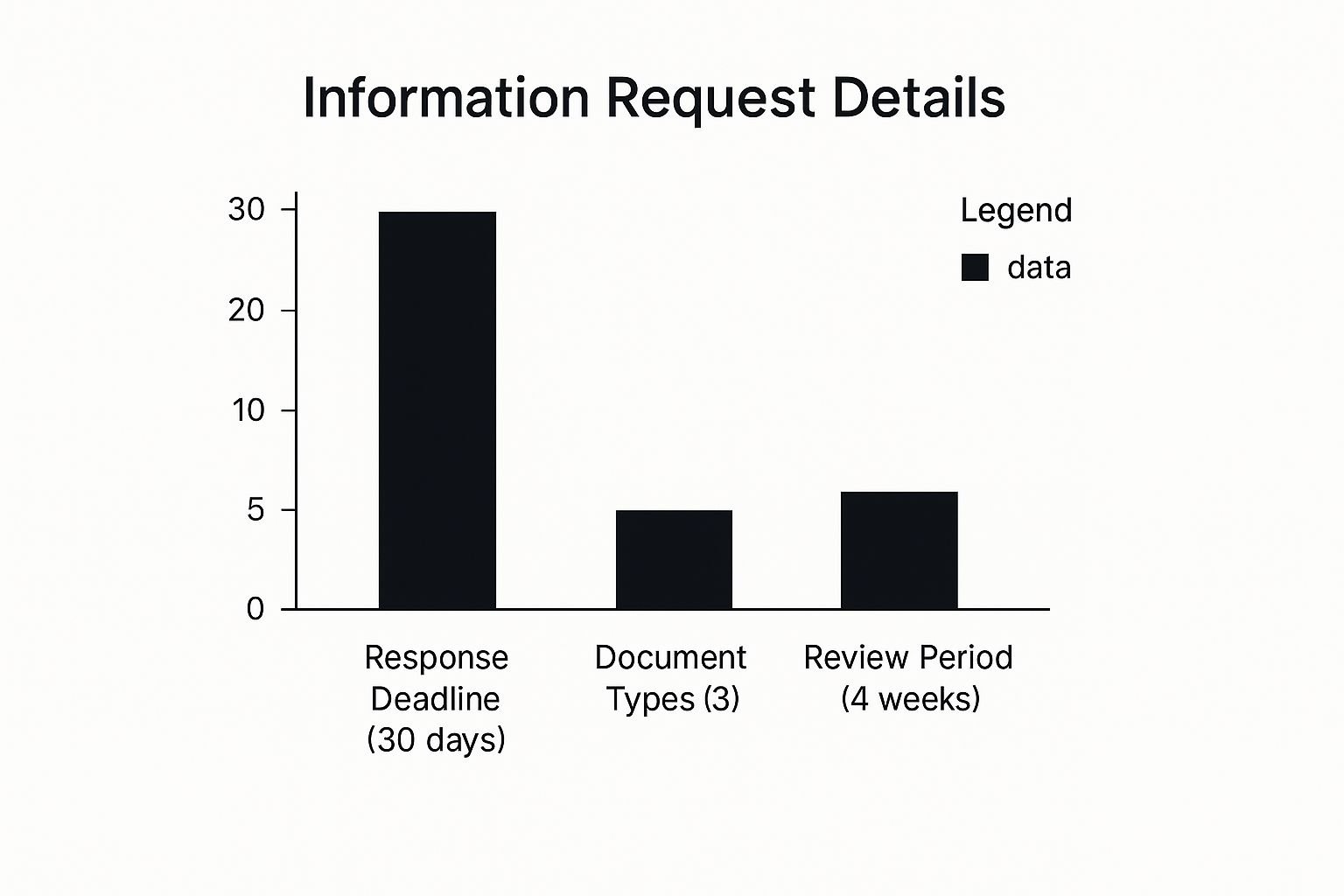
This visual gives you a good sense of the standard timeframes involved, helping you know what to expect while you wait.
What Happens After the 60-Day Review?
That 60-day review period mentioned in your IRS Letter 4464C can feel like an eternity, especially when you're counting on that tax refund. As the clock ticks down, it's completely normal to wonder what’s coming next. The good news? For most people, this all ends smoothly.
Once the IRS finishes its review, there are really only a handful of ways things can go. Knowing what to expect can help you stay calm and be ready for whatever comes your way.
The Most Common Outcome: Your Refund Is Released
Let's start with the best and most likely scenario. The IRS wraps up its review, everything on your return looks good, and they process your refund. That's it.
If this is the case, you won't get another letter. Your refund will just show up as you originally requested—either via direct deposit or a paper check in the mail. You can track its progress using the IRS's Where's My Refund? tool. For you, the 4464C journey is over.
Scenario Two: The IRS Adjusts Your Refund
Sometimes, the review turns up a small discrepancy. This doesn't mean you're in trouble; it could be something as simple as a math error or a slight misunderstanding of a tax credit.
When this happens, the IRS will simply adjust your refund amount—either up or down—to fix the mistake. They’ll send you a different notice, like a CP12 or CP21B, that clearly explains what they changed and why. This new letter officially closes the loop on their review and gives you the final numbers.
Scenario Three: The IRS Needs More Information
What if the IRS can't clear things up on their own? If their review brings up questions they can't answer internally, they'll reach out with another letter asking for specific documents.
This is your cue to act. A follow-up notice, like an IRS Letter CP05A, isn't a reason to panic. It’s a direct request for your help. The letter will spell out exactly what they need—maybe copies of your W-2s, 1099s, or proof that you qualify for a certain credit—and give you a deadline to send it in.
Responding quickly and sending exactly what they asked for is the key here. This is where having your tax documents organized really pays off, letting you resolve the issue and get your refund back on track.
What to Do if 60 Days Pass with No Word
If it's been more than 60 days since the date on your 4464C letter and you've heard nothing—no refund, no new letters—it's time to be proactive.
Check Your Refund Status: The first step is always to check the Where's My Refund? tool on the IRS website one more time for any updates.
Contact the IRS: If the tool doesn't give you any new information, it's time to call the IRS. Use the phone number on your original Letter 4464C. Be prepared for a potentially long wait, so have your documents handy when you call.
Get an Advocate: If you can't get through to the IRS or you aren't getting clear answers, consider contacting the Taxpayer Advocate Service (TAS). TAS is an independent organization within the IRS dedicated to helping taxpayers solve problems.
When You Should Consider Professional Tax Help
Most of the time, an IRS Letter 4464C is just a bump in the road—a routine check that gets sorted out on its own. But sometimes, it's a sign of something more complicated under the hood, and that's when calling in an expert is your best move.
Think of it like this: you can probably change a flat tire yourself, but you wouldn't try to rebuild the engine. The same principle applies here. If your tax return is anything but straightforward, a professional can step in and make sure your financial interests are protected.
So, when does a simple review turn into a "call for backup" moment? There are a few clear red flags that suggest an expert's eye could save you a world of time, money, and stress.
Key Situations Demanding an Expert
Trying to handle a tax review alone when your finances are tangled can be a recipe for disaster. You should seriously think about hiring a tax professional if your situation involves any of these:
Complex Income Sources: If you're dealing with a lot of self-employment income, revenue from a business, or have tricky investment gains, a pro knows how to organize and present the proof the IRS needs.
Substantial Deductions or Credits: Claiming unusually large or uncommon deductions for your business is fine, as long as you can back it up. An expert has seen it all and knows exactly what documentation will satisfy the IRS.
Suspected Identity Theft: If you have a sinking feeling that you're a victim of tax identity theft, don't go it alone. A professional can walk you through the very specific steps needed to resolve the case and secure your information.
And if the IRS sends a follow-up notice that’s more serious—like a formal audit letter or a Notice of Deficiency—that's no longer a suggestion. It's time to get help, period. When looking for help, many tax firms use a specialized accounting answering service to handle calls, so you can be sure you'll get through to someone who can assist.
If your review uncovers a bigger issue and you suddenly owe the IRS a significant amount, a tax professional can lay out all your options. They can see if you're a candidate for programs like an Offer in Compromise, which can allow you to settle your tax debt for less than you originally owed.
If a large tax bill is the outcome of this review, a professional can analyze your next steps. You can learn more about how the IRS Offer in Compromise formula works to see if that might be a realistic path forward for you.
Frequently Asked Questions About Letter 4464C
Getting an IRS Letter 4464C can leave you with a lot of questions. Even when you understand the basics, the little details can be stressful. Let's tackle some of the most common concerns people have after receiving this notice.
Will This Delay My State Tax Refund Too?
Good news here: probably not. The IRS Letter 4464C is a federal matter, tied only to your federal return.
State tax departments are completely separate entities. A hold-up on the federal side doesn't automatically mean your state refund is also on pause. You can—and should—track your state refund directly on your state’s department of revenue website.
Is It Okay to Call the IRS Before 60 Days?
I know the urge to pick up the phone is strong, but calling before the 60-day review window is up usually won't get you very far. The letter itself asks you to wait for a reason.
The agents on the main IRS phone lines typically don't have access to the specific details of your review while it's in progress. They can only see the same information you can—that your return is being processed.
It's a tough pill to swallow, but patience really is the best strategy here. Unless those 60 days have passed without an update, or the IRS sends another letter asking for something specific, calling will likely just lead to a long hold time with no new answers.
What if I Moved After Filing My Taxes?
This is a big one. If you’ve moved since you filed, you need to let the IRS know your new address immediately.
Any follow-up letters—or, hopefully, your refund check—will be mailed to the last address they have on file. You can officially update your information by filing Form 8822, Change of Address. Don't skip this step.
Can I Check the Status of the Review Online?
Unfortunately, the IRS "Where's My Refund?" tool isn't much help during a 4464C review. It won't give you a play-by-play of the process.
Most of the time, it will just display a generic message saying your return is still being processed. The status will only change after the review is complete and your refund is officially approved and scheduled.
If you're feeling stuck dealing with an IRS Letter 4464C or any other tax headache, remember you don't have to figure it out on your own. For a free, no-pressure analysis of your tax situation, get in touch with the experts at Attorney Stephen A Weisberg today. We’ll walk you through your options and help you find the best way forward. Visit us at weisberg.tax to get started.
Let’s be honest, getting a letter from the IRS can make your heart skip a beat. But before you panic, take a deep breath. IRS Letter 4464C is not an audit notice. It's a heads-up that your tax return has been pulled for a routine review before they cut you a refund check. The main reason? To double-check its accuracy and protect you from identity theft.
Want to understand your options before you call anyone?
Download my free book — Freedom From Tax Debt — a plain-language guide to how the IRS collections process actually works and what resolution really looks like.
➥ Contact Attorney Stephen A. Weisberg for a free Tax Debt Analysis.
Contact Me Here: https://www.weisberg.tax/contact-1
Email: s.weisberg@weisberg.tax
Phone/Text: (248) 971-0885
Address: 300 Galleria Officentre, Suite 402, Southfield, MI 48034
