The Real Cost of a Tax Attorney Explained
Let's get one thing straight: there's no single price tag for a tax attorney. The cost is a spectrum, and where you land on it depends entirely on your situation. You could be looking at $250 an hour for a junior attorney or upwards of $1,000 an hour for a top-tier partner. For specific, one-off projects, a flat fee might range anywhere from $2,500 to $25,000.
The final bill comes down to the mess you're in, the experience of the person getting you out of it, and even where they're located.
Your Guide to Tax Attorney Costs

Figuring out the potential cost of hiring a tax attorney is your first move in tackling IRS problems without getting hit with a surprise bill later. It’s a lot like hiring a specialist for your car. A quick oil change and a complete engine rebuild are two very different jobs with two very different price points. The same idea applies here. A simple consultation will cost a fraction of what it takes to defend you in a full-blown audit or a criminal tax investigation.
Several key things will move the needle on your total cost:
The Complexity of Your Case: Getting a simple wage garnishment lifted is a walk in the park compared to a multi-year business audit that requires digging through mountains of records. More complexity means more hours.
The Attorney's Experience: A lawyer who has spent decades battling it out in Tax Court will naturally charge more than someone fresh out of law school. You're paying for their track record and deep expertise.
Your Location: It’s no surprise that attorneys in major cities like New York or Los Angeles have higher rates. Their overhead is higher, and the market simply commands it.
The Firm's Size: A large, downtown law firm has significant expenses to cover, and that gets passed on to clients. A solo practitioner often has a leaner operation and can charge less.
To get a better sense of the bigger picture, it's helpful to understand the overall cost of managing tax affairs, as this will show you how different professional services are priced in the market.
Tax Attorney Fee Structures at a Glance
So, how do all these factors come together in the real world? Most tax attorneys use a few common billing models. This table breaks down what you can expect to see.
| Fee Model | Typical Service | Average Cost Range | Best For |
|---|---|---|---|
| Hourly Rate | IRS Audits, Tax Court Litigation, Ongoing Negotiations | $250 - $1,000+ per hour | Complex, unpredictable cases where the time commitment is a total unknown. |
| Flat Fee | Offer in Compromise, Penalty Abatement, Tax Return Prep | $2,500 - $25,000+ | Clearly defined tasks with a predictable scope of work and a clear finish line. |
| Retainer | Initial Deposit for Hourly Services | $2,500 - $10,000+ | Securing an attorney's services for a large or ongoing matter, acting as a down payment. |
Ultimately, the right fee structure depends on the job. A flat fee gives you cost certainty for a predictable task, while an hourly rate is necessary for complex battles where no one knows how much time the fight will take.
Understanding How Tax Attorneys Charge for Services
Before you can get a real handle on what a tax attorney might cost, you have to get inside how they bill for their time and expertise. It's not a single, straightforward system. Instead, attorneys use a few different models that are tailored to the kind of work you need done.
The two main ways they charge are hourly rates and flat fees, and each one makes sense for different situations.
Think of an hourly rate like hiring a contractor for a home renovation with unexpected problems. You pay for the actual time they spend working—every phone call, every bit of research, every document they draft. This model is the go-to for messy, unpredictable cases like a full-blown IRS audit or tax court litigation where no one can guess the exact time commitment upfront.
A flat fee, on the other hand, is like buying an all-inclusive ticket. You agree on one fixed price for a very specific, well-defined service, like filing a particular form or setting up a payment plan. You know the final cost from day one, which brings a lot of peace of mind.
Decoding the Different Fee Models
Attorneys don't just pick a fee structure out of a hat. They choose the one that best fits the scope and predictability of your tax problem. Getting familiar with how each model works will give you a much better idea of what to expect when the bill arrives.
This infographic gives a great visual breakdown of the key parts of an attorney's fee structure.
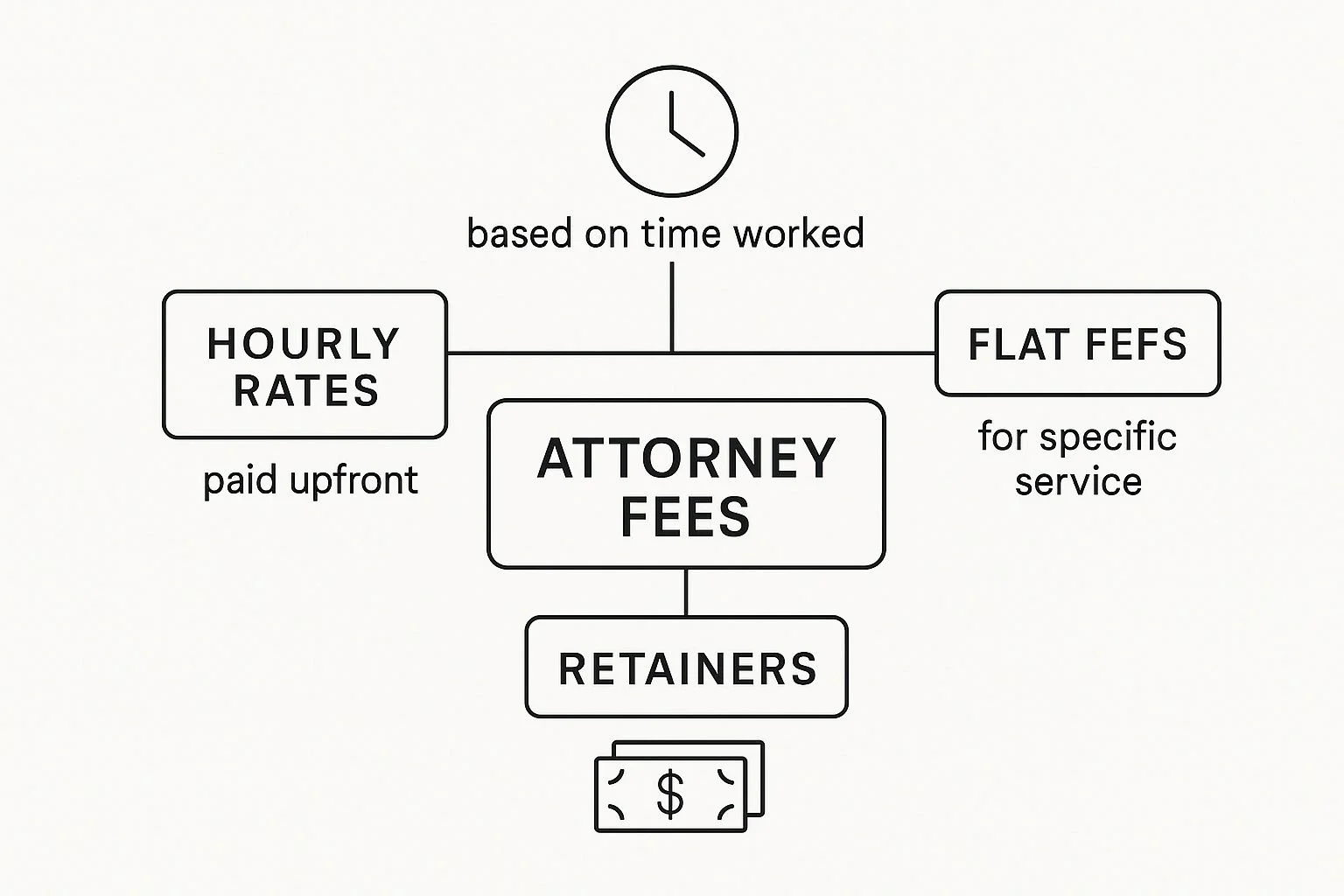
As you can see, the billing world for tax attorneys really boils down to three core concepts: hourly rates, flat fees, and retainers.
Understanding Retainer Fees
You'll often hear the word retainer, especially with hourly billing. A retainer isn't an extra fee—it's essentially a down payment. You pay a lump sum upfront, and the attorney holds it in a special trust account for you.
As your attorney works on your case, they'll draw their hourly fees from that fund. If the work continues after the retainer is used up, you’ll start getting a monthly bill for the new hours.
A retainer is a commitment. It secures the attorney's time for your case and covers their initial work, so they aren't sending you a bill after every single phone call. It’s a standard practice that builds trust and security for both you and the law firm.
Attorneys often use flat fees for services where the workflow is predictable. For example, preparing a complex tax return might cost somewhere between $200 and $500. But for more involved services like representing you in an audit or helping with long-term tax planning, those flat fees can climb much higher depending on the complexity. If you're curious, you can find more insights about how law firm billing rates are structured across the legal field.
What Really Drives the Final Cost?

It can be baffling when one tax attorney quotes you a $5,000 flat fee while another estimates $15,000 in hourly charges for the same problem. But these numbers aren't just pulled out of a hat. There are a few core factors that will always shape the final bill you receive.
Think of it like hiring a contractor. Fixing a leaky faucet is a world away from repairing a cracked foundation, and the price will reflect that. The same logic applies here; the complexity of your issue, the attorney's experience, their location, and the size of their firm are all part of the equation.
The Complexity of Your Tax Issue
This is, by far, the biggest driver of cost. A straightforward problem with clear paperwork and a predictable outcome will always be less expensive than a messy, multi-year investigation.
For example, helping someone get a simple wage garnishment released might only take a few hours. It’s a fairly routine process of filing the right forms and making a few phone calls. On the other hand, a case involving allegations of tax fraud demands a deep dive into years of financial records, extensive interviews, and tough negotiations with IRS criminal investigators. That's a different beast entirely.
Simpler Issues: Things like penalty abatement requests or setting up a basic installment plan.
Highly Complex Matters: Offshore account disclosures, tax evasion defense, or multi-year business audits.
The more tangled the financial mess, the more time an attorney has to spend unraveling it.
Attorney Experience and Reputation
You'd expect to pay more for a top surgeon, and the same is true for legal experts. An attorney with decades of specialized experience litigating in Tax Court, backed by a reputation for winning tough cases, will naturally charge a premium. You're not just paying for their time—you're investing in their hard-won wisdom and proven ability to get results.
A junior associate just starting out might bill at $250 per hour. A senior partner at that same firm, however, could easily command $800 per hour or even more. That price difference reflects their skill in navigating complex legal minefields and resolving issues far more efficiently than a less experienced lawyer ever could.
Geographic Location and Firm Size
Where an attorney hangs their shingle makes a huge difference. The overhead for a law practice—office rent, staff salaries, insurance—is dramatically higher in a major city. An attorney in New York City or San Francisco simply has to charge more than a practitioner in a smaller town just to keep the lights on.
We've seen legal costs skyrocket recently, particularly in major U.S. markets where top partner rates can now hit $2,400 to $2,950 per hour. These rates are often double what you'd find in smaller metro areas, a gap driven by the higher cost of living and the concentration of large corporate clients. You can read more about these trends in a recent analysis on attorney fee increases from Valeo Partners.
The size of the law firm also plays a critical role. A massive national firm has enormous overhead that gets passed down to clients. In contrast, a solo practitioner often runs a much leaner operation, allowing them to offer more competitive rates, sometimes for the exact same level of expertise.
When is a Tax Attorney Actually Worth the Money?
Let's be honest, the thought of paying a tax attorney can be intimidating. You're already dealing with a stressful tax situation, and now you're looking at a potentially hefty legal bill. It’s easy to get stuck wondering if the cost is really justified.
But here's a better way to frame it: this isn't just a cost, it's an investment. It's an investment in getting the best possible outcome and protecting your financial future.
Think of it like this. For a regular check-up, you go to your family doctor. But if you need complex heart surgery, you demand a specialist. A tax attorney is that specialist for when you're facing a serious, high-stakes battle with the IRS. While a great CPA or Enrolled Agent is your go-to for tax prep and planning, some situations absolutely require the legal muscle and protection that only an attorney can provide.
High-Stakes Scenarios That Demand a Lawyer
When the stakes are incredibly high, a tax attorney isn't a luxury; they're a necessity. These aren't the kind of problems you can ignore or hope will just go away. They demand a swift and strategic legal game plan.
Here are the big ones where you absolutely need an attorney in your corner:
IRS Criminal Investigations: If you get any hint that the IRS is looking at you for criminal charges, your very first call should be to a tax attorney. This is no longer just about money; it's a legal fight, and you need the confidentiality of attorney-client privilege on your side.
Serious Tax Debt: When you're buried under a mountain of tax debt—think $50,000 or more—and have no realistic way to pay it back, an attorney is your best bet. They can navigate complex settlement options like an Offer in Compromise that are often out of reach for other tax pros.
Complex or High-Level Audits: A simple letter from the IRS asking for a few documents can often be handled with your CPA. But for an intensive field audit where agents are showing up at your business or home, a tax attorney is critical. They act as a buffer, protect your rights, and manage the entire invasive process. This is why seeking assistance during a tax audit is one of the most common reasons people hire them.
Making the Right Financial Call
The key is to match the expert to the problem. You don't want to hire a surgeon for a common cold, but you also don't want to trust a band-aid to fix a broken leg. Overpaying for help you don't need is a waste, but skimping on expertise during a major crisis can be catastrophic.
The real value of a tax attorney shines through when the potential penalties, stress, and long-term damage of a major IRS problem far exceed their professional fees.
To figure out what's right for you, look at the potential consequences. A few years of unfiled returns? An Enrolled Agent can probably get you caught up efficiently. But if the IRS might see those unfiled returns as a deliberate attempt to evade taxes, the cost of an attorney becomes a crucial shield against crippling penalties and even criminal charges.
Actionable Strategies to Manage Your Legal Costs

While the thought of a tax attorney’s bill can be daunting, you have more control over the final number than you might think. By taking a proactive role, you can trim down wasted time and money without ever sacrificing the quality of your legal support. These strategies help you become a more effective partner in solving your own tax problems.
Thinking ahead is the name of the game. It’s about treating your interactions with your attorney’s office with the same care you’d apply to any other major investment.
Prepare Before You Engage
One of the biggest drains on your legal budget is the time your attorney has to spend untangling a disorganized mess. You can slash these billable hours by doing a little legwork yourself. It’s like packing your own boxes before the movers show up—the more you handle upfront, the less you pay them for their time.
Before you even step into that first meeting, get all your relevant documents in order. This means:
All IRS Notices: Put them in chronological order so they tell a clear story.
Tax Returns: Have copies of the specific returns in question on hand.
Financial Records: Gather the bank statements, receipts, or any other proof you need to back up your position.
Getting organized allows your attorney to get right to the heart of the matter—analysis and strategy—instead of billing you for basic administrative work.
Being prepared isn't just about saving a few bucks. It signals to your attorney that you're a serious, engaged client, which helps build a stronger, more collaborative relationship from the get-go.
It’s also helpful to know what’s happening behind the scenes. Law firms, especially those specializing in tax, have seen their own costs go up, with expense growth recently hitting over 5%. That trend inevitably affects their billing rates, making your own efficiency more valuable than ever. For a deeper dive, a detailed report on these rising costs can shed light on the current state of the U.S. legal market.
Communicate Efficiently and Effectively
Clear, consolidated communication is another huge money-saver. Every quick phone call or one-line email can add up, especially if you’re on an hourly rate. A smarter approach is to bundle your questions. Instead of firing off emails as they pop into your head, keep a running list and send your non-urgent questions in a single, well-organized message.
Always get the terms in writing before any work starts. The engagement letter is your best friend here. This contract should spell out exactly what they’ll be doing, the fee structure, and how they bill for time—whether it’s in six-minute or fifteen-minute chunks. If anything seems vague, ask for clarification. This one step can save you from a world of confusion and surprise fees later on, making sure everyone is on the same page.
Your Top Questions About Tax Attorney Costs, Answered
Alright, we’ve covered the different fee models and what drives costs up or down. But you probably still have some specific, practical questions rattling around. Let's tackle them head-on.
This is where the rubber meets the road—moving from theory to the real-world financial side of hiring a tax attorney. We’ll get into the nitty-gritty of tax deductions, negotiating fees, and what you’ll actually have to pay to get started.
Are My Tax Attorney Fees Tax Deductible?
This is one of the first questions most people ask, and for good reason. The short answer? It depends on why you hired the attorney.
The IRS generally allows you to deduct legal fees connected to producing or collecting taxable income. That also includes the cost of professional tax advice itself. So, if you hired an attorney to navigate a business tax audit or to provide strategic planning for your S-corp, those fees are almost always a deductible business expense.
On the other hand, legal fees for purely personal tax issues are a different story and usually aren't deductible. If your attorney is helping with a tax problem that’s completely separate from a business or any income-producing activity, you likely won't be able to write it off.
It all boils down to the "purpose test." If the legal help is for your business or is related to determining, fighting, or getting a refund for any tax, it’s probably deductible. But always double-check with a tax pro to see how this rule applies to your specific case.
What's the Cost Difference Between a Tax Attorney and a CPA?
While tax attorneys and CPAs are both fantastic resources, they play very different roles—and their price tags reflect that. Picking the right one is key to not overpaying for expertise you don't need.
A CPA is your go-to for tax prep, bookkeeping, and general financial planning. They’re masters of compliance and are typically more affordable. Think of them as the experts who keep your financial house in order and make sure your tax returns are filed correctly and on time.
A tax attorney steps in when things get legal, which is why they command higher fees. You absolutely need an attorney for legal disputes, representing you in U.S. Tax Court, or handling a criminal tax investigation.
Crucially, your conversations with an attorney are protected by attorney-client privilege. That's a powerful legal shield a CPA can't offer, and it’s non-negotiable when you're dealing with sensitive or potentially criminal tax issues.
Can I Negotiate Fees with a Tax Attorney?
Many people feel awkward even thinking about this, but yes, you can often negotiate fees. While a senior partner at a massive downtown law firm might have a take-it-or-leave-it rate, many attorneys in solo, small, or mid-sized practices have more flexibility.
The trick is to have the conversation professionally before you sign anything. This isn't about lowballing them; it's about finding a payment structure that works for everyone.
Here are a few practical ways to approach it:
Talk About the Retainer: You can ask if the initial retainer amount is flexible or if it could be paid in a couple of installments.
Suggest a Flat Fee: If your case seems straightforward, ask if they'd consider a flat fee. This gives you predictable costs and removes the anxiety of watching the clock.
Get Clear on Billing Increments: Do they bill in six-minute chunks or fifteen-minute chunks? It might sound small, but it can make a real difference in your final bill.
Being open about your budget from the very beginning can pave the way for a much more manageable financial arrangement.
Do I Have to Pay All the Fees Upfront?
It's highly unlikely you'll be asked to pay the entire estimated legal bill before any work begins. However, you should almost always expect to pay something upfront. The exact structure really depends on the fee model.
For hourly billing, most attorneys require an upfront retainer. Think of it as a deposit they hold in a trust account. They’ll bill their time against that retainer, and you’ll typically get a monthly invoice if you need to replenish it or pay for hours that exceeded the initial amount.
With flat-fee services, the payment schedule is often more varied. Some attorneys might want the full flat fee upfront. A more common approach is asking for 50% to begin the work, with the other half due when the case is resolved. The most important thing is to get these payment terms spelled out clearly in your written engagement letter. That document is your roadmap and prevents any confusion later on.
At the office of Attorney Stephen A Weisberg, we believe in starting with clarity, not a bill. Instead of demanding a large payment just to get started, we offer a FREE Tax Debt Analysis to see exactly how we can help you. Schedule your free consultation today at weisberg.tax to understand your options with zero upfront commitment.
Want to understand your options before you call anyone?
Download my free book — Freedom From Tax Debt — a plain-language guide to how the IRS collections process actually works and what resolution really looks like.
➥ Contact Attorney Stephen A. Weisberg for a free Tax Debt Analysis.
Contact Me Here: https://www.weisberg.tax/contact-1
Email: s.weisberg@weisberg.tax
Phone/Text: (248) 971-0885
Address: 300 Galleria Officentre, Suite 402, Southfield, MI 48034
